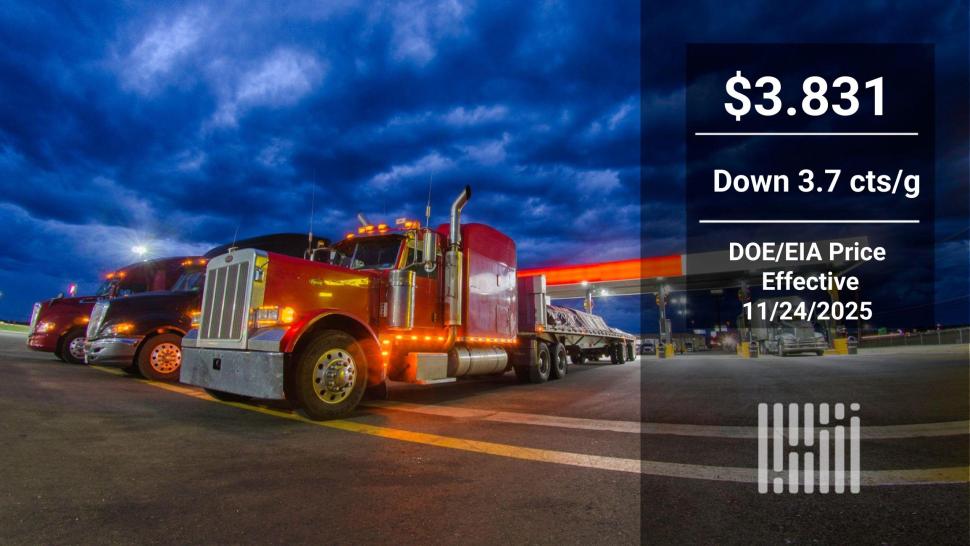
After several wild weeks of movement in diesel prices, at times rising far faster than any movement in crude prices would justify, the benchmark price used for most fuel surcharges fell after four weeks of increases.
The Department of Energy/Energy Information Administration average weekly retail diesel price declined 3.7 cents/gallon to $3.831/g. The one-week decline comes after a four-week stretch in which the price rose 24.8 cts/g to $3.868/g.
The DOE/EIA price was effective Monday and posted Tuesday.
There are signs that the diesel “bubble” that has built up in recent weeks, in which the spread between crude and diesel in futures and physical markets blew out to some of the widest levels this year, is starting to retreat.
In the last four trading days, a straight comparison of front month ultra low sulfur diesel (ULSD) and crude benchmark Brent on the CME commodity exchange has seen the spread decline from $1.1561 cts/g at the November 18 settlement to 89.73 cts/g Monday.
That roughly $1.15/g spread last week was the highest since September 2023.
In early trading Tuesday, ULSD was declining at a faster rate than crude, setting up a likely narrower spread when settlement numbers are published after 2:30 pm Eastern time.
The recent surge in diesel prices relative to crude was believed to be driven by two factors: a new round of sanctions implemented by the Trump administration several weeks ago against Rosneft and Lukoil, Russia’s two biggest oil companies and major world suppliers of diesel, and the still tight inventories of diesel and other non-jet fuel distillates worldwide that should be growing at this time in preparation for winter.
But the focus on the Rosneft/Lukoil sanctions have been replaced by talk of a peace plan in the Russia-Ukraine war. And while there have been no updated reports of U.S. stocks of distillates and diesel since a week ago–the next report is Wednesday–the spread between the first month and second month ULSD contracts on CME, which is often seen as a proxy for inventories, has started to narrow.
That spread has been in the structure known as backwardation for months. Backwardation is the relationship when the front month price of a commodity contract is priced higher than the next month, a situation that develops in part because of tight inventories. In a perfectly-balanced market, the structure that prevails is called contango and it is the opposite of backwardation, with prices rising as the market goes out in time.
After holding mostly between 4-5 cts/g for most of the first two weeks of the month, the spread blew out in four consecutive days to negative 7.64 cts/g on November 18, negative 8.36 cts/g the next day and then retreating to negative 8.17 cts/g on Thursday. It moved back to negative 6.23 cts/t Friday and then settled Monday at negative 4.22 cts/g.
Looming in the background to the moves between crude and diesel are the models that continue to show an overall surplus in oil markets going into 2026.
The forecasts of a surplus have not shown itself in markets for weeks. Brent closed out September near $67/barrel and surpassed $70/b several times.
But after drifting down to a recent low settlement of $61.01/b on October 20, the Monday settlement of $63.37/b, compared to that late September price, is lower than late September but hardly the sign of a market in collapse.
That view of a potential surplus was most evident in a report discussed in social media published this week by J.P. Morgan.
While the report was not immediately available, social media postings said the J.P Morgan forecast said oversupply might be so heavy by 2027 that a Brent price in the $30 range is not impossible.
A less apocalyptic but still bearish forecast came from Goldman Sachs.
The company’s co-head of global commodities research Daan Struyven told CNBC last week that his company sees West Texas Intermediate, the U.S. benchmark, averaging $53 for 2026. The price settled Monday at $58.84.
WTI has not settled less than $54/b since February 2021.
But Struyven said Goldman Sachs expects the 2026 price to be the low water mark in the current cycle. A dropoff in capital spending because of the low price will eventually hit production levels, and the company sees oil prices rising back toward $80/b by the end of 2028.
More articles by John Kingston
A ‘jobs apocalypse’: panel at Trimble eyes AI’s future in logistics
Likely 1st AB5 trucking enforcement action in California snags 3 companies
Trucking takeaways from Trimble: volume down, driver population sliding
Brokerage Compliance Symposium
The day before F3. Every compliance issue you face - fraud exposure, carrier liability, FMCSA rules, cargo theft, insurance gaps - navigated by attorneys and operators defining best practices in a changing industry.
F3 Awards Dinner
The night before F3. FreightTech100 companies honored. FreightTech 25 and Shipper of Choice winners revealed live. Cocktail reception into dinner and live music - 300 industry leaders in one purpose-built room.
F3: Future of Freight Festival
Industry-defining keynotes, rapid-fire technology demos, and industry leaders networking in experiences across Chattanooga - plus the inaugural F3 Awards Dinner featuring the FreightTech and Shipper of Choice reveals.
The day before F3. Every compliance issue you face - fraud exposure, carrier liability, FMCSA rules, cargo theft, insurance gaps - navigated by attorneys and operators defining best practices in a changing industry.
The Signal at Chattanooga Choo Choo • Chattanooga, TN Register NowThe night before F3. FreightTech100 companies honored. FreightTech 25 and Shipper of Choice winners revealed live. Cocktail reception into dinner and live music - 300 industry leaders in one purpose-built room.
The Signal at Chattanooga Choo Choo • Chattanooga, TN Register NowIndustry-defining keynotes, rapid-fire technology demos, and industry leaders networking in experiences across Chattanooga - plus the inaugural F3 Awards Dinner featuring the FreightTech and Shipper of Choice reveals.
The Signal at Chattanooga Choo Choo • Chattanooga, TN Register Now