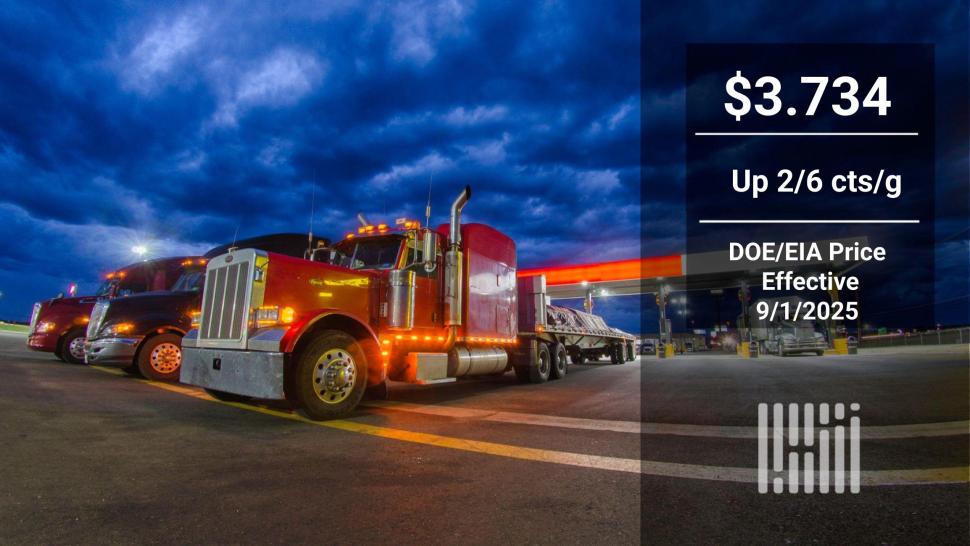
For the first time in six weeks, the benchmark diesel price used as the basis for most fuel surcharges has moved higher.
The weekly Department of Energy/Energy Information Administration average weekly retail diesel price rose 2.6 cents/gallon to $3.734/g, effective Monday but published Wednesday. It’s the first increase since a 5.4 cts/g increase July 21.
Since a big jump of 20.4 cts/g on June 23, 2025, which followed the tit-for-tat air attacks by Israel and Iran, the DOE/EIA retail diesel price has been published in a narrow range.
Its high price during the 10 weeks that followed the June 23 price was $3.812/g on July 21; its low was last week, at $3.708/g.
Oil markets have not reacted strongly to macroeconomic developments or news events in petroleum markets themselves, even as markets as diverse as equities and precious metals have been volatile.
But oil futures markets have been largely stable. For example, Brent, the world’s crude benchmark, did not settle above $70/barrel on any single day in August. It settled below $66/b twice; it settled above $69/b only on August 1, the first trading day of the month.
Brent opened September by rising to a settlement at $69.14/b, with the latest rise in tensions between Ukraine and Russia cited as the reason.
But markets then reversed Wednesday, driven by news that the OPEC+ meeting this weekend is expected to authorize putting more oil on to the market. This is not much of a surprise–the group has been doing that monthly–but it helped reverse the gains of Tuesday in oil prices. At approximately 11:35 AM EDT, Brent was down $1.64/b to $67.50/b.
One area that might be the focus of diesel consumers in coming weeks and months is California, where the state is expected to lose another refinery soon.
Phillips 66 (NYSE: PSX) has said it plans to shutter its refinery complex in the Los Angeles area–specifically in Carson and Wilmington–by the end of the year. However, Reuters reported that the shutdown operations are going to begin soon.
California gasoline and diesel prices have long been higher than the rest of the country, due to a mix of factors: higher taxes, carbon taxes, specialized blends and other regulatory issues.
The spread between the national DOE/EIA diesel price and the California price in the Monday release was $1.18/g, with the DOE/EIA price that much less than the California price.
That was the highest spread since June 16. But it is well below the highest spread this year, which came in at $1.321/g on May 26.
California’s diesel price differential over the national figure this week is more than it was a year ago, when it was $1.124/g, but less than two years ago, when the spread was $1.309/g. But three years ago, it was just $1.09/g.
But the closure of the Phillips refineries, and an earlier closure in the San Francisco bay area by Valero (NYSE: VLO), California officials appear to be starting to worry about what that might do to prices.
And they don’t want to drive any other refineries out of the state. As an example, in recent days, regulators have put on hold a plan to place a cap on refining profits in the state.
More articles by John Kingston
Two state troopers who falsified CDL test results get short jail sentences in Massachusetts
BMO’s transportation numbers show slight improvement in trucking credit conditions
NFI driver misclassification case in New Jersey could reach individual payouts of $50k
Brokerage Compliance Symposium
The day before F3. Every compliance issue you face - fraud exposure, carrier liability, FMCSA rules, cargo theft, insurance gaps - navigated by attorneys and operators defining best practices in a changing industry.
F3 Awards Dinner
The night before F3. FreightTech100 companies honored. FreightTech 25 and Shipper of Choice winners revealed live. Cocktail reception into dinner and live music - 300 industry leaders in one purpose-built room.
F3: Future of Freight Festival
Industry-defining keynotes, rapid-fire technology demos, and industry leaders networking in experiences across Chattanooga - plus the inaugural F3 Awards Dinner featuring the FreightTech and Shipper of Choice reveals.
The day before F3. Every compliance issue you face - fraud exposure, carrier liability, FMCSA rules, cargo theft, insurance gaps - navigated by attorneys and operators defining best practices in a changing industry.
The Signal at Chattanooga Choo Choo • Chattanooga, TN Register NowThe night before F3. FreightTech100 companies honored. FreightTech 25 and Shipper of Choice winners revealed live. Cocktail reception into dinner and live music - 300 industry leaders in one purpose-built room.
The Signal at Chattanooga Choo Choo • Chattanooga, TN Register NowIndustry-defining keynotes, rapid-fire technology demos, and industry leaders networking in experiences across Chattanooga - plus the inaugural F3 Awards Dinner featuring the FreightTech and Shipper of Choice reveals.
The Signal at Chattanooga Choo Choo • Chattanooga, TN Register Now