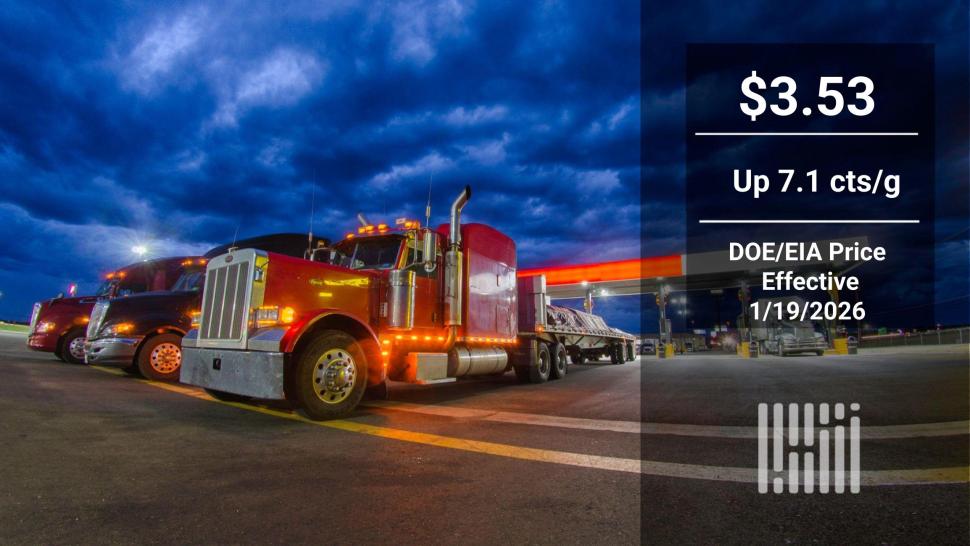
After eight weeks of declines, the benchmark diesel price has turned higher.
The Department of Energy/Energy Information Administration average weekly retail diesel price, used as the basis for most fuel surcharges, rose 7.1 cents/gallon to $3.53/g, posted Tuesday but effective Monday.
It is the first upward move since the DOE/EIA price hit a recent high price of $3.868/g on November 17, the last time it had posted an increase before the eight-week stretch of lower prices commenced.
The higher price comes after about two weeks worth of increases in the price of ultra low sulfur diesel (ULSD) on the CME commodity exchange.
After a settlement of $2.0567/g on January 7, prices began a climb that took ULSD as high as a settle of $2.2819/g on January 14. A few days of weakness followed that, but the geopolitical tensions of the past few days added more than 10 cts/g to the price on Tuesday, settling at $2.3385/g. That was the highest settlement since December 5.
The upward trend was continuing Wednesday. At approximately 11 a.m., ULSD on CME was up 8.31 cts/g to $2.4216/g, an increase of 3.55%. If it settled there, it would be the highest settlement since November 21.
One cause of the higher futures prices in recent days has been a production slowdown in Kazakhstan.
According to multiple news reports, Kazakhstan, a member of the OPEC+ group but not a member of OPEC, has stopped output at two key fields, Tengiz and Korolev. Problems at the field are said to be tied to electric power issues.
Reuters reported that output is expected to be down for another seven to 10 days.
Kazakhstan’s output in December, according to several reports, already had dropped to about 1.52 million b/d from 1.75 million b/d in November because of tanker loading problems.
The higher prices came against a backdrop of a monthly report from the International Energy Agency that highlighted the underlying bearish fundamentals that have been an issue in oil markets for months.
The IEA’s analysis has consistently forecast a surplus of supply relative to demand for 2026. Markets were beginning to react to that surplus, with the price of world crude benchmark Brent dropping to a recent low settlement of $59.96/barrel. It settled at the end of October at $65.07/b and has been moving lower since then.
But the combination of the Kazakh problems, a few days’ worth of concern over Iranian supplies and the general geopolitical tension created by the fate of Greenland all combined to turn prices around, with Brent settling Tuesday at $64.92/b. It was even higher January 14, with a $66.52/b settlement.
But none of that changed the message the IEA published in its monthly report Wednesday.
The forecast for 2026 did tighten slightly. The IEA sees global oil demand growing 930,000 b/d this year, up from an estimate of 860,000 b/d in its December outlook for 2026.
But the IEA estimate on supply growth in 2026 is 2.5 million b/d, which is up 100,000 b/d from a month earlier. The increase in supply for 2025 was estimated by the IEA at 3 million b/d, which if the 2026 estimate is correct would tack on 5.5 million b/d in just two years, far outstripping demand growth, which would be less than 2 million b/d.
The fruits of that sort of imbalance, since they aren’t really visible in the price, can be seen in inventories. The IEA said inventories over the course of the year grew at a rate of about 1.3 million b/d and that the surge continued in December.
More articles by John Kingston
Five State of Freight takeaways: tighter market is holding
Louisiana staged truck accident indictment widens as trials and sentencings loom
C.H. Robinson makes its legal written case before SCOTUS on broker liability
Brokerage Compliance Symposium
The day before F3. Every compliance issue you face - fraud exposure, carrier liability, FMCSA rules, cargo theft, insurance gaps - navigated by attorneys and operators defining best practices in a changing industry.
F3 Awards Dinner
The night before F3. FreightTech100 companies honored. FreightTech 25 and Shipper of Choice winners revealed live. Cocktail reception into dinner and live music - 300 industry leaders in one purpose-built room.
F3: Future of Freight Festival
Industry-defining keynotes, rapid-fire technology demos, and industry leaders networking in experiences across Chattanooga - plus the inaugural F3 Awards Dinner featuring the FreightTech and Shipper of Choice reveals.
The day before F3. Every compliance issue you face - fraud exposure, carrier liability, FMCSA rules, cargo theft, insurance gaps - navigated by attorneys and operators defining best practices in a changing industry.
The Signal at Chattanooga Choo Choo • Chattanooga, TN Register NowThe night before F3. FreightTech100 companies honored. FreightTech 25 and Shipper of Choice winners revealed live. Cocktail reception into dinner and live music - 300 industry leaders in one purpose-built room.
The Signal at Chattanooga Choo Choo • Chattanooga, TN Register NowIndustry-defining keynotes, rapid-fire technology demos, and industry leaders networking in experiences across Chattanooga - plus the inaugural F3 Awards Dinner featuring the FreightTech and Shipper of Choice reveals.
The Signal at Chattanooga Choo Choo • Chattanooga, TN Register Now