




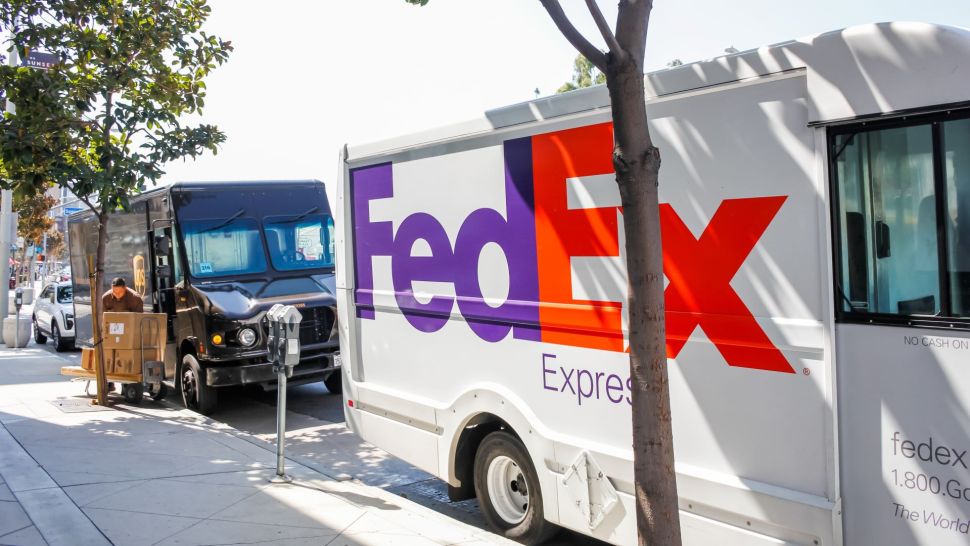
Legacy parcel carriers FedEx and UPS have begun to discontinue commercial discounts, previously offered in response to increased market competition, prioritizing instead high-yield shipments and profitability to better meet Wall Street expectations, according to the TD Cowen/AFS Freight Index published this week.
Businesses are paying more per package shipped with FedEx (NYSE: FDX) and UPS (NYSE: UPS) as the couriers’ ground networks lose volume at the bottom end and replace some of that with express volume as customers trade down in service levels. The shift of cost-conscious shippers to alternative providers with slower, cheaper services is reflected in the ground parcel cost per package reaching a record high of 32% above the index’s 2018 baseline during the second quarter.
The loss of lightweight volume resulted in a higher average billed weight per package that in turn drove up the cost per package, the report from AFS Logistics and financial services firm TD Cowen said.
Parcel volumes for the two delivery powers soared during the pandemic, but began declining in 2023 as e-commerce sales normalized, Amazon expanded and new couriers entered the market. FedEx and UPS engaged in a pricing war with startup delivery companies and retailers like Walmart for about 18 months. Management at both companies has signaled to investors this year that the focus is now on profitable parcel freight.
UPS’s decision in January to give up half of its business with Amazon over the next two years underscores the interest in boosting profitability.
“They both are almost conceding they can’t be a major player in the B2C space,” said Satish Jindel, president of parcel management and consulting firm ShipMatrix, in an interview.
In recent earnings presentations, executives at both companies have concentrated discussion on the B2B market segment.
Data analytics and consulting firm LJM echoed the index’s findings in an investor briefing this week, saying that parcel pricing is more stable today than it was in 2023-24, but is not back to pre-pandemic predictability, according to a readout of the call from Susquehanna Investment Group. It said many clients are making the shift to use the U.S. Postal Service because of Ground Advantage, a product introduced two years ago as a low-cost option for packages up to 70 pounds with transit times of two to five business days.
“The challenge for smaller and mid-sized shippers is that saving $3 to $5 per package by shifting some of their business to USPS or a regional carrier from FedEx or UPS must be weighed against the loss in savings from FedEx/UPS’s volume-driven pricing structure when some of that volume is shifted away. This can effectively trap small and/mid-sized shippers with limited volume in a sole-sourcing parcel strategy with one of the legacy national providers,” Susquehanna equity analyst Bascome Majors wrote.
The parcel giants have also been busy tacking on service fees to their base shipping rates, usually matching any surcharge imposed by their rival.
Memphis, Tennessee-based FedEx earlier this month notified U.S. customers of peak season surcharges that are higher than those imposed last year. The extra fees begin phasing in on Sept. 29, based on the handling needs or service levels, and run through Jan. 18. FedEx also imposed similar handling, oversize and unauthorized package surcharges on July 14 for international packages.
UPS has been the most aggressive of the two in overhauling its rating model and rolling out new surcharges, according to the TD Cowen/AFS Freight Index.
The manipulation of surcharges by the integrated network carriers is most notable with fuel. Fuel surcharges, based on opaque formulas pegged to the price of fuel, have long been considered a way for carriers to pad profits beyond simply being a cost-recovery mechanism, but FedEx and UPS have “weaponized fuel surcharge as a revenue tool,” the authors said.
During the past year, domestic ground shippers have experienced a cumulative increase in fuel surcharges of 30% when compared to a constant diesel fuel price level, indicating that the fees are because of carrier actions rather than fuel price fluctuations, according to TD Cowen and AFS data.
Express shippers saw a modest 0.6% increase due to carrier adjustments even though the U.S. Gulf Coast jet-fuel index fell 10.3% in the second quarter.

“Low demand and competition from other players have pushed both FedEx and UPS to focus on right-sizing networks to hold onto the volumes they can profitably serve,” said Mingshu Bates, AFS Logistics’ chief analytics officer and president of parcel, in the report.
FedEx has recently accelerated the consolidation of its separate Ground and Express networks. UPS is also closing terminals and moving activity into larger, automated sortation centers to reduce overhead and improve efficiency.
The TD Cowen/AFS Ground Parcel Freight Index is expected to reach 29.2% in the third quarter, representing a 7% year-over-year increase and a 2.2% decrease from the second quarter.
AFS Logistics provides managed transportation, freight audit and cost management services to freight buyers. It has visibility into more than $39 billion in annual freight spending.
Click here for more FreightWaves/American Shipper stories by Eric Kulisch.
Write to Eric Kulisch at ekulisch@freightwaves.com.
RELATED STORIES:
LTL pricing index to hit record high in Q3
FedEx, UPS lose market share to big retailers, small couriers
Brokerage Compliance Symposium
The day before F3. Every compliance issue you face - fraud exposure, carrier liability, FMCSA rules, cargo theft, insurance gaps - navigated by attorneys and operators defining best practices in a changing industry.
F3 Awards Dinner
The night before F3. FreightTech100 companies honored. FreightTech 25 and Shipper of Choice winners revealed live. Cocktail reception into dinner and live music - 300 industry leaders in one purpose-built room.
F3: Future of Freight Festival
Industry-defining keynotes, rapid-fire technology demos, and industry leaders networking in experiences across Chattanooga - plus the inaugural F3 Awards Dinner featuring the FreightTech and Shipper of Choice reveals.
The day before F3. Every compliance issue you face - fraud exposure, carrier liability, FMCSA rules, cargo theft, insurance gaps - navigated by attorneys and operators defining best practices in a changing industry.
The Signal at Chattanooga Choo Choo • Chattanooga, TN Register NowThe night before F3. FreightTech100 companies honored. FreightTech 25 and Shipper of Choice winners revealed live. Cocktail reception into dinner and live music - 300 industry leaders in one purpose-built room.
The Signal at Chattanooga Choo Choo • Chattanooga, TN Register NowIndustry-defining keynotes, rapid-fire technology demos, and industry leaders networking in experiences across Chattanooga - plus the inaugural F3 Awards Dinner featuring the FreightTech and Shipper of Choice reveals.
The Signal at Chattanooga Choo Choo • Chattanooga, TN Register Now