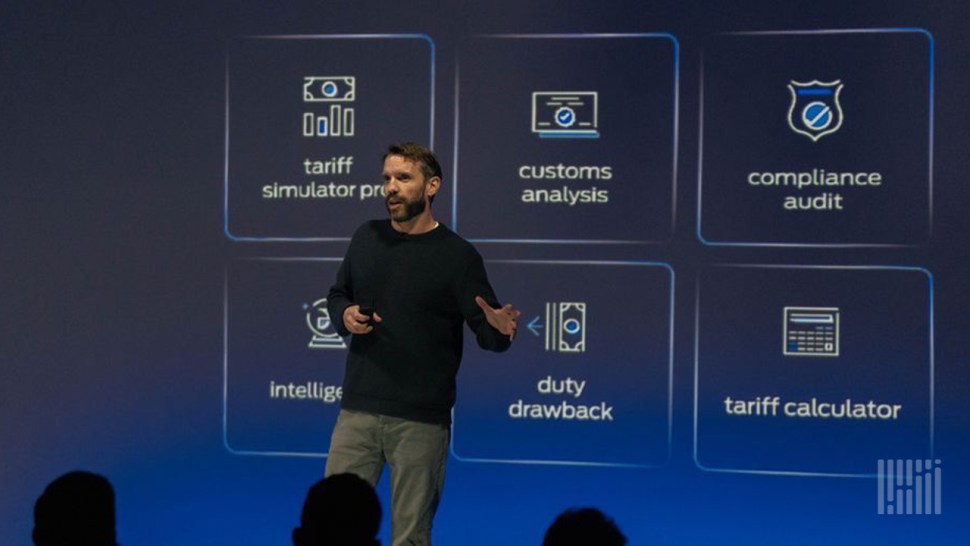
New York–Flexport’s public introduction of its winter technology release could not have been more opportune, and one part of its timeliness wasn’t even known when the presentation took place.
At a well-attended event in New York City late last month, with dimmed lighting and a setting more akin to a cocktail reception, Flexort CEO Ryan Petersen had an unexpected tailwind when he addressed the audience about the latest version of the company’s supply chain software: the Supreme Court rejection of President Donald Trump’s tariffs. That step suddenly made several features in the company’s latest release likely more valuable to its freight forwarding customers than they might have been had the court’s decision gone the other way.
And then a little more than a week after the New York event, the U.S. and Israel launched its attack on Iran, followed by an Iranian counterattack, creating massive turmoil in international freight markets. The tools in the winter Flexport release thus got a little more valuable.
The radical shifts in some shipping routes as a result of the Middle East war were almost a perfect “value prop” for the first product Petersen introduced in his presentation: the Flexport Atlas.
Atlas is the first new product cited
The Atlas, like all the services introduced at the New York event, has no cost. Additionally, the Atlas is available to non-users of the Flexport system and can be accessed here.
It’s based on data Flexport already has for use by its customers monitoring the status of their shipments. “This is our first attempt to really bring that to the surface and allow you to see how the world’s ocean network actually functions,” Petersen said.
As Petersen described it, Flexport Atlas allows its users to “zoom in on any port and see what’s happening. What are the terminals? What are the ships that are coming and going to this port? What are the current levels of congestion?” The list continued from there.
While Flexport Atlas may not have seemed as valuable during the presentation as now, because the Middle East war was still more than a week away, several other features rolled out in the Flexport system (all are no-cost additions) were more immediately important coming so soon after the Supreme Court tariff decision.
As with any presentation today about technology changes, AI was never far from the discussion.
Tariffs tools: Petersen had spoken for a while before mentioning tariffs, “which is pretty crazy given the Supreme Court ruling,” he said. The court invalidated the Trump administration tariffs imposed under the International Emergency Economic Powers Act (IEEPA).
The fall release featured a tariff simulator, which Petersen said “is getting a huge amount of usage.” It was part of a suite of products aimed at aiding the interaction between shippers and U.S. Customs.
The simulator is driven, Petersen said, by a Flexport staff that he said has “a team of experts with dozens of years and decades of experience in customs compliance, to interpret the rules and read the new regulations, to figure out, OK, how does this actually work?”
The tool is available online to non-Flexport customers. The changes wrought by the Supreme Court decision on tariffs, which came down on a Friday, had been built into the tariff simulator by Monday, Petersen said. “We have that commitment to always keep this up to date and accurate,” he said.
Petersen said the number one user of the simulator, based on data coming off the tool, is U.S. Customs and Border Protection.
The next logical step, given all that has occurred with tariffs, is a refund calculator. Flexport’s product to calculate refunds had been in development when the Supreme Court decision came down, Petersen said. He said the tool is “very easy to use.”
But that doesn’t mean the question of refunds will be easy. “Don’t get too excited, don’t start spending that money,” Petersen said. “But I do believe there will be refunds on the IEEPA duties.”
Even if the tool is simple, he said, calculating refunds is not simple. “But that’s what this tool is about,” Petersen said. “Your CFO is going to love it to show them what might be coming.
Flexport Digital Routing Guide: Petersen described current routing guides as “simply taking two different port pairs and saying, OK, when I have a container going between those ports, which carrier should ship it? And if it’s not available on the first carrier it rolls over to the second and on downward.” He described the system as “dumb and static. There’s no business logic here.”
The digital routing guide will use agentic AI to answer the question of “how do you want your container to move? Do you want to go in the first ship available, the cheapest ship, do you want to allocate freight in certain ratios?” The product’s real time algorithms will assign the containers to a ship based on those customer desires, Petersen said.
Improvements in search: In the fall release, Flexport introduced what Petersen described as a “single pane of glass, allowing you to see all your shipments on the platform, regardless whether you shipped it with Flexport with another forwarder or carrier.” That came with a search engine that Petersen described as “being able to just type what you’re looking for, whether it’s the name of a product, a purchase order number, and just instantly it shows up.”
The latest AI features within the search engine is “much more powerful in terms of using natural language to search,” he said. He said the tool is live for some customers now but will be rolled out to the universe of Flexport’s clients in the coming weeks.
Cutting back on notifications: Petersen said customer feedback has been that users “told us they don’t love the number of notifications that we send, just like sort of way too much information and it’s hard to figure out what really matters.” That will be cut by about 80%, he said, “by just being really granular and specific about what data people are going to want to see and not doing this like sending the same message to two people at the same company.”
Translation service: “For the last 200 years or so, English has been the language of global trade, and today we’re introducing live translation because there’s billions of people around the who world who don’t speak English,” Petersen said. And a lot of them, he added, are from countries that “are really important manufacturing centers for our customers.” Languages available in the new tools are Vietnamese, Thai, Korean, Italian, German and Spanish. That range of languages should take care of about 86% of container trade, Petersen added.
TikTok tie-in: Flexport now services about a million orders per year for TikTok merchants, Petersen said. The company now will be a “first class citizen in the Flexport seller portal, so you can just instantly connect here, fulfilling inventory from a single pool.” The end consumers of the products will be able to get live tracking updates inside the TikTok app, he said.
More articles by John Kingston
Derek Barrs defends FMCSA’s bold moves at TCA
6th Circuit rejects NLRB’s Cemex rule, dealing blow to unionization efforts
Amazon defrauded: guilty plea in $3M+ fraud involving trailers
Brokerage Compliance Symposium
The day before F3. Every compliance issue you face - fraud exposure, carrier liability, FMCSA rules, cargo theft, insurance gaps - navigated by attorneys and operators defining best practices in a changing industry.
F3 Awards Dinner
The night before F3. FreightTech100 companies honored. FreightTech 25 and Shipper of Choice winners revealed live. Cocktail reception into dinner and live music - 300 industry leaders in one purpose-built room.
F3: Future of Freight Festival
Industry-defining keynotes, rapid-fire technology demos, and industry leaders networking in experiences across Chattanooga - plus the inaugural F3 Awards Dinner featuring the FreightTech and Shipper of Choice reveals.
The day before F3. Every compliance issue you face - fraud exposure, carrier liability, FMCSA rules, cargo theft, insurance gaps - navigated by attorneys and operators defining best practices in a changing industry.
The Signal at Chattanooga Choo Choo • Chattanooga, TN Register NowThe night before F3. FreightTech100 companies honored. FreightTech 25 and Shipper of Choice winners revealed live. Cocktail reception into dinner and live music - 300 industry leaders in one purpose-built room.
The Signal at Chattanooga Choo Choo • Chattanooga, TN Register NowIndustry-defining keynotes, rapid-fire technology demos, and industry leaders networking in experiences across Chattanooga - plus the inaugural F3 Awards Dinner featuring the FreightTech and Shipper of Choice reveals.
The Signal at Chattanooga Choo Choo • Chattanooga, TN Register Now