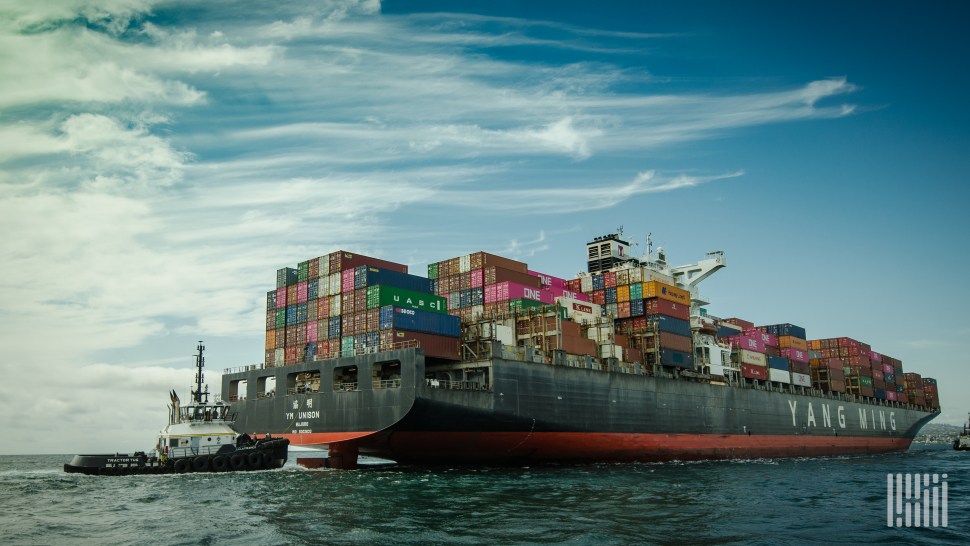

Chart of the Week: Inbound Ocean TEUs Volume Index – USA SONAR: IOTI.USA
Bookings of containers bound for the U.S. (IOTI) have fallen 20% over the past six weeks, signaling that importers may have fully recovered from early-year inventory concerns. After plunging in May, imports surged to an early peak when the president paused the 145% tariff on Chinese goods. Now, companies appear to be trying to avoid another inventory hangover as questions persist about the health of the consumer. What does this mean for transportation markets for the rest of the year?
Shifts in sourcing
Upstream, one of the biggest shifts has been the continued pullback from China. Import bookings from China to the U.S. are down 25% year-over-year, while Vietnam is one of the few countries showing annual growth as of last week.
China has offset much of the decline, however, as total export bookings remain nearly flat compared to 2024, according to SONAR data. The takeaway is that global trade flows are rapidly adjusting to Trump’s ongoing negotiations, forcing carriers to rebalance trade lanes. This could eventually affect service levels as schedules shift and blank sailings increase.
Lagging impact on domestic markets
The slowdown in imports has not yet fully reached the domestic market, since bookings data represents containers still two to four weeks away from arriving at U.S. ports. For example, shipments from China to Los Angeles currently take about 16–17 days, based on published transit times.
Intermodal demand remains the most directly tied to containerized imports. Shippers have leaned more on rail over the past year as longer lead times and pre-emptive ordering provide extra flexibility. With warehousing costs rising quickly, many shippers are using containers as “moving storage” to offset inventory holding costs.

Loaded container volumes—both domestic and international—are currently in line with last year, while truckload tender volumes are down about 15%. If import volumes continue to erode, intermodal demand, especially for international containers, could weaken further in the months ahead. The truckload market has been less affected, as shippers have relied more on shorter hauls where rail offers limited cost savings or utility.
Inventory strategies in flux
Supply chains remain reactive, balancing upstream procurement with uncertain downstream demand. The result has been a hybrid strategy: maintaining a small buffer of inventory while avoiding the kind of glut seen in early 2022.

The Logistics Managers’ Index (LMI) shows inventory levels expanding more quickly this year compared to the first seven months of 2024. Some of this growth is defensive ordering, but some likely reflects weaker demand. Import bookings data reinforces the idea that companies are facing softer demand overall.
If demand continues to fade, transportation markets may see a quiet second half. But if inventories dip too low or consumer demand rebounds unexpectedly, there could still be surprises ahead.
Major retailers reporting Q2 earnings this past week reflected that uncertainty. Walmart raised its guidance, while Target described its approach as “planning cautiously.”
Fed to the rescue?
On Friday, Fed Chair Powell signaled a potential policy shift, suggesting that rate cuts are increasingly likely. The remarks boosted financial markets in the short term but may not be enough to restore full business confidence in capital spending. The announcement alone might nudge outlooks slightly more optimistic, but actions will ultimately matter more.
For now, ordering strategies still reflect more caution than confidence. Any boost from monetary policy remains speculative. Consumers will be the wild card to watch, as business investment and policy changes typically take longer to ripple through transportation. As always, the fourth quarter will hinge on retail—a sector that still carries plenty of question marks.
About the Chart of the Week
The FreightWaves Chart of the Week is a chart selection from SONAR that provides an interesting data point to describe the state of the freight markets. A chart is chosen from thousands of potential charts on SONAR to help participants visualize the freight market in real time. Each week a Market Expert will post a chart, along with commentary, live on the front page. After that, the Chart of the Week will be archived on FreightWaves.com for future reference.
SONAR aggregates data from hundreds of sources, presenting the data in charts and maps and providing commentary on what freight market experts want to know about the industry in real time.
The FreightWaves data science and product teams are releasing new datasets each week and enhancing the client experience.
To request a SONAR demo, click here.
Brokerage Compliance Symposium
The day before F3. Every compliance issue you face - fraud exposure, carrier liability, FMCSA rules, cargo theft, insurance gaps - navigated by attorneys and operators defining best practices in a changing industry.
F3 Awards Dinner
The night before F3. FreightTech100 companies honored. FreightTech 25 and Shipper of Choice winners revealed live. Cocktail reception into dinner and live music - 300 industry leaders in one purpose-built room.
F3: Future of Freight Festival
Industry-defining keynotes, rapid-fire technology demos, and industry leaders networking in experiences across Chattanooga - plus the inaugural F3 Awards Dinner featuring the FreightTech and Shipper of Choice reveals.
The day before F3. Every compliance issue you face - fraud exposure, carrier liability, FMCSA rules, cargo theft, insurance gaps - navigated by attorneys and operators defining best practices in a changing industry.
The Signal at Chattanooga Choo Choo • Chattanooga, TN Register NowThe night before F3. FreightTech100 companies honored. FreightTech 25 and Shipper of Choice winners revealed live. Cocktail reception into dinner and live music - 300 industry leaders in one purpose-built room.
The Signal at Chattanooga Choo Choo • Chattanooga, TN Register NowIndustry-defining keynotes, rapid-fire technology demos, and industry leaders networking in experiences across Chattanooga - plus the inaugural F3 Awards Dinner featuring the FreightTech and Shipper of Choice reveals.
The Signal at Chattanooga Choo Choo • Chattanooga, TN Register Now