




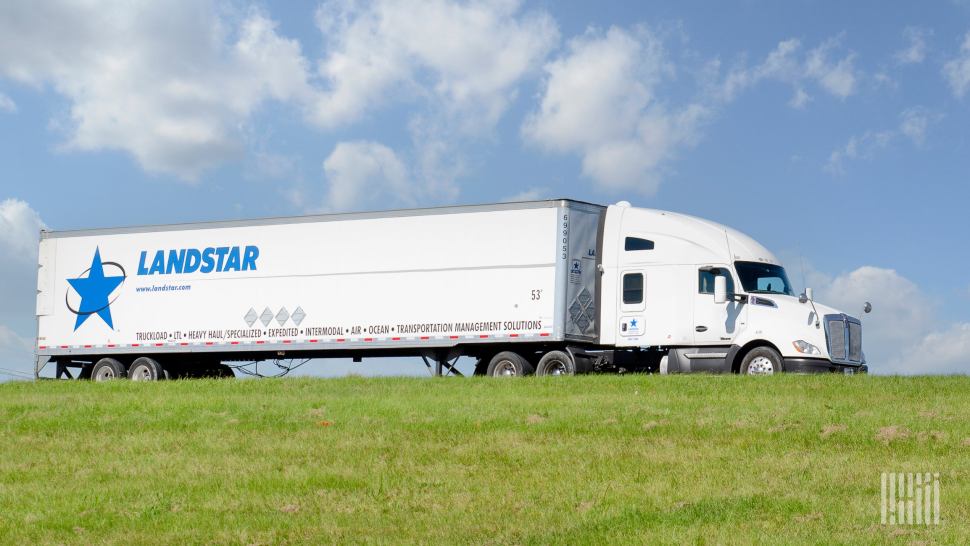
Broker Landstar System said it’s readying for an inflection, noting largely normal seasonal trends on its first-quarter call. The fact that it isn’t in cost-cutting mode like the asset-based operators is a bit of a reprieve from the carnage this earnings season has delivered.
The company beat expectations for the first quarter, but its second-quarter guidance was light of consensus.
Landstar (NASDAQ: LSTR) reported earnings per share of $1.32 for the 2024 first quarter, which was 4 cents ahead of the consensus estimate but 85 cents lower year over year (y/y). The period included some cost headwinds from a reset in variable compensation and expenses related to its CEO transition.
Consolidated revenue of $1.17 billion was 18% lower y/y but came in above the high end of management’s guidance range.
Total loads hauled by truck fell 13% y/y and revenue per load was down 7%. Both metrics were slightly better than the guided range, outperforming historical sequential trends in February and slightly underperforming in March.
On a Thursday call with analysts, management said it is seeing favorable demand in a few industrial-related end markets and noted that flatbed metrics, particularly for heavy-haul freight, are logging more subdued declines than the dry van business.

Capacity on Landstar’s platform continued to decline in the quarter, but the company believes operators will come back to the network as the market and spot rates improve.
Total truck capacity on the platform was down 21% y/y in the quarter and 6% sequentially. Trucks provided by business capacity owners (BCOs), which are owner-operators who haul almost exclusively for the company, fell 13% y/y (down 4% from the fourth quarter) to 9,410. However, BCO productivity, or loads per truck, was up 3%.
“When there’s opportunity, these guys [BCOs] really flock to Landstar,” said Joe Beacom, chief safety and operations officer, on the call. “As capacity comes out of the market and things turn … I think we’re still the home for owner-operators who want to have the freedom to make decisions and provide for themselves. … As rates and volumes come back, they’ll come back.”
Revenue per mile on BCO loads, which is a cleaner pricing metric as it excludes fuel surcharges, declined 7% y/y on dry van loads and 5% on flatbed loads. Both yield metrics are higher than pre-pandemic levels by 21% and 23%, respectively. However, those gains for owner-operators have been wiped out by higher operating costs.

Variable contribution, or revenue less purchased transportation and commissions, declined 19% y/y to $168 million. The variable contribution margin was down just 10 basis points to 14.4%.
Landstar expects second-quarter revenue to be in a range of $1.2 billion to $1.3 billion, a 9% y/y decline at the midpoint but in line with the consensus estimate at the time of the print. Loads hauled by truck are expected to decline between 5% and 9% with revenue per load flat to down 4%.
The y/y comparisons ease as the second quarter progresses.
Through the first three weeks of April, truck volumes have been more in line with normal seasonal trends but revenue per load has slightly underperformed. The guidance calls for a 4% to 8% sequential increase in truck volumes from the first to second quarter (historical average is an 8% increase), with revenue per load in a range of down 1% to up 3% (historical average is up 2%).
So far in April, revenue per load is flat with March (historical average is up 1%).
Second-quarter EPS guidance of $1.35 to $1.55 fell short of the $1.60 consensus estimate.
“The Company is laser-focused on supporting our network of small business owners and executing on our strategic growth initiatives and technology enhancements, Landstar’s new CEO, Frank Lonegro, said in a news release. “We are excited about the future, the new leadership structure of our sales organization and the strength of our balance sheet. Landstar is well positioned to capitalize when freight fundamentals improve.”
Lonegro took the helm in February, succeeding Jim Gattoni, who retired. The company added two new sales roles to its executive team last month.
Shares of LSTR were up 1.3% on Thursday at 10:07 a.m. EDT compared to the S&P 500, which was down 1.5%.
Brokerage Compliance Symposium
The day before F3. Every compliance issue you face - fraud exposure, carrier liability, FMCSA rules, cargo theft, insurance gaps - navigated by attorneys and operators defining best practices in a changing industry.
F3 Awards Dinner
The night before F3. FreightTech100 companies honored. FreightTech 25 and Shipper of Choice winners revealed live. Cocktail reception into dinner and live music - 300 industry leaders in one purpose-built room.
F3: Future of Freight Festival
Industry-defining keynotes, rapid-fire technology demos, and industry leaders networking in experiences across Chattanooga - plus the inaugural F3 Awards Dinner featuring the FreightTech and Shipper of Choice reveals.
The day before F3. Every compliance issue you face - fraud exposure, carrier liability, FMCSA rules, cargo theft, insurance gaps - navigated by attorneys and operators defining best practices in a changing industry.
The Signal at Chattanooga Choo Choo • Chattanooga, TN Register NowThe night before F3. FreightTech100 companies honored. FreightTech 25 and Shipper of Choice winners revealed live. Cocktail reception into dinner and live music - 300 industry leaders in one purpose-built room.
The Signal at Chattanooga Choo Choo • Chattanooga, TN Register NowIndustry-defining keynotes, rapid-fire technology demos, and industry leaders networking in experiences across Chattanooga - plus the inaugural F3 Awards Dinner featuring the FreightTech and Shipper of Choice reveals.
The Signal at Chattanooga Choo Choo • Chattanooga, TN Register Now