




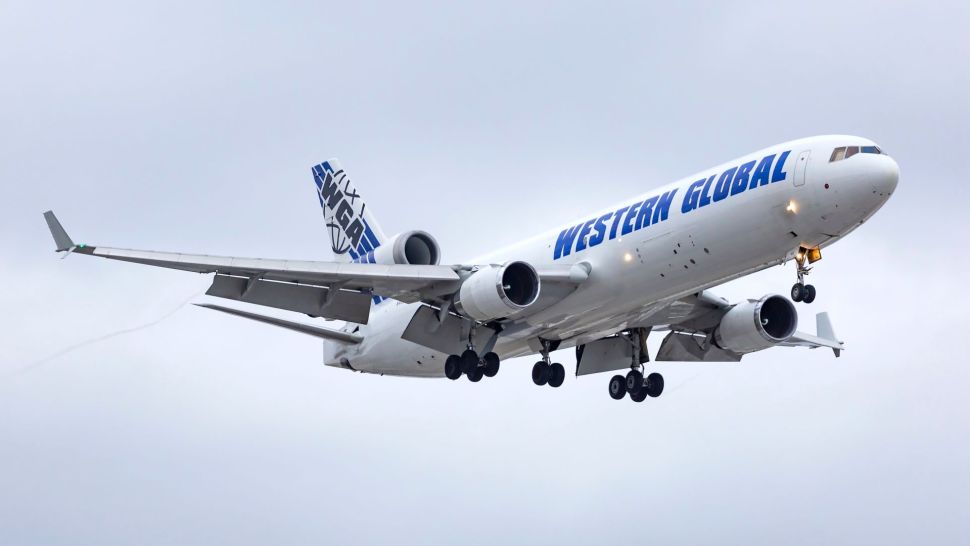
Inspections and potential repairs for MD–11 cargo jets under a no-fly ban following this month’s fatal crash of a UPS freighter could take much longer than some originally expected, leaving FedEx, UPS and Western Global Airlines with a shortage of widebody capacity during the peak shipping season.
Western Global Airlines on Friday informed all MD-11 pilots that they have been furloughed indefinitely, effective on Nov. 22, because of the longer time horizon for completing safety checks mandated by the Federal Aviation Administration, according to an internal letter from Tom Romnios, vice president of human resources. The letter was posted on LinkedIn by Nik Fialka, a professional pilot who hosts the “Ready 4 Pushback” podcast.
A former employee, who requested anonymity, estimated that about 75 pilots received work suspensions.
Western Global, headquartered in Estero, Florida, and based out of Southwest Florida International Airport in Fort Myers, is the most impacted of the three carriers. UPS and FedEx had 26 and 25 active MD-11s at the time of the accident, respectively. The MD-11 represents about 9% of their mainline fleet, but a much larger share of Western Global’s fleet. Western Global has about six active MD-11s and three Boeing 747-400 freighter aircraft, according to aircraft databases.
The engine separated from the left wing of UPS Flight 2976 as it rolled down the runway Nov. 4 during takeoff from Louisville International Airport in Kentucky, causing a fire and dooming the aircraft. The freighter barely got off the ground and crashed into an industrial park, killing 14 people.
“During the past two weeks, WGA has been in constant communication with Boeing, who originally anticipated that by Nov. 14 they would have an approved noninvasive inspection protocol to return the aircraft to service. Because of this, we were hopeful that the MD-11 grounding would be short-lived. However, Boeing has now advised that more and highly invasive inspections, as well as repairs and parts replacements, would be required, resulting in an extended grounding of the MD-11 fleet for an undeterminable period of time,” Romnios wrote.
FedEx’s Chief Financial Officer John Dietrich raised expectations on Nov. 11, as first reported by FreightWaves, that the inspection process would be relatively quick. He gave his optimistic outlook before National Transportation Safety Board investigators on Thursday said they found fatigue cracks inside a large structural component that attached the engine to the left wing of UPS Flight 2976. UPS has been more circumspect about suggesting any quick conclusion of the inspection regime.
“While none of this situation was caused by the company, we are now forced to make very difficult decisions right away in order to save the company for when the MD-11s eventually return to service,” Western Global said in the letter. “In the entire 12-year history of WGA, we never had any furloughs or pay cuts. However, the current situation is untenable, threatens the company’s survival and leaves WGA no choice” but to reduce the size of its workforce.
Western Global has 147 pilots, according to the Air Line Pilots Association. The company survived bankruptcy two years ago, but was forced to downsize operations.
A company executive declined to comment when contacted by FreightWaves.
“We remain in close contact with operators and the FAA. Our team is working diligently to provide instructions and technical support to operators so they can meet the requirements of the FAA Airworthiness Directive,” Boeing spokesperson Shelley Spreier said in a statement.
FedEx and UPS have implemented contingency plans to replace the lost MD-11 capacity. Steps taken include consolidating flights, deferring scheduled maintenance checks on aircraft with available time before the due date, contracting with airline partners to fly freighter aircraft in their networks and shifting some domestic shipments to ground networks.
UPS recently engaged Cargojet to operate several Boeing 757-200 freighter aircraft and Amerijet to operate at least one Boeing 767 freighter on domestic routes. Both aircraft types are smaller than the MD-11.
Cargo Facts first reported about the Western Global pink slips earlier on Monday.
Click here for more FreightWaves/PostalMag stories by Eric Kulisch.
RELATED READING:
NTSB links fatigue cracks to fatal crash of UPS cargo jet
Brokerage Compliance Symposium
The day before F3. Every compliance issue you face - fraud exposure, carrier liability, FMCSA rules, cargo theft, insurance gaps - navigated by attorneys and operators defining best practices in a changing industry.
F3 Awards Dinner
The night before F3. FreightTech100 companies honored. FreightTech 25 and Shipper of Choice winners revealed live. Cocktail reception into dinner and live music - 300 industry leaders in one purpose-built room.
F3: Future of Freight Festival
Industry-defining keynotes, rapid-fire technology demos, and industry leaders networking in experiences across Chattanooga - plus the inaugural F3 Awards Dinner featuring the FreightTech and Shipper of Choice reveals.
The day before F3. Every compliance issue you face - fraud exposure, carrier liability, FMCSA rules, cargo theft, insurance gaps - navigated by attorneys and operators defining best practices in a changing industry.
The Signal at Chattanooga Choo Choo • Chattanooga, TN Register NowThe night before F3. FreightTech100 companies honored. FreightTech 25 and Shipper of Choice winners revealed live. Cocktail reception into dinner and live music - 300 industry leaders in one purpose-built room.
The Signal at Chattanooga Choo Choo • Chattanooga, TN Register NowIndustry-defining keynotes, rapid-fire technology demos, and industry leaders networking in experiences across Chattanooga - plus the inaugural F3 Awards Dinner featuring the FreightTech and Shipper of Choice reveals.
The Signal at Chattanooga Choo Choo • Chattanooga, TN Register Now