




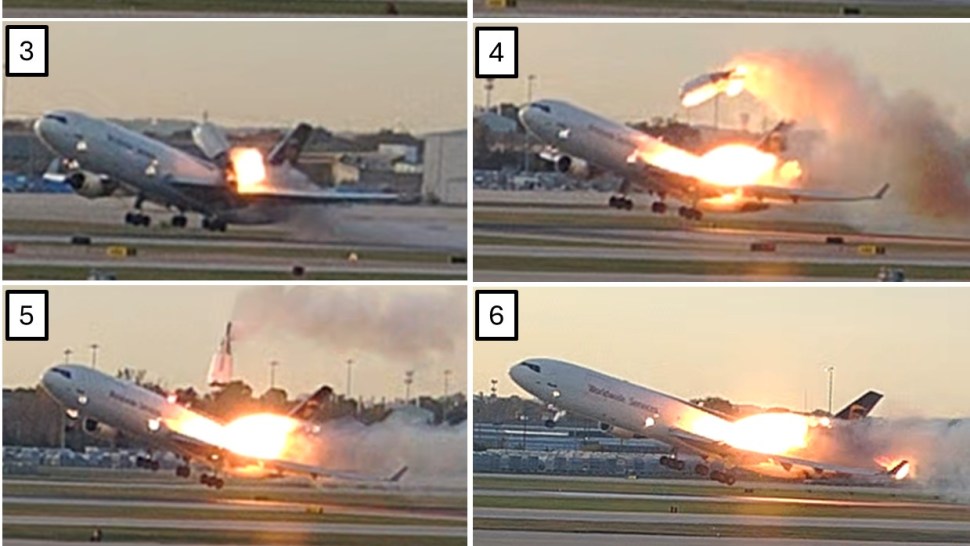
The left-wing engine mount on a UPS MD-11 freighter aircraft that crashed in Louisville, Kentucky, on Nov. 4 showed signs of fatigue cracks, according to a preliminary investigative report issued by the National Transportation Safety Board on Thursday.
Airport surveillance video of Flight 2976 showed the engine and pylon separating from the wing shortly after the front landing gear lifted up, igniting a fire. The cargo jet never got higher than 30 feet before striking a UPS Supply Chain Solutions warehouse just beyond the fence line on the southern edge of the airport and slamming into a storage yard and other buildings. Fourteen people died in the crash, including the three pilots.
The NTSB said the rear lug holding sections of the left-engine pylon together had fatigue cracks in two locations.
The 34-year-old converted widebody cargo jet had accumulated 92,992 hours of flying time and 21,043 engine cycles. The left pylon aft mount was visually inspected, as required by UPS’s (NYSE: UPS) maintenance program at a 72-month interval, on Oct. 28, 2021. The pylon thrust links and spherical bearings were lubricated on Oct. 18, 2025, as required every two years or 4,800 hours, according to the NTSB report.
A detailed inspection of the left pylon aft mount lugs were not due until 29,200 cycles.
The Federal Aviation Administration earlier this month ordered UPS, FedEx and Western Global Airlines, the only operators of the MD-11, to pull their aircraft from service until thorough inspections are conducted and any necessary corrective actions completed. UPS Airlines has 26 active MD-11s, according to the company.
UPS has activated contingency plans to replace the freight capacity of the MD-11 fleet. Steps taken include contracting with other airlines to temporarily fly routes in UPS’s express and deferred delivery networks, consolidating flights and moving domestic shipments to the ground network.
Click here for more FreightWaves/PostalMag stories by Eric Kulisch.
RELATED READING:
Brokerage Compliance Symposium
The day before F3. Every compliance issue you face - fraud exposure, carrier liability, FMCSA rules, cargo theft, insurance gaps - navigated by attorneys and operators defining best practices in a changing industry.
F3 Awards Dinner
The night before F3. FreightTech100 companies honored. FreightTech 25 and Shipper of Choice winners revealed live. Cocktail reception into dinner and live music - 300 industry leaders in one purpose-built room.
F3: Future of Freight Festival
Industry-defining keynotes, rapid-fire technology demos, and industry leaders networking in experiences across Chattanooga - plus the inaugural F3 Awards Dinner featuring the FreightTech and Shipper of Choice reveals.
The day before F3. Every compliance issue you face - fraud exposure, carrier liability, FMCSA rules, cargo theft, insurance gaps - navigated by attorneys and operators defining best practices in a changing industry.
The Signal at Chattanooga Choo Choo • Chattanooga, TN Register NowThe night before F3. FreightTech100 companies honored. FreightTech 25 and Shipper of Choice winners revealed live. Cocktail reception into dinner and live music - 300 industry leaders in one purpose-built room.
The Signal at Chattanooga Choo Choo • Chattanooga, TN Register NowIndustry-defining keynotes, rapid-fire technology demos, and industry leaders networking in experiences across Chattanooga - plus the inaugural F3 Awards Dinner featuring the FreightTech and Shipper of Choice reveals.
The Signal at Chattanooga Choo Choo • Chattanooga, TN Register Now