




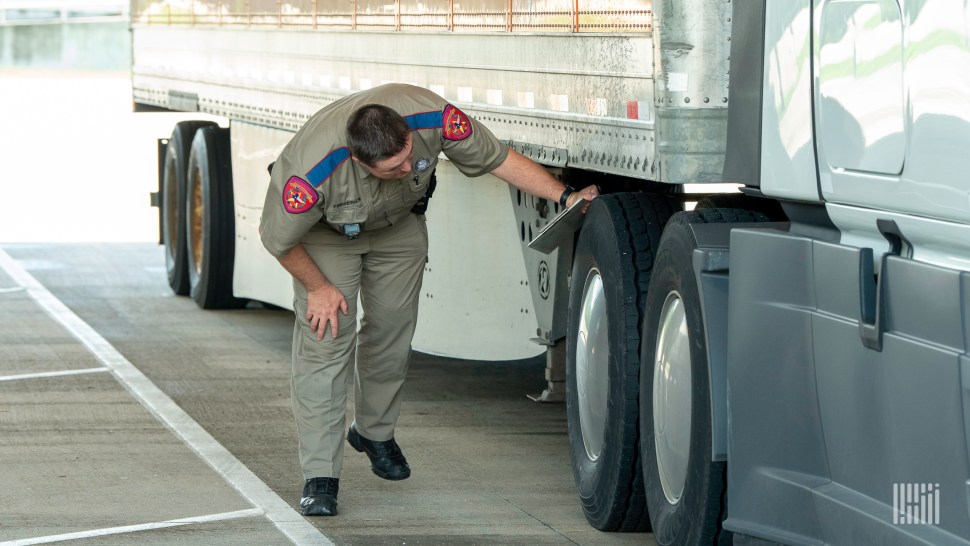
A Commercial Vehicle Safety Alliance decal on a truck cab’s windshield is considered a badge of honor for a truck driver and for trucking fleets – a signal to law enforcement that a vehicle is mechanically sound and is not generally subject to reinspection for up to three months.
But a policy change request filed with CVSA argues that this three-month “free pass” may be undermining the safety mission it was designed to support.
“The CVSA decal policy is in dire need of either significant revision or complete repeal,” Alabama law enforcement officer Harold Kenneth Davis wrote in his CVSA request, which the organization posted this week.
Davis pointed out that under the policy, an inspector who performs a Level I inspection and finds no “critical vehicle inspection items” must issue a decal, which is not subject to reinspection up to three months “even if the driver was arrested for DUI, had multiple false [hours-of-service] logs, suspended license, possessed controlled substances, or if evidence was discovered linking the driver and/or the carrier to human trafficking,” he stated.
Davis’s request comes months after CVSA – an alliance of law enforcement and industry representatives –
reaffirmed its policy that a truck can receive a safety decal even if its driver has been ordered out of service.
“The CVSA decal criteria apply only to the condition of the vehicle, not the driver,” CVSA states in a revised operational policy issued in September. “It is possible for a driver to be out of service and still have his or her vehicle qualify for a CVSA decal.”
Davis contends, however, that while the mission of CVSA, the Federal Motor Carrier Safety Administration, and state enforcement agencies is to reduce crashes, injuries, and fatalities involving commercial vehicles, the decal policy “misaligns” those missions.
“Research shows that approximately 80-90% of crashes are driver-related, while only 2-5% are attributed to vehicle defects,” he asserts. “A policy that prioritizes decals based solely on vehicle condition fails to address the primary causal factors of crashes and contradicts the stated mission of these agencies.”
Davis also contends that the decal policy is not followed consistently across jurisdictions.
“Inspectors often fail to issue decals due to either a lack of supply [of decals] or discomfort with applying decals when violations are present but not classified as ‘Critical Vehicle Inspection Items’,” he said. Critical Vehicle Inspection Items include items such as brake systems, cargo securement, tires, or windshield wipers. “This inconsistency undermines the credibility and uniformity of enforcement efforts.”
He suggests that a “modernized” approach to truck safety inspection policy should:
- Align enforcement practices with the actual causes of commercial vehicle crashes.
- Reduce unnecessary administrative costs and burdens on states.
- Ensure inspectors retain discretion to prioritize driver-related violations and broader safety concerns.
- Strengthen consistency and credibility of enforcement across jurisdictions.
CVSA assigned the request for discussion with its board of directors. It is expected to be addressed at “the next appropriate CVSA meeting” which is the alliances’ spring workshop.
Related articles:
Brokerage Compliance Symposium
The day before F3. Every compliance issue you face - fraud exposure, carrier liability, FMCSA rules, cargo theft, insurance gaps - navigated by attorneys and operators defining best practices in a changing industry.
F3 Awards Dinner
The night before F3. FreightTech100 companies honored. FreightTech 25 and Shipper of Choice winners revealed live. Cocktail reception into dinner and live music - 300 industry leaders in one purpose-built room.
F3: Future of Freight Festival
Industry-defining keynotes, rapid-fire technology demos, and industry leaders networking in experiences across Chattanooga - plus the inaugural F3 Awards Dinner featuring the FreightTech and Shipper of Choice reveals.
The day before F3. Every compliance issue you face - fraud exposure, carrier liability, FMCSA rules, cargo theft, insurance gaps - navigated by attorneys and operators defining best practices in a changing industry.
The Signal at Chattanooga Choo Choo • Chattanooga, TN Register NowThe night before F3. FreightTech100 companies honored. FreightTech 25 and Shipper of Choice winners revealed live. Cocktail reception into dinner and live music - 300 industry leaders in one purpose-built room.
The Signal at Chattanooga Choo Choo • Chattanooga, TN Register NowIndustry-defining keynotes, rapid-fire technology demos, and industry leaders networking in experiences across Chattanooga - plus the inaugural F3 Awards Dinner featuring the FreightTech and Shipper of Choice reveals.
The Signal at Chattanooga Choo Choo • Chattanooga, TN Register Now