What the surge in empty container moves says about the freight market
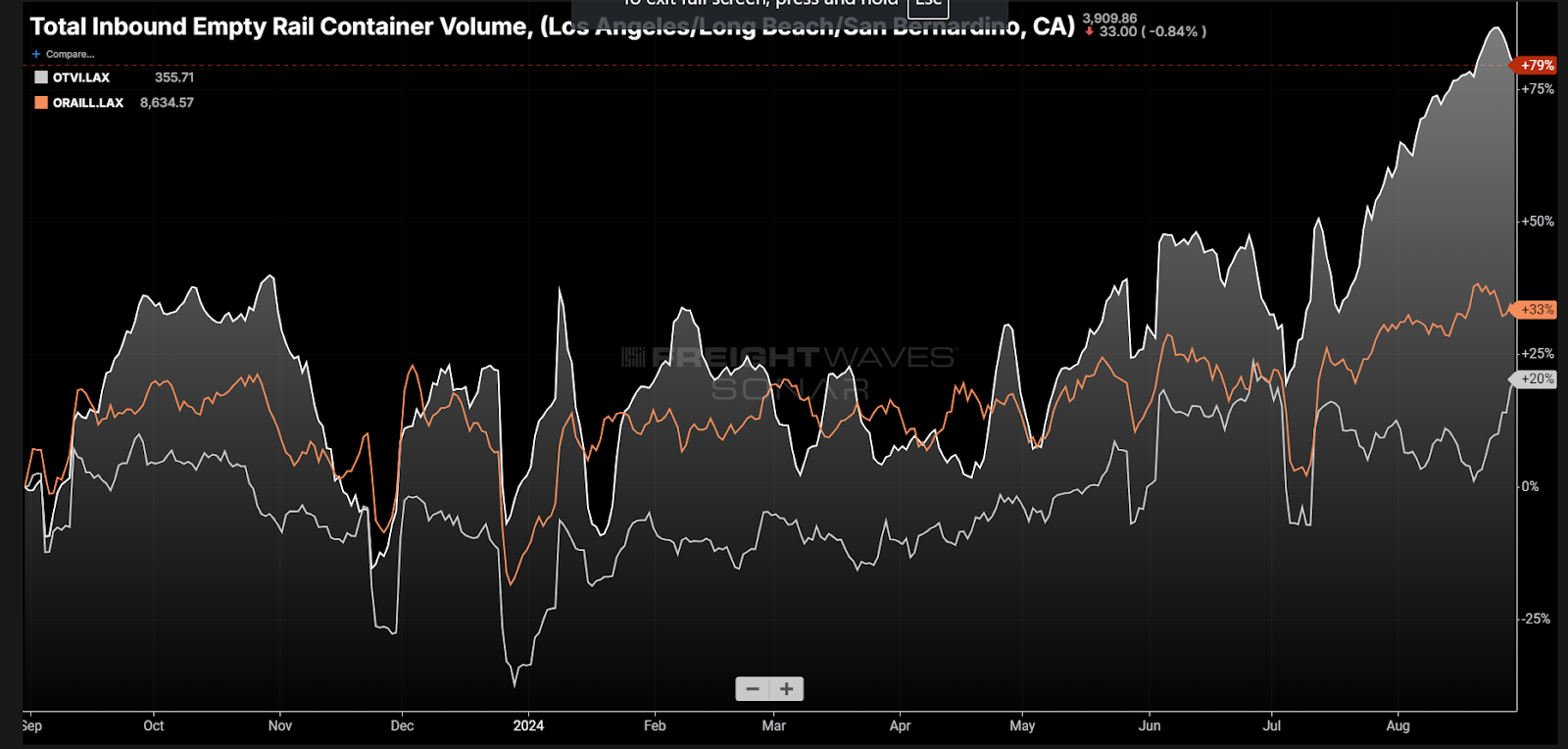
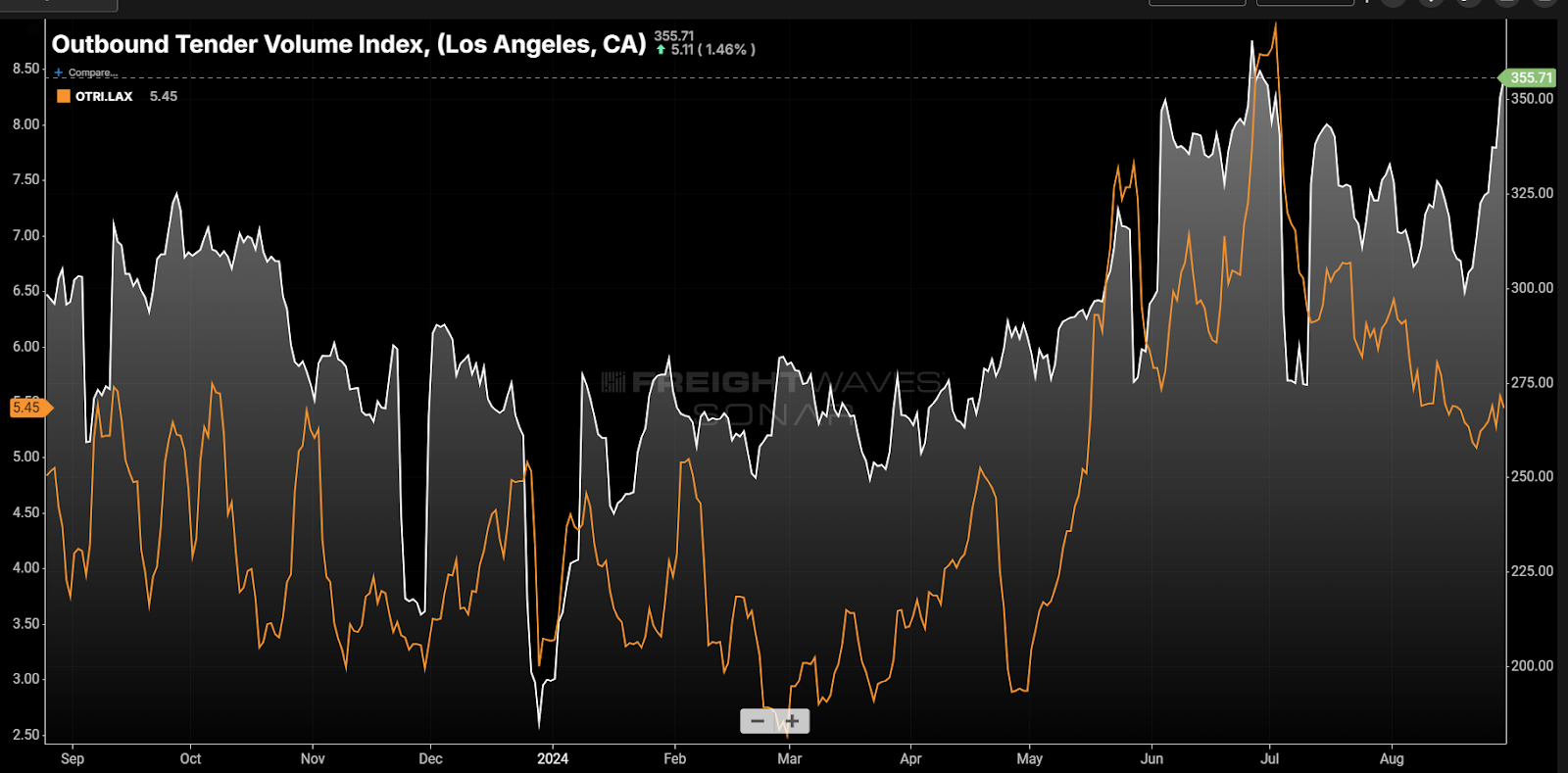
Chart of the Week: Inbound Empty Rail Container Volume, Outbound Tender Volume Index, Outbound Loaded Rail Volume – Los Angeles SONAR: IRAILE.LAX, OTVI.LAX, ORAILL.LAX
The rails movement of empty international and domestic sized containers into the Los Angeles market have spiked over the past month. The implication is that demand is outpacing the supply of available containers both on the west coast and overseas. The transportation market appears to be able to handle it.
The dominant flow of consumer goods into the U.S. is from Asia to southern California. These are items like electronics, furniture and apparel. The primary consumption markets are in the eastern half of the country, which means most of the goods that come in through the ports of Los Angeles and Long Beach get moved either by rail or truck to the east.
This trade route should not be confused with raw materials or routes associated with manufacturing and processing. Those are much more dispersed and less focused.
The route represents the American consumer with shipments of primarily finished goods. It has been formed over the past 30 years as companies recognized the cost effectiveness of producing their goods in Asia.
This mechanism is responsible for creating the largest imbalance in the flow of transportation capacity. The natural flow of goods continually puts pressure on Asian and Los Angeles market capacity.
The result is that container ships move back to Asia with empty — non revenue generating — containers. The same is true for truckload carriers and the railroads. Since there is no natural mechanism pushing capacity back to where it is needed most, capacity tightens rapidly at times.
Loaded domestic intermodal container volumes out of Los Angeles have grown significantly over the past year, with daily volumes averaging over 10% higher y/y throughout August. This was its fastest growth rate of the year.
Truckload tender volumes out of Los Angeles averaged over 20% higher in June, pushing tender rejection rates to multi-year highs over 8% before the Fourth of July. Tender volumes and rejections fell throughout July up until last week.
The data suggests intermodal had taken share from the truckload market and provided a way to relieve pressure on capacity.
Unlike June, last week’s spike in tender volumes out of Los Angeles did not have a strong impact on capacity as tender rejection rates did not increase meaningfully, moving from 5.1% to 5.45% in the past week. Spot rates from Los Angeles to Chicago were only up 0.4% week over week last Thursday.
The transportation market was able to absorb the blow leading into the Labor Day holiday weekend, but the surge of empties suggests that there may be more to come.
It does seem that efficiencies have been gained since the pandemic when port and rail infrastructure was overwhelmed. Truckload capacity remains in abundance, but that is the one aspect of the transportation equation that is changing.
Earlier this week, John Kingston wrote about the increasing instability in trucking sector credit, indicating that a wave of carrier exits is becoming increasingly likely.
September will probably not be the month that the domestic transportation market flips to a tighter state, but it is not without vulnerability. There are growing risks for the fourth quarter with strong demand side dynamics as capacity continues to bleed out.
About the Chart of the Week
The FreightWaves Chart of the Week is a chart selection from SONAR that provides an interesting data point to describe the state of the freight markets. A chart is chosen from thousands of potential charts on SONAR to help participants visualize the freight market in real time. Each week a Market Expert will post a chart, along with commentary, live on the front page. After that, the Chart of the Week will be archived on FreightWaves.com for future reference.
SONAR aggregates data from hundreds of sources, presenting the data in charts and maps and providing commentary on what freight market experts want to know about the industry in real time.
The FreightWaves data science and product teams are releasing new datasets each week and enhancing the client experience.
California issues draft framework for autonomous heavy trucks
California unveiled on Friday a draft framework proposal that will be used to inform standards for operating heavy-duty autonomous trucks weighing 10,001 pounds or more.
The draft language, issued by the state’s Department of Motor Vehicles (DMV), follows several meetings held jointly last year with the California Highway Patrol to get public feedback on safety, economic, and workforce implications associated with autonomous trucks.
“It’s time to take the next step and continue to responsibly advance technology that has the potential to not only enhance safe and sustainable transportation options but also to create new jobs and opportunities for workers within the evolving transportation sector,” said California Transportation Secretary Toks Omishakin, in announcing the draft language.
The framework would allow autonomous trucks to operate on roads with speed limits of 50 mph or more and on frontage access roads – “essentially allowing for long-haul deliveries along hub-to-hub routes and in less complex operational areas,” according to a proposal summary.
“The [DMV] requests input on what might be the appropriate criteria for establishing long-haul operational design domains.”
The agency stated it would also like comment any other proposed changes, including from manufacturers, technology experts, labor, first responders, and “potential end-users of autonomous vehicle technology.”
The framework envisions a phased two-step permit process. Manufacturers would be required to initially hold a permit to test with a safety driver in the vehicle and apply in separate subsequent phases for driverless testing permit and a deployment permit.
“To further document their overall safety approach, manufacturers would be required to submit a safety case with each permit application that describes how they are comprehensively addressing safety at an organizational, operational, and vehicle level,” according to the agency. The DMV is seeking comments on appropriate thresholds for the amount of testing, both in terms of time and mileage, that must be completed by a truck manufacturer before progressing to the next permitting phase.
Certain commercial truck operations, including household movers, oversize loads, hazardous material and bulk tankers, are excluded from the framework for safety reasons, the agency stated.
The agency acknowledged that questions still exist as to how law enforcement will cite autonomous trucks for moving violations and other “human driver-oriented elements of vehicle operation” as they relate to autonomous trucks.
“The department anticipates continued discussions on how to best address these other issues,” the DMV noted.
Autonomous Vehicle Industry Association (AVIA) CEO Jeff Farrah called the draft framework an important step for roadway safety and the supply chain in California.
“AVIA applauds Governor Gavin Newsom and the California DMV on the release of the proposed regulations and looks forward to reviewing and engaging constructively,” Farrah said.
Public comments can be emailed to AutonomousVehicles@dmv.ca.gov no later than October 14, 2024. Submissions must include the name of the person or organization. The agency will not accept anonymous feedback.
CSX appeal fails in container terminal antitrust suit against Norfolk Southern
CSX said it was considering its options after a U.S. appeals court refused to restart its lawsuit against eastern competitor Norfolk Southern over access to a key Virginia container port, causing it hundreds of millions of dollars in damages.
The allegations fell outside the four-year window for filing claims under U.S. antitrust law, a three-judge panel of the 4th U.S. Circuit Court of Appeals in Virginia decided on Thursday.
A lower judge in 2023 ruled against CSX and the Richmond court’s decision upholds that ruling in the case involving Norfolk International Terminals at the Port of Virginia.
“CSX is evaluating all options as we remain committed to gaining competitive access at NIT, the Virginia Port Authority’s largest marine terminal, so that we can best serve our customers,” the Jacksonville, Florida-based company said in an email statement to FreightWaves.
Norfolk Southern provides on-dock service on its owned tracks to NIT, which has an annual capacity of 3.6 million twenty-foot equivalent units.
CSX in 2018 sued claiming Norfolk Southern had conspired with Norfolk & Portsmouth Belt Line Railroad Co. to set an excessive “switch rate” for on-dock access, Reuters reported.
The claims dated to 2009 and the appeals court said the lawsuit filed against NS and Norfolk & Portsmouth years later was “untimely.”
But CSX asserted that it had endured “accumulating harm” from the daily switch rate over years, extending the statute of limitation clock. CSX also claimed that the lower court ruling in effect created an “immunity shield” that would block future lawsuits.
The appeals court decided that the allegedly unlawful switch rate in place for years inflicted no “new harm causing new injury” to CSX within the limitations period.
“We are pleased with the decision by the Fourth Circuit Court of Appeals and we are hopeful that this unnecessary litigation is now ended,” said an NS spokesperson in an email.
The case is CSX Transportation v Norfolk Southern Railway et al, 4th U.S. Circuit Court of Appeals, No. 23-1537.
This story was updated with comment from a Norfolk Southern spokesperson.
How Costco leveraged its supply chain to become 3rd largest retailer on Earth | WHAT THE TRUCK?!?
On episode 753 of WHAT THE TRUCK?!? Dooner is joined by supply chain super consultant Brittain Ladd to talk about how Costco leveraged its supply chain to become the third largest retailer in the world. Nearly one third of Americans count themselves as members and the company is now expanding into East Asia. Ladd shares how Costco is using tech to scale the business even further.
MoLo co-founder and podcaster Andrew Silver returns to the show to talk about the state of the industry and lessons learned from his time in the trenches. We’ll also find out how he’s building his show The Freight Pod and what insights he’s gleaned from top leaders in freight.
Plus, a wild truck chase; should truckers be allowed to sing; JAS Worldwide’s ransomware attack; Chicago sports and more.
This year’s Future of Freight Festival takes place Nov. 19-21 in Chattanooga, Tennessee. But it’s not your average conference. Sure, there are wonderful speakers and fireside chats. But that’s only half the fun. F3 is set up with half-days of speakers and amazing content. The other half we take over downtown Chattanooga, and there are events, networking and a lot of fun to be had by all. This year, subscribers to Running on Ice get a promo code exclusive to us! You can register with this link or use the code F3ROI24 at checkout for a discount.
All thawed out
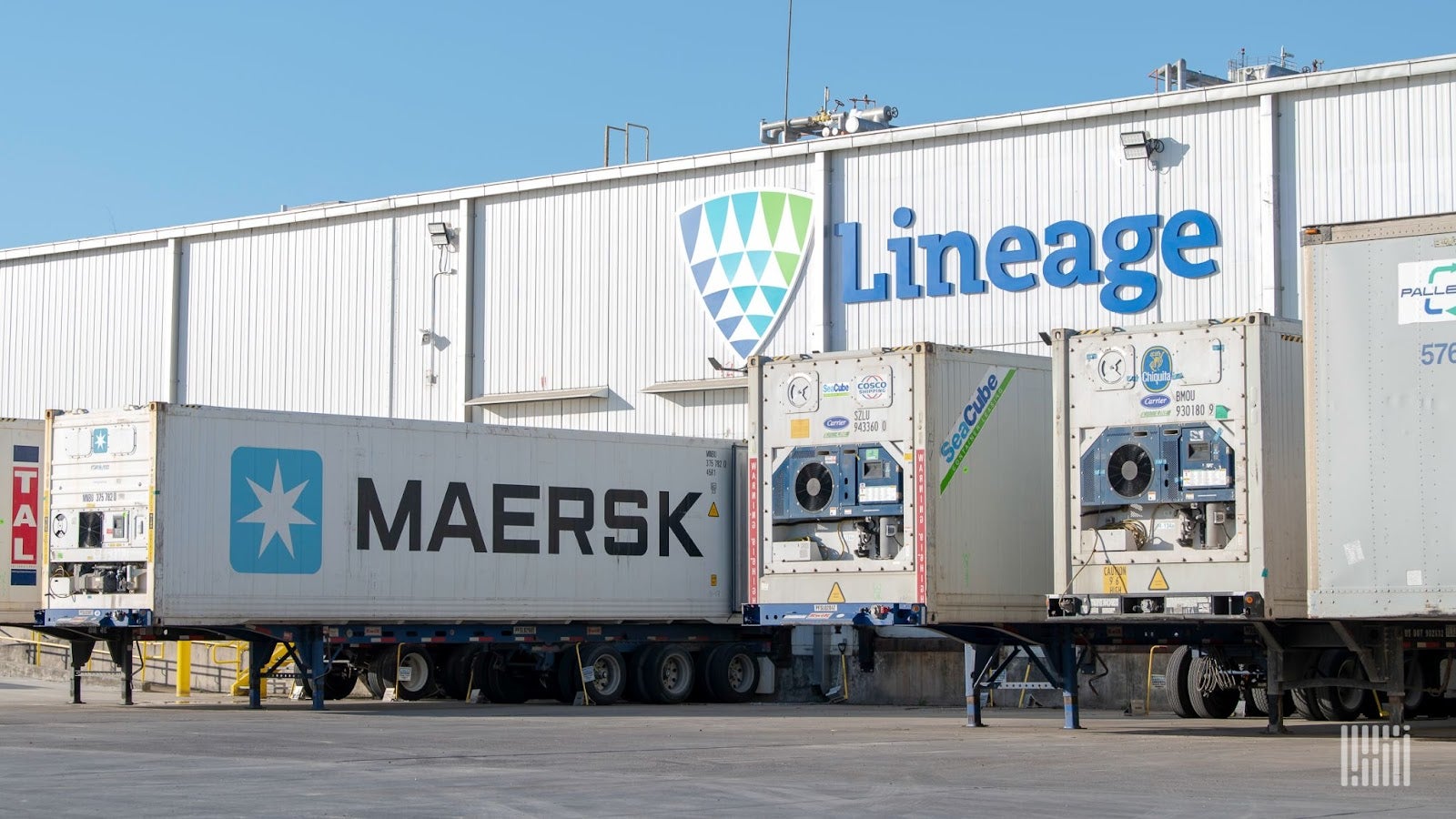
(Photo: Jim Allen/FreightWaves)
Fresh off the largest IPO of the year, cold chain powerhouse Lineage has recently secured the company’s 100th patent. The patent is for “Lego”, a proprietary solution for optimizing pick-pallet build operations and sequencing. The technology helps users organize outbound order lines by pallet and order.
Essentially, Lego can identify the shortest route to collect goods for orders, whether it is being collected by a human or robots to minimize unnecessary travel distances. The tech can also determine the ideal placement of items outbound pallets, increasing the average number of cases per pallet.
Quotes in a news release Sudarsan Thattai, Lineage chief information and transformation officer, “Our patent philosophy is rooted in a relentless pursuit of innovation and excellence. Lineage’s 100 patents are remarkable achievements that highlight the solution-oriented mindset and dedication our team exhibits every day.”
Temperature checks
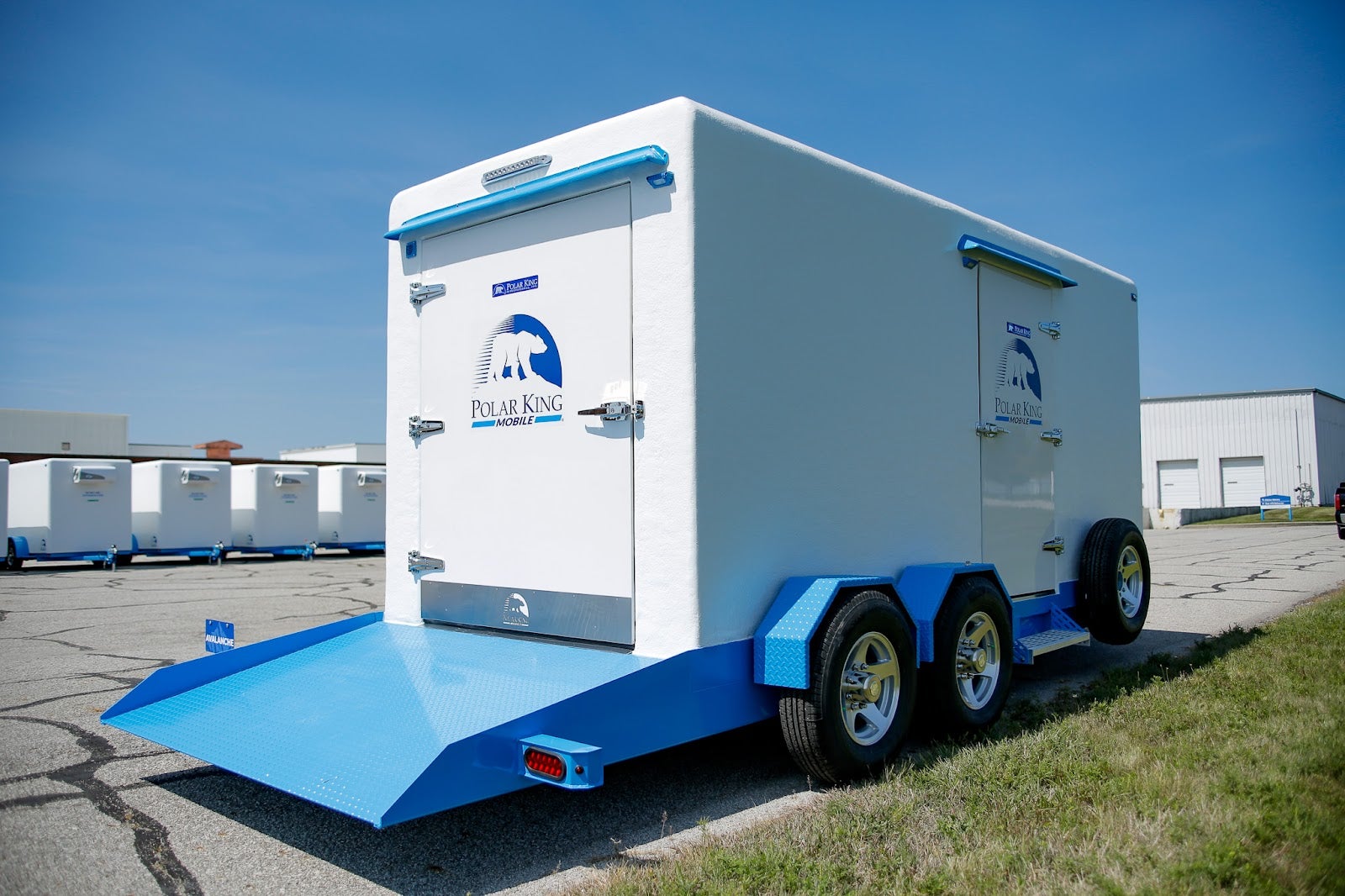
(Image: Polar King Mobile)
Mobile cold storage trailers got a massive upgrade with Polar King Mobile, as the cold storage giant announced a new drop-deck loading walk-in trailer. This new advancement removed the need for ramps to load trailers. The new units have a temperature range of 0°F to 50°F. The all-electric over-the-road trailers also include dual doors for easier cargo management for loading and unloading.
According to a news release, Christian Aitken, Vice President of Polar King Mobile, emphasizes that these trailers are engineered for safety, efficiency, and versatility. “Whether you’re a small business owner, event organizer, or just require seasonal refrigeration, the Avalanche Series delivers a seamless and dependable solution for transporting temperature-sensitive goods.”
All of the new Polar King Mobile units with the drop-deck feature only require 110V and 15 amps of electricity adding to the convenience for customers who are energy conscious.
Food and drug
(Photo: Business Wire)
Big developments have come to the frozen food packaging industry. Gunze Limited has announced its ultra-thin film. Purewrap, specifically designed for food products requiring transportation in frozen environments. The unique thing about this new two product line is that the product keeps its tough ultra-thin characteristics and are also able to be boiled and maintain its integrity.
According to a news release, “In January 2022, Gunze introduced Purewrap FS35N and FS40N, which offer more than twice the puncture strength of conventional non-oriented nylon-polyethylene 70 µm [thickness] films while reducing plastic use by approximately 50%. This film type has been widely adopted by customers. It has now been renewed as a boilable type, expanding its applicability to a wider range of foods processed in central kitchens for commercial prepared foods and restaurants.”
The pinhold resistance and heat tolerance allows for kitchens and other food processing facilities to use hot water to thaw products without having to worry about accidental exposure to outside contamination.
Cold chain lanes
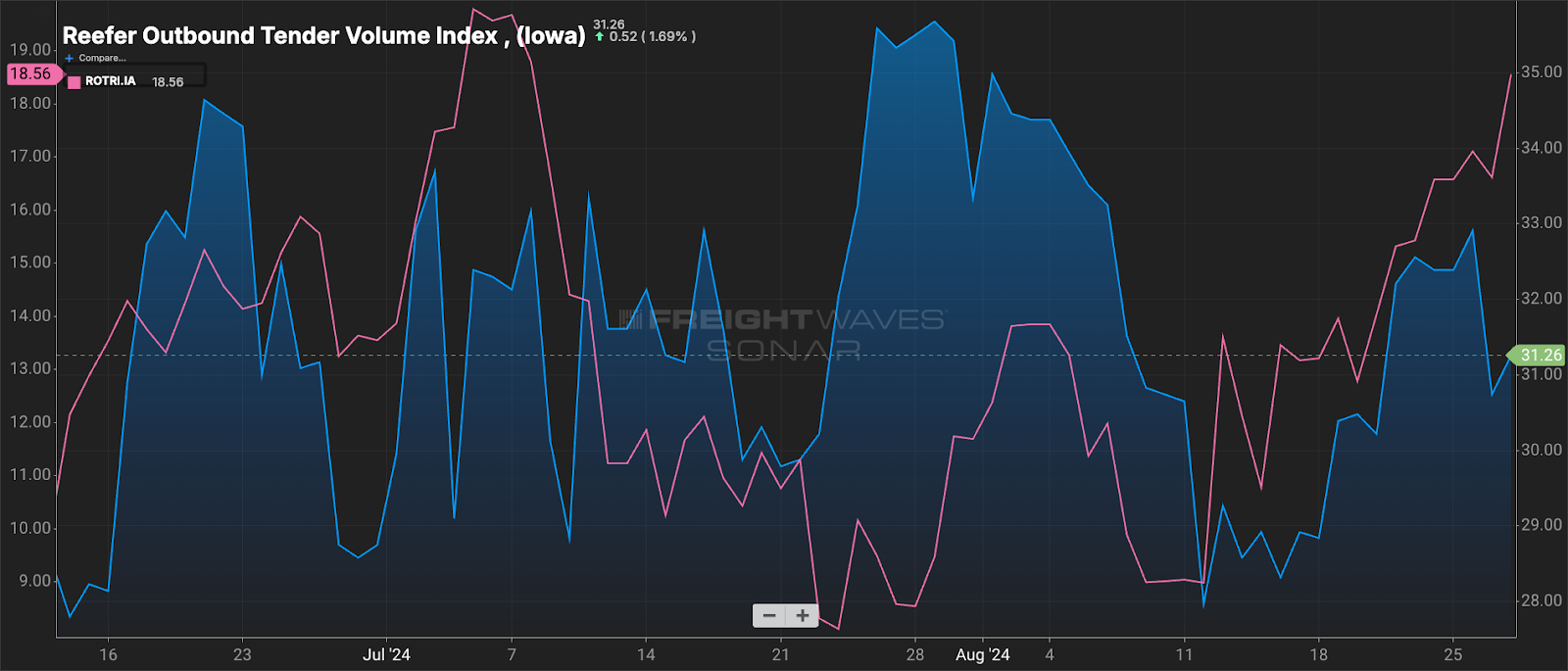
SONAR Tickers: ROTVI.IA, ROTRI.IA
This week’s SONAR market goes to the heart of corn country, Iowa. The state that could best be described as “I really like corn” has seen a sharp uptick in reefer outbound tender rejections. Overall reefer outbound tender volume rates are still up 3.44% w/w. The ROTRI has increased 452 basis points week over week going from 15.3% to 18.56%. Reefer outbound tender volumes have started trickling upwards after taking a drive to start the week off. Since reefer outbound tender rejections are well above 10% and have consistently been above 10% expect seriously inflated spot market rates in most markets within the state of Iowa. As it gets closer and closer to corn and soybean harvest those rejection rates will continue to climb signaling a bit of a capacity crunch for the state as Labor Day Weekend comes around.
Wanna chat in the cooler? Shoot me an email with comments, questions or story ideas at moconnell@www.freightwaves.com.
See you on the internet.
Mary
If this newsletter was forwarded to you, you must be pretty chill. Join the coolest community in freight and subscribe for more at www.freightwaves.com/subscribe.
Revitalizing rail starts with improving company culture
Moving goods via rail comes with a plethora of perks for shippers, consumers and the general public. Unfortunately, the lower shipping costs and reduced carbon emissions often come at the expense of reliability and service. CSX is committed to changing that.
Before CSX CEO Joe Hinrichs joined the company in 2022, he spent over three decades working in the automotive, manufacturing and energy industries. During that time, he experienced the advantages – and disadvantages – of rail firsthand.
“I watched the auto industry move many things from rail to truck,” Hinrichs said.
While finished vehicles still typically move via rail, the majority of other automotive components now move via truck. This switch can be partially explained by the rise in just-in-time manufacturing models, but Hinrichs also noted a sector-wide loss of faith in the railroads’ ability to be on time as a contributing factor.
“The biggest inhibitor to growth in the rail industry is our service levels,” Hinrichs said.
Now, Hinrichs is tackling the rail reliability and dependability issues he used to face from inside the industry. For him, improving customer service starts with creating a better work environment for employees.
“You have to change the culture of the railroad to be more employee-centric,” Hinrichs said. “If we don’t work on the culture and experience our employees have, we aren’t going to get the level of customer service our customers deserve”
Hinrichs stressed that creating a more employee-centric work culture can be as simple as listening to employees talk about what is bothering them and implementing solutions to address those issues.
For example, CSX has made it a priority to create more predictable schedules for their employees despite the inherently unpredictable nature of railroad work. The company also worked hard to get every single employee home on Christmas last year.
“Feeling valued and appreciated goes a long way for people being motivated to do the work,” Hinrichs said. “It is all about listening to each other to improve safety, customer service and efficiency.”
When employees feel appreciated, they perform better. When performance improves, service levels naturally follow suit. In this way, creating a more work-friendly culture is a strategic step toward improving customer service.
Beyond improving work culture, railroads need to be innovative with their offerings in order to spark profitable growth.
“The big opportunity is for us to think differently about intermodal,” Hinrichs said. “We used to load auto parts into box cars. Those docks don’t exist anymore in manufacturing plants, but also [manufacturers] didn’t trust the reliability and repeatability of that service. What if we were able to think differently about loading those materials into containers and trucking them over to the rail yard?”
CSX’s 2021 acquisition of chemical transporter Quality Carriers has provided another opportunity for the company to expand its intermodal capabilities. Working together, Quality Carriers and CSX developed an ISO tank proposal for intermodal.
Reimagining the ways things move is an important part of truly revitalizing the railroads. For CSX, this also means taking shipments off the rail if leaving it on is going to cause a delivery delay. This level of commitment to service is necessary in today’s logistics landscape.
CSX’s approach is working. During the second quarter of 2024, the company was one of the most efficient railroads in North America while still delivering on the highest levels of service in the industry.
“You can expand margins by lowering your cost, and you can also expand margins by increasing your revenue. We want to do both,” Hinrichs said. “The industry is sold this idea that there is a conflict between creating good service for customers and having a low operating ratio. Our view is: You can do both. We are trying to show that to people.”
Third parties reinforce autonomous trucking safety
As the day nears when driverless trucks join traffic flows on interstate highways, autonomous system developers point to third-party validators to help reinforce their safety messages.
Be safe out there
Aurora Innovation has long claimed safety was imperative in putting Class 8 trucks without human drivers on the roads. Ditto for Kodiak Robotics. And Torc Robotics.
Repeating the message helps. Third-party validation gives the claims heft.
The latest comes from Kodiak, which focuses on autonomous vehicles before they hit the road. Working with the Commercial Vehicle Safety Alliance (CVSA), Kodiak focuses on rigorous pre-trip inspections.
Traditional CVSA North American Standard Level I Inspections require cooperation between drivers and enforcement during the inspection process. That collaboration is missing when no human driver is present. Typically, drivers test indicator lights, step on brake pedals, and demonstrate key safety systems operate properly.
That is, when the drivers are present.
Working with connected truck services provider Drivewyze and the Texas Department of Public Safety, Kodiak in April 2023 launched a pilot of CVSA Enhanced Inspections along the I-45 Corridor between Dallas and Houston. The Safety Message Data Set is seamlessly communicated to enforcement officers.
Kodiak has a year of experience with enhanced pre-trip inspections of its autonomous trucks and the trailers they pull. The tougher inspections found more defects, especially in trailers. (Photro: Kodiak)
“This program shows how law enforcement and autonomous vehicle developers can partner to ensure extremely high safety and maintenance standards for self-driving trucks,” Kodiak CEO Don Burnette said at the time the pilot began.
Enhanced pre-trip inspections tougher to pass
Since launching the pilot, Kodiak has performed more than 1,000 enhanced inspections. It found 525 defects, 5% on tractors and 95% Kodiak keeps close tabs on its Kenworth T680 tractors. It is less familiar with the 53-foot trailers they haul. Trailers passed the enhanced inspections 59% of the time compared with a 70% pass rate for a traditional inspection.
Enhanced inspections are zero-defect affairs. Tractor-trailers with a single failure are grounded until a repair is made. About nine in 10 trailer defects get fixed before dispatch. Those that cannot be usually result in an equipment swap.
At 46%, tire issues were most prevalent defects among Kodiak’s 160 enhanced Inspections of customer trailers. Ten percent involved broken or missing lights. Frame issues account for 9%. Brake issues – the subject of two CVSA Operation Airbrake programs this year, including this week – accounted for 4%.
Aurora’s safety quality audit
Aurora recently received its grades from a Safety Management System audit that found the startup is proactive, responsible and thorough in its safety approach.
TÜV SÜD, a global leader in testing, inspection and certification, reviewed policies and programs that directly impact Aurora’s safety. That included evaluating how Aurora’s Safety Management System fosters safety-related decisions, addresses safety concerns, measures organizational safety, and prioritizes the expertise of safety leadership.
Aurora Chief Safety Officer Nat Beuse (Photo: Alan Adler/FreightWaves)
“Aurora adapted best practices from other safety-critical industries to implement safety processes throughout their organization,” Bijoy Bhaskaran, mobility division director at TÜV SÜD America Inc., said in a news release.
TÜV SÜD inspected Aurora’s alignment with the Automated Vehicle Safety Consortium Report for Adapting a Safety Management System for Automated Driving System SAE Level 4 and 5 Testing and Evaluation .
“Since Aurora’s founding, we’ve put safety policies and programs at the center of how we develop our self-driving product,” Aurora Chief Safety Officer Nat Beuse said.
Torc’s deliberate safety ethos
Aurora plans to launch 20 Class 8 tractors upfitted with the Aurora Driver system before the end of the year on I-45 in Texas. Kodiak will follow next year after launching driverless trucks in the Permian Basin oil fields.
Daimler Truck independent subsidiary Torc is at a similar state of readiness but won’t pull human drivers until 2027. It wants to launch at scale completely assured of its safety case.
“I have a lot of respect for the other folks in the industry,” Andrew Culhane, Torc chief strategy officer, told me in an interview in November. “Most of us have been in self-driving together for 15-plus years. Everybody has a different definition of what commercialization really means to them.”
Torc founder, former CEO and current Torc director Michael Fleming never minded sounding like a broken record: “Our overarching principle must be safety.”
Former leader TuSimple pays shareholders over safety claims
TuSimple, once a leader in the autonomous trucking market in the U.S., on Monday agreed to pay $189 million to settle a shareholders’ suit claiming it defrauded investors in part by overstating its safety claims.
A preliminary settlement of the proposed class action was filed on Monday in U.S. District Court in San Diego, where TuSimple is based. It requires a judge’s approval. The company, various TuSimple founders and executives, and TuSimple’s bank underwriters, all denied wrongdoing in agreeing to settle.
Shareholders pointed to an April 2022 safety driver-monitored crash on I-10 in Arizona as evidence TuSimple rushed its safety processes to get autonomous trucks on the road.
In happier times, TuSimple CEO Cheng Lu yucked it up with company employees. TuSimple is still based in San Diego but it has shuttered U.S. operations. (Photo: Alan Adler/FreightWaves)
TuSimple has paid $174 million of the settlement amount into an escrow account while its insurers have paid in $15 million..
The company voluntarily delisted from Nasdaq in January, fewer than three years after raising more than $1 billion in an April 2021 initial public offering. TuSimple was the first autonomous trucking developer to demonstrate driverless trucking, covering 80 miles from Tucson, Arizona, to Phoenix in December 2021.
TuSimple mostly operates in Asia, where it has tested driverless trucks in Japan and China.
What’s next for autonomous trucking legislation in California?
It is deja vu all over again – cap tip to the late Yogi Berra – when it comes to legislation that would all but ban driverless heavy-duty trucks in California.
The state assembly overwhelmingly passed two bills on Thursday that would make it difficult for driverless trucks to operate in the Golden State. Now it is up to Gov. Gavin Newsom to sign them or exercise his veto as he did last year.
One Teamster-back bill requires human operators, also known as safety drivers, in autonomous vehicles weighing more than 10,000 pounds. The union said the jobs of thousands of truck drivers were at risk of being replaced by autonomous driving systems.
A second bill requires enhanced reporting and collection measures for AV roadway violations and other accidents.
Assembly Bill 2286 and Assembly Bill 3061 passed the California Assembly on votes of 31-3 and 30-7 respectively.
In vetoing Assembly Bill 316 in 2023, Newsom said it was unnecessary to assure safe operation of robotaxis and driverless trucks. He effectively chose Big Tech over Big Labor. Both are major constituencies of the Democratic governor.
The Autonomous Vehicle Industry Association urged Newsom to veto both bills. Legislative proponents decided against trying to override Newsom’s veto last year. Instead they brought forward new bills in the current legislative term.
BP Pulse, formerly Amply, is building a medium- and heavy-duty charging outlet at a TravelCenters of America site in California. (Image: BP Pulse)
The China Daily reports a first of its kind “super charging hub combining photovoltaic power generation, energy storage, charging, and battery swapping under one roof.”
Nikola has hired former Forward Air CEO Thomas “Tom” Schmitt as its first Chief Commercial Officer, overseeing sales, commercial operations, dealerships, service, customer success and marketing. Schmitt was ousted from the less-than-truckload carrier following a problem-plagued merger with Omni Logistics.
Separately, former Nikola CEO Michael Lohscheller takes on his fourth CEO automotive position Oct. 1 as the top executive at financially struggling Polestar. Lohscheller previously led Opel, Vinfast and Nikola, where he stepped down a year ago for family reasons.
Three years after a cyberattack that led to hundreds of gigabytes of data being auctioned on the dark web, Navistarhas hired Robert Oh as its first Chief Digital and Information Officer.
Truck Tech Episode No. 80: Behind the scenes of Cummins’ engine plant in Jamestown, New York
Shawn Hricko oversees the manufacture of more than 500 Cummins’ engines a day at the company’s Jamestown, New York, engine plant. (Photo: Alan Adler/FreightWaves)
Nominations for the FreightTech 25 close at 6 p.m. EDT on Sept. 6. Winners will be announced at the Future of Freight Festival in November in Chattanooga, Tennessee, in November. Here’s a discount offer for F3 tickets.
That’s it for this week. Thanks for reading and watching. Click here to subscribe and get Truck Tech delivered to your email on Fridays. And catch the latest episodes of the Truck Tech podcast and video shorts on the FreightWaves YouTube channel.Send your feedback on Truck Tech to Alan Adler at aadler@firecrown.com.
Norfolk Southern and BNSF reach tentative agreements with additional labor unions
ATLANTA – Norfolk Southern and BNSF Railway have reached tentative five-year contract agreements with additional unions four months before the opening round of national collective bargaining.
The Norfolk Southern agreements with five unions, coming on the heels of four tentative agreements announced last week, cover approximately 55% of the railroad’s unionized workforce.
The most recent agreements announced today, which NS reached in partnership with BNSF Railway and are subject to ratification, include the International Brotherhood of Boilermakers and Blacksmiths and the National Conference of Firemen and Oilers.
Norfolk Southern also separately reached tentative agreements with the American Train Dispatchers Association, the Brotherhood of Maintenance of Way Employes Division, and the SMART-TD Yardmasters.
BNSF previously had reached agreements with four other unions, including the Brotherhood of Railway Carmen Division/TCU, SMART-Mechanical Division, and the Transportation Communications Union/IAM, and the American Train Dispatchers Association.
NS said reaching early agreements underscores the railroad’s “commitment to provide prompt, meaningful enhancements to pay, health care, and time off for its dedicated craft railroaders.”
“These agreements would not be possible without the industry-leading partnership Norfolk Southern has built with our labor unions,” CEO Alan Shaw said in a statement. “As we recognize Labor Day this upcoming weekend, we express our appreciation for the contributions of our craft employees. We’re committed to supporting them with the pay, health care, and personal time they deserve, and look forward to reaching additional agreements with all of our unions in the near future.”
The tentative agreements provide a 3.5% average wage increase per year over the next five years. They also offer railroaders more vacation earlier in their career and enhance health care benefits.
“This agreement marks a historic milestone, reached well before the expiration of the moratorium period, and reflects the mutual cooperation and commitment of Norfolk Southern and BMWED to engage in open, honest dialogue while proactively addressing the critical issues facing our members,” BMWED National President Tony Cardwell said in a statement. “We are proud of the progress we have made working together and look forward to implementing this agreement and partnering with Norfolk Southern to build on this foundation of collaboration and mutual respect.”
BNSF CEO Katie Farmer said the railway was pleased to reach tentative agreements long before the next scheduled national bargaining round. “The well-being of our people is key to our collective success, and this swift collaboration is indicative of our commitment to working together to continue delivering exceptional freight service to our customers. Thank you to our team of negotiators and labor leaders for prioritizing this agreement,” she said in a statement.
“The International Brotherhood of Boilermakers is excited to have a tentative agreement with BNSF as it is a whole package with wage increases, vacation and insurance,” said IBB Director of Railroad Lodge Services John Mansker. “Katie Farmer and BNSF have really stepped the game up for negotiating contracts for rail labor before their contracts are up. All the unions hope this will be a standard practice in the future.”
“I want to thank President & CEO Katie Farmer on tasking the Vice President of Labor Relations Sam Macedonio and General Director of Labor Relations Derek Cargill to work on this,” said NCFO President Michael Pistone. “The NCFO welcomed the opportunity to roll up our sleeves at the bargaining table to reach this solid tentative agreement that will improve the overall quality of life for the NCFO membership and their families.”
CSX was the first railroad to reach early tentative agreements with some of its unions, and the railroad currently has tentative contract deals with seven unions which collectively represent more than half of its unionized workers.
Absent from any of the tentative contract deals: The Brotherhood of Locomotive Engineers and Trainmen.
State of Freight for August: Freight benchmarks show positive signs
FreightWaves’ State of Freight webinar for August discussed the holiday season and what it could mean for carriers in 2024, as well as an ongoing surge in West Coast container imports, and the need for more trucking capacity to exit the marketplace.
Craig Fuller, FreightWaves CEO and founder, said, “the fourth quarter is where you make all your margin. That’s really the most important quarter of the year, and it’s largely driven by holiday goods.”
Here are five takeaways from the webinar:
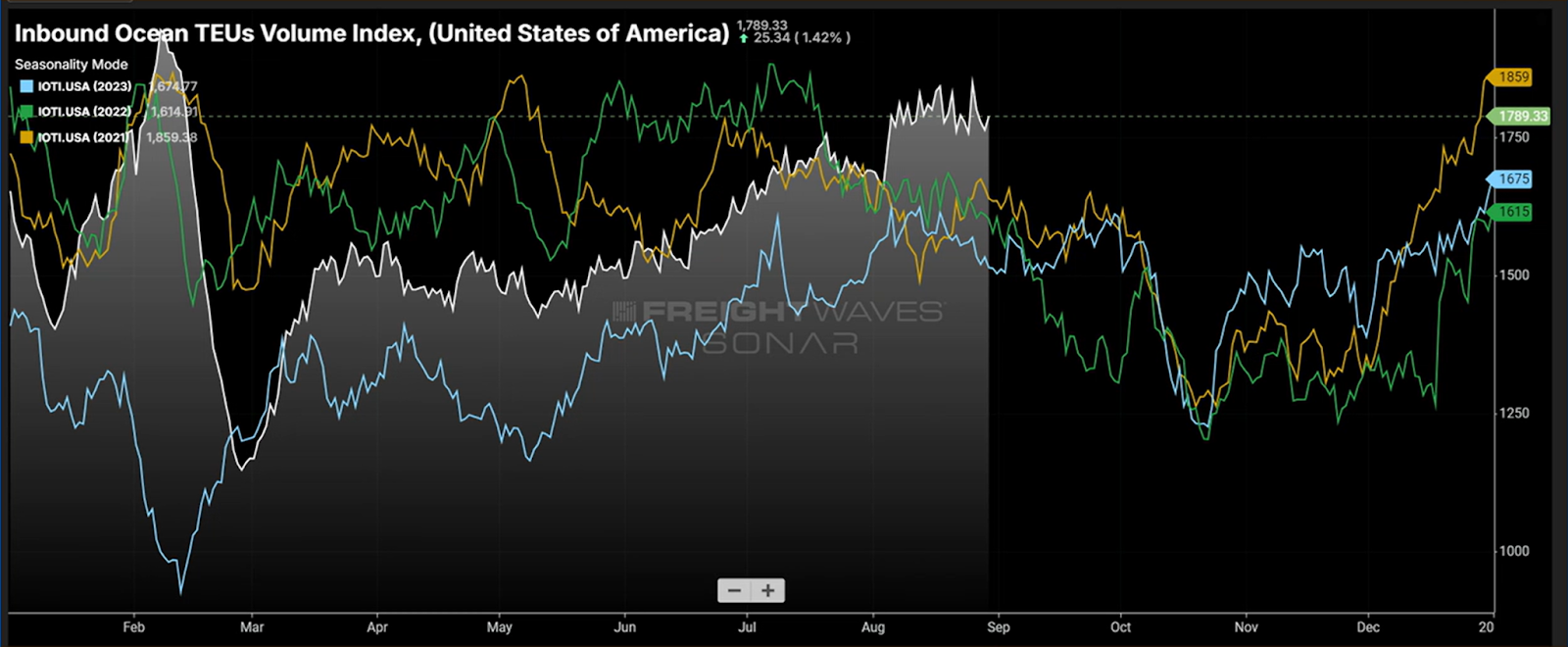
The Inbound Ocean TEUs Index shows a lot of containers headed to the US
Fuller said freight volumes in the fourth quarter should get a boost from imports of containers from China.
“One of the things I think is really interesting is that the ocean container movements foretell what we’re about to see in over-the-road trucking and intermodal,” Fuller said.
Container import volume into the U.S. continues to trend upwards compared to August 2023, according to FreightWaves’ SONAR Inbound Ocean TEUs Volume Index (IOTI.USA). Import volume into the U.S. increased 14% year over year in June and was up 18% year over year compared to July 2023.
According to FreightWaves’ Inbound Ocean TEUs Volume Index for the U.S. (IOTI.USA), container shipments have been surging over the past several months. Chart: FreightWaves SONAR. To learn more, click here.
Zach Strickland, FreightWaves Director of Market Intelligence, said the IOTI.USA index for container movements shows large amounts of freight coming to the U.S.
“This shocks me at how crazy this data set looks,” Strickland said. “The white line is the current year, and I left the pandemic era on here. So the green and orange lines are the pandemic era years where we had this flood of imports. Right now, we are seeing bookings data on par with the pandemic years.”
Fuller said while volumes are high, the freight marketplace isn’t seeing the disruption from all of the container movements like it did in 2021 and 2022.
“The reason we’re not seeing a supply chain crunch or supply chain inflation is because what’s driving the volume today are the big importers and the big box retailers, and not a lot of the other importers that make up the broader part of the economy during COVID,” Fuller said.
Los Angeles has become a bellwether for the global supply chain
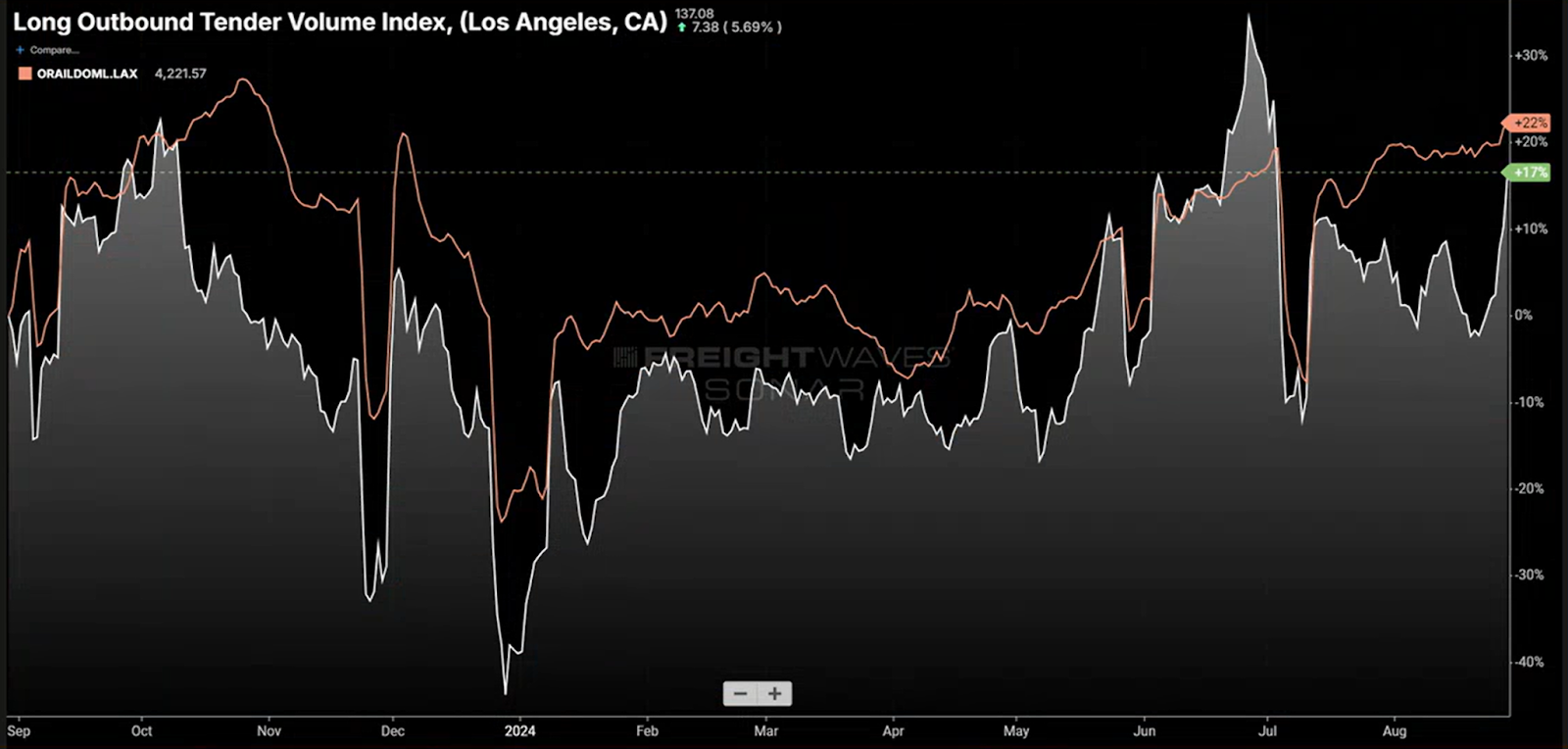
Looking at the Long Outbound Tender Volume for Los Angeles and the Rail Intermodal – Container Volumes indices, freight movements are trending upwards since mid-July.
The Long Outbound Tender Volume (LOTVI.LAX) and Rail Intermodal – Container Volumes (ORAIL.LAX) indices shows container shipments have been moving out of Los Angeles at an increasing rate. Chart: FreightWaves SONAR. To learn more, click here.
“This represents the loads moving more than 800 miles leaving the Los Angeles area market,” Strickland said. “On top of that is the domestic intermodal Los Angeles outbound component. This is stuff that’s literally getting translated onto a 53-foot container from probably some international containers leaving the port area and crossing the country. Los Angeles to me, has become kind of this bellwether, or maybe just this centroid of global supply chain activity. I feel like that this long haul component out of Los Angeles is getting relief that did not occur during COVID from the rail yards.”
Fuller said there is enough trucking capacity in the market to absorb all of the freight moving from the West Coast to other parts of the country.
“What’s driving this particular surge in goods is different from what drove the surge in goods during the COVID years,” Fuller said. “That surge in goods was caused by so much moving through the economy and you couldn’t get your hands on any capacity. We’re not seeing that right now.”
Contract rates are showing some positivity in the marketplace
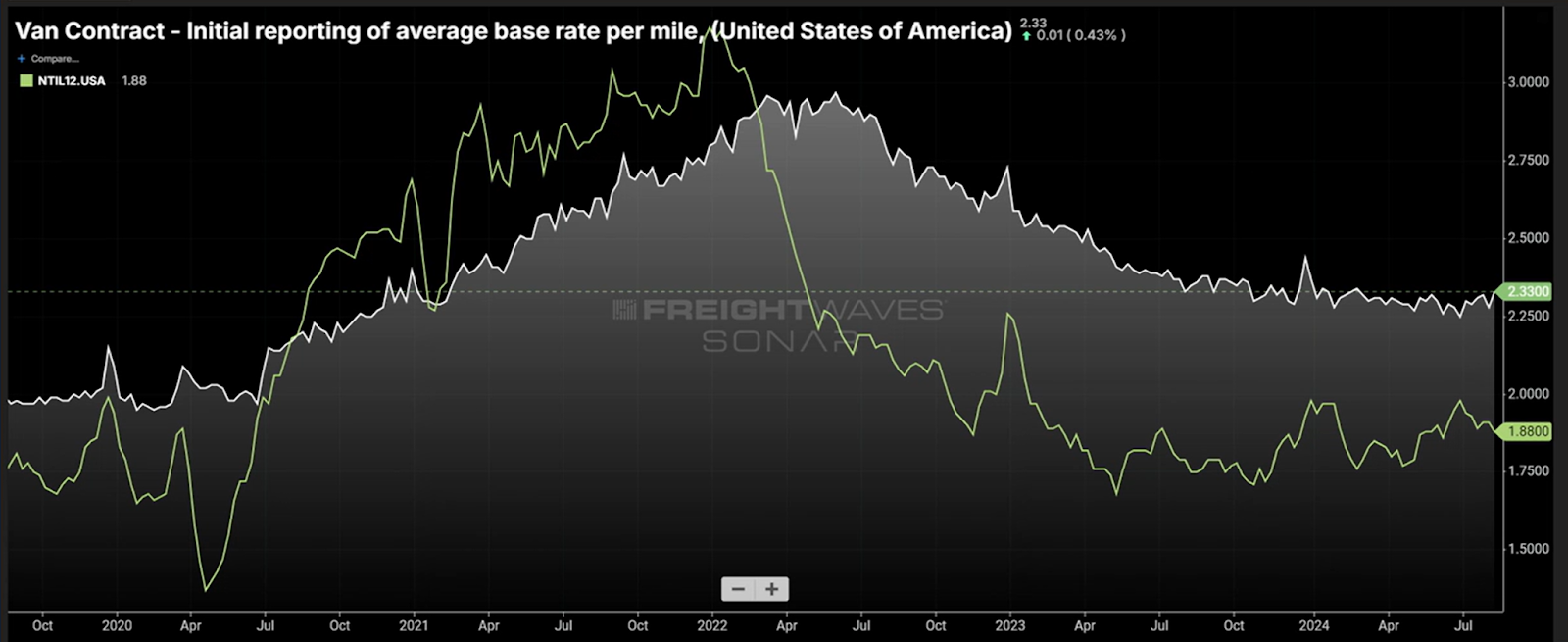
Truckload contract rates (VCRPM1) continue to show stronger upward movements in relation to spot rates, Strickland said.
FreightWaves’ Van Contract Base Rate Per Mile Index (VCRPM1.USA) measures the average rate of dry van load invoices paid by shippers for loads that move more than 250 miles or half a day’s drive from origin. Chart: FreightWaves SONAR. To learn more, click here.
“Contract rates are now starting to trend up,” Strickand said. “We’ve actually started to see the front edge of a turn. Now it’s very short, and it’s not a long term signal at all, but it looks like rates on the contracts are starting to turn up, a signal that we’ve seen already out of the spot market for the past year.”
Fuller said while contract rates are slightly up, it’s unclear whether it’s a trend that will continue for the rest of 2024.
“I think it is fair to say that contract rates probably are not getting cheaper,” Fuller said. “The market cannot reset until there’s more of a normalized range between contract and spot. It is getting close to there. It also tells us we have a little bit of room to go before the market is truly in balance.”
Not worried about possible disruptions from port worker’s strike
Strickland questioned whether a potential East and Gulf coast strike from dockworkers with the International Longshoremen’s Association (ILA) could affect the freight market in the coming months.
Contract talks between the ILA and United States Maritime Alliance are ongoing but some shippers are preparing to avoid any disruption if a strike occurs starting Oct. 1.
Fuller said election years are usually the worst time a union can threaten to hold a worker’s strike.
“I don’t think the Biden administration, which has been arguably the most labor friendly administration in decades, can afford to let a strike go on to disrupt the holiday season,” Fuller said. “They will likely put it into some type of arbitration. The administration will do everything it can to avoid a strike or a shutdown before the U.S. election. Frankly, if I’m the union, the worst possible time to have my contract come up is right before a U.S. election, because there is no way that the Biden administration or the Harris administration can allow for something catastrophic to happen to it.”
There’s still too much trucking capacity in the market
Fuller said more trucking capacity has to leave the market before the freight recession can end.
FreightWaves reported in July that $37 billion in Small Business Administration loans went to 419,500 companies in transportation and warehousing during the pandemic. The loans helped carriers hang around the market for far longer than anyone anticipated, keeping rates lower for longer, according to FreightWaves’ John Paul Hampstead.
“We want to see operators that have stayed in the industry, that do not have state sustainable businesses, to leave the market. Because this market needs a reset. We need to wash it out,” Fuller said. “I hate the fact that people struggle. As someone who takes risks in business, it sucks. No one wants to lose their job. No one wants to lose their business. But this is the way that the market works. We need a reset.”
White Paper: Top 10 Must-Knows For FMCSA Compliance
When it comes to safety and compliance on the roads, PCF Insurance stands tall as a leader in insurance, risk management and loss control with a team of professionals who specialize in all things trucking and transportation. Get the top 10 tips from PCF Insurance on how to stay compliant with the Federal Motor Carrier Safety Administration (FMCSA).