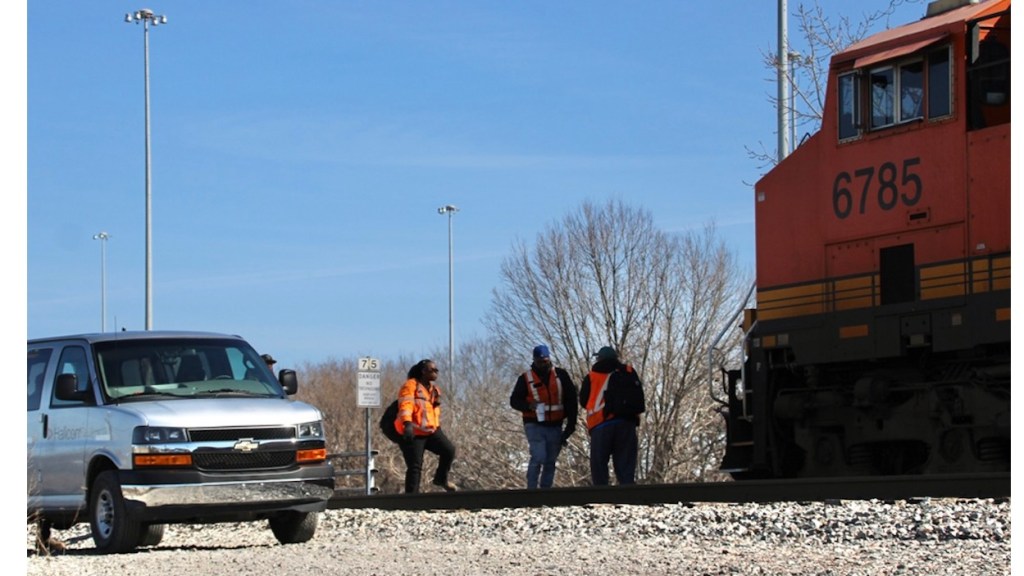
Wild West returns to California rails as suspected train burglar fires at BNSF officer
Update, Aug. 13: San Bernardino County officials announced five arrests in this investigation. Detectives identified Angel Castro as the man accused of firing toward a BNSF officer. Castro faces attempted-murder, cargo-theft and conspiracy charges. Read FreightWaves’ latest coverage here.
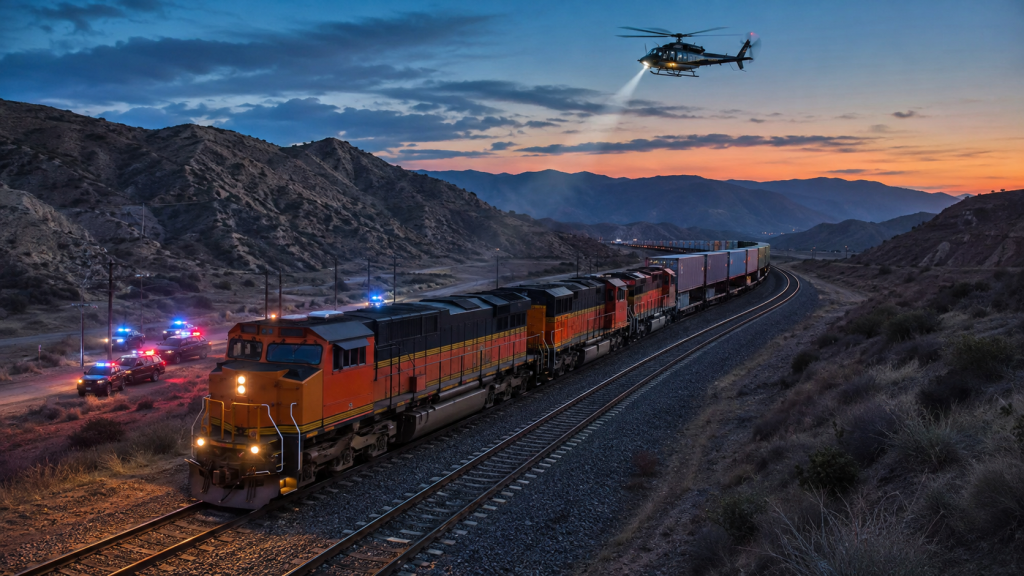
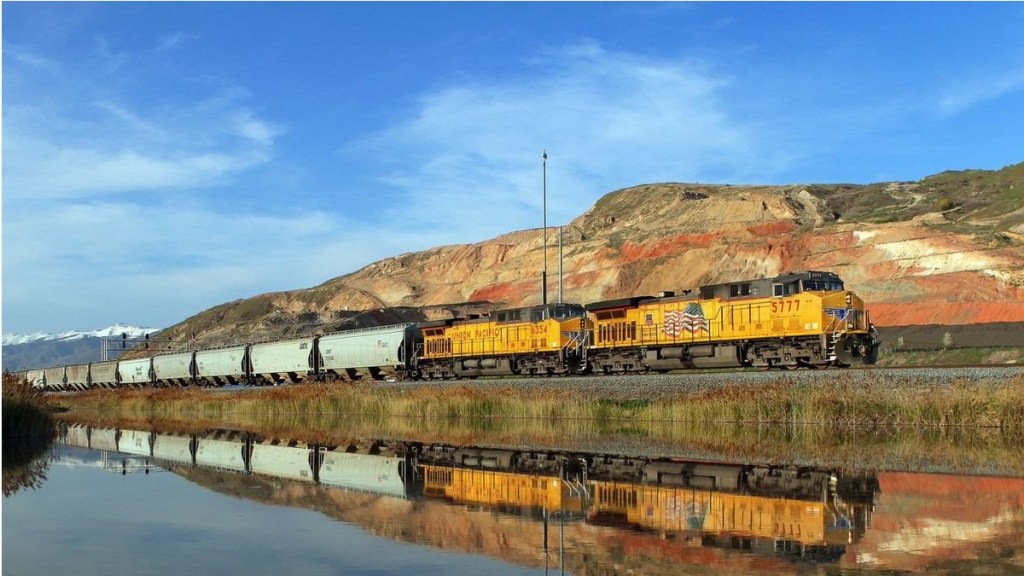
Railroad police encountered several people near rail cars in Devore, California, Monday evening. Personnel tried to deter activity beside Cajon Boulevard and Keenbrook Road. One person fired a handgun during that confrontation. The BNSF officer escaped injury.
The northbound freight train continued through Cajon Pass after the gunfire. It eventually stopped in the Summit Valley area. Deputies and BNSF officers established a perimeter around the equipment. Sheriff’s Aviation and specialized personnel joined the response.
Search teams examined railcars authorities believed burglars had entered. Deputies checked nearby vehicles and questioned people in the surrounding area. Officials determined every contact lacked a connection to the incident. Investigators found no suspects.
Search turns up no suspects
The San Bernardino County Sheriff’s Department released its public advisory Tuesday, Aug. 11. Deputies and California Highway Patrol officers responded around 6:04 p.m. Monday. The call concerned reported gunfire near Cajon Boulevard and Keenbrook Road. Officials classified the matter under California Penal Code 245.
That law covers assault with a weapon. The Rural Crimes Task Force now leads case 012601915. Detectives continue investigating. Officials list all suspects as unknown.
No county deputy or BNSF police officer suffered harm. The department did not release descriptions. It also found no connection between the event and nearby vehicles. People encountered around the area also lacked ties to the case.
In response to follow-up questions from FreightWaves, the San Bernardino County Sheriff’s Department confirmed merchandise was stolen. “Merchandise was taken from the train,” the department wrote. Investigators have not determined the amount taken or the number of suspects. The agency had no images available.
Task force leads inquiry
The Sheriff’s Rural Crimes Task Force has assumed responsibility for the investigation. Detectives have not announced arrests. Officials have not identified the missing merchandise. Case updates may change those details.
Anyone with information can call the task force at 909-387-8400. Anonymous tipsters can call or text REPORT to We-Tip at 844-909-3006. The department accepts online submissions through its portal.
Why It Matters
Rail-car burglaries can turn dangerous when employees confront suspects. Freight professionals need clear escalation procedures after a security breach.
Executives from J.B. Hunt Transport Services said Tuesday that the freight industry is in the “early innings of supply correction,” however, it’s the supply side that might limit the recovery’s upside when demand ramps. Management noted growing labor pressures, pointing out that driver recruitment needs are at their highest level since 2022. However, the hardened driver market presents a demand tailwind for its less driver-intensive intermodal unit.
Driver recruitment is getting tougher
Authorities started clamping down on bad actors last year. The impacts of strict enforcement of English-language proficiency requirements and non-domiciled CDL restrictions were quickly amplified by crackdowns on ELD providers and driver schools.
However, the exodus began before that. Many drivers that ventured out under their own operating authorities left the industry after a prolonged period of poor economics. Higher fuel prices, which most small operators can’t recoup through fuel surcharges, are the latest headwind for this segment of the market.
The Supreme Court’s ruling widening broker liability exposure has added another bottleneck for driver hiring. It’s also driving up insurance costs—an additional impediment to entry.
These actions have certainly been a net positive for large carriers. The bottom layer of capacity, which is often reliant on cheap rates, is being removed.
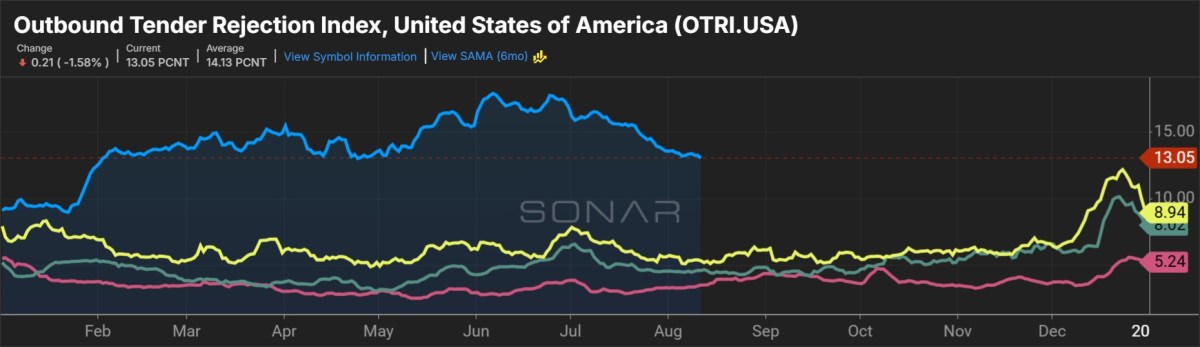
SONAR: Outbound Tender Rejection Index (OTRI.USA) for 2026 (blue shaded area), 2025 (yellow line), 2024 (green line) and 2023 (pink line). A proxy for truck capacity, the tender rejection index shows the number of loads being rejected by carriers. Current tender rejections show a tight truckload market.To learn more about SONAR, click here.
Large fleets have reported significant improvements in equipment utilization and their contractual rate renewals are yielding low-double-digit increases. After several quarters of cutting truck counts to improve utilization, some public fleets are again looking to grow. But growth will be tested by a tighter driver market.
J.B. Hunt (NASDAQ: JBHT) has made significant additions to its driver recruiting teams in recent weeks, management said Tuesday at Deutsche Bank’s Chicago Industrials Summit. While wages are moving up in certain regions, the company possesses some recruiting advantages.
Management said the regulatory crackdown has drivers looking to latch on with financially stable carriers that have ample safety protocols in place. J.B. Hunt’s dedicated segment also maintains an advantage. The average length of haul was just 172 miles in the recent quarter, providing drivers with normal day-job hours.
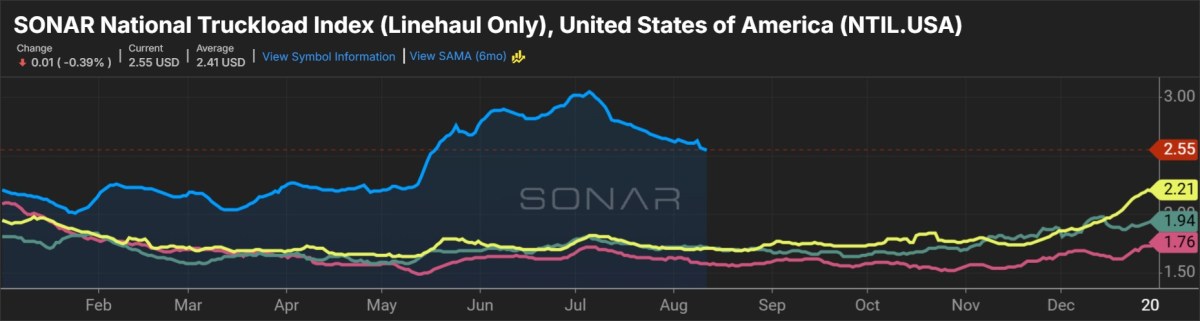
SONAR: National Truckload Index (linehaul only – NTIL.USA) for 2026 (blue shaded area), 2025 (yellow line), 2024 (green line) and 2023 (pink line). The NTIL is based on an average of booked spot dry van loads from 250,000 lanes. The NTIL is a seven-day moving average of linehaul spot rates excluding fuel. Rates remain significantly higher on a y/y comparisonin August.
J.B. Hunt’s financials started healing ahead of upcycle
While overall demand has room to improve, management expressed optimism about the company’s trajectory, noting that its financial performance has improved over the past year. The better results have been achieved even though its two largest segments—intermodal and dedicated—don’t immediately participate in truckload market inflections.
J.B. Hunt tightened the belt last year, ramping cost takeouts and AI-led lean initiatives. It has achieved an annual cost savings run rate of $135 million (on $956 million in last 12 months’ operating income). Four straight quarters of year-over-year margin improvement came without a material benefit from pricing. Intermodal pricing normal lags the TL market by two to three quarters. Multi-year dedicated contracts have annual cost-based price escalators that are slower to adjust when the market turns.
The company has also achieved record intermodal volumes across the network coming out of the downturn. Management said the current road-to-rail conversion opportunity is the best in a decade. Everything is in place—high fuel prices, high TL rates and very good rail service. A competitive driver market can also be a net tailwind for modal conversion, as drayage drivers are only required for a fraction of the total intermodal shipment distance.
Stacey Griffin, senior vice president of pricing for intermodal, said it’s “the summer of many minibids” as customers try to mitigate TL rate hikes.
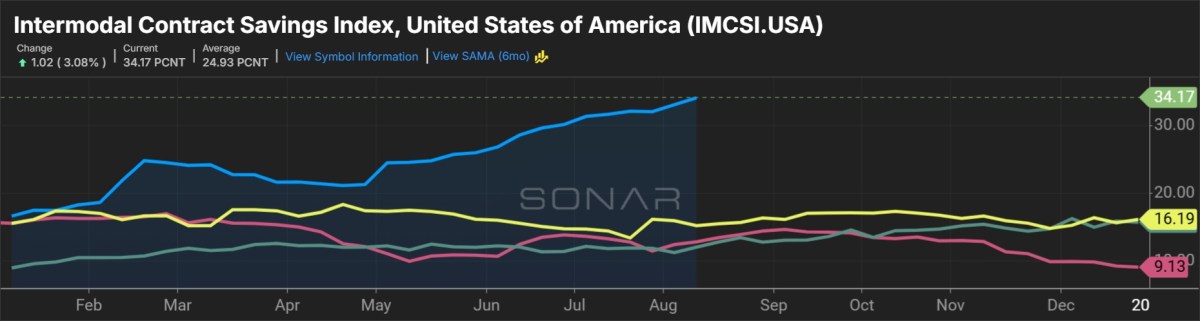
Even with a “normal peak season” on the horizon, management said it will be tougher for shippers to sidestep volume surcharges this year. J.B. Hunt expects to begin closing the pricing gap between TL and intermodal. Sonar data shows the gap has widened through the summer, with intermodal currently 34% cheaper than TL, well past historical benchmarks—10% to 15% in the truck-competitive East and 25% in the West (transcontinental).
SONAR: Intermodal Contract Savings Index (IMCSI.USA). The IMCSI shows the savings percentage between domestic intermodal contract rate per mile and truckload contract rate per mile. The comparison includes fuel surcharges.
The company’s intermodal bid season starts in October, with 10% of annual contracts being repriced in the fourth quarter. The remainder are evenly split across the first, second and third quarters. Truckload rates are still climbing and just starting to bleed into carrier results, which likely leads to “more opportunity” for intermodal rate increases.
J.B. Hunt’s dedicated pipeline ended the second quarter at an all-time high.
It labeled the second quarter “the squeeze quarter” for the TL brokerage industry, as spot rates (purchased transportation costs) surged. Despite the pressure, J.B. Hunt’s brokerage unit returned to profitability for the first time in 14 quarters. Across the industry, brokerage margins likely improved in July (the second-weakest volume month of the year) as spot rates cooled while contract pricing continued to reset higher.
Why it matters? J.B. Hunt’s presentation highlights how structural supply-side constraints, rather than just shifting demand, are creating a long-term competitive advantage for large, financially stable carriers.
Why Global Diesel Prices Are Soaring: War, Hurricanes & Drone Attacks
Diesel prices are hitting “insane” levels at $180/barrel wholesale, and a Gulf hurricane could mean “apocalyptic numbers” past $200, warns Gulf Oil’s Tom Kloza. He breaks down the unprecedented impact of drone attacks on global oil infrastructure, further tightening the refined products market. Plus, how US diesel exports are soaring and fuel surcharges are leaving shippers in the red.
Wholesale diesel prices have climbed to roughly $180 a barrel on world markets — already exceeding the peaks many analysts expected after Russia’s invasion of Ukraine — and could push above $200 a barrel if a tropical storm threatens Gulf Coast refining infrastructure, according to Tom Kloza, Chief Energy Advisor for Gulf Oil, speaking on FreightWaves Today.
The warning comes as fresh Energy Department data showed the United States exported nearly 2 million barrels of distillate last week, a record, on top of domestic consumption running close to 3.5 million barrels a day. With refinery margins offering roughly $90 more per barrel of diesel than the cost of crude — itself trading in the mid-$80s — U.S. refiners are running hard, but maximum domestic output is capped near 5.3 million barrels a day, leaving little buffer if demand spikes or unplanned outages hit.
Kloza pointed to a rapidly expanding threat that he said the media has largely overlooked: drone strikes on refining infrastructure. In the span of a single week, attacks knocked out refining capacity in Russia, Saudi Arabia, and Libya. Kloza warned that the tactic is now a permanent fixture of the energy security landscape, noting that drones costing tens of thousands of dollars can destroy billions of dollars of petroleum infrastructure because refineries are, in his words, essentially powder kegs.
“For the first 48 years of my career, I never heard about a refinery being attacked with drones. And in the last 2 years, it’s been happening in spades,” Kloza said.
Global refining capacity is already short by an estimated 7 to 9 million barrels a day, Kloza said, a gap worsened by Venezuela’s long decline and Latin America’s growing dependence on U.S. diesel supply. That makes the U.S. Gulf Coast what Kloza called “the cleanest dirty shirt” for sourcing distillate, a position that benefits the U.S. trade balance but also concentrates global price risk on a narrow stretch of coastline.
Kloza said the Trump administration could raise the specter of diesel export curbs to cool prices if the market overheats, noting that presidential commentary on social media has already helped keep crude oil below $100 a barrel. He cautioned, however, that actually imposing export restrictions would be counterproductive: “That would be a horrible policy outcome,” he said, because suppressing domestic prices would discourage refinery investment at exactly the wrong time.
The interview also surfaced a structural distortion in how fuel surcharges are calculated. Kloza and FreightWaves founder Craig Fuller noted that government-linked fuel surcharges are indexed to EIA retail diesel prices, yet only about 2% of large fleets actually pay retail. The vast majority buy at cost-plus or negotiated rack-minus arrangements, meaning shippers tied to EIA-based surcharge formulas may be overpaying relative to what carriers actually spend at the pump. Consolidation among the three dominant truck-stop chains has amplified that spread, giving major fueling networks significant pricing power over the posted numbers that underpin those surcharge calculations.
Wholesale diesel hit ~$180/barrel globally, with Kloza warning prices could top $200/barrel if a Gulf Coast hurricane disrupts refining.
Drone strikes knocked out refinery capacity in Russia, Saudi Arabia, and Libya within a single week, threatening a global market already 7–9 million barrels/day short on refining capacity.
U.S. fuel surcharges are indexed to EIA retail diesel prices, but roughly 98% of large fleets buy at negotiated cost-plus rates, creating a windfall discrepancy for carriers and excess costs for shippers.
This Summary is generated thanks to a transcription of the interview, for the full interview please enjoy the video above.
Mega rail deal under fire: 7 State AGs warn UP-NS merger could drive up shipping costs
A coalition of seven Republican state attorneys general is urging the Surface Transportation Board to reject Union Pacific’s proposed acquisition of Norfolk Southern, arguing that the railroads have not shown the transaction would serve the public interest or strengthen rail-to-rail competition.
In a letter entered into the STB’s public record Aug. 11, the attorneys general said the railroads’ revised application – supplemented in July – relies on a proposed pricing remedy that would preserve only a narrow slice of existing competitive options while potentially raising rates for shippers.
States challenge pricing proposal
The letter was signed by Montana Attorney General Austin Knudsen, joined by Brenna Bird of Iowa, Kris Kobach of Kansas, James Uthmeier of Florida, Drew Wrigley of North Dakota, Marty Jackley of South Dakota and Jonathan Skrmetti of Tennessee.
It’s the third such filing seeking to kill the proposal to create the first U.S. transcontinental freight railroad, and comes after President Donald Trump earlier blessed the merger in an Oval Office meeting with UP Chief Executive Jim Venna. In November 2025, the top law enforcement officials from Florida and Ohio joined the current seven AGs in opposing the merger. A similar scrutiny letter in February dropped Florida and Ohio from the letter.
The current objection centers on Union Pacific (NYSE: UNP) and Norfolk Southern’s (NYSE: NSC) proposed Committed Gateway Pricing, or CGP, arrangement. The plan is intended to establish rate protections for certain existing interline movements involving BNSF Railway (NYSE: BRK-B) and CSX Transportation (NASDAQ: CSX) through Chicago, St. Louis, Memphis and New Orleans.
But the states contend CGP creates no new rail option for shippers. Rather, they say, it would merely allow some current interline movements to continue after the merger – an outcome they characterize as preservation of an existing option, not an enhancement of competition as required by the STB’s merger criteria.
Rate concerns dominate critique
The officials also challenge the formula proposed for CGP rates. According to the letter, UP and NS would set rates at the 70th percentile of their own comparable traffic rates, rather than at a median or below-average benchmark.
That approach, the coalition argued, means many eligible shippers could receive a higher price than they pay today. The letter further cites the applicants’ own expert evidence as acknowledging that the mechanism could incentivize higher rates on the traffic lanes used to calculate the CGP benchmark.
The states also noted that UP and NS have said CGP service would not match post-merger single-line service on speed or reliability and was not designed to compete with it. “If UP and NS admit CGP would not create competitive service, we should take them at their word,” the attorneys general wrote.
Narrow reach, temporary protection
Even under the railroads’ revised proposal, the coalition said CGP would apply to only 0.9% of U.S. rail traffic. The arrangement excludes Canadian National (NYSE: CNI) and CPKC (NYSE: CP) interline traffic, automotive and intermodal shipments, storage-in-transit and railroad-owned transload movements, dimensional loads, and routes where more than one rail option already exists at both ends.
In addition, the protection would be temporary, ending with the STB’s oversight period, which the states said would likely be five years. That limited scope cannot counterbalance a deal that the letter says would create a railroad controlling more than half of the U.S. Class I rail market, the coalition argued.
Call for outright denial
The AGs said rail competition is particularly consequential for agriculture, mining, forestry and manufacturing, whose customers may depend on a limited number of rail transportation options. They warned that further consolidation could bring fewer routing choices, higher rates for captive shippers and supply-chain disruptions, particularly in rural markets.
Borrowing on the approach of a recent filing by industrial shippers, the letter asks the STB to determine that UP and NS have failed to make the required prima facie showing – Latin for “on its face” – that the merger is in the public interest and to deny the revised application on that basis. The filing adds a new state-government challenge to the railroads’ effort to defend the proposed combination through claimed operating efficiencies and customer benefits.
Why It Matters: It is significant that the top law enforcement officials from seven states say that the deleterious effects of an historic consolidation will outweigh what the railroads have said will speed rail freight and modernize the U.S. supply chain.
Freight technology doesn’t move in straight lines. It’s often pulled one direction by market pressure, another by regulation, and another by the slow grind of digital adoption.
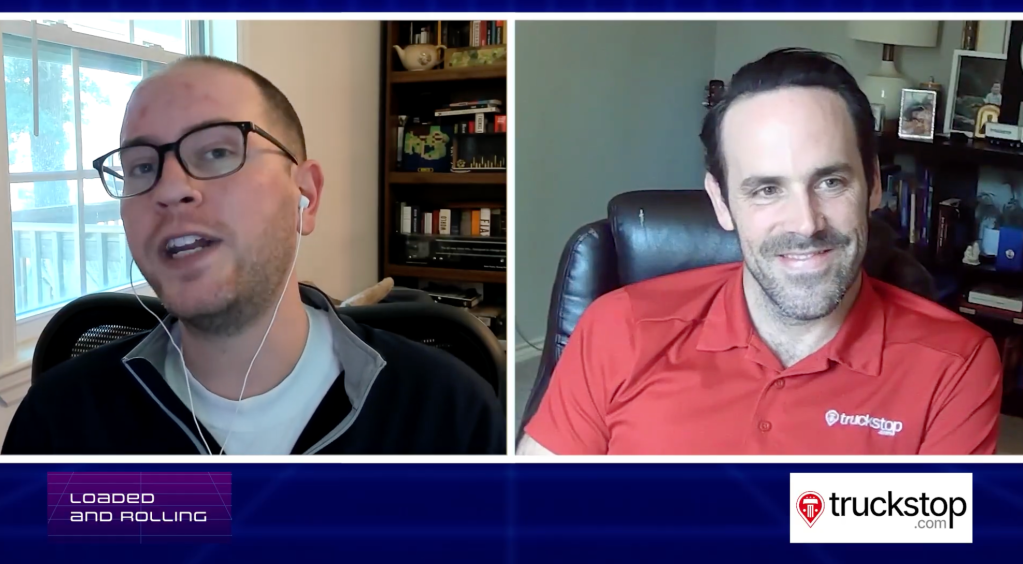
Loaded and Rolling host Thomas Wasson sat down with Sean Dehan, vice president of strategy and corporate development at Truckstop, to discuss where those factors have led the industry when it comes to combatting fraud.
Dehan, who joined Truckstop a little over four years ago, arrived at the company during what he now recognizes as a pivotal stretch for trucking. Industry veterans have noted that the last few years have been the worst recession in their lifetimes. Dehan’s response? “I guess I’m proud to have made that one my first.”
At Truckstop, Dehan’s role sits above the day-to-day product roadmap.
“I help guide the company on where to invest, where to go, what to build next, where to grow next, how to expand our services for our customers,” Dehan said. He described a mandate that spans product development, partnerships, and potential acquisitions. His vantage point gives him a read not just on what Truckstop is building, but on where the broader industry is heading.
Truckstop’s philosophy, according to Dehan, has always started with the carrier. “Truckstop has always been a company that focuses on the carrier first,” he said. “We believe we can serve our brokerage customers best if we serve our carrier customers best and first as well.”
Carrier-first orientation is structurally built into how a two-sided marketplace functions.
“When we build for one side, it typically works for both sides and typically improves both sides,” Dehan said.
But the era of one-size-fits-all tooling, in Dehan’s view, is ending. There are wildly different operational realities within the carrier population. A dry van operation and a flatbed hauler that moves oversized machinery have very different hardships and priorities.
“They might be driving the same tractor with the same engine, but the trailer they’re pulling and the type of freight they’re pulling is all very, very different,” Dehan said. That diversity demands a shift in strategy. “We’re really focused on building products and tooling that enable carriers to build the business that they want to build and work with the customers that they want to work with,” he said.
Part of that shifting strategy, of course, has involved the implementation of new technology. According to Dehan, though, the industry’s posture toward digital adoption quickly turned once bad actors found ways to exploit it.
“Digital adoption can drive a lot of great things, but it can also come with a lot of new challenges,” Dehan said. “AI will bring a lot of amazing things, but it will bring a lot of dark things, too.”
He traced the fraud surge back to the freight brokerage boom years (roughly 2010 to 2022) when growth-hungry brokers pushed for frictionless onboarding to build the largest possible carrier networks.
“If you’re providing me with the onboarding solution, I need you to keep that as low friction as possible,” Dehan explained. That appetite for scale, he said, came with an implicit tolerance for risk. “The fraud that was occurring on the sidelines was just a part of the industry. It was an accepted consequence of running the business,” he said.
The pandemic accelerated the problem as new entrants flooded the market with little scrutiny. “A lot of them were probably fake carriers,” Dehan said. “A lot of them were shell companies. As the market dropped, obviously, the fraud continued and got worse.”
The compounding issues then reshaped broker behavior permanently, according to Dehan.
“Even though we’re in this market right now, which is by all accounts tight on a capacity basis, our brokers aren’t really loosening their standards,” Dehan said. “They’re not changing how they procure capacity. They’re just learning how to procure capacity differently than they used to.”
The legal landscape has added another layer of urgency. Dehan pointed to the Montgomery ruling and a subsequent Texas decision he flagged as potentially even more consequential as forces that are pushing brokers toward stricter, more defensible carrier-selection processes.
“The need to have very consistent standards to deliver and display a reasonable care and approach to carrier selection has probably changed some of the pendulum swing,” Dehan said.
Rather than layering on new, unvetted data sources in a panicked reaction, brokers are focused on tightening what they already do.
“Brokers are really trying to harden their compliance with the process,” Dehan said. That extends to how exceptions get handled. “Logistics is basically one giant exception, or millions and trillions of giant edge cases and tiny exceptions.”
Carriers get evaluated largely through third-party data they have little ability to contextualize or correct, but Truckstop is working to shift that dynamic.
“In a lot of ways when a carrier is being vetted or validated or verified, it is a single player game,” Dehan said. “In some cases, the info wasn’t even right. In other cases, there were good reasons for some of the anomalies that existed in their business.”
Truckstop’s answer is what Dehan called a shift toward “multiplayer dynamics” in carrier evaluation in which carriers have a mechanism to explain themselves rather than sit passively under review. He offered a hypothetical: a violation tied to a broken taillight, since resolved.
“Carriers need to be able to say, ‘We fixed that taillight issue,’” Dehan said. “That’s not an issue anymore. You don’t need to be worried about that out of service.”
This is more of an opportunity than an obligation, according to Dehan. “If carriers want to and believe it’s in their best interest to present alternative or maybe confirmatory data, we want to enable them to do that,” he said.
To illustrate how industry norms shift, Dehan recounted an early, humbling experience proposing ELD integration across Truckstop’s carrier base. “In my naivete, it seemed like a no brainer,” he said. He was quickly educated on the resistance such integration faced. “They were very kind to me and they corrected my outside-the-walls thinking.”
The resistance to such practices eroded over time as fraud concerns and loose capacity conditions converged. “We had a perfect storm… the integration became the norm,” Dehan said. Dehan sees a parallel opportunity now for carriers to get ahead of a similar shift around operational data. “Get out in front of what will likely just become a standard at some point in time. Use it as your own carrot,” he said.
Asked to define what carriers actually want, Dehan resisted the industry’s default answer. “I think we get distracted by the concept of broker transparency and things of that nature,” he said. Instead, he framed fairness as mutual accountability. Carriers should be able to vet brokers with the same rigor that brokers apply to them. That’s the next frontier for Truckstop: helping carriers identify which brokers are trustworthy partners, not just surviving broker-side scrutiny.
“How do we create a participatory ecosystem versus an obligatory ecosystem?” Dehan asked.
There’s no easy answer yet, but Dehan signaled that more updates are to be expected from Truckstop before year’s end.
U.S. container imports surge on China peak season momentum
U.S. containerized imports increased 4.5% in July from June, reaching 2.51 million twenty foot equivalent units as the traditional peak shipping season gained momentum, according to Descartes Systems Group’s July Global Shipping Report.
The July total of 2,508,310 TEUs marked a seasonal increase in inbound cargo volumes. Descartes said the month-over-month gain was consistent with the pattern seen during July in each of the past 10 years.
Imports from the 10 largest countries of origin rose 4.9% from June, a gain of 83,706 TEUs. China accounted for the largest share of that increase, with volumes rising 7.2%, or 58,655 TEUs, to their highest monthly level since July 2025.
Other major origin markets posting July gains included Hong Kong, Germany, Japan, South Korea and India. The broad-based increase points to a stronger seasonal flow of cargo from key Asian and European sourcing markets.
Despite the July pickup, total U.S. containerized imports were 4.3% below the July 2025 level. Descartes attributed the year-over-year comparison in part to unusually strong cargo frontloading last July, when importers were responding to trade-policy uncertainty alongside normal seasonal demand.
The July 2025 total reached 2.62 million TEUs, creating a difficult comparison for this year’s peak-season volume.
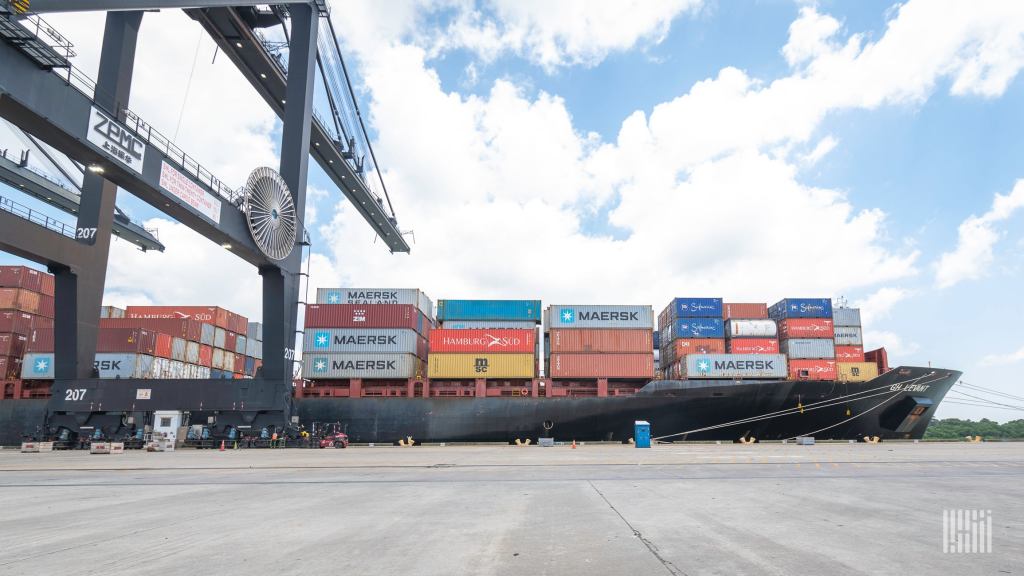
Gulf Coast container imports rose in July, continuing a shift in freight flows among U.S. gateways.
The July figures indicate that U.S. import demand regained seasonal momentum after June’s modest decline following tariff-driven frontloading. But trade-policy uncertainty and prior frontloading continue to affect comparisons with 2025.
Trimble sees freight ‘green shoots’ as transportation revenue rises 5%
Trimble’s transportation and logistics business posted higher revenue and recurring revenue in the second quarter as CEO Rob Painter said the company is beginning to see signs that the prolonged freight downturn may finally be easing.
The technology company also disclosed Wednesday that it has received unsolicited interest from multiple parties in its transportation and logistics business, prompting Trimble’s board and management to launch a strategic review of the unit.
Trimble’s transportation and logistics segment generated $141 million in second-quarter revenue, up 5% organically year over year, while annualized recurring revenue, or ARR, increased 7% to $533 million.
The segment’s operating margin reached 24%, an improvement of 240 basis points from a year earlier.
“After four years of a freight recession, we are seeing initial green shoots in the market,” Painter told analysts during Trimble’s second-quarter earnings call Wednesday before the market opened.
Painter pointed to rising spot rates and tender rejection rates as indications that freight supply and demand are beginning to rebalance. Trimble also reported healthy quarterly bookings in transportation and logistics, which Painter said reinforced the company’s expectations for midterm growth.
Transporeon, Trimble’s cloud-based transportation management platform, grew in the mid-teens during the quarter, according to Painter.
The performance comes as the broader trucking industry continues trying to emerge from a freight downturn characterized by excess capacity, depressed rates and weak carrier profitability.
Trimble (Nasdaq: TRMB) is a provider of technology solutions for trucking companies, freight brokerages and 3PLs. The company also operates in industries such as buildings and infrastructure, geospatial hardware and software, and resources and utilities.
Trimble weighs future of transportation business
Trimble made another potentially significant disclosure for the freight technology sector Wednesday: The company has received what Painter described as “credible inbound interest” in its transportation and logistics business from multiple parties.
Trimble’s board and management, working with longtime financial adviser Goldman Sachs, will conduct a strategic review to evaluate the third-party interest, Painter said.
During the question-and-answer portion of the call, Painter said the interest was recent and originated with prospective outside parties rather than Trimble putting the unit on the market.
“There is no predetermined outcome,” Painter said.
Painter said the transportation and logistics unit is strong, with significant future potential and said Trimble would weigh any outside proposal against the value it believes it can create by continuing to operate the business within the company’s platform.
The review comes as the transportation business has continued expanding recurring revenue despite difficult freight conditions. Trimble’s second quarter presentation shows transportation and logistics ARR increasing to $533 million in the second quarter from $492 million a year earlier.
Trimble pushes AI deeper into freight operations
Trimble is also expanding its use of artificial intelligence across transportation and logistics.
Painter highlighted the launch of ArcAgent, an AI agent designed to consolidate fragmented transportation tasks and automate execution while incorporating enterprise guardrails and human oversight.
Trimble said the technology operates across a global network touching more than 1 million trucks and 1,500 shippers and retailers. The company also said its AI-native autonomous procurement product landed new customers in North America during the quarter.
The company has increasingly positioned AI and connected data as central to its broader strategy, with Painter telling analysts that Trimble is deploying agentic workflows intended to automate tasks and improve customer productivity.
Companywide revenue reaches $972 million
Trimble posted second-quarter revenue of $972 million, representing 10% organic growth and exceeding the high end of the company’s guidance.
Revenue topped Wall Street forecasts of $950.9 million.
Adjusted earnings per share came to 86 cents in the quarter. The results exceeded Wall Street expectations, which called for adjusted earnings of 80 cents per share.
Total ARR reached a record $2.509 billion, up 12% organically. Adjusted EBITDA margin expanded 120 basis points to 28.6%, while non-GAAP earnings per share reached 86 cents, up 21% year over year.
Chief Financial Officer Phil Sawarynski said Trimble generated $502 million in free cash flow through the first two quarters of the year. The company ended the quarter with $214 million in cash and a leverage ratio of 1.1 times.
Trimble also authorized a new $1 billion share repurchase program. The company has repurchased nearly $1.2 billion of shares since the beginning of 2025.
Strong first-half results prompted Trimble to raise its full-year outlook.
The company increased the midpoint of its 2026 revenue forecast by $50 million to $3.925 billion, representing approximately 9% growth, and raised the midpoint of its non-GAAP EPS forecast by 10 cents to $3.65, or roughly 17% year-over-year growth.
Trimble now expects adjusted EBITDA margins of approximately 30%, reaching a profitability target originally set for 2027 one year early.
For the third quarter, Trimble expects approximately $965 million in revenue, 12% ARR growth, adjusted EBITDA margins of 28.6% and non-GAAP EPS of 85 cents.
Trimble Q2 financial highlights
Metric
Q2 2026
Q2 2025
YoY change
Total revenue
$972M
$876M
+10%
Transportation & Logistics revenue
$141M
$133M
+5%
AECO revenue
$389M
$350M
+9%
Field Systems revenue
$442M
$393M
+12%
Adjusted EBITDA
$278M
$240M
+16%
Adjusted operating income
$261M
$223M
+17%
Adjusted EPS
$0.86
$0.71
+21%
Trimble Q2 2026 key financial metrics.
Why it matters: Trimble’s improving transportation results, rising freight-market indicators and unsolicited interest in its transportation and logistics business suggest investors and potential buyers may increasingly see value in freight technology platforms positioned to benefit from an eventual trucking-market recovery.
Prosecutors say a hit man killed a federal witness tied to staged 18-wheeler crashes
A federal court scheduled jury selection Monday in New Orleans for Sean Alfortish. Prosecutors accuse the disbarred attorney of conspiring to kill cooperating witness Cornelius Garrison. The indictment connects that homicide to a sprawling scheme involving purposeful collisions with 18-wheelers. He pleaded not guilty.
The indictment identifies Garrison as a “slammer” who intentionally sideswiped commercial vehicles. He later began cooperating with the FBI during its investigation. Someone fatally shot him at his mother’s home on Sept. 22, 2020. Authorities charged Alfortish and Leon Parker with causing the witness’s death through a firearm.
Prosecutors link killing to staged crashes
Alfortish faces one fraud-conspiracy count, three obstruction charges and four witness-tampering accusations. Prosecutors also charged him with conspiracy to commit murder. Another count accuses both men of causing Garrison’s death through a firearm. That offense carries potential life imprisonment and a $250,000 fine.
Prosecutors claim Alfortish tried to move Garrison to the Bahamas before the shooting. Ryan Harris pleaded guilty in January 2025 to causing death through a firearm. His agreement also covered wire fraud plus a mail-and-wire conspiracy. Authorities previously identified him as a participant in collision staging.
Federal authorities have charged 63 defendants in the broader New Orleans probe. A jury convicted attorneys Vanessa Motta and Jason Giles on March 20 following a three-week trial. Their law firms also received guilty verdicts. Those cases involved staged wrecks, fraudulent lawsuits and insurance payments.
Earlier trial exposed long-running operation
Court documents describe an operation that ran from December 2011 through December 2024. Participants recruited passengers and paid drivers to target 18-wheelers carrying large commercial policies. Lawyers then filed claims seeking payouts for purposeful collisions. Some clients underwent medically unnecessary surgeries to increase settlement values, according to the Justice Department.
WDSU reported that Chief U.S. District Judge Wendy Vitter limited evidence before the proceeding. The court blocked prosecutors from introducing Alfortish’s 2011 conviction. Her ruling permits references to his disbarment. Vitter also excluded Parker’s 2010 arrest but allowed other information involving Harris.
Stephen Waguespack, president of the U.S. Chamber of Commerce Institute for Legal Reform, told FreightWaves:
“What happened in New Orleans should be a wake-up call. The trial is a reminder of just how far these criminal enterprises can go: endangering lives, driving up costs for everyday Americans, and hijacking the legal system. Staged collisions targeting trucks put everyone on the road at risk, and the legislation we’ve been supporting would give federal authorities more tools to crack down on these rings before they evolve the way this one did in Louisiana.”
Case renews focus on federal proposal
U.S. Sen. Ashley Moody, R-Fla., introduced the Staged Accident Fraud Prevention Act in July. The proposal would create specific federal penalties for intentionally causing commercial vehicle collisions. Participants could receive up to 20 years in prison. Serious bodily injury or death would trigger a minimum two-decade sentence.
That legislation did not produce the New Orleans prosecution. Investigators began their work years before Moody introduced her bill. Current charges rely on existing fraud, obstruction, witness-tampering and firearm statutes. Reps. Mike Collins, R-Ga., and Brandon Gill, R-Texas, introduced companion legislation in April 2025.
The FBI, New Orleans Police Department and Louisiana State Police investigated the case. Several parish sheriff’s offices and the Metropolitan Crime Commission provided assistance. Federal prosecutors from Louisiana and the Justice Department handle the trial. Prosecutors must prove every charge beyond a reasonable doubt.
Why it matters
The trial shows how staged-crash schemes can expose carriers to fraudulent claims, legal costs and threats against cooperating witnesses. Transportation professionals should follow how investigators connect collision staging, insurance fraud and organized criminal activity.
Kroger taps digital retail expert to lead e-commerce push
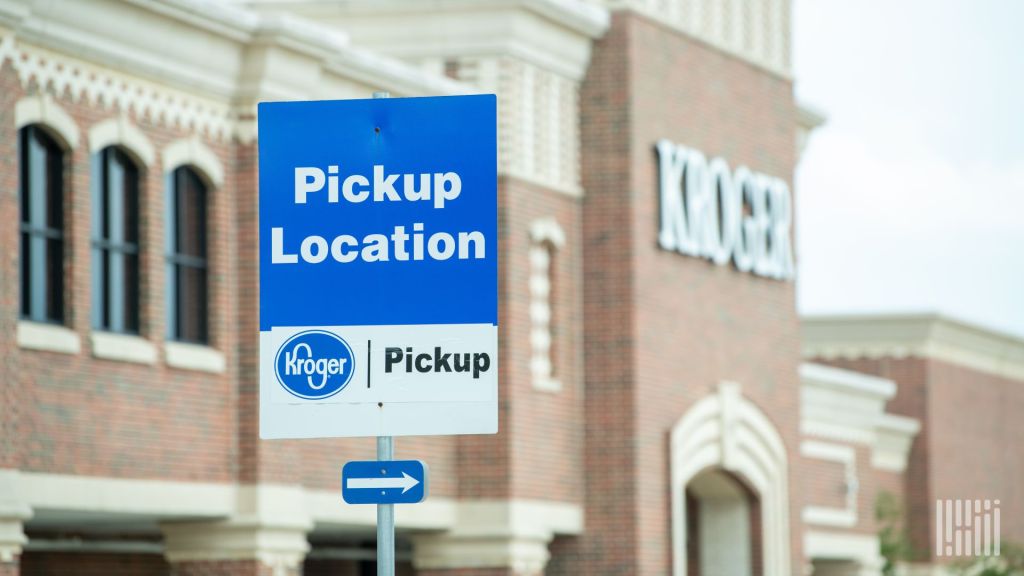
Grocery giant Kroger on Tuesday named former Walmart and startup executive Nate Faust as chief e-commerce officer, with a mandate from new CEO Greg Foran to shake up the company’s digital commerce business, effective Sept. 1.
Kroger (NYSE: KR) said his 20-plus years of experience building and scaling successful e-commerce businesses will help improve the online shopping experience for customers and sales.
Faust co-founded Jet.com, a mass merchandise marketplace, which was bought by Walmart in 2016. As Jet’s chief operating officer, he led first-party merchandising, replenishment, fulfillment and customer service. He also is credited with launching the innovative Smart Cart model that rewarded customers with lower prices for shopping more efficiently. At Walmart, Faust served as senior vice president, U.S. e-commerce supply chain, where he led a multi-year transformation of the customer delivery experience, according to a Kroger news release.
Earlier in his career, Faust was an executive at Diapers.com, where he built what was considered a very fast fulfillment and delivery network for its time — offering free one-and-two-day shipping nationwide and same-day delivery in key markets.
“Nate built businesses that redefined what customers expect from eCommerce, built on speed, value and the experience of getting exactly what the customer ordered,” said Foran. “That is the standard we are holding ourselves to as we grow our digital business.”
Foran was hired as CEO in February. He worked with Faust at Walmart, where he worked for nine years as the CEO of China, Asia and then U.S. operations.
Brittain Ladd, an e-commerce logistics expert, praised the Faust appointment on LinkedIn.
“Foran, has once again proved that he is raising the bar on talent across the company. Foran is also proving that he’s not protecting the status quo, and that he is determined to make Kroger a better company,” he wrote. “Kroger has a massive e-commerce opportunity. Nate is the person who can turn the opportunity into a reality.”
After leaving Walmart, Faust founded Olive, an online shopping site that supported brands like Rent the Runway. He ran the company from 2020 to 2023.
Faust holds an MBA from Harvard Business School and an undergraduate degree from Princeton University.
Ladd surmised that Faust will focus on several initiatives, including leveraging a partnership with AI-powered logistics platform Nash aimed at replacing Instacart, DoorDash and Uber Eats, with Kroger’s own delivery capability. That effort should also involve working with Autolane, which orchestrates autonomous vehicles for pickups, deliveries and rideshares, something Kroger’s biggest competitors are already pursuing.
Kroger also has an opportunity to partner with restaurants and other retailers on a host of online pickup and delivery options, Ladd added.
Faust could also turn Kroger’s retail media into the engine that subsidizes delivery rather than being a separate profit line “that sits next to a struggling fulfillment business. Right now, ad revenue and delivery costs are managed as two different profit-and-loss categories,” Ladd said, pointing to Amazon as an example of how ad revenue directly funds shipping.
Another priority will be figuring out how to improve the strategic relationship with U.K.-based online grocery platform Ocado and how to test purpose-built robots, likely from Blue Collar Robotics, to fulfill online orders from inside stores.
Federal court upholds challenge to FRA’s two-person rail crew rule
A federal appeals court on Tuesday upheld the two-person crew requirement established by the Federal Railroad Administration, turning down industry arguments that the rule adopted in 2024 was arbitrary and capricious and represented regulatory overreach.
In a 93-page, 2-1 decision, the U.S. Court of Appeals for the 11th Circuit turned down the challenge by the Association of American Railroads, American Short Line and Regional Railroad Association, and six railroads, saying “none of the railroads’ arguments have merit.”
The International Association of Sheet Metal, Air, Rail and Transportation Workers-Transportation Division – which was granted status to take part in the case – hailed the ruling as “a major victory for railroad safety.”
SMART General President Michael Coleman said, “The court’s decision reinforces what SMART-TD members and rail workers already know: having two qualified workers on a train crew is just common sense. It’s about safety, security and the well-being of workers and communities nationwide.”
The AAR and ASLRRA said they are reviewing the decision and considering their options. The Brotherhood of Locomotive Engineers and Trainmen indicated in a message to Trains that it would have a reaction later today. BNSF (NYSE: BRK-B) and Union Pacific (NYSE: UNP) deferred to the AAR for comment. Trains has also asked the FRA for a comment.
Decision denies seven industry arguments
The decision organized the multiple challenges into two groups of arguments. One set came from challenges by the AAR, BNSF, UP, Florida East Coast Railway, and the Indiana Rail Road, raising five separate objections. The other includes the ASLRRA, Texas & Northern Railway, and Nebraska Central Railroad, and raised two other issues.
The decision, authored by Judge Robin Rosenbaum and supported by Judge Embry Kidd, turned down all of those arguments.
Included in the arguments from the first group, labeled the AAR petitioners:
The AAR argued the statute authorizing the FRA to make rules “as necessary” requires an action to be “essential” to safety. The court found the rule fell within the FRA’s general rulemaking authority, and the “as necessary” language implies discretion to act.
The AAR contended the rule was arbitrary and capricious because it reversed a 2019 decision that evidence did not support a two-person crew rule, and because it did not address a National Transportation Safety Board recommendation that would have gathered more data. Noting that the 2019 decision withdrawing a two-person rule was struck down by a lower court, the decision says the court does not see “how a judicially invalidated action leaves anything that constitutes agency policy.” And it says the AAR misread the NTSB recommendation, saying the safety agency “never urged the FRA to refrain from regulating crew size without first collecting more accident data.”
The AAR also argued the rule was arbitrary and capricious because it did not fully consider the costs of the rule in terms of savings lost by not allowing one-person operation, and noted a different, higher cost estimate for an earlier version of the rule in 2016 than the one adopted in 2024. The court found that the new rule allows for one-person crews through a special approval process, and so “it’s no surprise if that difference shows up as a lower cost estimate.”
The AAR argued the rule conflicts with the “risk reduction program” of the Rail Safety Improvement Act of 2008, which the court described as a program broad in addressing the aspects of a railroad that impact safety. “Nothing in this statute poses an impediment to the Crew Size Rule,” the court says.
The AAR group asked that the rule be vacated because the FRA took more than a year to be finalized, citing a congressional directive that rules be disposed of “not … more than 12 months after the date it begins.” The court cited two decisions by the D.C. Circuit that declined to vacate FRA rules for the same reason, under a Supreme Court decision that says that if a statute does not specify a consequence for non-compliance with a time limit, “the federal courts will not in the ordinary course impose their own coercive sanction.”
Regarding arguments raised by the ASLRRA and two shortlines, the decision:
Says the group forfeited its arguments that the rule was arbitrary and capricious for establishing a two-year threshold for “legacy status” allowing continued use of one-person operation, and that it was “arbitrarily vague” about whether a change in railroad ownership changes that status, by not addressing either point during the rulemaking process. A further argument says the rule is arbitrary and capricious for allowing railroads with that legacy status to handle hazardous materials with a one-person crew, while requiring others to request special approval. But the court found “the FRA considered the relevant factors and reasonably explained its decision – all the APA [Administrative Procedure Act] requires.”
The rule’s requirement that all locomotives operated by a one-person crew have an alerter, which will stop the train if an engineer is non-responsive, is a change from an earlier rule that only required alerters on locomotives operating above 25 mph. But the court found that the agency had met the requirement to explain such a change, and “provided good reasons” for the policy.
The third member of the three-judge panel, Judge Elizabeth Branch, wrote in a 28-page dissent that she would have struck down the rule as arbitrary and capricious for two reasons. She found it changed a prior position without adequately explaining the change, and did not adequately consider the rule’s cost.
Rosenbaum is a 2014 appointee of President Barack Obama, while Kidd is a 2025 President Joe Biden appointee. Branch is a 2018 appointee of President Donald Trump.
The path to the rule
The FRA issued the 223-page final version of the two-person crew rule in April 2024, providing an exception for operations it said “do not pose significant risks to railroad employees, the public, or the environment.”
“Common sense tells us that large freight trains, some of which can be over 3 miles long, should have at least two crew members on board – and now there’s a federal regulation in place to ensure trains are safely staffed,” then-Transportation Secretary Pete Buttigieg said. The AAR criticized the rule as “unfounded and unnecessary.”
The rule was first proposed in 2016, but was withdrawn in 2019 during the first Trump administration, with Ron Batory, then FRA administrator, saying the rule was unnecessary. While public comment was significantly in support of the rule, Batory said the anecdotal evidence in those comments was outweighed by information supplied by the industry group. He cited a study by consulting firm Oliver Wyman, commissioned by the AAR, that found no concrete evidence that trains with two-person crews were safer than those with just one.
But the rule was revived in 2022, during the Biden administration, with then-FRA Administrator Amit Bose, saying longer trains “require a level of crew size that is proportional to the length of the train.” Train length has increased as railroads adopted the Precision Scheduled Railroading operating model. Bose said “having more than one person … is to the benefit of the community, if safety issues arise.”