Using telematics data and reporting to improve fleet safety and culture

An evergreen challenge for fleets is developing trust between not only drivers and fleets but between fleet operations and safety departments. The rise in technology and innovations in fleetwide telematics capabilities is creating new possibilities for fleets that historically have been reactive when it comes to developing safety programs. 

Erin Baucum, director of client intelligence and analytics at Lytx®, spoke with FreightWaves about what fleets should consider when pairing safety with technology. For Baucum, the biggest challenge is first understanding the role safety plays in a fleet’s success.

To get the right data, she works with Lytx’s clients to create customizable data-reporting solutions and dashboards that blend telematics hardware inputs with information about driver behavior for a holistic view of the fleet’s safety.

For fleets struggling with higher insurance premiums, failing to keep up with these trends can mean the difference between success or bankruptcy in the form of nuclear verdicts or revocation of operating authority.

More safety data places more pressure on fleets

To highlight the growing safety risks for fleets, Lytx recently released a report leveraging 40 billion miles of driving data collected from its devices in 2023. Lytx’s “2024 State of the Data Report” showed more vehicles are creating more risk but that companies that implement a fleetwide safety program are seeing better results than those that are unprepared. 

Brandon Nixon, chairman and CEO of Lytx, said in the report that “despite an overall rise in road risk, our data indicates that companies that have implemented fleet safety programs are seeing the results across a number of success metrics – from lower claims costs and more efficient fuel use to improved collision avoidance.” 

One way fleets can address risk is understanding the riskiest times of the day to drive. Commute-hour risk is significantly different in the morning versus the afternoon. Despite similar congestion patterns, 4-7 p.m. commute hours are three times riskier than 5-8 a.m. commute times.

Risky driver behaviors is another area where clear trends appear. Among the 10 riskiest driving behaviors in the report, Lytx noted following too closely – by greater than 1 second but less than 2 seconds – remains the top challenge, followed by using a handheld device and not wearing a seat belt. 

Larger cities mean more vehicles and higher risk for accidents. Among the five riskiest U.S. cities for driving, New York was No. 1, followed by Los Angeles, Chicago, Atlanta and Boston. 

Using reports and data to coach and develop drivers

Baucum notes it’s important to take this voluminous data from many sources and build a story around it. Raw data needs to be analyzed, cleaned and then put into appropriate context if decision makers are to use it. Setting up reporting that describes or highlights the story is a first step.

Within the Lytx application, there’s a driver’s report that is accessible and lets users see which drivers are contributing the most risk. It’s powerful information and helps fleets guide coaching conversations and highlight specific risky behaviors.

Fleets can also use longer-term management-level reports. This data helps determine if there are trends or specific driver behaviors and can help fleets assess whether their coaching strategies are reducing unsafe behaviors.

Finally, the executive management reports and tools give fleets the ability to benchmark groups or business units against one another. For instance, a fleet may notice trends based on region, terminal, driver manager or division. The flexibility and customization of these reports have been used by some customers to prepare monthly safety meetings, where regional managers present and talk about their specific metrics and safety campaigns.

When looking at risky behaviors, the data does not follow a normal distribution but instead follows a power law dynamic. From Baucum’s experience working with clients using Lytx data, 20% of drivers were contributing 80% of a fleet’s risk. 

The challenge for fleets is twofold: Identify, coach and develop that 20% of riskiest drivers while highlighting the positives and celebrating good driving behaviors. This can be tricky, as conversations with drivers on their driving behaviors can quickly get bogged down if fleets do not have the right data and fleet-reporting capabilities. On the flip side, fleets often overlook or fail to acknowledge the positive impacts of good driving behaviors. 

Using custom reports for managers and executives is quickly becoming table stakes for fleets when they tackle these two challenges. An added benefit for identifying good behaviors is it allows fleets to learn from those drivers who are the safest, highlight their process and then share it within the organization to develop a positive safety culture. 

Operations and safety go hand in hand

Having the reporting and data is the first step, but for fleets on the road, operations managers and safety specialists are often in separate roles. Large fleets can quickly get stuck in information silos where day-to-day business needs are not directly in sync with the goals of the safety department.

For Lytx, the quality of safety alerts is more important than the quantity, because drivers can quickly get frustrated by a barrage of notifications while driving. Modern tractors are equipped with various sensors in addition to the telematics and ELD devices. The result can be a nonstop symphony of lane, speed, distance and braking alerts all using unique tones or driver voice reminders. 

The right alerts must be given at the right time if you want to build trust and a safety culture. 

“Correcting behavior helps you not only avert risk but it also improves operations. But mostly it builds trust: You’re retaining drivers. They’re feeling more comfortable. Coaching isn’t used as a tool to defeat them but as a tool to help them get better,” said Baucum.

This trust must also exist between not only drivers and the company but between safety and operations departments. Fleet utilization goals hinge on getting the most value from drivers’ time, but unsafe drivers can quickly tank fleet utilization goals if they’re placed out of service or suspended for unsafe driving behaviors.

At the end of the day, Baucum believes those fleets that succeed are those that pair reporting with accountability to build trust. For Baucum and the Lytx clients she works with, fleet safety is more than a priority. It’s a responsibility.

To learn more, visit lytx.com.

Illinois trucking company, brokerage file for bankruptcy liquidation

A 36-year-old Illinois trucking company and brokerage ceased operations recently and filed for Chapter 7 bankruptcy liquidation.

B.T. Trucking Inc. of Broadview, Illinois, doing business as Blue Thunder Trucking, and its three affiliated companies — B.T. Transportation Group Inc., JPL Transport Inc. and Rysoti Inc. — filed for Chapter 7 liquidation on July 19 in the U.S. Bankruptcy Court for the Northern District of Illinois.

At the time of its closure, Blue Thunder had 75 drivers and the same number of power units, according to the Federal Motor Carrier Safety Administration’s SAFER website. 

The petitions for the four entities list Michael J. Irwin as president and founder.

The trucking company’s website, which has since been taken down, stated that Irwin founded Blue Thunder Trucking in 1988 with 35 owner-operators and 50 trailers. At one time, the family-owned regional and over-the-road fleet, which hauled general freight, operated 130 tractors and had 220 trailers, according to the companies’ social media pages.

No reason was given as to why Irwin and his companies filed for Chapter 7. The entities are represented by bankruptcy attorney Joel A. Schechter of Chicago. As of publication time Thursday, neither Schechter nor Irwin had responded to FreightWaves’ request for comment.

Based on FMCSA data, Blue Thunder Trucking was granted its common and contract carrier authority in 1988.

Prior to its closure, the company’s trucks had been inspected 65 times, and 28 had been placed out of service for a 43% out-of-service rate over the preceding 24-month period. That is nearly double the industry’s national average of around 22.3%, according to FMCSA.

The company’s drivers had been inspected 138 times, and 11 were placed out of service over a two-year period, resulting in an 8% out-of-service rate. This is slightly higher than the national average of about 6.7%.

In the past two years, Blue Thunder  trucks had been involved in six injury crashes and five tow-aways.

Blue Thunder’s insurance was canceled July 1, and its common and contract authority was involuntarily revoked on July 8, according to FMCSA.

The company listed its assets as between $100,000 and $500,000 and liabilities as between $1 million and $10 million, according to the petition. Blue Thunder states that it has up to 199 creditors. While the petition includes a list of its creditors, the filing did not include the claim amounts the companies are owed.


B.T. Transportation Group

In its petition seeking Chapter 7, B.T. Transportation Group of Broadview, formerly known as B.T. Truck Brokerage, states that it has up to 199 creditors. The petition lists both its assets and liabilities as between $100,000 and $500,000. As with the Blue Thunder petition, B.T. Transportation includes a mailing list of creditors but doesn’t include the amounts it owes to more than 100 trucking and logistics companies that hauled B.T. Transportation’s freight.

According to FMCSA, the brokerage’s authority was granted in April 1997, and its surety bond was canceled last Saturday, a day after it filed for bankruptcy.

JPL Transport Inc.

The trucking company listed its assets as up to $50,000 and liabilities as between $50,000 and $100,000. JPL Transport’s petition states that it has up to 49 creditors. 

Its petition, which seeks liquidation, lists 17 former employees, including Michael J. Irwin, his wife, Linda Irwin, and their son, Ryan Irwin, as creditors in the bare-bones petition. No amounts were given as to how much the ex-employees are owed.

JPL Transport received $1.5 million in U.S. Small Business Administration Paycheck Protection Program (PPP) loans from Beverly Bank & Trust Co. to make payroll to save 137 jobs, according to ProPublica’s PPP tracking database. About $1.1 million of that was forgiven.

Irwin is listed as the president, secretary and director of JPL Transport, according to its most recent business entity filing in April on the Illinois secretary of state’s database.

JPL Transport received its PPP loan during the first round of funding of the CARES Act in April 2020 to help businesses stay afloat during the COVID-19 pandemic. 

Prior to the 3PL’s website being taken down, Irwin said he had 30 employees, “including sales, dispatch, safety, administration and a full clerical staff” at his facility, which encompassed 25,000 square feet of office and warehouse space. The site also had “three acres of parking area for our 250 trailers and power units based in the Chicago area,” according to the website.

Rysoti Inc. 

The company listed assets of between $100,000 and $500,000 and liabilities as between $1 million and $10 million. Rysoti has up to 49 creditors.

U.S. Bankruptcy Judge David D. Cleary has given the entities until Aug. 2 to submit their schedules of assets and liabilities as well as their statements of financial affairs. The four Chapter 7 petitions state that no funds will be available to unsecured creditors after administrative expenses are paid.

Cleary has set a creditors meeting for Sept. 5.

Do you have a news tip or story to share? Send me an email or message @cage_writer on Twitter. Your name will not be used without your permission.


2 Miami trucking companies file for bankruptcy protection
SEC charges 2 executives in $112M trucking Ponzi scheme

FreightWaves Infographics: Hurricane Beryl: Kicking off the 2024 Hurricane Season with a Bang


To view more FreightWaves infographics, click here

FedEx to cut daytime domestic flight activity by 60% 

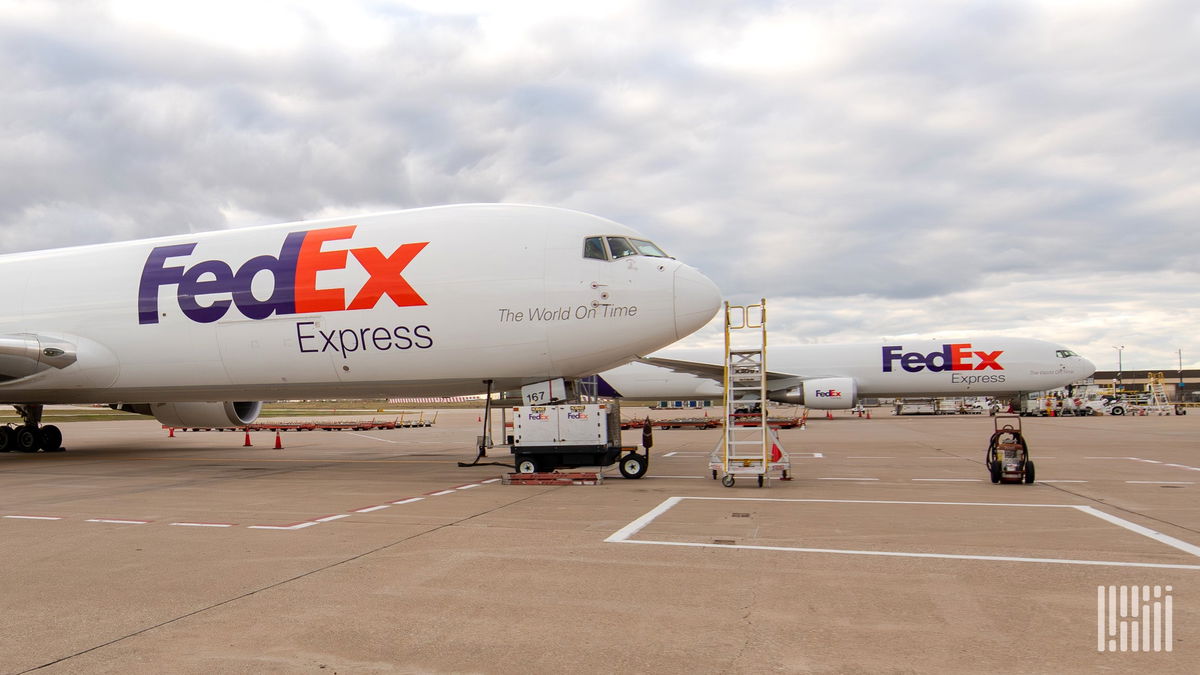
Purple-tailed FedEx planes parked in the background as another jet rolls down the taxiway.

(UPDATED at 2 P.M. ET with comments from the Air Line Pilots Association)

FedEx Corp. plans to slash daily flights and the number of U.S. cities served by air during the daytime when its air cargo contract with the U.S. Postal Service expires on Sept. 29, resulting in significant pay cuts for pilots, senior managers informed crews this week.

Shedding daytime flying capacity in response to the lost postal business is part of a broader FedEx (NYSE: FDX) initiative to boost corporate profits that includes restructuring airline operations to align with lower parcel demand and improve efficiency.

The parcel logistics giant will reduce daytime domestic flying time by 60% and the number of city destinations by 55%, which will add about 500 pilots to the existing surplus, said Justin Brownlee, senior vice president for flight operations and network planning, in a letter to airline workers obtained by FreightWaves. No pilots will be hired for the foreseeable future, he added.

The company now has 5,500 pilots, down from 5,800 at the start of the year. With the workforce redundancy, remaining flight hours will be divided up among the entire cohort, resulting in a “significant” reduction in the minimum number of flight hours guaranteed to pilots starting in October, Brownlee told the flight team.

The Postal Service in early April selected UPS (NYSE: UPS), instead of incumbent FedEx, as its air cargo carrier for the next 5 1/2 years. The last day FedEx will provide service to the Postal Service is Sept. 29, but the company has already been scaling back flights as the agency transitions volumes to UPS. FedEx recently said losing the Postal Service business will drag down operating income by $500 million in the current fiscal year.

Lower postal volumes left FedEx with surplus equipment for its daytime air network and higher operating costs per unit. Management previously said the Postal Service contract wasn’t making money. Postal revenue in the fiscal year ending Sept. 30, 2022, fell $236 million to $1.9 billion and was expected to continue decreasing. The contract previously generated annual revenue of at least $2 billion.

Equity research analysts argued that FedEx’s airline was much bigger than necessary, partly because of commitments to fly postal shipments during the daytime in addition to its overnight express operation.

FedEx officers earlier this year said expiration of the Postal Service contract gives them more flexibility to reorganize the daytime air network because aircraft won’t be dedicated to a single customer.

Pat DiMento, vice president flight operations and training, provided pilots more details about the network changes in a follow-up memo, also shared with FreightWaves. The route map in October will go from 75 to 28 cities served – a 63% reduction versus the 55% mentioned by Brownlee, with daily flight trips in an average week falling nearly two-thirds. Cities losing daytime service include Atlanta; Austin, Texas; and Baltimore. Weekly flight hours will tumble from 2,945 to 1,203 (down 60%). Airbus A300 freighters, for example, will experience an 81% reduction in weekly daytime flight legs while Boeing 767 trips will be cut 70%, going from nearly 700 to 209 per week.  

Executives stressed that the tentative October schedule was released now to give flight operations personnel pertinent information as early as possible, but that adjustments could still be made. 

“The above plan will likely change as we settle into the new system form and other business opportunities develop. Our company is rapidly moving towards the network efficiencies that will ensure we remain the leader in the incredibly competitive cargo and logistics industry. We appreciate the significant impact these changes will have on your schedules and value your commitment to FedEx as we navigate these changes together,” DiMento wrote.

Despite the reduced daytime flying, FedEx expects to maintain fleet size at current levels because the number of aircraft is primarily dictated by the priority overnight network and the company is working to attract other cargo business, Brownlee said.

“In preparation for the conclusion of our air freight contract with the United States Postal Service, we have begun implementing adjustments to network operations that support postal volume. These adjustments include a reduction in daytime flight hours,” said Caitlin Adams Maier, FedEx’s director of public affairs, in a statement to FreightWaves. “As we transform our network and operations for the future, we remain committed to delivering world-class service to our customers around the world while providing outstanding service to the USPS through the contract’s completion in September.”

Pilots have made substantially less money the past year because they share a smaller pool of flying assignments. No progress has been made on a new labor contract since June 2023, when members of the pilots’ union rejected a tentative contract. Negotiations remain in federal mediation. Company officials have privately suggested that a new ratified contract would incentivize pilots to retire, which would help address overstaffing.

The Air Line Pilots Association, which represents the FedEx pilots in collective bargaining, urged management to resolve the contract talks so that the business transformation can fully achieve the desired financial outcome.

Brownlee’s comments that aircraft count will stay the same while overstaffing levels increase “are contrary to one another and conveniently ignore the negative impact of the Drive and Tricolor [restructuring] on our pilots. We are certainly wondering how exactly management intends to implement Network 2.0 and Tricolor with a misaligned crew force,” said Jose Nieves, chair of ALPA’s FedEx Master Executive Council in a message to members and the company.

Fleet plan

The airline’s mainline fleet has shrunk from 417 aircraft in fiscal year 2022 to 389 as more aircraft are put out of service than are being added to modernize the fleet. FedEx last quarter permanently retired 22 Boeing 757-200 freighter aircraft as part of the downsizing effort. The older 757s were expendable because they are less fuel-efficient than other planes operated by FedEx, which still has 92 of the narrowbody freighters in the fleet. The company also retired nine MD-11s in the fiscal year ending May 31 and plans to phase out the tri-engine aircraft by mid-2028, subject to changes in customer demand. 

FedEx last year received 14 freighter aircraft from Boeing (four 777s and 10 767-300s medium widebodies). The company is scheduled to take delivery of two factory-built 777 freighters in the next 12 months and 14 B767s over the next two years, according to its latest statistics.

Meanwhile, as part of the new effort to consolidate the Express and Ground networks into one integrated system, FedEx in late January began repainting mainline cargo jets to present a unified brand, said Brownlee. That means aircraft will no longer show Express markings. The new paint scheme, which features a larger logo and different positioning to reflect a more modern look, has been applied to 18 freighters so far.

Tricolor drive

FedEx is now implementing its Tricolor strategy for streamlining its global air network with the goal of segregating the fleet according to various product categories and demand. Brownlee said new flights are being added to the Orange network to accommodate nonparcel cargo growth.

The so-called Purple network is geared toward international customers willing to pay the most for the fastest speeds using dedicated aircraft that are well timed to go overnight into FedEx hubs for next-day delivery. Fewer large freight shipments will be mixed in to maximize density on aircraft and sorting efficiency, executives explained in the spring.

Orange-designated flights will operate during the daytime and focus on priority international freight. Management describes this deferred air network as an extension of its European and U.S. less-than-truckload networks, designed to attract high-yield freight, such as pharmaceuticals, perishables, electronics and automotive components, that is more profitable per pound than heavier, general consignments. FedEx says it will mix in deferred parcels to fill out the aircraft.

FedEx is reorganizing air operations to ensure planes are as full of packages and other cargo as possible. (Photo: Jim Allen/FreightWaves)

The White network will handle e-commerce and other low-priority shipments, much of it processed through the company’s freight forwarding arm, FedEx Trade Networks. Those loads will utilize the belly space of commercial passenger aircraft operating between major international gateways that can be integrated into the FedEx Ground network in the U.S.

Starting in September and October, FedEx will add a Boeing 777 route between Liege, Belgium, and its regional hub in Oakland, California; a route connecting Miami, Guatemala City and San Pedro Sula, Honduras, operated with a Boeing 757 freighter; and a Miami-Buenos Aires-Santiago, Chile-Quito, Ecuador-Miami route with a Boeing 767, according to Brownlee’s letter.

In addition to those routes, the logistics integrator is expanding the Orange network in the Asia, Middle East and Africa operating out of a hub in Guangzhou, China. FedEx in early June also launched an MD-11 route from Guangzhou to Newark Liberty International Airport in New Jersey, with stops in Tokyo and Anchorage, Alaska, and bypassing the global hub in Memphis, Tennessee.

“This route provides parcel and freight growth opportunities by directly connecting the East Coast and Asian markets while improving service levels by removing unnecessary touch points in our U.S. domestic network, which prevents more congestion” in Memphis, said Brownlee.

He also disclosed that FedEx launched an intra-China flight between Guangzhou and Beijing utilizing a Boeing 737 freighter operated five times per week by Tianjin Air Cargo. As a foreign airline, FedEx does not have regulatory authority to operate the flight itself. Brownlee said the flight strengthens FedEx’s position in the China market and “provides freight growth opportunities by feeding additional volume into the global international air network” without displacing any company aircraft.

Tricolor is part of a comprehensive restructuring program launched two years ago to strengthen profits after the pandemic surge wore off, specifically aimed at reducing redundant infrastructure and associated costs.

The Drive initiative to take out $4 billion in structural costs by mid-2025, coupled with pickup and delivery efficiencies from a new consolidation of separate operating companies into one organization, has helped achieve four consecutive quarters of operating income and margin expansion despite revenue declines.

FedEx’s adjusted operating profit increased 5.6% year over year to $1.9 billion last quarter on a 1% gain in revenue, underscoring the company’s progress in containing costs amid soft market conditions. It was the first time FedEx had year-over-year revenue growth after six quarters of declines.

The company achieved $1.8 billion in structural savings last year and is targeting an additional $2.2 billion in savings from its transformation program in fiscal year 2025. 

(Correction: An earlier version of this story incorrectly said FedEx has 1,200 excess pilots. The overage is well below that as the pilot ranks have come down this year through attrition.)

Click here for more FreightWaves/American Shipper stories by Eric Kulisch.

FedEx retires one-fifth of Boeing 757 freighter fleet

UPS wins air cargo contract with Postal Service, replaces FedEx

FedEx explores divestment of Freight business

TFI International Q2 2024 highlights

TFI International saw an increase in operating income, it reported in its second-quarter results after market close Thursday. The increase is due to acquisitions, offsetting weaker market conditions. This suggests that the company’s acquisition strategy is successful in expanding its business and generating revenue.

Despite the positive contributions from acquisitions, TFI International also faced weaker market conditions in Q2 2024. This resulted in a slight decrease in net income compared to the same period last year. This indicates that the overall market environment may be challenging for the transportation industry.

Net income declined compared to the same period last year, but adjusted net income and earnings per share increased. The company generated substantial cash from operations and free cash flow, allowing for debt repayment.

Overall, TFI International’s Q2 2024 performance demonstrates the company’s ability to navigate a complex market environment. While acquisitions provided a boost, weaker market conditions posed some challenges.

Paris Olympics will be a true test of supply chains

The views expressed here are solely those of the author and do not necessarily represent the views of FreightWaves or its affiliates.

By Bart De Muynck

The opening ceremony for the Summer Olympics in Paris takes place Friday. Thousands of athletes and millions of visitors will spend part of their summer in France to attend the 2024 Games. The past few years, supply chains have looked like an Olympic marathon or sometimes even like a 3,000-meter steeplechase race lined with obstacles.

Besides the complexity of organizing such a massive gathering with 329 events across 32 sports over just 16 days, the 2024 Olympics are expected to significantly impact global supply chains, both positively and negatively. On the one hand, the event is forecast to boost demand for various goods and services, leading to increased production and transportation activities. On the other hand, the influx of people and goods into France will put a strain on existing infrastructure and logistics networks, potentially leading to disruptions and delays.

The Olympics have already created and will continue to create a surge in demand for various products and services, including construction materials, food and beverages, hospitality services, and sporting goods. This increased demand can stimulate economic activity and create opportunities for businesses in the supply chain. The preparation for the Olympics has involved significant investments in infrastructure. Seven billion euros in private funding was invested in long-term infrastructure projects such as transportation networks, stadiums and accommodations. These investments will lead to long-term improvements in logistics capabilities and overall economic development in Paris.

But there are also many challenges and disruptions, as already witnessed by many tourists who are just visiting Paris in the days ahead of the Games. The influx of people and goods into France for the Olympics will lead to congestion at ports and airports and on roads, causing delays and disruptions in the movement of goods. This affects the timely delivery of essential supplies and equipment for the event. Working closely with the Organizing Committee of the Paris 2024 Games since February 2023, CMA-CGM Group and its subsidiary Ceva Logistics are offering a full range of logistics transport solutions for the event. The partnership includes freight services, international transport of goods, customs clearance, storage, delivery, site logistics, special freight and IT systems integration.

Major events like the Olympics often face security threats, which can necessitate heightened security measures and additional checks. This can lead to delays in customs clearance and transportation, impacting overall supply chain efficiency.

The environmental impact of large-scale events like the Olympics is a growing concern as well. Increased transportation activities and waste generation can contribute to carbon emissions and other environmental issues. The organizers of the Olympics plan to power the events’ operations with 100% renewable energy from wind and solar. They are using existing venues, when possible, had new ones built with low-carbon concrete and recycled materials, and brought in thousands of seats made of recycled plastic. This focus on sustainability goes back to 1996, and in 2012, the London Olympics pioneered a new international certification standard, ISO2012, which provides guidelines for any large event to make more sustainable choices, from construction to catering. All furniture and temporary buildings approved for the Games also must have a contractually guaranteed second life, rather than going into a landfill. Further, the Paralympics, which will run from Aug. 28 to Sept. 8, will use the same venues and housing.

Upfront planning and the use of technology can help companies offset the challenges and disruptions caused by such a large event. Proactive planning and coordination with suppliers, carriers and other stakeholders can help identify potential bottlenecks and develop contingency plans. Utilizing advanced technologies like AI, machine learning and real-time tracking can enhance visibility, optimize routes and improve overall supply chain efficiency. Reducing reliance on single suppliers and diversifying supply sources can mitigate the impact of disruptions in specific regions or industries. Implementing sustainable logistics practices, such as optimizing routes, using low-emission vehicles and reducing waste, can help minimize the environmental impact of the event.

The 2024 Olympics present a unique challenge for global supply chains. By anticipating and proactively addressing these challenges, organizers and logistics providers can ensure the smooth and successful execution of the event while minimizing disruptions to the global supply network. But don’t let that keep you from watching the Summer Olympics together with over 1 billion people around the world, and let’s cheer for the U.S. team.

Bart

About the author

Bart De Muynck is an industry thought leader with over 30 years of supply chain and logistics experience. He has worked for major international companies, including EY, GE Capital, Penske Logistics and PepsiCo, as well as several tech companies. He also spent eight years as a vice president of research at Gartner and, most recently, served as chief industry officer at project44. He is a member of the Forbes Technology Council and CSCMP’s Executive Inner Circle.

California Supreme Court upholds AB5 exemption for gig workers

Uber and Lyft drivers in California will continue to be protected from the state’s AB5 independent contractor classification law following a decision by the state’s Supreme Court. The ruling possibly ends a legal battle that has gone on almost since November 2020 when California voters approved Proposition 22, creating the gig drivers’ exemption. 

In a unanimous decision, the California Supreme Court ruled that the workers’ compensation provision of Prop 22 were not illegal and the gig driver exemption could remain law. The issues in the case were complex, relating to whether the workers’ comp provision in Prop 22 were illegally enacted given other laws that appeared to give full authority over workers’ compensation to the State Legislature.

Prop 22 established that gig drivers such as those who work for Uber (NYSE: UBER) and Lyft (NASDAQ: LYFT) were not covered by the state’s workers’ compensation laws. But as the court recounted, the plaintiffs who brought the lawsuit against Prop 22, which includes the Service Employees International Union, argued that the workers’ compensation provision in Prop 22 “conflicts with … the California Constitution, which vests the Legislature ‘with plenary power, unlimited by any provision of this Constitution, to create, and enforce a complete system of workers’ compensation, by appropriate legislation.’”

In March 2023, the Court of Appeals for the 1st Appellate District reversed part of the August 2021 decision that Prop 22 was unconstitutional, citing the issues regarding workers’ comp. The case was then appealed to the Supreme Court, which handed down its ruling Thursday.

The initiative power in California, which is what was used in the Election Day 2020 vote that approved Prop 22, includes “the power to abrogate existing [laws],” the court said, citing an earlier precedent. “Accordingly, the people may alter existing workers’ compensation policy without running afoul of article XIV, section 4.”

The Supreme Court agreed with a lower court ruling that the law “does not … limit the legislature’s power to enact workers’ compensation laws.”

AB5, enacted in 2019, establishes legal definitions of when a worker can be considered an employee or when the worker is legitimately an independent contractor.

ABC test is the core of AB5

It has at its heart the ABC test, a three-pronged guideline that says a worker can be considered independent if:

  • The worker is free from the control and direction of the hiring entity in connection with the performance of the work, both under the contract for the performance of the work and in fact.
  • The worker performs work that is outside the usual course of the hiring entity’s business.
  • The worker is customarily engaged in an independently established trade, occupation or business of the same nature as that involved in the work performed.

The B prong has proved particularly problematic for independent owner-operator truck drivers and gig drivers, since the entities they provide their services for are transportation companies and they are providing transportation while being classified as independent. No exemption from AB5 has been granted to independent owner operators.

In a prepared statement, the Uber- and Lyft-based group Protect App Based Drivers + Services called the decision an overwhelming victory for voters’ rights and the integrity of our state’s initiative system.”

The statement, quoting spokeswoman Molly Weedn, said the decision is “not just a win for the nearly 1.4 million drivers who rely on the flexibility of app-based work to make ends meet, but for millions of consumers and thousands of businesses who rely on app-based services across the state. The courts have spoken, and this issue can finally be put to rest.”

What Prop 22 does say about workers’ comp

Prop 22 did call for some degree of compensation for injuries or illnesses on the job, according to a blog post by the law firm of Boxer & Gerson before the 2020 vote.

In the post signed by Julius Young, the law firm said Prop 22 “provides that the companies must maintain occupational accident insurance to cover medical expenses and lost income ‘resulting from injuries while the app-based driver is online with a network company’s online-enabled application or platform.’”

But Young added that the proposition did not define what constitutes injuries.

He also noted the limits of the coverage specified in Prop 22. “Prop 22 would require occupational insurance cover medical expenses incurred only up to one million dollars,” Young wrote. “While this might seem like a big number, in catastrophic injury claims medical bills can sometimes exceed one million dollars. If  a worker has a long hospitalization, multiple surgeries, a long period of rehabilitation, and followup care over a period of years, bills can be astronomical.”

Young summed up his post by noting he was voting against Prop 22.

The Prop 22 case put the state of California in the odd position of defending an action meant to limit AB5 while at the same time defending AB5 in the still-ongoing California Trucking Association case against the law. But the state’s position is to defend the people, who had voted on Election Day 2020 in favor of Prop 22, which had been backed and financially supported by Uber and Lyft.

More articles by John Kingston

Backed by big companies and labor, Supply Chain Council debuts

Victory for a 3PL again — TQL — in case involving broker liability

California’s forklifts were going zero-emission even before latest mandate

Declining coal volumes can’t sink Union Pacific’s second quarter results

This story originally appeared on Trains.com.

OMAHA, Neb. – Union Pacific’s profits rose in the second quarter despite a sharp drop in coal traffic.

“When you remove coal, our total volume was up 3% in the second quarter. This demonstrates that even in a tough freight environment, we are winning with our customers to bring new business to the railroad,” CEO Jim Vena said on the company’s earnings call on Thursday morning.

Quarterly operating income increased 9%, to $2.4 billion, as revenue grew 1%, to $6 billion. Earnings per share rose 7%, to $2.74. UP’s operating ratio improved 3 points, to 60%.

“Despite a challenging environment, we achieved strong financial results in the quarter,” Vena says. “We continue to drive efficiency into the network, and the commercial team has done a good job generating price for the value we provide our customers.”

Overall, UP’s volume for the quarter was flat compared to a year ago. Bulk traffic declined 5%, due to a 23% drop on coal traffic as natural gas prices remained low and utility coal stockpiles remained elevated. Industrial products volume declined 3%. Premium traffic – which includes intermodal and automotive – was up 6% due to a combination of international and domestic intermodal growth and landing new auto contracts from Volkswagen and General Motors.

UP slightly downgraded its outlook for the rest of the year. The railroad now said its volume expectations are uncertain based on economic indicators and weak coal demand. Previously UP expected muted traffic volumes this year.

The railroad’s key operational metrics held steady despite the impact of flooding in both its southern and northern regions.

“Our service was challenged in the quarter, but I’m pleased with our ability to recover,” Vena says.

Freight car velocity was flat at 201 car miles per day. The manifest and automotive service performance index was flat at 84%. But the intermodal service performance index rose 4 points to 93%.

UP’s locomotive and workforce productivity metrics improved for the quarter. UP set an average train length record for the quarter, at 9,544 feet, which included a highest ever monthly figure above 9,600 feet in June, says Eric Gehringer, executive vice president of operations.

Gehringer praised UP’s maintenance of way teams for quickly rebuilding flooded track, repairing bridges, and clearing trees in the wake of storms that hit the railroad this spring.

“Operating outdoors these past three months has not been easy,” Vena says.

The railroad’s derailment and personal injury rates both improved during the quarter, but UP did not provide specifics.

Union Pacific’s earnings presentation is available online.
https://investor.unionpacific.com/static-files/666cca98-8779-48df-8e53-adc443e1a7ae

Embrace the suck – Taking the Hire Road

Karen Smerchek, President of Veriha Trucking, joined Jeremy Reymer on the latest episode of Taking the Hire Road to discuss how carriers can embrace the current operating environment and improve the lives of both truck drivers and trucking industry personnel.

Smerchek was raised working for Veriha, founded and owned by her father, and returned once she graduated from college. “I wasn’t sure what I wanted to do, but you don’t always have good opportunities like that, so I thought I should at least come back to try it,” she said.

Eventually, Smerchek would become the owner of the company, and now she’s proud to be president and owner of one of the few women-owned businesses in the trucking industry. 

As she prepared to become the owner of Veriha Trucking, Smerchek attended Truckload Carriers Association (TCA) conferences and seminars to further her education. “They offered educational packages about transferring family-owned businesses and other specifics that I couldn’t get at college,” she said. “It was so refreshing to actually find real-world value.”

While Smerchek initially viewed TCA through an educational lens, she learned that the activist and networking components were just as impactful, if not moreso. Starting with the upcoming term, Smerchek will serve as the chair of the TCA advocacy and advisory committee and hopes to continue the legacy that guided her. “I grew up in this industry alongside TCA, and so getting to serve as the next chair is just giving back to the industry that educated me,” she said. 

Political involvement, benchmarking standards and especially networking are all vital for everyone in the transportation industry. Smerchek says that associations like the TCA help carriers leverage trucking industry involvement and community for the benefit of the entire industry.

“There are some conferences that seem like they might not be relevant for me, but when I go, I come back with way more useful information that I could have hoped for just from the conversations I have with fellow professionals during the social moments of conferences,” Smerchek explained. “You can learn so much from people with experience,” she said.

Likewise, forming relationships with mutual trust across the industry is invaluable, according to Smerchek. “Having those relationships means you can lean on each other when you are struggling with a problem,” she added. 

In difficult times like today’s freight market, Smerchek says that those networks can help companies survive, along with careful planning and risk mitigation. “Veriha has been able to survive for 45 years precisely because we planned ahead with good business partnerships and diversification, but it’s hard for the people who have only been in this industry for five years,” she said. 

Her mantra through the difficult times is to “Embrace the suck.” “I have to encourage my colleagues who haven’t been with me long because they haven’t ever gotten to see the fun side of trucking,” Smerchek added. “Even though we’re dealing with a hard time, I know that a better day is coming.”

According to Smerchek, the fact that trucking was thriving for a time meant that many people and companies were attracted to the industry who are now seeing that there may not be success for them when the margins are slimmer. “As long as you’re appropriately planning from a cash flow, customer and diversification standpoint, hopefully you’ll endure through this season.”

Click here to learn more about Veriha Trucking.

Book recommendations: “Atomic Habits”, “Dare to Lead”, “Principles”, “The 15 Commitments of Conscious Leadership” 

Sponsors: The National Transportation Institute, Career Now Brands, Carrier Intelligence, Infinit-I Workforce Solutions, WorkHound, Asurint, Arya By Leoforce, Transportation Marketing Group, Seiza, Drive My Way, F|Staff, Trucksafe Consulting, Seated Social, Repowr

Covenant Logistics sees possible truckload market rebound in 2025

Covenant Logistics Group sees improvement in the overall freight market but not enough for a 2024 recovery, according to Chairman and CEO David Parker.

Chattanooga, Tennessee-based Covenant (NASDAQ: CVLG) reported second-quarter earnings after the market closed Wednesday. Company officials held a conference call to discuss the results with analysts on Thursday.

“I think things have bottomed out, and I do think that it’s all because of the capacity that has left that we’ve all been figuring out how long it’s going to take in the last two years for capacity to leave,” Parker said. “But I have a feeling that until more capacity leaves, I think that what we’re seeing today is kind of where we’re going to be for the next few months.”

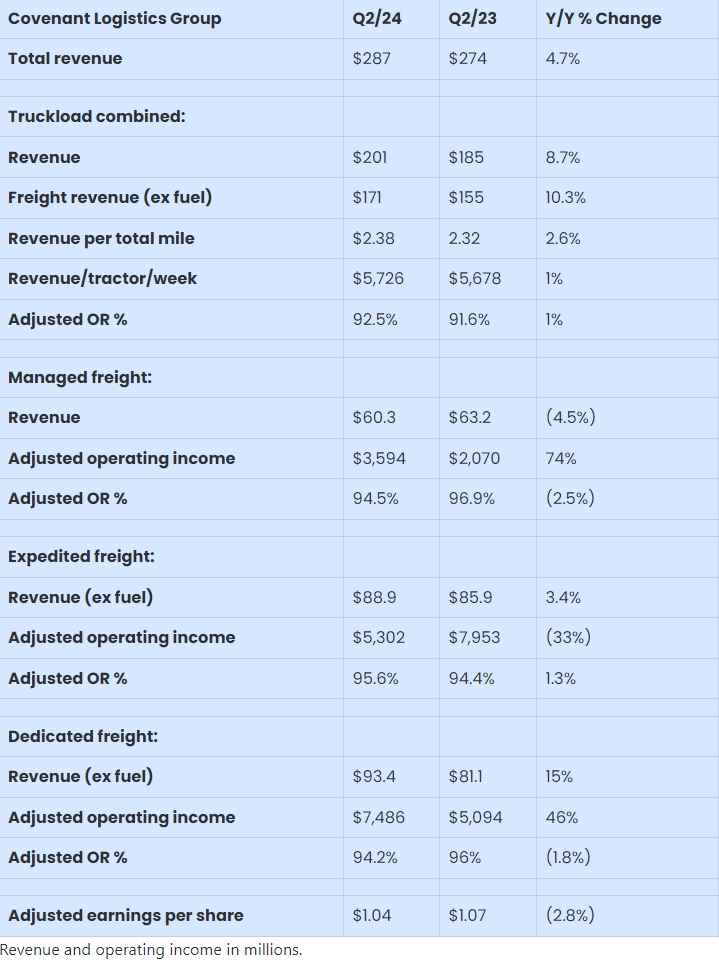
Covenant reported revenue of $287.5 million in the second quarter, an increase of 4.7% year over year.

The company posted adjusted second-quarter earnings of $1.04 cents per share, a 2.8% decrease compared to the same year-ago period.

Parker noted Covenant has seen several rate increases over the past few weeks, something that had not occurred in almost two years.

“We actually have customers that are at least open and willing to have discussions about our costs and those kinds of things. Those are events that have not happened in the last two years, that are starting to happen now,” Parker said. “We don’t have the momentum yet to go full pledge to say rollout rate increases all over to every customer, but we’re looking at that, and the ones that are not performing well are the ones that we’re going to have talks with.”

Covenant’s second-quarter freight revenue, excluding fuel charges, increased 5.3% year over year to $256.5 million, and adjusted operating income increased 15% year over year to $18.7 million.

“The increase in freight revenue was primarily derived from growth in average tractor counts within our asset-based truckload segments consisting of expedited and dedicated,” Tripp Grant, executive vice president, said. “The growth in adjusted operating income was principally derived from our asset-based dedicated segment in both of our asset-light segments, managed freight and warehousing.”

Covenant’s average freight revenue per tractor per week in the second quarter increased about 1% year over year to $5,726, while average freight revenue per total mile increased 2.6% to $2.38. Average miles per tractor per period decreased 0.5% year over year to 20,667.

The company’s number of weighted tractors during the quarter increased 11% year over year to 1,384.

“Regarding our outlook for the future as we head into the third quarter of the year, we believe freight fundamentals are continuing to improve through excess carrier capacity slowly exiting the market with unsustainable conditions, absent an outside catalyst to facilitate improved demand,” Paul Bunn, president and chief operating officer, said. “We remain optimistic about our business model, as evidenced by the durability and growth of our core operations over the last 12 months. In the third quarter, we believe we have the momentum necessary to produce sequential operating income growth throughout the year.”