YunExpress charters Atlas Air freighters for US e-commerce service
All-cargo airline Atlas Air on Thursday announced that YunExpress, a freight forwarder based in China that specializes in cross-border small package delivery, has signed a long-term transportation services agreement for dedicated use of a Boeing 777-200 freighter.
YunExpress launched its first 777 charter service, operated by Atlas Air, in December between Xiamen, China, and Miami. Atlas Air did not issue a news release at the time about the new partnership.
YunExpress is a subsidiary of Zongteng Group, a large, China-based provider of cross-border warehousing and logistics services for e-commerce sellers.
Atlas Air will begin operating YunExpress’ second freighter in April six times per week on trans-pacific routes between China and the U.S.
A contract for dedicated carriage gives customers like YunExpress more control over an aircraft’s use and more consistent service than booking cargo on a scheduled commercial service available to anyone.
The news highlights how e-commerce players in China have become the primary growth engine for the air cargo industry in the past year, helping to accelerate the demand recovery from a lengthy downturn. Many of them are seeking out dedicated freighter capacity.
“Cross-border e-commerce is driving significant demand for Atlas’ dedicated large widebody freighter capacity,” said Atlas Air CEO Michael Steen.
Zongteng purchased its own 777 and subleased it to China-based Central Airlines in early 2023 to fly its cargo from Shenzhen, China, to Paris. It now has two 777s in service. One freighter operates multiple times per week between Shenzhen; Riyadh, Saudi Arabia; and Paris. The other connects Xiamen, China; Tianjin, China; and Paris, with occasional service to Shenzhen, according to tracking site FlightRadar24.
Privately held Atlas Air had revenue of $4.5 billion last year. It has 113 aircraft in its fleet across four aircraft types. Holding company Atlas Air Worldwide has 16 777s under control, including ones its leasing subsidiary rents to other airlines, ones owned and operated by Atlas and others provided by customers for Atlas to operate. The airline is scheduled to receive two more 777 freighters from Boeing this year.
Atlas operates 777s for customers such as DHL Express and MSC Air Cargo. Some planes still bear the logo of Southern Air, a company Atlas acquired several years ago and provides international airlift for DHL.
FMCSA urged to factor electric trucks into detention study
WASHINGTON — A study by federal regulators aimed at reducing truckers’ detention time should take into account the time it will take to recharge an electric truck, according to an insurance group.
In comments filed with the Federal Motor Carrier Safety Administration, the National Association of Mutual Insurance Cos. (NAMIC), which supports FMCSA’s effort, said the insurance industry can provide the agency with recommendations — especially regarding zero-emission trucks — on “specific metrics, key performance indicators, and measures of success” as FMCSA plans the study.
“A number of states have adopted or are considering adopting requirements for [commercial motor vehicles] to be electric,” wrote NAMIC General Counsel Thomas Karol. “California may require half of all heavy trucks sold by 2035 to be electric. The impact of electric trucks on detention time may be substantial. Electric trucks are typically charged with a DC fast charger either overnight, at a warehouse destination, or on-the-move along highways.”
Karol noted that in addition to the estimated 30 minutes to eight hours, depending on the scenario, of actual charging time, “there is often time required to drive to and from the charging sites, as well as potential waiting time if another truck is already using the charger.”
NAMIC’s emphasis on considering electric trucks in a driver detention study could become more significant as the Biden administration readies a final rule on heavy-duty truck emissions, which could require truck makers to start phasing in electric trucks within three years.
The Truckload Carriers Association, in its own comments filed with the agency on the proposed study, pointed out that studies conducted by FMCSA since 2001 have already shown truck driver detention time to be a “prominent instigator” for making roads more dangerous.
The problem, however, is that FMCSA has failed to act on the results of those studies, according to TCA.
“While we appreciate the FMCSA’s commitment to further investigating issues related to detention time, we are concerned about potential delays in addressing new issues that may be identified,” wrote TCA President Jim Ward. “We are apprehensive that any new issues that arise may not be promptly explored, potentially leading to significant delays, like the decade-long interval observed in the past.”
Delays in loading and unloading, along with access to restrooms at shipper facilities, ranked No. 5 among commercial drivers in a survey conducted last year by the American Transportation Research Institute.
ATRI wants to add to the government’s study on detention time — and update its own 2019 analysis on the issue — with new research. It has issued a call for data on detention experiences at customer facilities, and encourages drivers to complete a short, confidential survey that can be accessed here.
The survey, which will remain open through April 26, asks truck drivers to share details “on their experience with driver detention and how it impacts their day-to-day life, professional livelihood and perceptions of the industry,” according to ATRI.
Analysts lower truckload carriers’ earnings expectations ahead of Q1
Analysts lower truckload carriers’ earnings expectations ahead of Q1
(Photo: Jim Allen/FreightWaves)
Ahead of Q1 earnings reports, analysts are adjusting their earnings expectations for truckload companies as excess capacity continues to weigh down pricing and margins. While spot rates jumped after January’s winter weather, for large publicly traded trucking companies, most of their exposure comes from contract rates rather than spot. The winter weather caused lower equipment utilization, which had a larger impact, leading to fewer revenue miles.
Shipper behaviors and inventory replenishment were additional headwinds. FreightWaves’ Todd Maiden writes, “analysts have indicated that channel checks and conversations with management teams suggest March will likely be softer than expected. Shippers have toggled back to a just-in-time inventory strategy, knowing the market is loose and that should consumer buying trends suddenly indicate the need for more merchandise, trucks are readily available to quickly accommodate.”
“To be sure, retailers still appear highly hesitant on restocking, but the trajectory of sales in the context of the destock that’s occurred should be positive for inventory balances and in turn freight flows,” said Deutsche Bank analyst Amit Mehrotra. Despite challenges for truckload carriers and freight brokers, those companies exposed to rail and intermodal are expected to fare better. Bascome Majors, analyst at Susquehanna Financial Group, told clients Monday, “We continue to see outsized earnings risk from asset-based carriers and brokers exposed to the annual contractual pricing cycle relative to LTL and rails.”
For-hire driver availability continues to improve in February
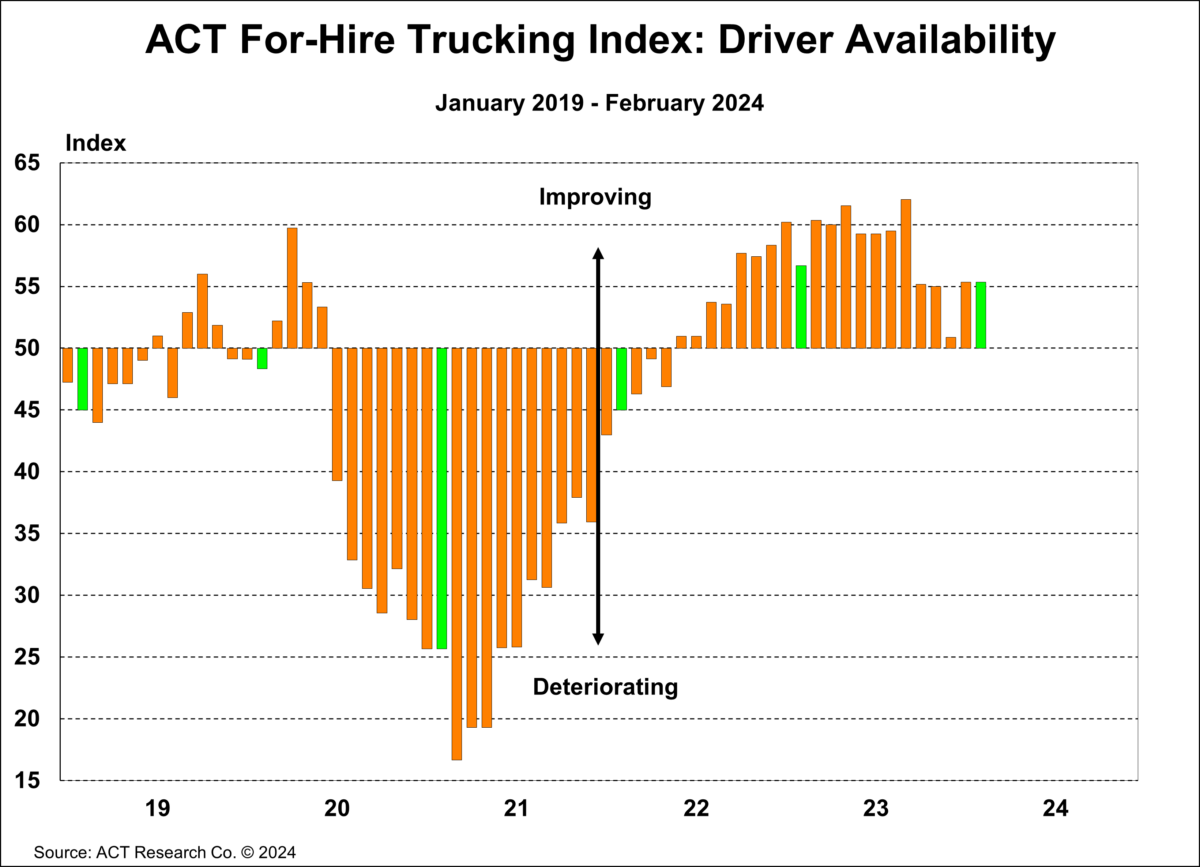
ACT Research recently released February data for its For-Hire Trucking Index, which saw early green shoots and suggested improvements to the freight market into 2024. The index uses survey data to create a diffusion index, with a reading above 50 showing growth and below 50 indicating contraction. The volume, productivity and driver indexes all saw positive growth in March, with volumes at 52.3 points in February compared to 50 in January. Pricing continued to show declines month over month but at an improving rate from 43.5 points in January to 46.1 points in February. Capacity continues to leave the market, from 49.8 points to 48.7 points, but private fleet growth is still offsetting headwinds in the for-hire space.
For driver availability, the index remained unchanged from January at 55.4, but the February result is not seasonally adjusted. Looking ahead, the report expects more downward pressure on drivers due to competition from higher-paying jobs in construction, manufacturing and private fleets. There was one demographic surprise, the report adds: “Baby boomer retirements should continue, but our survey also found drivers delaying retirement because of the recent surge in inflation. One [respondent] even noted some of their best ‘runners’ are past retirement age.”
For finding more drivers, there may be a novel solution. The Commercial Carrier Journal writes that Ken Gronbach, author, demographer and marketer, told an audience at the Truckload Carriers Association convention in Nashville, Tennessee, that one large pool of overlooked labor is convicted felons. Gronbach noted that a third of the 60 million men between the ages of 25 and 55 fit that criteria.
Market update: Contract rates down 8% versus last year
(Source: FreightWaves SONAR)
Commentary courtesy of the Daily Watch, a newsletter for SONAR subscribers.
The average dry van contract rate (VCRPM1) is down about 8% versus where it was in early March last year, according to FreightWaves invoice data. Contract rates tend to take stairsteps downward versus the more reactive and volatile spot market rates, which negotiate for shorter durations. Spot rates excluding estimated fuel costs above $1.20 a gallon — comparable to an average fuel surcharge — are only down about 1.6% compared to the previous year and appear to have shifted their direction.
The market remains in a heavy state of oversupply, and there is little support for the idea that spot or contract rates will turn sustainably higher in the near term. The positive takeaway for transportation service providers is that the contract rate declines have slowed significantly over the past six months, falling only 2% since late September.
Spot rates are actually 5.7% higher over the same period. This could be the result of shorter-length-of-haul freight having a stronger presence in the spot market, which can inflate the average rate per mile. A sustained directional shift in rates is expected later in the year. A driving reason behind this logic is simply that this market cannot last forever. These two values do suggest that is likely if you apply the previous 12-month trend line forward, albeit the market shifts have been more dramatic in recent years.
FreightWaves SONAR spotlight: Net changes in carrier operating authorities flash positive
(Source: FreightWaves SONAR)
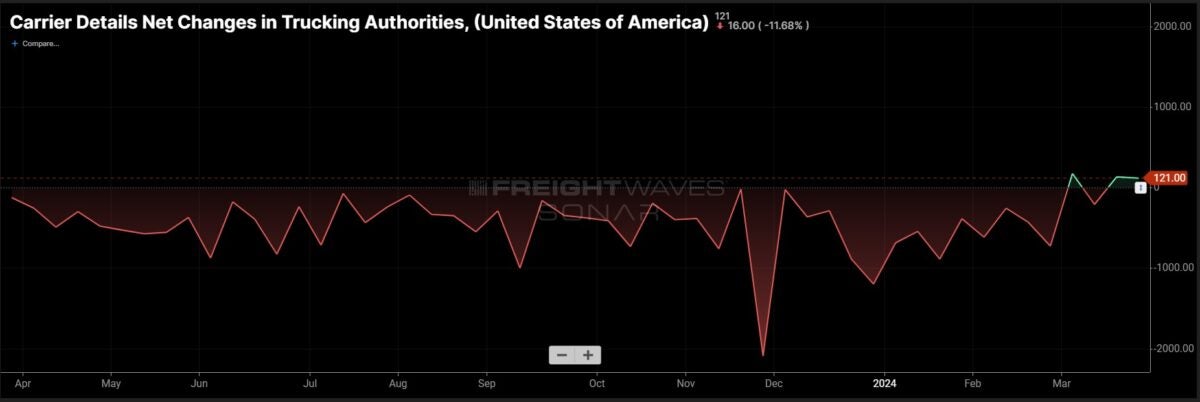
Summary: The net change in motor carrier authorities for March showed positive despite prolonged softness in both contract and spot markets and unfavorable conditions for trucking. The Carrier Details Net Changes in Trucking Authorities (CDNCA) showed a net gain of 258 unique operating authorities in the past two combined weeks ending March 15 and 22. The gains were 137 and 121 unique authorities, respectively. Despite this flash of optimism, that same two-week period saw 2,219 net revocations in operating authorities before adding new entrants, which caused the positive net change.
Truckload capacity as measured by the total number of unique operating authorities continues to decline but at a lower rate, with 1.33% fewer carriers year to date since January 2024 compared to a 6.4% decline year over year. The explosive growth of trucking capacity to handle the pandemic surge in consumer demand remains staggering when looking at the number of unique authorities compared to five years prior. There are 41% more unique operating authorities at 351,384 compared to the week ending March 31, 2019, at 249,605 authorities.
Like the content? Subscribe to the newsletter here.
Texas trucking company employee gets over 5 years for payroll fraud
A woman who used her position in two Texas trucking companies to fraudulently pay excess funds to co-workers and friends was sentenced Tuesday to more than five years in prison. Her co-defendants got probation.
Veronica Rios and six co-defendants were indicted in April 2021. In sentencing this week, Rios received 63 months in prison on six counts of wire fraud. The 63 months was the sentence for each of the counts but will be served concurrently.
Rios pleaded guilty in September.
Electronic records for the proceedings in the U.S. District Court for the Western District of Texas note that the sentencings of co-defendants Pedro Guillen, Maira Vargas, Guadalupe Alsidez, Amanda Hernandez, Mario Martinez and Tommy Bynum all occurred at various times going back to last fall after plea deals. They all received probation and no fine.
According to the initial indictment in the case, Rios joined Texas Chrome Transport and affiliate MJR Truck Lines in March 2017 as an administrative assistant. Her duties included payroll processing.
Some of the co-defendants were employed by Texas Chrome Transport. But three were described as Rios’ boyfriend (Martinez) or simply friends (Vargas and Alsidez).
At the time of the indictment, Rios faced 18 counts of wire fraud. Each of the co-defendants faced three charges each of wire fraud. Various counts were dismissed as part of plea deals.
Total losses to the trucking companies, according to the indictment: $1,407,392.43.
According to the indictment, Rios’ fraudulent activities began in her first year on the job. “Rios began overpaying employees of the company in exchange for a return of some of the amount of overpayment,” the indictment said. The activities continued until 2020.
The overpayments were more than $424,000 to Guillen and more than $140,000 to Bynum. Hernandez received an overpayment of $30,000 for several months in 2019, left the company but continued to get paid by Rios.
“Rios also added non-existent employees to the payroll list,” the indictment said. “After causing the payroll to be processed, Rios would then delete the non-existent employees from the payroll list so that her superiors would not notice that the payroll report contained non-existent employees.”
Those non-employees were boyfriend Martinez and friends Vargas and Alsidez.
Vargas received fraudulent payments of more than $30,000, Martinez got more than $432,000, and Alsidez received more than $200,000. Kickbacks were then paid to Rios.
“Interstate wire communications” with a payroll processing company in Illinois were used in the scheme, an action that presumably is the basis for the fraud case ending up under federal jurisdiction.
Venture 53 invests in Heale Labs’ tokenization technology
Heale Labs announced Thursday it has received a seed investment from the supply chain technology fund Venture 53 as the company continues its work to standardize industry data. Terms of the funding were not disclosed.
“Heale solves some of the thorniest issues in supply chain and logistics. With unparalleled data accuracy and real-time connectivity, we’re introducing a new era of efficiency, reliability and profitability in global supply chains,” said founder Todd Haselhorst.
To understand what the company, whose name stands for Hyper Enabled Autonomous Logistics Ecosystem Labs, is doing, you must first understand what the term “tokenization” means in the context of logistics.
Tokenization is a way to transform text into a format understandable to machines while preserving its contextual significance. This process segments text into tokens, facilitating algorithmic analysis for pattern recognition. That recognition enables machines to interpret and react to human input effectively.
The key to tokenizing data is avoiding ambiguity and the use of different languages. Heale’s platform encourages users to share complete and accurate shipment data to avoid ambiguity and confusion.
Users integrate a digital wallet into their existing management systems. When a shipment is added to the Heale network, data is collected and added to the master record. After completion, users may qualify for rewards based on their actions and the quality of shared data, distributed through the digital wallet.
Heale Labs interface (Photo: Heale Labs)
The incentive structure encourages best practices during shipments, rewarding data providers for cleanliness, timely bill payment and use of electronic bills of lading. This approach aims to increase profitability by reducing errors, theft, fraud and waste in the shipment life cycle.
“We can apply [tokenization] to logistics and items like a box, a carton, a pallet, a truck or your warehouse,” Haselhorst said in a recent interview with technology provider Optym. “That token or that unique identifier represents that thing digitally. So when you want to find an available space on a truck, across the whole [logistics] network, you can reference that unique identifier. The same is true for an item or a box or a pallet, right? … They can’t be replicated and they can’t be duplicated, so it eliminates the ability for people to fraudulently create these assets.
“When a carrier posts its capacity on a load board, you have brokers and shippers that are calling on that capacity, trying to match those two together. Well, if I as a carrier got [the truck] covered, that [truck] is still sitting on all these other load boards. How many times are brokers and shippers still calling on that capacity that has been long gone? So by tokenizing it as soon as you remove it, you remove it from all other locations.”
Heale’s model could drive necessary changes to address data quality and security concerns, potentially revolutionizing the industry. By resolving foundational data issues, it paves the way for advanced technologies like AI to optimize operations.
“Web3 and AI have a meaningful role in the future of logistics,” said Pat Martin, partner at Venture 53. “Heale is paving the way for this future where seamless, transparent and efficient operations are standard. The team shares our vision for the future of the supply chain ecosystem, which is why we invested.”
The company has integration pilots planned with freight brokers and transportation managing systems in Q3.
Port of Baltimore’s indefinite closure deals blow to city, state economy
The collapse of the Francis Scott Key Bridge on Tuesday after it was struck by a container ship has disrupted the Port of Baltimore’s container shipping services, which will impact the economy of the city and beyond, analysts said.
Six people are missing and presumed dead after the Singapore-flagged MV Dali slammed into the bridge in the early morning hours, sending debris into the Patapsco River that continues to block a large portion of the channel that leads into Baltimore’s harbor.
The state of Maryland and the U.S. Department of Transportation announced the closure of the shipping lane to the port until further notice as the investigation, recovery and cleanup get underway.
Economist Anirban Basu said that along with the Johns Hopkins Health System, the Port of Baltimore is one of the main drivers of the city and state economy, and its indefinite closure will impact jobs and revenue across the region.
Baltimore is the largest city in Maryland, with a population of about 576,000. It has more than 2.8 million in its metropolitan area.
“I would say the Port of Baltimore is the leading economic driver for the region in Baltimore,” Basu, chairman and CEO of Baltimore-based Sage Policy Group Inc., told FreightWaves. “One could argue that the leading driver is Johns Hopkins. It’s a difficult comparison, because you’re talking about two very different fields of endeavor. But the Baltimore region has been one of the nation’s underperformers in recent years. In the Baltimore region, we have had to clawback the jobs lost early during the pandemic.”
The port is the deepest harbor in Maryland’s Chesapeake Bay, with five public and 12 private terminals. It handled over $80 billion worth of cargo in 2023. It serves more than 50 ocean carriers making nearly 1,800 annual port calls.
The port generated nearly $3.3 billion in total personal income and supports 15,330 direct jobs and 139,180 jobs connected to the port, according to state data.
“If you were to compare the jobs in the Baltimore region in February of 2020 just before the pandemic, to February of 2024, the Baltimore region is down 34,900 jobs, the state of Maryland is down 41,100 jobs, while the nation is up 5.5 million jobs during this period …,” Basu said. “But one thing we could say in Baltimore was that we are anchored by the Port of Baltimore, that whatever has happened with our corporate headquarters, many of them have just disappeared, but the Port of Baltimore was not going anywhere.”
According to recent data from Implan, the port’s 15,000-plus direct employees could lose an estimated $275 million in labor income if container operations are down for a month.
Implan is a Huntersville, North Carolina-based economic software and analysis firm.
“Before we even performed the analysis, we knew this event would have a negligible loss to the U.S. gross domestic product,” Candi Clouse, Implan’s vice president of customer success and education services, told FreightWaves. “The logistics and shipping will just shift to another U.S. port temporarily. However, the potential impact to Maryland is something to keep an eye on. Even if the port is only closed for 30 days, Maryland would be at risk for losing $550 million to its gross domestic product and $1 billion loss in total value of goods and services.”
Basu said how much the ship channel’s closure disrupts the city and state’s economy depends on how long until the port is fully operational.
The federal Bureau of Transportation Statistics said as of noon Tuesday, three bulk carriers, one vehicle carrier, two general cargo ships, one oil/chemical tanker and three logistics naval vessels were stuck behind the fallen bridge in the port. One vehicle carrier was in the port but outside the bridge, and nine bulk carriers, one vehicle carrier and two general cargo vessels were anchored.
“The short-term effects are very large. … There is a significant amount of cargo being diverted away from the Port of Baltimore to other ports, who are often competitors,” Basu said. “This impact is multimodal, because not only is the ocean carrier community impacted by this, but so too is rail transport, trucking and even air cargo, including cargo operations at Baltimore-Washington International Airport.”
With 31,000 vehicles per day crossing the Francis Scott Key Bridge, it is a major conduit for traffic in the region. Basu pointed to several ways trucking operations at the port and in the area will be affected.
“The port is not only adjacent to I-95, it’s in the proximity of I-70, and so it’s a major way for northwest and east-to-west routes,” Basu said. “One would think that the trucking community would be quite meaningfully impacted as would distributors located in the region. Distribution is going to be less efficient, given lengthier travel times, both into the distribution centers and from the distribution centers.”
Supply chain visibility platform project44 released a report detailing how an estimated $1 billion per week in goods will be affected by the bridge collapse and indefinite suspension of container activities at the port.
“The Port of Baltimore handles freight from major automakers including, but not limited to, Nissan, Toyota, General Motors, and Volvo,” the project44 report said. “Expect disruptions to manufacturing in the automobile market until companies can establish dray networks through neighboring ports.”
Rerouting the port’s container cargo to ports in New York and New Jersey, Philadelphia, or Virginia could push up some trucking and rail prices in the short term, according to Tony Thrasher, senior director of product management at SPS Commerce.
“In the short-term, there is an impact on exporting/importing goods and services,” Thrasher said in an email to FreightWaves. “However, once things get cleaned up, and other routes out of the port are determined, operations will resume and the initial downtime will be over. Operations won’t be as efficient, and there will be additional costs to use other ports that are further away. Retailers that have prepared for disasters will navigate this disruption fine.”
Minneapolis-based SPS Commerce provides cloud-based supply chain management software to retailers, suppliers and 3PLs.
“Since we are in March, retailers are not in the crazy holiday rush yet, so I see this impact being short-term and not hurting big retailers,” Thrasher said. “I don’t think consumers will see the impact either. Retailers will have to deal with it, but the delays will not be enough for consumers to feel.”
Yellow gets favored venue for hearing on $7.8B in pension liability claims
A Delaware bankruptcy court ruled Wednesday that approximately $7.8 billion in pension withdrawal liability claims against bankrupt less-than-truckload carrier Yellow’s estate will remain under its jurisdiction and not be decided by arbitrators as numerous pension funds had sought.
The court denied motions from the multiemployer pension plans (MEPPs) to which Yellow (OTC: YELLQ) contributed on behalf of its union employees. The motions sought to either compel arbitration or grant relief from an automatic stay so the pension funds could pursue arbitration. Following a bankruptcy filing, an automatic stay halts creditors from collecting on debts until valid claims, and the order in which they are to be repaid, are determined.
Judge Craig Goldblatt’s decision said either venue would ultimately be required to apply the same legal standard in making a decision and that both were likely to arrive at the same outcome, which would be reviewed by a district court.
“While governing caselaw dictates that in some circumstances a bankruptcy court must enforce an arbitration provision, the Court concludes that this is not such a circumstance,” Goldblatt said.
Goldblatt ruled the ultimate outcome of the claims allowance process is “a core bankruptcy matter” and reminded all parties that they had already agreed that the settlement of the claims was “perhaps the most important issue to be decided in the bankruptcy case.”
He also said the bankruptcy court will allow other interested parties to participate in the claims dispute, which may not have happened in arbitration, and that a timeline has already been established versus “the uncertainties about how long an arbitration process might take.”
The judge heard arguments on the matter from all parties on March 6, at which time a trial date of Aug. 5 was set. Central States and other pension funds agreed at the hearing to allow Yellow’s largest equity holder, MFN Partners, to participate in arbitration.
The Boston-based investment firm amassed a more than 40% stake in Yellow’s equity just weeks before it shut down.
The pension funds recently served subpoenas to MFN seeking documents regarding Yellow’s shutdown and the company’s bankruptcy filing. Information on the firm’s financial analysis of Yellow and what would happen to the withdrawal liability claims has also been requested.
Billions in claims could turn to just millions in payments
Claims against the estate from 11 MEPPs have been estimated at as much as $7.2 billion. Court filings have shown Central States Pension Funds claims it’s due $4.8 billion. Yellow participated in at least 20 MEPPs, with claims amounting to $7.8 billion in total.
Any of those amounts would likely leave shareholders with no monetary recovery. However, an expert on pension withdrawal claims has told FreightWaves the ultimate payout will likely be negotiated down to a fraction of the headline amount.
While counsel for Yellow and the various funds previously acknowledged the matter was mostly procedural, both parties clearly wanted separate venues. Yellow asserted the funds’ claims were made to the bankruptcy court and should be decided there, while the funds as well as pension insurer Pension Benefit Guaranty Corp. (PBGC) pointed to a federal statute requiring arbitration, not the bankruptcy court, as the ultimate authority.
The funds also argued that arbitration would provide the expertise to determine if the correct actuarial assumptions were made when determining unfunded vested benefits (UVBs) — the basis for any withdrawal liabilities due — and whether the correct rates of return and discount rates were applied, among other items contested by Yellow.
Yellow said there are no UVBs following the government’s 2021 MEPP bailout. Congress awarded roughly $80 billion in special financial assistance under the American Rescue Plan Act, which is being overseen by PBGC. Yellow maintains that the MEPPs are now fully funded, meaning it has no withdrawal liability and that the funds are simply seeking a “double recovery.”
PBGC has said in filings that it enacted a rule that requires MEPPs to recognize the distributions over time, not as a lump sum, meaning Yellow is still on the hook for pension withdrawal liabilities. It said the rule was created to keep employers from seeking an early exit from MEPPs, which could ultimately lead to plan insolvencies.
Central States received $35.8 billion under the rescue plan.
Other claims from the funds, like unpaid benefits payments for June and July, among other items, are not subject to arbitration.
Central States returning $127M overpayment from PBGC
Central States has started the process of returning a $127 million overpayment earmarked for nearly 3,500 dead participants received from PBGC as part of the pension bailout, PBGC Director Gordon Hartogensis said at a March 20 House committee hearing.
Central States’ bailout application, which was approved by PBGC, included 3,479 dead plan participants. PBGC didn’t cross-check the list against Social Security Administration records, resulting in the overpayment.
A February letter from Sen. Bill Cassidy, R-La., alleged the pension fund was not planning to return the money, claiming it would “lack sufficient funds to cover all of its liabilities.” The amount is a small fraction of the nearly $36 billion it received from the bailout.
Hartogensis said PBGC is auditing applications from and payments to other pension funds to make sure other overpayments were not made.
Yellow’s liquidation continues
Yellow’s estate has repaid all secured creditors, including the U.S. Treasury, which provided the carrier a $700 million COVID-relief loan in 2020. The Treasury received a 30% equity stake in Yellow as part of the transaction. MFN, which provided debtor-in-possession financing, was also repaid. The estate generated roughly $2 billion in proceeds from the sale of service centers.
The estate is still in the process of selling an additional 30 to 40 owned properties and unloading 78 terminal leases, which could fetch “hundreds of millions of dollars.” It is terminating leases on approximately 40 other locations.
Equipment auctions started earlier this month with additional auctions scheduled through May.
Shares of YELLQ jumped nearly 14% when the court’s decision was published late in the trading session on Wednesday.
End-to-end visibility changes the game for shippers, carriers
Companies across the supply chain have been laser-focused on improving their visibility options over the past several years. While most companies understand that visibility paves the way for increased efficiency and better coordination throughout the life cycle of a shipment, many leaders in the space do not yet have a solid understanding of partial versus complete visibility.
Virtually all visibility solutions offer some level of value to users because they increase the amount of data available to decision-makers and stakeholders. Complete, end-to-end visibility solutions, however, change the game entirely. A holistic visibility tool goes beyond simply providing data, instead creating a pathway for companies to identify and mitigate risks proactively — from transportation disruptions to supplier issues and unforeseen delays.
Additionally, complete visibility solutions are the only tools that are able to meet shippers’ growing expectations surrounding shipment transparency.
“With the software advancements we’ve seen over the past decade, customers now expect transparency and reliability,” according to Troy Cook, vice president of sales and marketing at Dynamic Logistix. “End-to-end visibility leads to better delivery estimates, quicker response time to customer inquiries and ultimately, enhances customer satisfaction for our shippers.”
A truly holistic visibility solution has the power to bring supply chain partners — including suppliers, manufacturers and distributors — together. When there is collaboration among all the different players, the entire operation tends to improve.
This collaborative effort often leads to streamlined routes, minimized disruptions, reduced costs and lead times, improved environmental impact, and increased innovation. All of these advantages factor into a stronger, more resilient supply chain, and it starts with transparency.
On a more individual level, end-to-end visibility solutions also impact each player in a company’s org chart. There are a multitude of people in any given company’s supply chain — including production experts, salespeople, warehouse employees, logistics professionals and leadership teams. While each of these groups performs a different function, they all impact the supply chain and are all integral to the company’s success.
“Visibility within logistics impacts each of these roles significantly,” according to Cook. “The warehouse needs to know where inbound trucks are to coordinate their docks. The sales team needs to understand current trends in the freight market so they can build in the appropriate cost. The customer service teams need to know where the product is to ensure their clients receive their products on time. Logistics needs to know which orders can easily be planned and routed together to reduce the overall cost of shipping. And the executive leadership teams need to be able to easily track the overall cost of transportation and be able to identify what factors have the greatest impact on that cost.”
Understanding which factors have the greatest impact on cost is the first step in creating a more cost-effective — and attractive — operation. For shippers, this is paramount, as controlling transportation costs and working efficiently are the two biggest factors when it comes to their logistics operations.
Optimized shipping routes and consolidated shipments are powerful methods of cutting out wasteful transportation spend. A strong transportation management system (TMS) — like XTMS offered by DLX — excels at gathering the supplier data needed to implement these methods, including transit time, number of loads, weight and destination.
The information that comes from a high-quality TMS is a crucial component of saving money and reducing loss, but the effort should not stop there. The more human-centered elements of the logistics industry — including customer service — are also critical.
“DLX is unlike other 3PLS and standard transportation management systems. We offer a state-of-the-art TMS, but it’s the customer service that we deliver to our partners that sets us apart,” said George Schergen, vice president of client services. “A lot of other logistics providers will implement the software and call it a day.”
At DLX, customer relationships do not stagnate after implementing XTMS. After adoption, DLX works with its clients to manage their entire supply chain, including providing each user a dedicated account manager to work as an extension of their team.
DLX also offers robust key performance indicator reporting, ensuring customers have the most efficient and cost-effective shipping strategy in place. For that same reason, the company has a team dedicated to auditing invoices and bills to make sure there aren’t any discrepancies or duplicate charges on their accounts.
DLX works hard to create a fair space in the logistics industry by ensuring this comprehensive suite of services is available to its entire clientele, regardless of a company’s size or age going into the partnership.
“Our XTMS and freight broker partners will receive best-in-class service, regardless of their size. That’s something we guarantee,” Schergen said.
B-1 drivers offer unique value proposition for cross-border carriers
Freight movements between the U.S. and Mexico continue to grow, and ongoing nearshoring efforts show no signs of slowing. As more goods move across the border, conversations between carriers and insurance providers regarding B-1 truck drivers from Mexico are happening more frequently.
While B-1 truck drivers from Mexico are able to enter the U.S. to complete deliveries, cabotage laws greatly restrict their movements and activities within the country.
When moving freight between Mexico and the U.S., these drivers are permitted to pick up a load in Mexico and drop it off in the U.S. They are then allowed to pick up another load in the U.S., but that shipment must be dropped off back in Mexico. All movements must be part of an international stream of commerce.
“There are only a handful of providers that will offer auto liability and other lines of coverage to fleets with B-1 drivers for a variety of factors stemming from the difference in Mexican versus American standards — paramount of which include cabotage law, cargo insurance standards, differences in federal driver performance tracking, licensing and language proficiency,” said Mark Vickers, executive vice president and head of international logistics at Reliance Partners. “However, we have many of our standard insurance providers, insurtechs and captives starting to play ball with us for the first time, and this timing is perfect.”
Insurance companies also shy away from B-1 drivers because of the differences in driver performance tracking between the U.S. and Mexico.
All U.S. drivers have motor vehicle records (MVRs) managed by the Federal Motor Carrier Safety Administration. These files play a large role in assessing driver safety and determining carrier insurability. Mexican drivers do not have MVRs. Instead, they have PSP files. While these documents do provide some insight into a driver’s track record, they are not as detailed or complete as MVRs, creating hesitancy among insurance markets.
“Historically, U.S. markets have stayed away from B-1 drivers, as driving performance is one of the main rating factors when quoting for most companies,” according to Reliance Partners Account Executive Stephanie Alegria. “Unfortunately, with these license types, there are no driving/violation records that can be used to help determine the quality of the driver pool.”
Despite this relative lack of performance documentation, B-1 drivers bring a unique value proposition to the table, including lower hiring costs and an eagerness to find — and retain — driving jobs.
Vickers noted that truck driving is a highly desirable job in Mexico because it tends to pay significantly more than any comparable positions within the country. This creates a high level of competitiveness and excellence in the Mexican driver pool.
While it is difficult for B-1 drivers to provide evidence of their previous driving behaviors via government documentation, Alegria noted that most of these drivers have proved even safer than their U.S. counterparts in practice. This is likely because the process of becoming a truck driver is much more stringent in Mexico.
“The extensive process to become a B-1 driver creates drivers that tend to be more cautious and more involved in operations, leading to fewer accidents and violations. In turn, this creates a safety culture that most markets really appreciate and reward in the form of more favorable premiums,” Alegria said.
The performance-based hesitancy surrounding B-1 drivers is starting to ease up. Alegria attributes this shift to the increase of technology-driven carriers, as companies are now able to monitor driver performance through ELD data sharing on almost a real-time basis.
This ability to monitor drivers as they go, combined with how well the cross-border market carriers have performed from a loss ratio perspective, has prompted more insurance providers to begin accepting carriers with a portion of B-1 drivers.
Reliance Partners sees embracing B-1 drivers as a positive step toward a safer and more efficient transportation industry, and the company has committed to helping its peers in the insurance space better understand the value these drivers bring to the table.
“As Reliance, we have made an effort to put a spotlight on these types of drivers and the risks associated with them,” Alegria said. “We have made a significant move to get markets in conversations about these drivers, in the hopes of creating more options for these types of operations.”
Industrywide change takes time, but Alegria and Vickers agree that opportunities for B-1 drivers will likely expand significantly as both the transportation and insurance industries continue to become more globally focused and technologically advanced.
Reliance Partners’ 7th Annual Modernization of Cross-Border Trade Event will be held in Laredo, Texas, on Aug. 6. For more information on the event and where to sign up, visit here.
UPS to close 200 sort centers in modernization push
UPS says a projected rebound in parcel demand combined with an aggressive strategy for network consolidation and automation to reduce excess capacity and labor costs will drive double-digit profit margins by 2026. Up to 200 facilities are slated for closure over a five-year period.
The optimization plan, code-named Network of the Future, is expected to save $3 billion per year by 2028 through better productivity, according to a new strategic framework outlined by management on Tuesday. The leadership team explained why it is targeting premium segments such as health care and small businesses, as well as nearshoring trends, as big opportunities.
The event for investors was held in a massive new aircraft hangar at the delivery giant’s global air hub in Louisville, Kentucky, and streamed on the web.
UPS (NYSE: UPS) declared financial targets for 2026 include revenue of $108 billion to $114 billion — up from $91 billion last year — an adjusted operating margin above 13%, free cash flow of about $17.5 billion and capital spending of about 5.5% of total revenue.
Wall Street, which wanted $3 billion in reduced costs by 2026 instead of 2028, didn’t seem impressed. The company previously warned that operating profit would be down 20% to 30% year over year in the first half and then rebound to be up by the same amount in the second half as the wage growth rate from the new Teamster contract eases. UPS’ share price fell 8% by Tuesday’s close, but recovered some ground on Wednesday.
The growth and productivity plan also will be boosted from the return of growth to the small package market, said Matt Guffey, chief commercial and strategy officer. The U.S. small package market was expected to grow from 74 million average daily packages to 108 million by 2023, but the COVID demand spike reverted, inflation increased and the industry only reached 84 million packages per day.
UPS estimates modest growth in 2024 to 88 million packages, rising to a daily volume of 98 million in two years, on a compound annual growth rate of 5.5%. International small package growth will be nearly flat this year but grow at a 3.5% annual rate to 30 million units in 2026.
Analysts said UPS’s revenue guidance for 11% growth in 2025 and 2026 is optimistic given average revenue growth of 5% to 10% in the 10 years prior to the pandemic and Amazon’s increasing capture of market share. They also questioned the need for mergers and acquisitions to reach the targets. BMO Capital Markets analyst Fadi Chamoun said UPS assumes it can make significant market share gains in premium market segments by leveraging its integrated network, which will be difficult to fully execute. He said a more realistic revenue target is $104 billion.
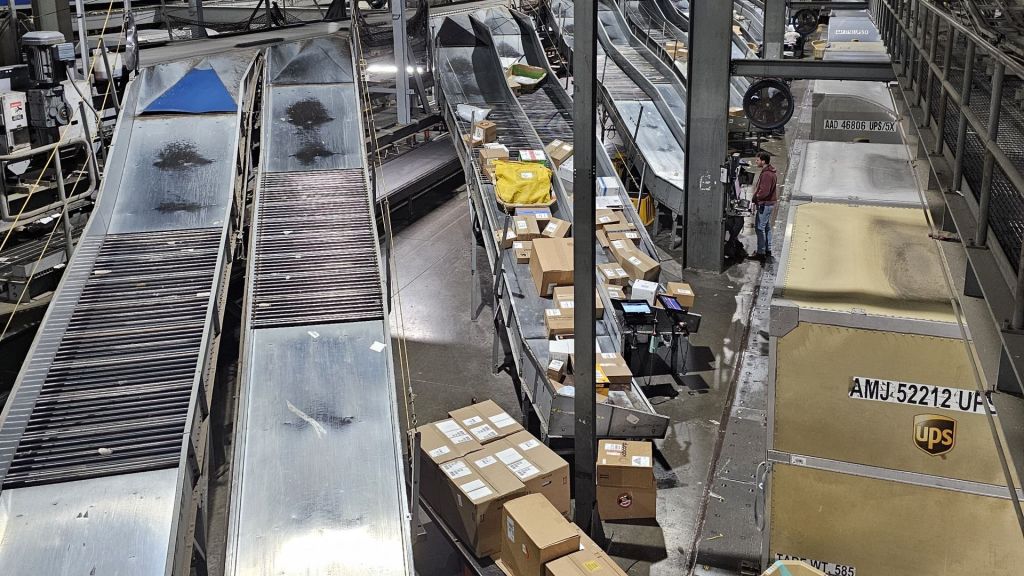
Also acting as a potential revenue drag is a capacity surplus equivalent to average daily volume of 12 million packages across the industry after e-commerce and delivery companies ramped up infrastructure to meet shelter-at-home demand during the pandemic. The company is doing its part to bring supply into equilibrium by closing 70 conventional sorting facilities in 2023 and 2024 and flowing more volume into automated facilities, said Nando Cesarone, president U.S. operations. By 2028, UPS will close 200 facilities and consolidate operations in high-capacity spaces.
The UPS forecast assumes that competitors such as Amazon,the U.S. Postal Service and regional parcel companies won’t add more capacity, said Ravi Shanker at Morgan Stanley. It should be noted, however, that Amazon has cut back on planned fulfillment centers and the USPS is streamlining its network too.
Warehouses outfitted with smart package technologies — such as autonomous guided vehicles, automated sorting systems, and systems that can prioritize processing for specific customer requirements without manual intervention — experience a 30% to 35% bump in effective handling capacity.
Atlanta-based UPS has 63 automation projects targeted between now and 2028 that will more than triple the number of buildings with automation to 400. In the U.S., the vast majority of the automation projects will be completed in existing buildings. Ten of those automation projects are new builds. Overall, UPS is investing $9 billion in network upgrades.
“Every single work area is being scrutinized for automation opportunities, not just our sortation hubs,” said Cesarone. Technologies being introduced include automated address correction and delivery redirection, automated dispatch for package car drivers and feeder operations, and affixing pre-load assist labels to packages. Automated loading and unloading of trailers is being pilot tested.
In Worcester, Massachusetts, UPS is replacing a facility built in 1969 with a larger one that will allow work from four regional facilities to be consolidated in one place, reduce network touches and improve utilization. Another example of network simplification is in Albany, New York, where the integrator is modernizing a facility to increase capacity, which will allow it to close another site.
Automation and consolidation projects in Massachusetts. (Source: UPS Investor Day presentation)
In Harrisburg, Pennsylvania, UPS has closed 15 sort centers and reduced staffing, resulting in 60,000 fewer packages being physically handled per day. The less a parcel is dumped out, shuttled through a conveyor system and swept into bins, the less chance of damage. Together, area savings amount to $80 million.
UPS recently notified the state of Oregon it will close a package terminal in Portland and lay off 331 workers in mid-April because it wasn’t busy enough, according to the Portland Business Journal.
Facilities are also being standardized to eliminate complexity for operators, which means no more customization to fit a specific client’s needs, according to management.
The Network of the Future bears similarities to FedEx’s network transformation called Network 2.0. FedEx, however, is delivering more tangible cost reductions in part because it needed greater changes to satisfy investor calls for better profitability. FedEx traditionally operated three distinct networks — Express, Ground and Freight — that weren’t very interoperable, and it has an airline more than twice the size of UPS’ fleet.
Target markets
UPS is much more than a parcel delivery company. On the logistics side, management said it aims for a 40% volume mix from small businesses and is building more digital tools to help them easily manage international shipments from end to end. And it plans to double revenue in health care logistics to $20 billion through organic growth and acquisitions by 2026.
Kate Gutmann, president of international, health care and supply chain solutions, said UPS is heavily investing in health care logistics, a market estimated to reach $152 billion in 2026 from $130 billion today, because an aging global population needs more drugs and biological medical products to deal with chronic disease.
“The health care logistics market is especially attractive to us, because it has year-round demand and is more resistant to economic downturns. That enables more predictability for operations across the whole supply chain. The majority of our health care customers buy more services across our end-to-end supply chain than customers in any other segment. That means we get a greater percentage of those customers’ total supply chain spend,” she added.
Pharmaceutical users account for 45% of UPS’ early morning delivery volume and are large users of premium services like Next Day Air and reverse logistics. The segment delivers operating margins in the high teens.
UPS will invest millions of dollars to expand its air base at Clark airport (pictured) in the Philippines. (Photo: UPS)
UPS and other third-party logistics providers are also benefiting from manufacturers diversifying their supply chains beyond China to Southeast Asia, India and Mexico. Gutmann said UPS is upgrading its physical and digital infrastructure to support new freight flows.
The express carrier, for example, is increasing throughput capacity in Asia to allow network and routing changes that will support growing demand and improve transit times. Last week it announced a significant expansion of its air terminal at Clark airport in the Philippines after adding nearly 237,000 square feet of cold-chain storage and distribution space there in 2023. Construction of the new Clark hub is set to begin next February, and the terminal will be fully operational in late 2026. In December, the company said it planned to build a new air cargo facility at Hong Kong International Airport by 2028 that is four times the size of the current hub and will be able to process 1 million tons per year.
Gutmann said UPS also plans to roll out this year an upgraded portal designed to improve efficiency of customs brokerage.