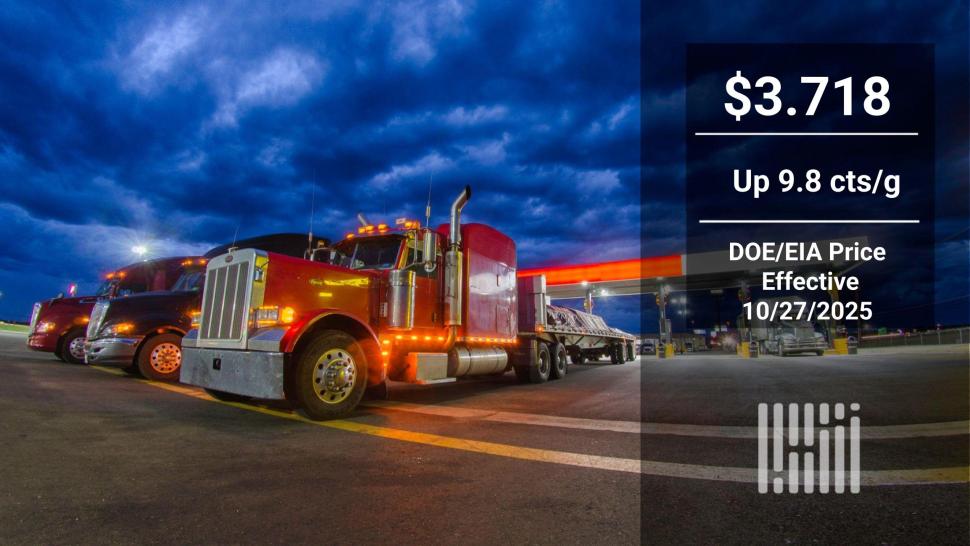
Retail diesel prices as measured by the weekly Department of Energy/Energy Information Administration average national price has registered the third-biggest jump this year.
The price of $3.718/gallon was up 9.8 cts/g. It’s the largest increase since a 20.4 cts/g climb on June 23. It also wiped out the last two consecutive weeks of 4-plus cents gain, and put the price used as the benchmark for most fuel surcharges above where it stood three weeks ago at $3.711/g.
The price effective Monday, released Tuesday, was the first number released since the shift in oil market sentiment last week on the back of sanctions announced by the Trump administration. The sanctions are aimed at Russia’s two biggest oil companies, Rosneft and Lukoil.
The reaction to that announcement was sharp and sudden. On Wednesday, ultra low sulfur diesel on the CME commodity exchange settled at $2.2496/gallon, up 4.38 cts/g from the prior day.
But it was the action the next day that really took prices higher. The gain of 15.34 cts/g to a settlement of $2.24964/g marked the biggest one-day increase since December 22, 2022. But while that gain from almost three years ago was more than 18 cts/g, the increase Thursday was a much larger jump when measured by percentage.
Trading on Monday tacked on a few more cents to the price, settling at $2.4361. Early trading Tuesday showed a small decline of less than 1 cent per gallon at approximately 9:40 a.m. EDT.
In an article published by the George W. Bush Presidential Center, the impact of the sanctions were described as twofold.
First, the two companies will see a freeze in their U.S. holdings, as well as any financial assets in which they own more than 50%.
But second, the most significant aspect of the latest announcement is seen as the emphasis on secondary sanctions. As per the Treasury guidance in the announcement, any entity “engaging in certain transactions involving the persons designated today may risk the imposition of secondary sanctions on participating foreign financial institutions.”
That is widely interpreted as being a message to countries buying Russian oil, like India. And the market reaction to the sanctions was to move higher, given that current Russian customers trying to switch out their Russian supplies could boost the price of oil as they seek oil from other sellers.
Meanwhile, the sanctions have helped boost the market in Europe for diesel and gasoil, a diesel-like product which is heavily supplied to Europe by Russia.
Energy consulting firm Energy Aspects, in its monthly report on the market for distillates such as diesel, reported Sunday that the spread between the first month and second month gasoil contract on the ICE commodity exchange had risen, a sign of concern about inventories.
But EA was less bullish going forward. “We expect balances to loosen from December, with global December 2025–January 2026 stockbuilds forecast as 22 million barrels above the five-year average, assuming workarounds can be found to clear Russian diesel, and Atlantic basin spreads have room to fall as inventories start to build,” the consultancy said in its report. “Strong margins should keep refinery runs high, and rising OPEC+ crude supply, especially medium sours, will improve crude slate optimisation and boost clean product yields.”
Whether current diesel inventories in the U.S. are tight is a matter of a half empty, half full analysis.
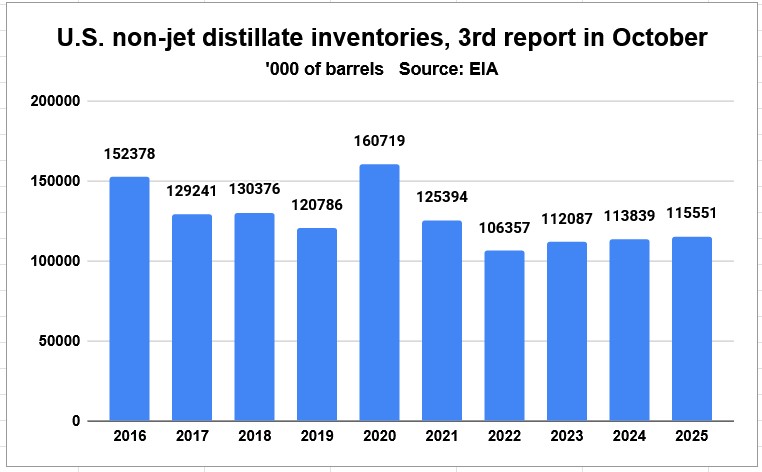
For the third week of October, last week’s report by the Energy Information Administration had non-jet distillate stocks, which are about 90% diesel, at about 115 million barrels. That is more than where inventories stood for the third week of October in the prior three years.
But that total is significantly less than the amount held at this point on the calendar in the years leading up to the pandemic. Stocks during those years ranged from a high of about 152 million barrels in 2016 to 120 million barrels in 2019.
In other bearish news reported in recent days, almost 1.4 billion barrels of oil are now on board crude tankers, according to data from Vortexa Ltd. That’s the highest figure going back to 2016.
The size of the flotilla measured by Vortexa has been rising for 10 weeks, according to the media reports citing the firm’s analysis. The jump has been fueled by increasing production from the OPEC+ group of oil exporters, which is unwinding its production cuts at a rapid pace.
Those increases are creating the growing view that the supply/demand balance in oil could be headed for a glut by the end of the year or into 2026.
More articles by John Kingston
Factoring companies squeezed by slowing shipper payments: Alsobrooks
DAT execs in two forums discuss how it seeks to reshape the freight sector
Brokerage Compliance Symposium
The day before F3. Every compliance issue you face - fraud exposure, carrier liability, FMCSA rules, cargo theft, insurance gaps - navigated by attorneys and operators defining best practices in a changing industry.
F3 Awards Dinner
The night before F3. FreightTech100 companies honored. FreightTech 25 and Shipper of Choice winners revealed live. Cocktail reception into dinner and live music - 300 industry leaders in one purpose-built room.
F3: Future of Freight Festival
Industry-defining keynotes, rapid-fire technology demos, and industry leaders networking in experiences across Chattanooga - plus the inaugural F3 Awards Dinner featuring the FreightTech and Shipper of Choice reveals.
The day before F3. Every compliance issue you face - fraud exposure, carrier liability, FMCSA rules, cargo theft, insurance gaps - navigated by attorneys and operators defining best practices in a changing industry.
The Signal at Chattanooga Choo Choo • Chattanooga, TN Register NowThe night before F3. FreightTech100 companies honored. FreightTech 25 and Shipper of Choice winners revealed live. Cocktail reception into dinner and live music - 300 industry leaders in one purpose-built room.
The Signal at Chattanooga Choo Choo • Chattanooga, TN Register NowIndustry-defining keynotes, rapid-fire technology demos, and industry leaders networking in experiences across Chattanooga - plus the inaugural F3 Awards Dinner featuring the FreightTech and Shipper of Choice reveals.
The Signal at Chattanooga Choo Choo • Chattanooga, TN Register Now