The benchmark price used for most diesel surcharges fell for the sixth time in the last seven weeks, with the prospect of more declines ahead.
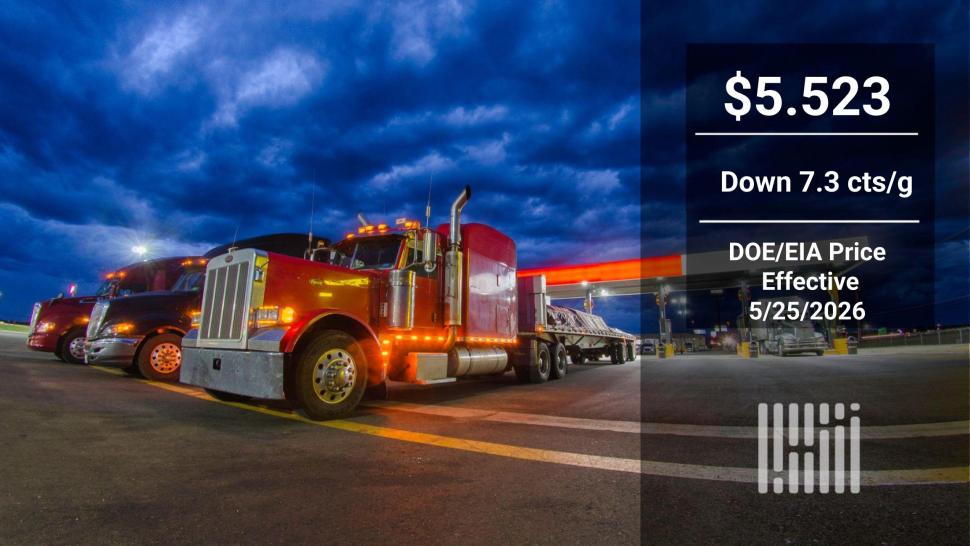
This week’s Department of Energy/Energy Information Administration average weekly retail diesel price fell 7.3 cents/gallon to $5.523/g.
Despite the six out of seven ratio, the benchmark used for most fuel surcharges is still more than where it was four weeks ago, $5.351/g on April 27. That’s because three weeks ago the DOE/EIA recorded a 28.9 cts/g gain.
The latest decline comes against a backdrop of steep declines in the futures price of ultra low sulfur diesel (ULSD) on the CME commodity exchange, as markets sell off on the prospect of some sort of peace deal among the U.S., Iran and Israel that could reopen the Strait of Hormuz to full or at least limited traffic.
Sliding on CME
The scorecard on ULSD on CME is that it hit a recent peak settlement of $4.1625/g May 19. With talk emerging after that of a possible peace deal, the settlement plummeted to $3.7146/g on Tuesday, a decline of 44.79 cts/g, or 10.8%.
In Wednesday morning trading, ULSD at approximately 9:40 a.m. was $3.5409/g, down 12.85 cts/g or 3.47%. If it settled at that level, it would be the lowest settlement since April 20.
As the energy research team at Merrill Lynch said in a recent note, “There have been several false starts around reopening – i.e. the Apr 1 US claims that Iran asked for ceasefire, the Apr 8 joint announcement of ceasefire, the May 6 claims of progress made toward peace, etc.”
But as the report also noted–referring to energy-related stocks but in a statement that could be applied to petroleum commodities as well–”even though the strait remains closed, some energy investors are hesitant to add to energy stocks, knowing the strait could reopen soon and stocks could drop materially.”
While the Trump administration continues to claim that oil prices will come down sharply should some sort of peace agreement take hold, voices from the industry themselves are less sure of a coming deep slide in price, even if there is an initial bearish selloff.
Inventories will need to be restocked
In that Merrill report, the prospect of the oil industry needing to restore inventories back toward normal levels was highlighted. That would provide a source of demand that may not be getting priced in to the market at this point.
“The world has lost 3- to 4-million barrels/day of damaged Persian Gulf refined product capacity and 11-million b/d of net crude flows as the Iran War and Hormuz Strait closure reaches day 85,” the report said. “We assume that after this, strategic petroleum reserves of both will be fully refilled, and commercial storage will be refilled to at least the midpoint.”
Merrill’s math is that there will be 1.2 billion barrels of crude restocking demand, and 300 million barrels of restocking demand for refined products. At 1.5 billion barrels between the two, that’s almost 15 days’ worth of total daily pre-war global oil demand that would be needed just to bring inventories back to a more normal level.
Small loss of supply can have big impact
Jeffrey Currie, the former head of commodity research at Goldman Sachs who has been one of the loudest bullish voices during the Iran war, said in a recent interview that the impact of reducing oil supplies by roughly 20% because of the closure of the strait can’t be measured by simple mathematical calculations.
Currie, in an interview with CNBC, discussed two previous price spikes: the 2008 surge to almost $150/b, and the jump in prices after Russia invaded Ukraine.
“What’s very different here from other times is that at the higher prices, you still had availability,” he said. “What’s different now is that we’re getting to a point where as you pull that molecule out of the system, it has a big impact on growth.”
Currie compared it to recent squeezes on rare earth supplies impacting car manufacturing.
Rare earths were the raw material that went into magnets in car doors, Currie said, “and you take the battery out or you took the magnet out, you shut down Detroit,” Currie said.
He made an analogy to recent increases in copper prices. Copper production is dependent on sulfuric acid, and restrictions on sulfur exports out of the Middle East means that sulfuric acid markets have been squeezed as well.
“(Markets) are not going to pay attention until it actually creates real shortages and forces them to,” Currie said.
More articles by John Kingston
Crucial changes in latest NJ independent contractor rule impacting truckers
New pot of money available to buy ZEV trucks in California
Nuclear verdict alert: almost $50M against a mystery Texas trucking company
Brokerage Compliance Symposium
The day before F3. Every compliance issue you face - fraud exposure, carrier liability, FMCSA rules, cargo theft, insurance gaps - navigated by attorneys and operators defining best practices in a changing industry.
F3 Awards Dinner
The night before F3. FreightTech100 companies honored. FreightTech 25 and Shipper of Choice winners revealed live. Cocktail reception into dinner and live music - 300 industry leaders in one purpose-built room.
F3: Future of Freight Festival
Industry-defining keynotes, rapid-fire technology demos, and industry leaders networking in experiences across Chattanooga - plus the inaugural F3 Awards Dinner featuring the FreightTech and Shipper of Choice reveals.
The day before F3. Every compliance issue you face - fraud exposure, carrier liability, FMCSA rules, cargo theft, insurance gaps - navigated by attorneys and operators defining best practices in a changing industry.
The Signal at Chattanooga Choo Choo • Chattanooga, TN Register NowThe night before F3. FreightTech100 companies honored. FreightTech 25 and Shipper of Choice winners revealed live. Cocktail reception into dinner and live music - 300 industry leaders in one purpose-built room.
The Signal at Chattanooga Choo Choo • Chattanooga, TN Register NowIndustry-defining keynotes, rapid-fire technology demos, and industry leaders networking in experiences across Chattanooga - plus the inaugural F3 Awards Dinner featuring the FreightTech and Shipper of Choice reveals.
The Signal at Chattanooga Choo Choo • Chattanooga, TN Register Now