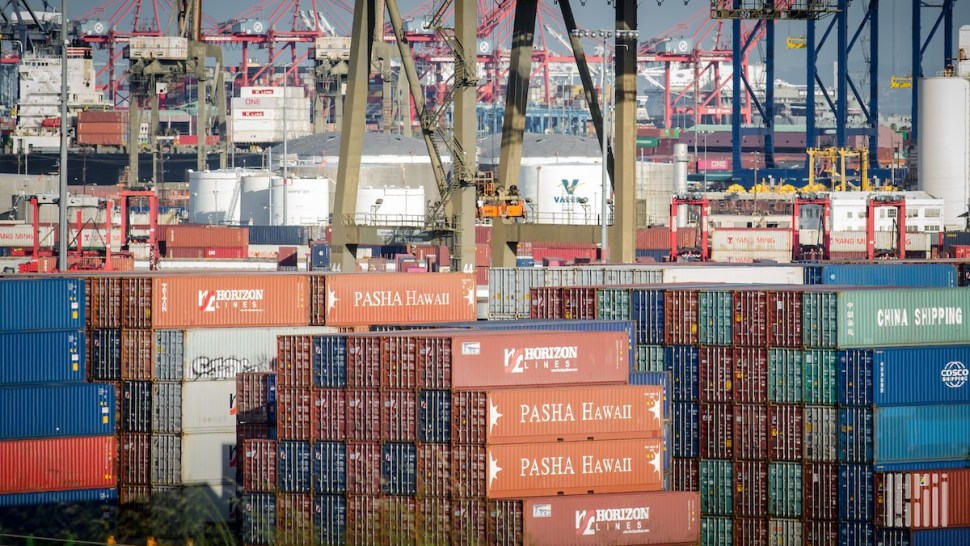
The effects of the Iran war are being felt across the global supply chain, as container rates rise sharply on vital headhaul trade routes including to the United States, an analyst said.
“Five weeks into the Strait of Hormuz closure and spot rates on every major east-west trade lane have risen sharply, showing this is a conflict with global repercussions for ocean supply chains,” said Peter Sand, Xeneta chief analyst. “No shipper is insulated from financial or operational risk. Far East to U.S. West Coast – a trade which transits the Pacific thousands of miles from the epicenter of conflict – has seen spot rates climb 29% since the end of February.”
Spot prices on services from the Far East to North Europe and Mediterranean – trades with direct exposure to the Middle East disruption – have climbed 31% and 30% since the end of February.
Port congestion in the Middle East has rippled across to key Asian transshipment hubs — including Singapore, Port Klang and Tanjung Pelepas — which are also vital for feeding goods toward the U.S.
Sand said shipper memories are fresh from the Red Sea crisis in 2024, even on trades with no direct exposure to the Middle East.
“The position of carriers is unambiguous – the cost of uncertainty sits with the shipper,” said Sand, noting that attacks on Red Sea shipping by Yemen-based Houthi rebels led port congestion in Singapore to double already-elevated rates. This time, shippers aren’t waiting around and are securing capacity at today’s rates.
“Shippers booking capacity today are paying a premium for certainty, but it is a calculated risk against being caught short in peak season three months from now and paying even higher rates,” said Sand. “Shippers who wait for conditions to stabilize are placing a bet with no clear evidence behind it.”
Market average spot rates tracked by Xeneta as of April 1 from Asia to the U.S. West Coast were $2,430 per 40 ft. container, and $3,382 from Asia to U.S. East Coast ports. North Europe to U.S. East Coast stood at $1,775.
Despite concerns, fuel shortages for vessels from Hormuz and attacks by Iran on Persian Gulf refining have yet to materialize.
Fuel at Singapore, the world’s leading bunkering hub, remains available, Sand said, though at roughly double pre-crisis prices. They are trending slowly downward after an initial spike of around 200%. Rotterdam prices continue rising, and ship-to-ship fuel transfers in the Far East are adding cost and complexity.
“With no visible end to the crisis, however, carriers are almost certainly drawing up another set of contingency plans. The coming weeks will show whether slow steaming and alternative routing can hold the line, or whether blank sailings become the next lever carriers reach for.”
Maersk (MAERSK-B.CO), the world’s second-largest container carrier, for the second time has asked the Federal Maritime Commission to waive the 30-day waiting period to implement emergency fuel surcharges. The agency in late March rejected an initial request from Maersk and other carriers; a spokesperson said the regulator would rule today on the latest request.
Read more articles by Stuart Chirls here.
Related coverage:
Trump mulls Iran exit without re-opening Strait of Hormuz; new attack on tanker
South Korean-owned U.S. shipyard gets first Navy contract
Brokerage Compliance Symposium
The day before F3. Every compliance issue you face - fraud exposure, carrier liability, FMCSA rules, cargo theft, insurance gaps - navigated by attorneys and operators defining best practices in a changing industry.
F3 Awards Dinner
The night before F3. FreightTech100 companies honored. FreightTech 25 and Shipper of Choice winners revealed live. Cocktail reception into dinner and live music - 300 industry leaders in one purpose-built room.
F3: Future of Freight Festival
Industry-defining keynotes, rapid-fire technology demos, and industry leaders networking in experiences across Chattanooga - plus the inaugural F3 Awards Dinner featuring the FreightTech and Shipper of Choice reveals.
The day before F3. Every compliance issue you face - fraud exposure, carrier liability, FMCSA rules, cargo theft, insurance gaps - navigated by attorneys and operators defining best practices in a changing industry.
The Signal at Chattanooga Choo Choo • Chattanooga, TN Register NowThe night before F3. FreightTech100 companies honored. FreightTech 25 and Shipper of Choice winners revealed live. Cocktail reception into dinner and live music - 300 industry leaders in one purpose-built room.
The Signal at Chattanooga Choo Choo • Chattanooga, TN Register NowIndustry-defining keynotes, rapid-fire technology demos, and industry leaders networking in experiences across Chattanooga - plus the inaugural F3 Awards Dinner featuring the FreightTech and Shipper of Choice reveals.
The Signal at Chattanooga Choo Choo • Chattanooga, TN Register Now