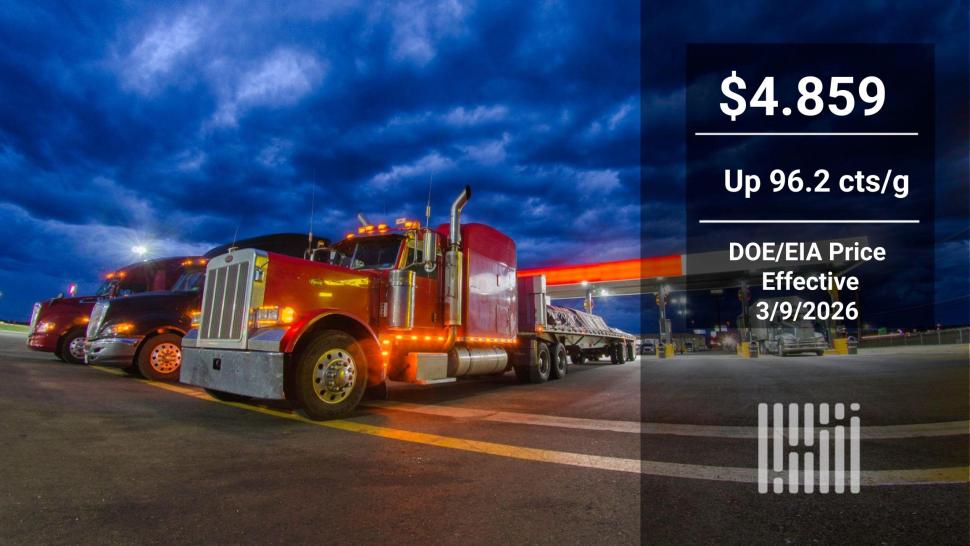
The price used to set most fuel surcharges has recorded its biggest one-week move in the history of the series.
The Department of Energy/Energy Information Administration average weekly retail price rose 96.2 cents/gallon to $4.859/g, effective Monday and published Tuesday. The history of the series goes back to March 1994.
An increase of 74.5 cts/g on March 7, 2022, right after Russia invaded Ukraine, had been the largest increase prior to this week’s move.
Given the sheer size of the latest increase, what has happened in prior weeks seems almost irrelevant. But the big upward move marks eight consecutive weeks of increases. The price is now $1.40/g higher following that string of higher prices.
Not since December 5, 2022, when the benchmark was $4.967/g, has the DOE/EIA price been this high.
The increase comes as oil markets made a sharp reversal Tuesday, with diesel having made some of that shift a day earlier.
At approximately 10:40 a.m. EDT Tuesday, ultra low sulfur diesel (ULSD) on the CME commodity exchange was down 14.01 cts/g to $3.4465/g, a drop of 3.91%.
The ride has been wild between Monday and Tuesday.
Although ULSD settled Monday at $3.5866/g, down 3.58 cts/g on the day, it traded as high as $4.4715/g. And mid-morning Tuesday, ULSD had traded as low as $3.3047/g, for a swing of about $1.17 between the high price and low price beginning with the start of Monday trading which actually occurred Sunday at 6 p.m. Eastern time. It was those early hours Sunday evening U.S. time when prices soared to their high levels.
Such volatility could be expected in a combination of uncertainty about the level of transit across the Strait of Hormuz and statements by President Trump that the Iran War might soon be over.
But reporting out of S&P Global Energy did not give much hope that restricted supplies will soon be in the rearview mirror.
According to a “factbox” produced by S&P Global Energy, only four ships transited the Strait of Hormuz on March 8. On February 28, that number was 91. (There have been reports of ships turning off their transponders, which could raise questions about the actual number of ships going through the waterway).
The factbox also quoted a report from Goldman Sachs from Monday that said traffic through the Strait of Hormuz was 10% of normal.
S&P Global Energy has a service, Commodities at Sea, which said Persian Gulf loadings were 3 million barrels on Sunday. The normal daily level is closer to 20 million b/d.
That would line up with other reporting from S&P Global Energy. It reported that last week, about 17 million b/d of crude and products failed to sail out of the Persian Gulf, driven in part by production shutdowns in Iraq and Kuwait.
Those countries, with their storage filling up and the export routes either totally shut or limited, shut in production. The longer-term concern is that shut-in wells do not come back as if flipping a light switch. They take varying degrees of time to return to their pre-shutdown status, a process that can be measured in weeks or months, not hours.
More articles by John Kingston
Derek Barrs defends FMCSA’s bold moves at TCA
Broker liability at SCOTUS: judges debate meaning of ‘motor vehicles’
What’s going on at the Louisiana staged truck accident trial?
Brokerage Compliance Symposium
The day before F3. Every compliance issue you face - fraud exposure, carrier liability, FMCSA rules, cargo theft, insurance gaps - navigated by attorneys and operators defining best practices in a changing industry.
F3 Awards Dinner
The night before F3. FreightTech100 companies honored. FreightTech 25 and Shipper of Choice winners revealed live. Cocktail reception into dinner and live music - 300 industry leaders in one purpose-built room.
F3: Future of Freight Festival
Industry-defining keynotes, rapid-fire technology demos, and industry leaders networking in experiences across Chattanooga - plus the inaugural F3 Awards Dinner featuring the FreightTech and Shipper of Choice reveals.
The day before F3. Every compliance issue you face - fraud exposure, carrier liability, FMCSA rules, cargo theft, insurance gaps - navigated by attorneys and operators defining best practices in a changing industry.
The Signal at Chattanooga Choo Choo • Chattanooga, TN Register NowThe night before F3. FreightTech100 companies honored. FreightTech 25 and Shipper of Choice winners revealed live. Cocktail reception into dinner and live music - 300 industry leaders in one purpose-built room.
The Signal at Chattanooga Choo Choo • Chattanooga, TN Register NowIndustry-defining keynotes, rapid-fire technology demos, and industry leaders networking in experiences across Chattanooga - plus the inaugural F3 Awards Dinner featuring the FreightTech and Shipper of Choice reveals.
The Signal at Chattanooga Choo Choo • Chattanooga, TN Register Now