




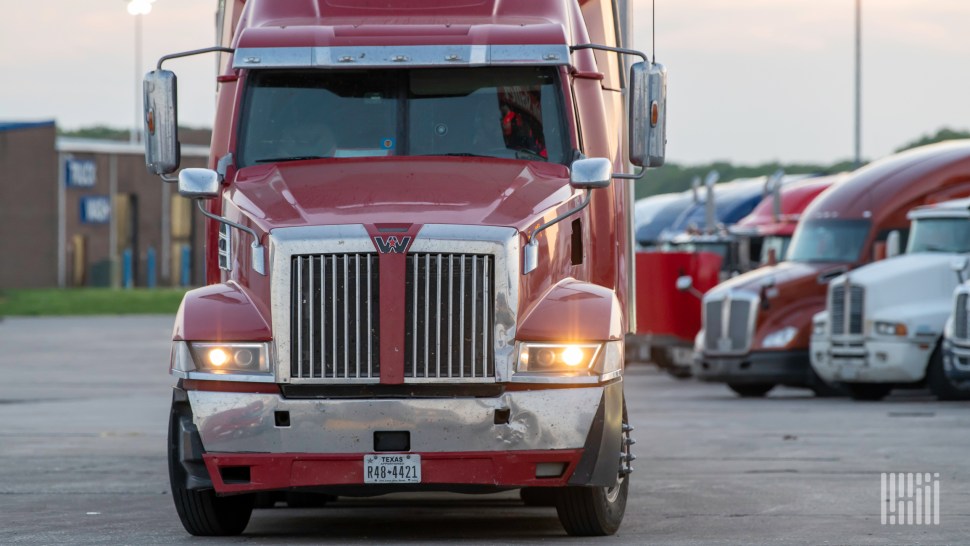
New research links truck drivers who violate English-language proficiency (ELP) rules to higher rates of safety violations and poor carrier safety scores – but cautions against assuming that a driver’s lack of English proficiency is the cause.
Join the leaders shaping freight’s future at
F3: Future of Freight Festival, Oct 21-22.
Network with the industry’s best and discover what’s next.
With thousands of injuries and deaths related to truck accidents every year, “it is important to develop and implement policies that identify unsafe drivers and carriers,” the study points out, which was co-written by Alex Scott, associate professor of supply chain management at the University of Tennessee at Knoxville.
“Thus, it is worth examining whether truck drivers who violate ELP regulations are in fact less safe compared to all truck drivers, and whether the carriers that employ these drivers are less safe compared to their peers.”
For the purposes of the study, Scott focused on the Unsafe Driving, Vehicle Maintenance, and HOS Compliance from among the seven different safety categories, known as BASICs (Behavior Analysis and Safety Improvement Category) tracked and scored by the Federal Motor Carrier Safety Administration, with higher scores indicating worse safety performance, as defined by the FMCSA.
Using roadside inspection data from May 1 through September 21, the study found that inspections with an ELP violation had 2.5 times the number of total non-ELP violations relative to a comparison group, and almost 3 times the rate for the most egregious driver violations.
Carriers with ELP violations, the study found, have “bad” safety scores as measured by FMCSA. Bad scores were especially true for the vehicle maintenance and unsafe driving categories, where average carrier scores would often be in “alert” status as defined by FMCSA, which indicates a serious violation was found.
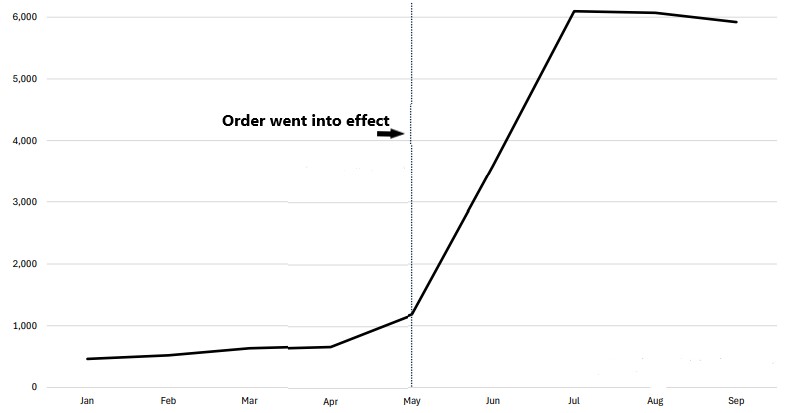
The study also revealed a “steady uptick” in enforcement in June and July, following President Trump’s April executive order cracking down on English language requirements for truck drivers – but not everywhere: California basically ignored the order, the research found, with state inspectors there citing fewer ELP violations after the order was issued compared to before.
Source: Alex Scott et al., UT Knoxville.
In fact, ELP violations were found at “vastly different rates across states,” the report notes, as well as when comparing federal with state inspectors, with federal inspectors reporting ELP violations at much higher rates. Rates of ELP violations on the federal level were more than 3.5 times that of Wyoming, the state with the highest rate.
Safety ratings of carriers with ELP violations were worse on average than carriers without ELP violations (see table – the higher the score the worse a carrier’s safety performance).

The average BASIC measure score in the Vehicle Maintenance category for carriers with ELP violations was 9.06, and the score for Unsafe Driving was 6.23.“These are very high scores, indicating poor safety performance,” the study notes.
Hours-of-service compliance for carriers with ELP violations was also higher, for all carriers as well as for for-hire interstate non-passenger carriers.
The study also looked at safety scores of U.S.-based versus non-U.S. based carriers – carriers based in Canada or Mexico – which are also tracked by FMCSA (for violations that occur within the U.S.).

Carriers based in the US had much higher (i.e., less safe) HOS Compliance BASIC scores compared to non-US carriers, “likely explained by the fact that US-based carriers are likely traveling longer distances and performing typical over-the-road operations,” the study notes, whereas non-US carriers likely are traveling shorter distances for border crossings during the day, when HOS violations are unlikely to occur, it speculates.
US-based carriers also had high unsafe driving scores. Both US based and non-US based carriers had bad Vehicle Maintenance scores, but non-US based carriers had an average score of 12.25, which is “very high,” the study acknowledges.
Causal relationship lacking
While the study could be used to support enforcement of ELP regulations as a way to identify an unsafe segment of the trucking industry, it does not prove that restricting this population based on language alone will directly eliminate the safety risk.
“The findings … do not suggest that a lack of English-language proficiency causes these violations and poor carrier safety scores, just that they are correlated,” the study points out, noting two possible explanations for the correlation.
“First, if a driver cannot speak English, then the driver is unlikely to be able to understand the extensive federal rules and regulations governing trucking. This could contribute to a lack of understanding of how trucks are expected to be maintained or how hours of service rules are expected to be followed.
“Second, it is possible that non-English speaking drivers are taken advantage of by unscrupulous carriers and managers at those carriers. It is possible that unsafe carriers hire drivers who cannot speak English and then push them to perform unsafely. If that is the case, then actions should be taken to protect drivers from those management practices.”
Related articles:
Brokerage Compliance Symposium
The day before F3. Every compliance issue you face - fraud exposure, carrier liability, FMCSA rules, cargo theft, insurance gaps - navigated by attorneys and operators defining best practices in a changing industry.
F3 Awards Dinner
The night before F3. FreightTech100 companies honored. FreightTech 25 and Shipper of Choice winners revealed live. Cocktail reception into dinner and live music - 300 industry leaders in one purpose-built room.
F3: Future of Freight Festival
Industry-defining keynotes, rapid-fire technology demos, and industry leaders networking in experiences across Chattanooga - plus the inaugural F3 Awards Dinner featuring the FreightTech and Shipper of Choice reveals.
The day before F3. Every compliance issue you face - fraud exposure, carrier liability, FMCSA rules, cargo theft, insurance gaps - navigated by attorneys and operators defining best practices in a changing industry.
The Signal at Chattanooga Choo Choo • Chattanooga, TN Register NowThe night before F3. FreightTech100 companies honored. FreightTech 25 and Shipper of Choice winners revealed live. Cocktail reception into dinner and live music - 300 industry leaders in one purpose-built room.
The Signal at Chattanooga Choo Choo • Chattanooga, TN Register NowIndustry-defining keynotes, rapid-fire technology demos, and industry leaders networking in experiences across Chattanooga - plus the inaugural F3 Awards Dinner featuring the FreightTech and Shipper of Choice reveals.
The Signal at Chattanooga Choo Choo • Chattanooga, TN Register Now