




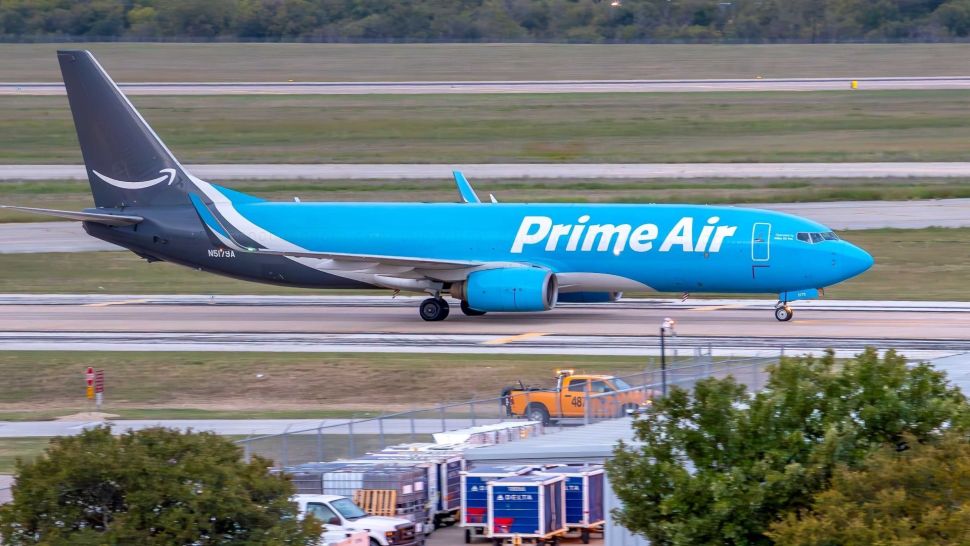
Sun Country Airlines in the first quarter took possession of three Amazon cargo jets, but only one is in service so far for the retail and logistics giant because integrating them into the existing fleet requires additional work, the company said Friday.
Amazon is transferring eight leased Boeing 737-800 converted freighters to Sun Country (NASDAQ: SCNY) from previous contractor Atlas Air. Sun Country plans to have all the narrowbody freighters in service by the end of summer, bringing the dedicated Amazon (NASDAQ: AMZN) fleet to 20 aircraft and doubling the airline’s cargo revenue.
The initial Amazon-supplied aircraft began flying packages in late March. The other two cargo jets will be inducted into the fleet this quarter, the Minneapolis-based carrier said in its latest financial results.
Sun Country CEO Jude Bricker told analysts on the quarterly earnings call that the amount of preparation necessary to absorb each used 737-800 freighter into the fleet varies because they may need parts to be replaced or inconsistent maintenance records to be resolved during the transition from the prior operator.
The integration delays increase costs because Sun Country has staffed up on pilots to operate the aircraft and can’t temporarily switch them to passenger operations because scheduled flights are planned months in advance and demand for ad hoc charters is difficult to project, he explained. It should be noted that delays so far are minor, and the entry-into-service timeline for all eight freighters is unchanged.
Sun Country has a unique hybrid business model based on seasonal scheduled passenger service to sun-and-fun travel destinations, a charter business for sports teams and other groups – which uses the same aircraft – and cargo flying.
Bringing an aircraft into a certificated airline’s fleet involves many steps to meet safety, regulatory and operational requirements, as well as company standards. The process includes reviewing the maintenance history; conducting thorough inspections of the engines, systems and airframe; updating operational manuals; training pilots, technicians and ground personnel; customization; and obtaining approval from civil aviation authorities.
“Those airplanes are coming just as rapidly as we can put them in there, but there’s a process of putting it on the certificate, getting the transition mods completed and then getting them scheduled. And we’re running behind for reasons beyond our control,” Bricker said. “So it’s going to be a little lumpy as we move through the transition, but I expect in September to be operating 20 airplanes.”
During the first quarter, Sun Country’s cargo revenue increased 17.6% year over year to $28.2 million, despite a 1% decline in cargo block hours due to normalization of flight schedules and some weather events. The improvement was primarily due to an annual rate escalation in the Amazon contract that went into effect in December and the new contract for the extra freighters. Cargo revenue per block hour, a measure of productivity, increased 18.9%
The cargo division’s operating income was $1.5 million versus a $1.3 million loss in the prior year.
Bricker reiterated that Sun Country will begin to double its cargo revenue in the fourth quarter, when the full fleet is in service. In 2024, the company achieved record cargo revenue of $107 million.
The airline is drawing down some of its scheduled passenger service over the next year to ensure it has a sufficient number of pilots to reliably manage the Amazon growth.
Overall revenue across Sun Country increased by $15 million to $326.6 million, and net income inched up to $36.5 million.
Sun Country began supporting Amazon’s air network in 2020.
Click here for more FreightWaves/American Shipper stories by Eric Kulisch.
RELATED READING:
Amazon airline prioritizes bigger aircraft to handle third-party cargo
Sun Country expects to double cargo revenue with Amazon fleet additions
Amazon transferring Boeing 737-800 cargo jets to Sun Country Airlines
Brokerage Compliance Symposium
The day before F3. Every compliance issue you face - fraud exposure, carrier liability, FMCSA rules, cargo theft, insurance gaps - navigated by attorneys and operators defining best practices in a changing industry.
F3 Awards Dinner
The night before F3. FreightTech100 companies honored. FreightTech 25 and Shipper of Choice winners revealed live. Cocktail reception into dinner and live music - 300 industry leaders in one purpose-built room.
F3: Future of Freight Festival
Industry-defining keynotes, rapid-fire technology demos, and industry leaders networking in experiences across Chattanooga - plus the inaugural F3 Awards Dinner featuring the FreightTech and Shipper of Choice reveals.
The day before F3. Every compliance issue you face - fraud exposure, carrier liability, FMCSA rules, cargo theft, insurance gaps - navigated by attorneys and operators defining best practices in a changing industry.
The Signal at Chattanooga Choo Choo • Chattanooga, TN Register NowThe night before F3. FreightTech100 companies honored. FreightTech 25 and Shipper of Choice winners revealed live. Cocktail reception into dinner and live music - 300 industry leaders in one purpose-built room.
The Signal at Chattanooga Choo Choo • Chattanooga, TN Register NowIndustry-defining keynotes, rapid-fire technology demos, and industry leaders networking in experiences across Chattanooga - plus the inaugural F3 Awards Dinner featuring the FreightTech and Shipper of Choice reveals.
The Signal at Chattanooga Choo Choo • Chattanooga, TN Register Now