What is LTL?
Anthony and Zach break down the less-than-truckload sector and talk about its connection with truckload along with giving a quick update on the latest economic and freight market trends.
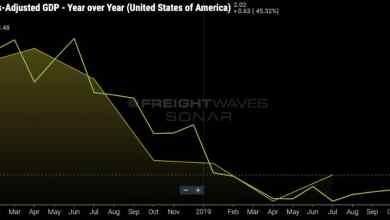

The overall GDP number is not very useful when looking for insight into freight conditions in the economy. The U.S. economy is dominated by the service sector, which includes segments like healthcare, education and financial services. These areas make up over half of all of the economic activity in the U.S., but do not play a significant role in freight movements in the economy. As a result, as long as the service sector is healthy, the U.S. economy can continue to grow even if the production and transportation of goods is stalling.
Market Expert Anthony Smith writes about the factors that will affect the U.S. economy in 2020 and what that willl mean for business.
Tender rejections above 10 for the first time in 2019, volumes are holding and holiday rates are cheery.
Critical events caused more panic than actual disruption to supply and demand.
The German economy shrunk by 0.1 percent in the second quarter of 2019, sparking fears of a recession.
The marketplace for truckload transportation is fragmented and opaque. Relationships between shippers and carriers are tenuous at best, forged and broken by wild swings in capacity availability and rates per mile. In this white paper, Transfix and FreightWaves define the problems distorting the marketplace for truckload transportation, discuss how carriers think about their assets, explain the role of technology in reducing empty miles, and sketch out the economic dynamics that come into play when the marketplace is optimized to free up capacity at the right price.
July PPI data showed another decline in trucking rates as yearly growth will likely turn negative soon.
Donald Broughton writes a thought-provoking commentary about how technology has killed inflation.
The Fed cut interest rates for the first time in over a decade. Shippers and carriers should benefit as the economy looks to reaccelerate
Donald Broughton’s third article about the impact of the gross domestic product and how it can be useful for business intelligence and forecasting is a must-read.
Job growth rebounded nicely in June as the economy added 224,000 workers to payrolls during the month. The transportation and logistics sector was one of the many areas of strength in June, led by improved gains among parcel and trucking companies.
Donald Broughton writes the second part of his look at the Gross Domestic Product (GDP) and how transportation professionals can tweak GDP numbers to better understand and forecast the business environment they are competing in.
Market expert Donald Broughton explains how the U.S. gross domestic product can be a valuable tool by trucking companies (and others).
Retail and industrial activity improved, providing some stability for freight Economic data from the goods side of the economy showed some signs of life in May, as growth in retail sales and industrial production exceeded expectations during the month. This is an encouraging sign that activity may be stabilizing in the second quarter, though details […]
President Trump’s recent announcement of tariffs on Mexico marks a sharp departure from previous moves with potentially disastrous results for U.S. businesses and supply chains
FreightWaves is providing a forum – Market Voices – for a number of market experts. Last week I wrote about why the ongoing decline in lumber shipments and the ongoing decline in housing starts should be a growing concern, and that continued contraction in this industry had several significant waves of secondary and tertiary economic […]
Transport ministers from 60 countries met at Leipzig to discuss strategies and the implication of global carbon emissions.