




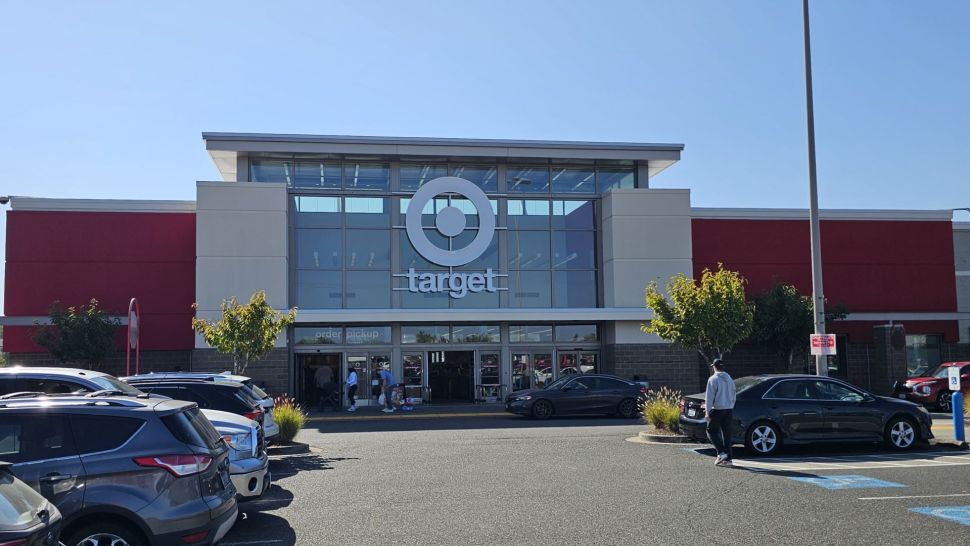
Target is expanding next-day delivery for online orders to the 35 top U.S. metropolitan areas as it looks to better compete with Walmart, Amazon and other retailers.
The company said last week that the faster service option will be available in those markets, including Cleveland; Orlando, Florida; and Pittsburgh by the end of October. The rollout comes ahead of the busy holiday shopping season.
The nation’s eighth largest retailer by revenue said it plans to expand next-day delivery to more than 20 areas next year as it continues renovating stores to be mini-fulfillment centers.
Next-day delivery is free for orders over $35 or with no minimum order amount if a person is a Target Circle 360 member or uses a Target credit card for purchases. Most items eligible for shipping are eligible for next-day delivery, including 85% of goods sold in physical stores, Target said in a news release.
Target (NYSE: TGT) already reaches 80% of the U.S. population with same-day delivery and 99% of the country two-day shipping.
During the second quarter, Target delivered over 2 million more packages the next day than it did during the period a year earlier, according to Gretchen McCarthy, executive vice president and chief supply chain & logistics.
Amazon delivered more than 9 billion items the same day or next day in 2024 and provides same-day delivery to 140 metro areas. Walmart says it reaches 95% of the U.S. population with same-day or next-day delivery and told the Associated Press it delivered 7.1 billion packages last year.
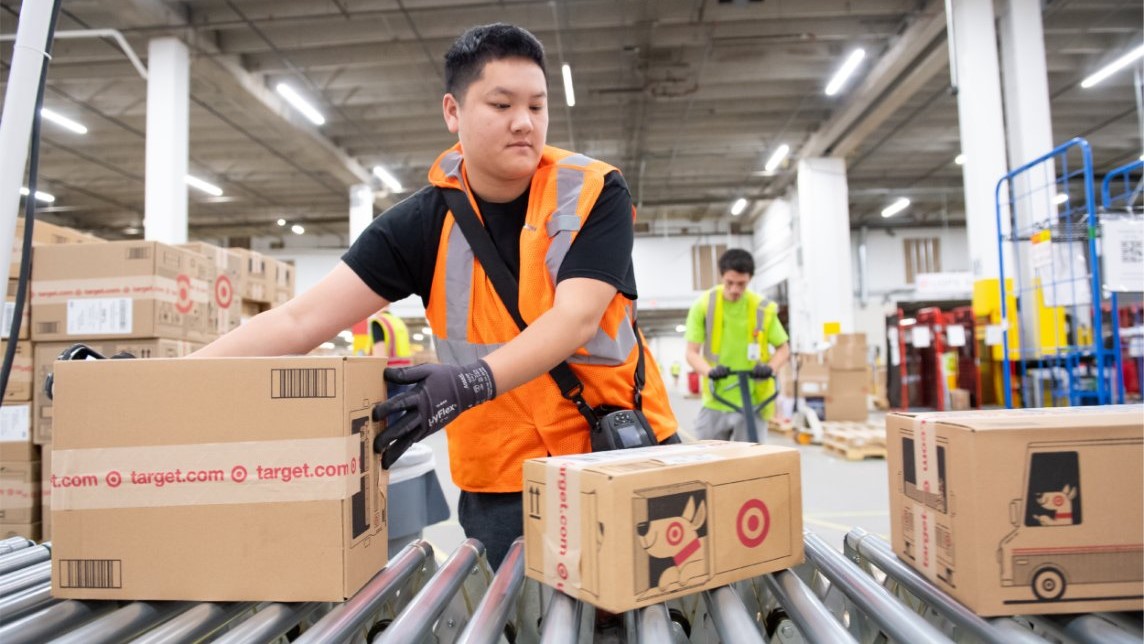
Under Target’s logistics model stores serve as fulfillment hubs, which the company says increases efficiency and lowers cost. Target retrieves packages from local stores and brings them to one of 11 sortation centers to sort, batch and route for delivery to local neighborhoods by Shipt, its delivery subsidiary, or third-party carriers. About 30 to 40 local stores feed each sortation center, depending on the market. Orders are assigned to stores based on inventory, staffing levels, backroom size and cost-to-serve.
Target says that removing the sorting and packing process from store backrooms saves valuable time and space for store teams to fulfill additional orders and serve customers. Also, because sortation center technology presorts and arranges packages for easy pickup, it reduces processing time for delivery partners.
Shipt relies on independent drivers that choose assignments through an app and use their own cars to make residential deliveries.
“Within areas with high or growing guest demand for shipping, we looked at where the density of our stores and supply chain assets would allow for next-day operations in a cost-effective way. That cost factor is key: Our digital business is profitable and as digital demand continues to rise, our supply chain needs to keep enabling that growth in ways that are good for Target’s bottom line,” McCarthy said in a Q&A article on the company’s website.
Advancements to Target’s routing and forecasting technology have enabled it to extend the time customers can place an order and get it the next day. The majority of next-day delivery markets have an “order by” time of 3 p.m. (local) or later, with several as late as 6 p.m.
Target also offers shoppers the convenience of order pickup and drive up at most of its 2,000 stores.
Adjusting store-as-hub model
“Improving Target’s digital experience means improving this fulfillment experience. So, this year we’ve introduced a new strategy that evaluates every store and supply chain facility at a granular level to ensure each one is focused on the work they do best within fulfillment. We’re refining how we use our buildings so we can deliver as fast and cost effectively as possible while reducing complexity for stores where needed,” said McCarthy.
Target tested next-day delivery in Chicago before implementing the expansion because it has dozens of stores, two fulfillment centers and two sortation centers. In the area, Target has concentrated a higher percentage of shipping volume into six stories, removed shipping capabilities from 18 stores and increased the amount of shipping volume processed by fulfillment centers. McCarthy said Target’s logistics team was able to make the logistics adjustments within a few weeks.
“Results so far show that we’re almost a full day faster with shipping and we’ve been able to offer next-day delivery on five times more of the local shipping demand. That increase of promise speed is leading to incremental sales gains, which we saw almost immediately in certain categories like baby and household cleaning,” McCarthy said. “Local fulfillment cost per unit is also significantly lower than before the test and Chicago has become one of our least expensive shipping markets across the network — proving that we can be faster for our guests and cheaper for our business at the same time.
“We’re also seeing the benefits of simplified operations in the stores no longer doing shipping. Many of those stores consistently beat sales forecasts throughout the summer months and team members are preparing Pickup and Drive Up orders at quicker rates,” she added.
Lessons from the Chicago experiment are guiding how and where next-day delivery is offered, with the capability turned off at some stories and turned on at others based on local demand and needs.
“Behind the scenes, we’re concentrating shipping operations within select stores in 10 other markets and transitioning them out of many stores across 36 markets. We’ll continue rolling out the strategy in different ways per market as we work to get faster,” McCarthy said.
Write to Eric Kulisch at ekulisch@freightwaves.com.
Click here for more FreightWaves/American Shipper stories by Eric Kulisch.
RELATED STORIES:
Amazon opens fulfillment services to Shein, Shopify and Walmart sellers
Veho brings e-commerce delivery network to southern California
Brokerage Compliance Symposium
The day before F3. Every compliance issue you face - fraud exposure, carrier liability, FMCSA rules, cargo theft, insurance gaps - navigated by attorneys and operators defining best practices in a changing industry.
F3 Awards Dinner
The night before F3. FreightTech100 companies honored. FreightTech 25 and Shipper of Choice winners revealed live. Cocktail reception into dinner and live music - 300 industry leaders in one purpose-built room.
F3: Future of Freight Festival
Industry-defining keynotes, rapid-fire technology demos, and industry leaders networking in experiences across Chattanooga - plus the inaugural F3 Awards Dinner featuring the FreightTech and Shipper of Choice reveals.
The day before F3. Every compliance issue you face - fraud exposure, carrier liability, FMCSA rules, cargo theft, insurance gaps - navigated by attorneys and operators defining best practices in a changing industry.
The Signal at Chattanooga Choo Choo • Chattanooga, TN Register NowThe night before F3. FreightTech100 companies honored. FreightTech 25 and Shipper of Choice winners revealed live. Cocktail reception into dinner and live music - 300 industry leaders in one purpose-built room.
The Signal at Chattanooga Choo Choo • Chattanooga, TN Register NowIndustry-defining keynotes, rapid-fire technology demos, and industry leaders networking in experiences across Chattanooga - plus the inaugural F3 Awards Dinner featuring the FreightTech and Shipper of Choice reveals.
The Signal at Chattanooga Choo Choo • Chattanooga, TN Register Now