





Temu matched Amazon in cross-border e-commerce sales during 2025 with a 24% share of the market, highlighting the company’s blistering growth over the last three years, according to a survey by postal services provider International Post Corp.
In 2022, Temu’s international online sales represented 1% of the market. Chinese fast-fashion retailer Shein, despite explosive sales between 2020 and 2023, has seen its market share level off at 9% over the past two years. Between 2018 and 2025, Wish lost 95% of its share, eBay lost 68% and AliExpress lost 33%.
Whether cross-border e-commerce continues to grow at the same pace in 2026 is an open question after the U.S. eliminated the de minimis rule that allowed duty-free, easy customs clearance for low-value shipments. Chinese e-tailers were forced to adjust their supply chain strategies in ways that increased logistics costs, raising the price of goods available to consumers and making products on Amazon (NASDAQ: AMZN) and other websites more competitive. Meanwhile, Europe is also trying to crack down on cheap e-commerce sales from China.
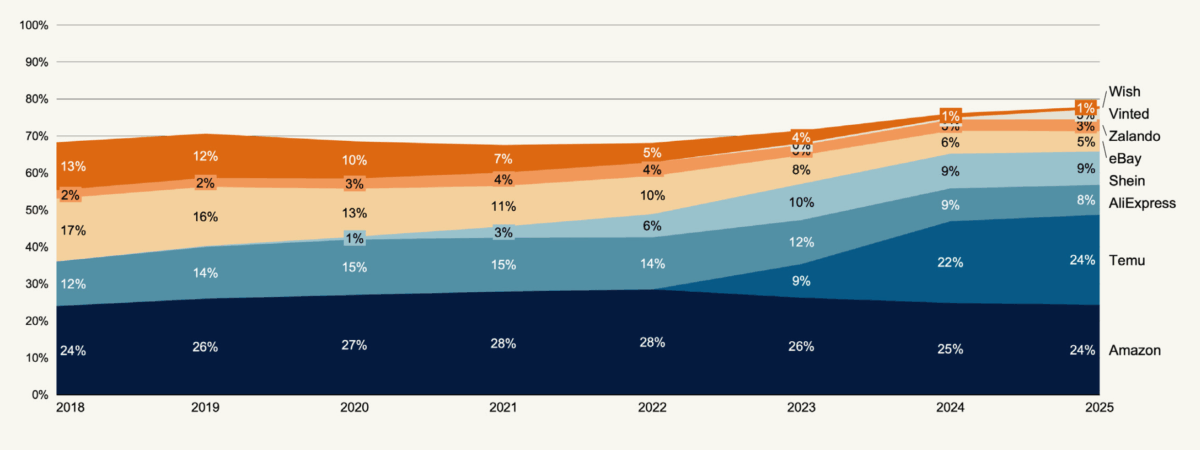
“Shein and Temu thrived in a unique window of deregulation and consumer appetite. But 2026 will be their toughest year yet — not because of competition, but because of tariffs and trade regulations that cut to the heart of their model,” said ECDB Chief Executive Officer Friedrich Schwandt, in a news release.
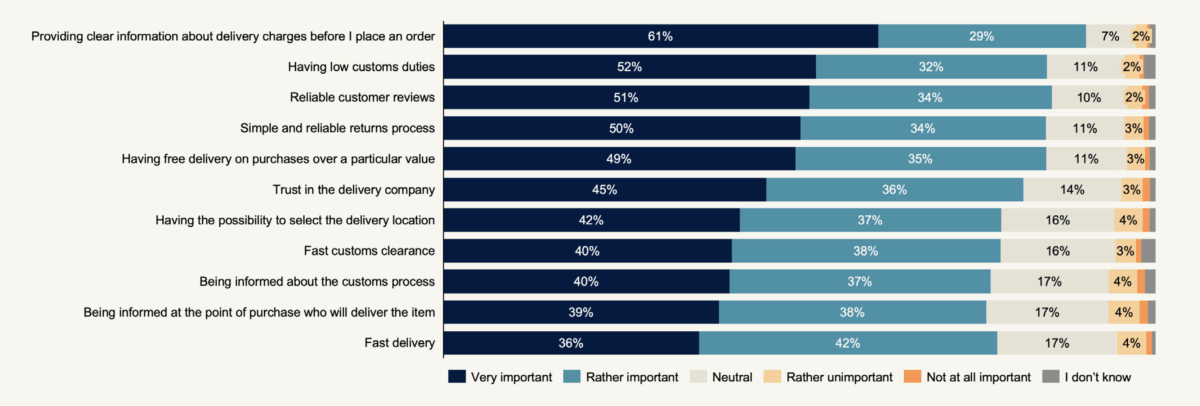
Buyers, who are now on the hook to pay customs duties and tariffs up front during the checkout process, want clear information on delivery charges before they make a purchase. Sixty-one percent of consumers, according to the IPC survey, consider pre-purchase information essential.
The IPC surveyed nearly 31,000 people in 37 countries.
Delivery speed isn’t the most critical requirement for shoppers buying from retailers in other countries. One-fifth of respondents said it took 10 to 14 days to receive a product from the time the order was placed. Another 19% of people surveyed said four-to-five day transit times were common. Delivery was usually fastest for consumers in countries who mainly purchased from neighboring countries, while delivery was slowest for those buying from more distant markets. The proportion of parcels taking 15 days or more decreased sharply from 29% in 2020 to 7% in 2025.
The survey also showed that use of parcel lockers increased significantly in 2025. Doorstep delivery was used by 44% of respondents for cross-border delivery, followed by parcel lockers (13%) and delivery to mailboxes (12%).
Click here for more FreightWaves stories by Eric Kulisch.
Sign up for the biweekly PostalMag newsletter The Delivery here.
RECOMMENDED READING:
Large parcel carriers improved on-time delivery during 2025 peak season
OnTrac challenges FedEx, UPS with cross-country delivery services
Brokerage Compliance Symposium
The day before F3. Every compliance issue you face - fraud exposure, carrier liability, FMCSA rules, cargo theft, insurance gaps - navigated by attorneys and operators defining best practices in a changing industry.
F3 Awards Dinner
The night before F3. FreightTech100 companies honored. FreightTech 25 and Shipper of Choice winners revealed live. Cocktail reception into dinner and live music - 300 industry leaders in one purpose-built room.
F3: Future of Freight Festival
Industry-defining keynotes, rapid-fire technology demos, and industry leaders networking in experiences across Chattanooga - plus the inaugural F3 Awards Dinner featuring the FreightTech and Shipper of Choice reveals.
The day before F3. Every compliance issue you face - fraud exposure, carrier liability, FMCSA rules, cargo theft, insurance gaps - navigated by attorneys and operators defining best practices in a changing industry.
The Signal at Chattanooga Choo Choo • Chattanooga, TN Register NowThe night before F3. FreightTech100 companies honored. FreightTech 25 and Shipper of Choice winners revealed live. Cocktail reception into dinner and live music - 300 industry leaders in one purpose-built room.
The Signal at Chattanooga Choo Choo • Chattanooga, TN Register NowIndustry-defining keynotes, rapid-fire technology demos, and industry leaders networking in experiences across Chattanooga - plus the inaugural F3 Awards Dinner featuring the FreightTech and Shipper of Choice reveals.
The Signal at Chattanooga Choo Choo • Chattanooga, TN Register Now