




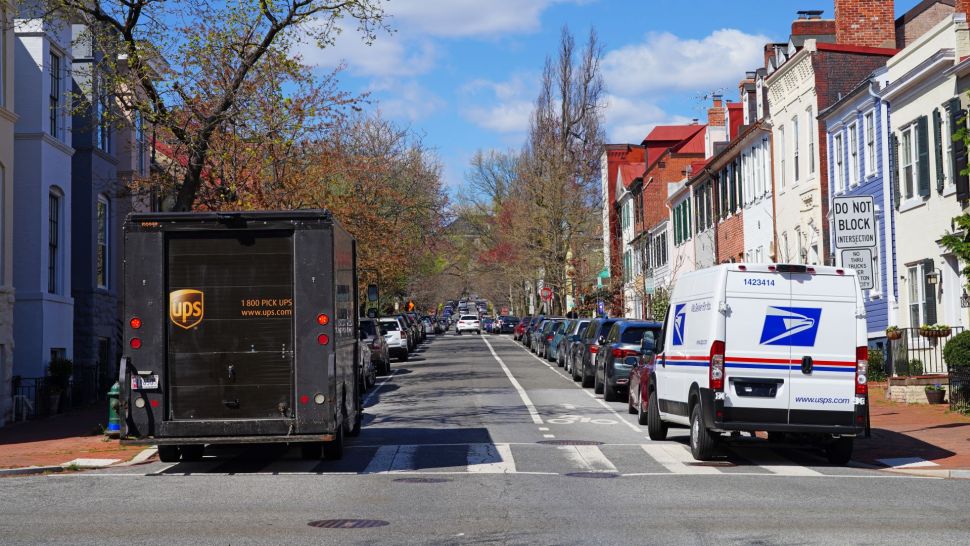
UPS has reached a tentative agreement with the U.S. Postal Service to provide last-mile parcel delivery for its low-cost Ground Saver shipping service, company officials disclosed on Tuesday, patching up a relationship that ruptured in late 2024 over rate hikes.
The move is part of a multi-pronged effort at UPS to reduce costs in the face of declining volumes in its domestic parcel business.
UPS (NYSE: UPS) has a “preliminary understanding” on revenue and rates with the Postal Service to resume home delivery for Ground Saver, CEO Carol Tomé said during a briefing with analysts about third quarter results. Details of the deal are expected to be ironed out by the end of the year.
Ground Saver is the name UPS gave early this year to its cheapest ground service after insourcing the final-mile component of its SurePost product when the Postal Service raised prices. With SurePost, UPS inducted huge parcel volumes deep into the postal network for last-mile delivery to residences. As the cost difference between the USPS and its own ground network narrowed, management determined it could provide better service on its own.
Ground Saver, which usually takes one to two days longer than regular Ground delivery, is primarily used by large businesses to ship low-value e-commerce packages to shoppers’ front doors.
UPS executives quickly realized they couldn’t achieve the benefits of end-to-end service because their delivery expense was higher than expected and didn’t support Ground Saver’s lower price. Delivery expenses in the second quarter were $85 million higher because UPS was unable to cut as many delivery stops as projected to optimize density, which offset a 5.5% increase in domestic revenue per piece and weighed on profitability.
In response, the company significantly raised Ground Saver rates, hoping to push retailers to more premium products. But as the spread between Ground Saver and Ground became tighter, Ground Savers’ value proposition evaporated.
The price increases drove away retailers. They bear the cost of e-commerce shipping more than 90% of the time, to ensure online shoppers don’t abandon their cart, and are intent on finding the least expensive shipping option. Studies have shown that a day faster delivery isn’t necessarily important to consumers when they get shipments for free. The TD Cowen/AFS Freight Index and data from ShipMatrix shows that UPS and FedEx have been losing market share to Walmart, Amazon and smaller independent couriers in recent years.
In the third quarter, UPS Ground Saver average daily volume declined 32.7% year over year. Tomé attributed the drop to this year’s decision to phase out 50% of Amazon volumes by mid-2026 because they are unprofitable and to trim lower-yielding e-commerce volume. Three months ago, the CEO said Ground Saver average daily volume fell 23.3% because of the Amazon glide down and volume declines from non-U.S.-based e-commerce companies — an apparent reference to Chinese marketplaces Temu and Shein, who are maniacally focused on low costs and imported fewer packages after the Trump administration in May ended duty-free status for low-value shipments from China.
Tomé explained that her team reached out to new Postmaster General David Steiner after he took office in mid-July in hopes of reaching better terms than received under his predecessor Louis DeJoy, who was pressured to leave by President Trump. She first indicated that UPS had reengaged with the Postal Service about resuming their partnership during the second quarter earnings call on July 29.
“When Mr. Steiner joined we immediately started having a conversation with him about how could we create a win-win-win relationship: a win for the postal system, a win for UPS and a win for our customers. And the way to do that is to leverage what they’re best at, which is final mile, and what we’re best at, which is middle mile,” she said.
The effort to plug into the USPS network is an acknowledgement that the delivery network with union drivers can’t compete in B2C delivery, the fastest growing segment of the parcel market, said Satish Jindel, president of ShipMatrix, said in an interview.
“What it tells you is that their cost structure has gone up so much from a competitive point of view that they are struggling to make money handling ground volume packages at the rate customers want,” he said. “It’s good that they are going to have this arrangement with the Post Office, it will save Ground Saver and Mail Innovations product and thereby the volume, but in the long-term they have to find a way to get the Teamsters to realize that they are the only carrier paying twice the amount for the same job as others. It’s not sustainable.”
UPS Mail Innovations included
The Postal Service will also handle last-mile delivery for Mail Innovations, a shipping and mailing service offered by UPS that utilizes a combination of UPS’s ground network and the USPS for delivery. It is designed for small to medium-sized businesses that need to ship a significant volume of letters, documents, and lightweight or flat packages. The workshare agreement with the USPS allowed Mail Innovations to deliver lightweight parcels at a reduced cost.
UPS Mail Innovations late last year lost its discounted pricing agreement with the U.S. Postal Service, triggering significant rate increases — especially for parcels under one pound. Mail Innovations was often stuck paying published rates that were often higher than the rates it charged shippers, resulting in the service operating at a loss for under-one-pound shipments, according to industry experts.
In response, UPS Mail Innovations raised rates by 20% to 40%. While that helped improve yields it also drove customers to other providers.
“There’s still more work to do, but we are confident we will come to an agreement that ensures our service levels will remain best-in-class,” said Tomé.
UPS intends to implement the last-mile outsourcing next year and see financial benefits starting in the second half of 2026, CFO Brian Dykes added.
The U.S. Postal Service declined to comment on the pending arrangement, saying through a spokesperson it doesn’t discuss supplier contracts.
Click here for more FreightWaves/PostalMag stories by Eric Kulisch.
RELATED READING:
UPS posts tepid results amid tariff, restructuring challenges
Teamsters call UPS driver buyout offer ‘paltry’
UPS to eliminate 20K jobs as Amazon decoupling accelerates
UPS drivers to receive buyout offer as company shrinks parcel network
New US postmaster general faces heavy lift stabilizing finances
Brokerage Compliance Symposium
The day before F3. Every compliance issue you face - fraud exposure, carrier liability, FMCSA rules, cargo theft, insurance gaps - navigated by attorneys and operators defining best practices in a changing industry.
F3 Awards Dinner
The night before F3. FreightTech100 companies honored. FreightTech 25 and Shipper of Choice winners revealed live. Cocktail reception into dinner and live music - 300 industry leaders in one purpose-built room.
F3: Future of Freight Festival
Industry-defining keynotes, rapid-fire technology demos, and industry leaders networking in experiences across Chattanooga - plus the inaugural F3 Awards Dinner featuring the FreightTech and Shipper of Choice reveals.
The day before F3. Every compliance issue you face - fraud exposure, carrier liability, FMCSA rules, cargo theft, insurance gaps - navigated by attorneys and operators defining best practices in a changing industry.
The Signal at Chattanooga Choo Choo • Chattanooga, TN Register NowThe night before F3. FreightTech100 companies honored. FreightTech 25 and Shipper of Choice winners revealed live. Cocktail reception into dinner and live music - 300 industry leaders in one purpose-built room.
The Signal at Chattanooga Choo Choo • Chattanooga, TN Register NowIndustry-defining keynotes, rapid-fire technology demos, and industry leaders networking in experiences across Chattanooga - plus the inaugural F3 Awards Dinner featuring the FreightTech and Shipper of Choice reveals.
The Signal at Chattanooga Choo Choo • Chattanooga, TN Register Now