




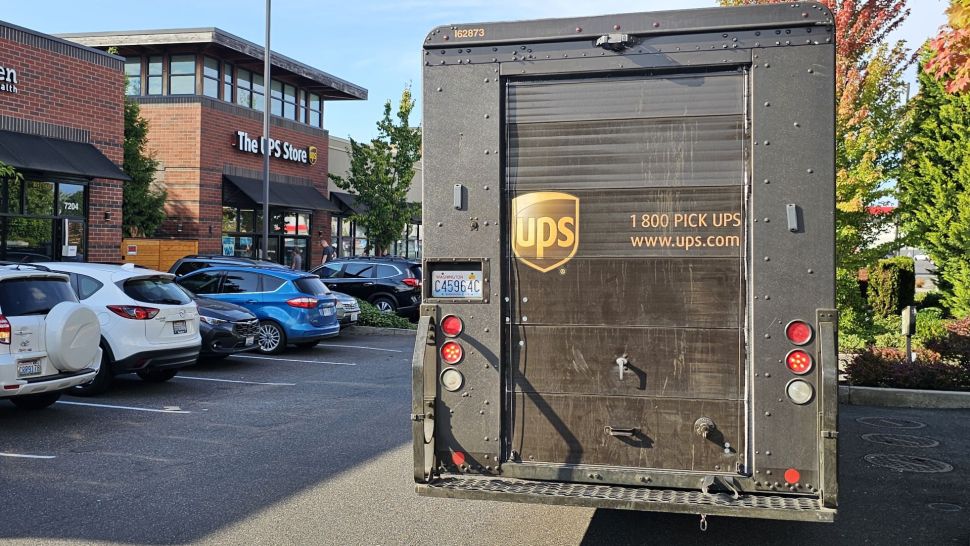
UPS on Tuesday said it would eliminate an additional 30,000 frontline jobs and at least 24 facilities as part of a multiyear strategy to recharge growth through a planned decoupling from Amazon and downsizing of its parcel delivery network to match lower volume flow.
Efficiency gains from the restructuring helped fourth-quarter earnings exceed forecasts despite a 10.6% decline in average daily domestic volumes. Lower throughput was expected as UPS (NYSE: UPS) sheds Amazon business and lower-yielding Chinese e-commerce volumes.
The integrated freight transportation and logistics giant last year reduced 48,000 operational jobs, including 15,000 seasonal positions, and closed 93 leased and owned distribution centers, resulting in $3.5 billion in savings. UPS reduced warehouse and driver payroll by 34,000 positions after originally estimating 20,000 persons would be cut. The reduced expenditures were offset by about $500 million in transformation costs.
UPS early last year reached an agreement to reduce Amazon volumes in its network by more than 50% by June 2026. Outbound deliveries from Amazon fulfillment centers are not profitable compared to returns and outbound volumes from retailers that sell on the Amazon marketplace. About 60% of UPS’s Amazon business is lossmaking.
During a presentation to analysts, management said it expects to handle 1 million fewer parcels from Amazon on a daily basis this year.
Chief Financial Officer Brian Dykes outlined targeted savings of $3 billion in 2026 related to the Amazon glide down, including a reduction of about 25 million operating hours, 30,000 jobs and facility closures. Two dozen buildings are scheduled to be closed in the first half and more facilities could be closed later in the year following further review.
Jobs will be eliminated through attrition, Dykes said, and a second voluntary buyout program for delivery drivers.
An estimated 2,000 drivers took the severance package last year, but UPS never disclosed the actual number of drivers who cashed out. The Teamsters union, which represents drivers, vigorously opposed the buyout offer as insufficient.
UPS deployed automated sorting capabilities in 57 buildings last year, enabling it to maintain service levels as it consolidates its physical footprint. CEO Carol Tomé said the company will further automate its network this year, resulting in about 68% of volume being processed in automated facilities by the end of the year compared to 66.5% at the end of 2025.
“You’re seeing a cascading effect of sites being closed at our legacy conventional facilities, a lot of labor required to run those facilities to a much more nimble, quicker automated, consolidated facility. And as we bring in all of those peripheral centers, we start to see the efficiencies of feeds, cube utilization, and, of course, any service disconnects can be rationalized right there in one facility. So that’s also helping from a customer perspective,” said Dykes.
The company reported revenue of $24.5 billion, down 3.2% year over year. Adjusted operating profit came in at $2.9 billion for the fourth quarter, off by 6.8% from the prior year.
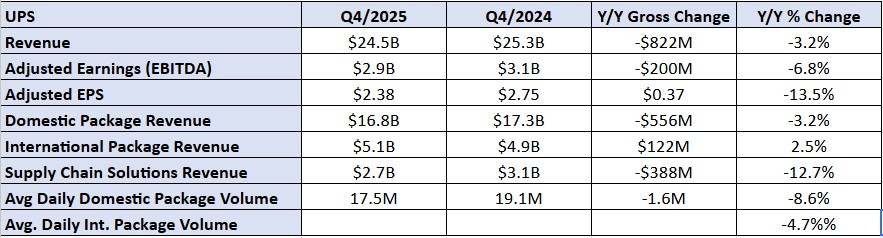
The decline in domestic package volume drove a 3.2% decline in domestic revenue, but UPS was able to increase operating margin to 8.5% thanks to a 7.1% increase in revenue per piece. Yield increases were supported by aggressive increases in fuel and accessorial surcharges.
Revenue for the international package segment grew 2.5% to $5.1 billion as higher pricing offset a sharp drop in average daily volume resulting from U.S. tariff hikes and the end of no-cost de minimis treatment for imported e-commerce packages. U.S. imports in total were down 24.4% year over year, led by an average daily volume decline from Canada and Mexico of 30.5% and a 21% volume drop from China.
UPS is on track to open a new air hub in the Philippines towards the end of the year, according to the presentation.
Tomé confirmed that UPS had finalized an agreement with the U.S. Postal Service to resume last-mile delivery for the company’s low-cost Ground Saver product (previously SurePost) after a one-year hiatus. UPS balked at USPS price hikes and exited the partnership, only to realize the costs were higher than the postal option. Tomé said the new arrangement is more favorable to UPS than the previous one and that Ground Saver volumes inducted into the USPS system will ramp up in the next few weeks and months. Technology will be used to separate low-density shipments for the USPS system.
UPS deployed RFID labeling technology at 5,500 UPS Store locations and completed installation of RFID readers in all U.S. package cars last year as it moves from a scanning to a sensing network. Management said the new capability will make package cars more productive, reduce missed loads and give customers more transparency into the progress of shipments.
2026 outlook
Management projected a profit dip in the first half of 2026 before increasing in the back half as the benefits of the company’s right-sizing efforts and shift to more profitable B2B delivery and logistics services, as well as savings from the USPS teaming arrangement, materialize. The biggest headwind in the first quarter will be muted international export growth, with difficult comparisons to 2025 when U.S. companies raced to import goods before the Trump administration announced global tariffs, additional costs from the Ground Saver transition to the USPS contract, and aircraft lease costs as UPS relies on outsourced airlift after ending use of its aging MD-11 fleet.
The small package market, excluding Amazon, is stabilizing and UPS expects to grow in the low single digits, along with the rest of the market.
Growth areas for UPS include automotive, healthcare, heavy airfreight, and small-and-medium businesses.
“We’re seeing the quality volume that we’ve been shifting to show up in the network. In the fourth quarter, we saw heavier weights, we saw longer zones, we saw the highest SMB penetration we’ve ever had, the highest B2B penetration we’ve had in four years. So the mix shift is happening, and we can see that. That enables us to lean in, in the places where we’ve invested, we’ve got differentiated capabilities and we want to grow,” Dykes said.
Full-year revenue is expected to be about flat at $89.7 billion.
Click here for more FreightWaves/American Shipper stories by Eric Kulisch.
RELATED STORIES:
UPS won’t resurrect MD-11 fleet after deadly crash, takes $137M charge
UPS posts tepid results amid tariff, restructuring challenges
UPS inks $1.6B deal for Canadian health care logistics provider
Brokerage Compliance Symposium
The day before F3. Every compliance issue you face - fraud exposure, carrier liability, FMCSA rules, cargo theft, insurance gaps - navigated by attorneys and operators defining best practices in a changing industry.
F3 Awards Dinner
The night before F3. FreightTech100 companies honored. FreightTech 25 and Shipper of Choice winners revealed live. Cocktail reception into dinner and live music - 300 industry leaders in one purpose-built room.
F3: Future of Freight Festival
Industry-defining keynotes, rapid-fire technology demos, and industry leaders networking in experiences across Chattanooga - plus the inaugural F3 Awards Dinner featuring the FreightTech and Shipper of Choice reveals.
The day before F3. Every compliance issue you face - fraud exposure, carrier liability, FMCSA rules, cargo theft, insurance gaps - navigated by attorneys and operators defining best practices in a changing industry.
The Signal at Chattanooga Choo Choo • Chattanooga, TN Register NowThe night before F3. FreightTech100 companies honored. FreightTech 25 and Shipper of Choice winners revealed live. Cocktail reception into dinner and live music - 300 industry leaders in one purpose-built room.
The Signal at Chattanooga Choo Choo • Chattanooga, TN Register NowIndustry-defining keynotes, rapid-fire technology demos, and industry leaders networking in experiences across Chattanooga - plus the inaugural F3 Awards Dinner featuring the FreightTech and Shipper of Choice reveals.
The Signal at Chattanooga Choo Choo • Chattanooga, TN Register Now