




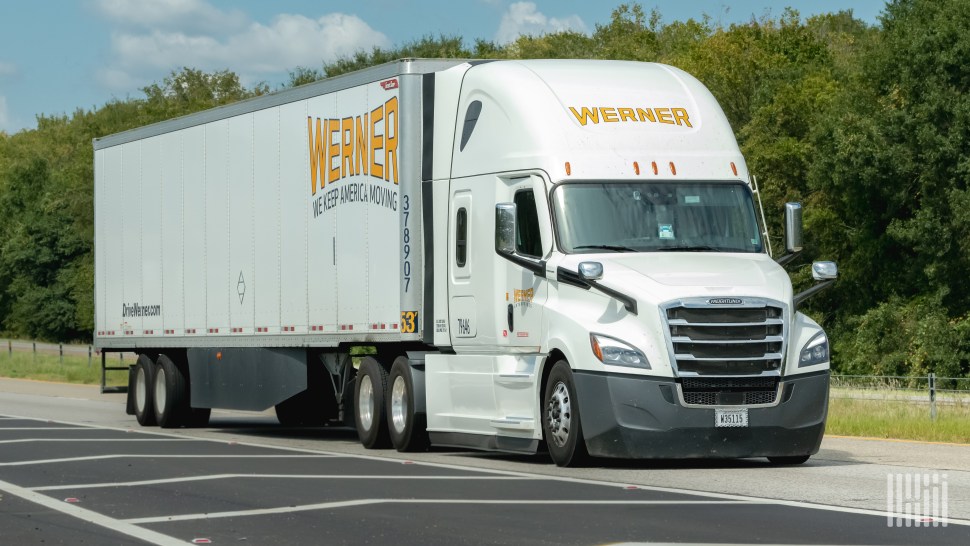
Entering this year, truckload carrier Werner Enterprises was hoping to grow its 7,500-truck fleet by as much as 5% following an extended downturn. Much of the growth was to occur in its dedicated segment, but new tariffs and other cracks in the broader economy pushed out a recovery in the freight industry. Even with the headwinds, the company said Tuesday that it has little room to further trim its dedicated fleet count.
“Our heels are on the line … there is no retreat from here on fleet size,” Derek Leathers, Werner chairman and CEO, told investors at the Baird Global Industrial Conference in Chicago.
Leathers cited base capacity needs to maintain service levels and the fixed-cost nature of the business as reasons further attrition is not an option.
Like most fleets, Werner (NASDAQ: WERN) cut its tractor count through the downturn to improve utilization and lower costs. Its active dedicated fleet of 4,865 units has been flat since the second quarter of last year, but remains 550 units, or 11%, below the 2022 peak. The company’s one-way fleet is down 25% to 2,638 units over that stretch, but some of those assets were moved to accommodate dedicated account wins.
(The company lowered its full-year truck count guidance to a range of negative-2% to flat when it reported third-quarter results last month.)
While Leathers called the current downcycle the worst he has seen in his 35 years in the industry, he’s eyeing growth, noting a “plenty robust” dedicated pipeline. He also pointed out that the company has cut costs without shying away from long-term investments like other companies have.
Decent peak coupled with capacity wild card
Werner is calling for a “normal” peak season this year, similar to last year, with “an opportunity to the upside,” based on recent conversations with major shippers. Leathers said its discount retail and more income-discretionary, big box customers are “doing pretty well right now.” He’s also encouraged with the potential for outsize tax refunds given new legislation allowing deductions on qualified tips and overtime pay.
The TL industry is also seeing very early supply-side tailwinds as regulatory enforcement ramps (non-domiciled CDL restrictions and English language proficiency enforcement) and Class 8 truck orders remain below typical replacement levels.
(The U.S. Court of Appeals for the District of Columbia ordered a stay on Monday to the FMCSA’s interim rule, limiting non-domiciled CDL eligibility to foreign nationals.)


Some states, according to Leathers, exploited worker eligibility limitations and took advantage of a loophole allowing drivers whose home states have long CDL testing delays to take their tests in another state. He pointed to CDL issuances jumping from an average of 15,000 to 50,000 in certain states without a corresponding increase in driver school networks.
He said the duration of the recent downturn is partly due to the creation of this capacity. He also said trucking accidents across the industry are on the rise even though many large fleets are reporting all-time lows in incident rates.
“If that’s not the base case of the major players within the industry … why is it increasing? I think the answer over time, when you get a chance to do the full exhaustive study, we’re going to find a lot of it linked back to lower standards on CDL issuance, lower standards on driver schools.”
Looking to an eventual recovery and the restoration of margins, the company will need rate increases higher than the low-single-digit percentage contractual price bumps it recorded during the 2025 bid season.
Werner lowered full-year 2025 rate guidance last month. Dedicated revenue per truck per week is now expected to range from flat to up 1.5% year over year (down from a range of flat to up 3%). One-way revenue per total mile is now forecast to be down 1% to up 1% y/y. (One-way y/y rate increases have averaged 1.4% over the past five quarters.)
Shares of WERN were off 2.6% at 1:13 p.m. EST on Tuesday compared to the S&P 500, which was up 0.2%.

Brokerage Compliance Symposium
The day before F3. Every compliance issue you face - fraud exposure, carrier liability, FMCSA rules, cargo theft, insurance gaps - navigated by attorneys and operators defining best practices in a changing industry.
F3 Awards Dinner
The night before F3. FreightTech100 companies honored. FreightTech 25 and Shipper of Choice winners revealed live. Cocktail reception into dinner and live music - 300 industry leaders in one purpose-built room.
F3: Future of Freight Festival
Industry-defining keynotes, rapid-fire technology demos, and industry leaders networking in experiences across Chattanooga - plus the inaugural F3 Awards Dinner featuring the FreightTech and Shipper of Choice reveals.
The day before F3. Every compliance issue you face - fraud exposure, carrier liability, FMCSA rules, cargo theft, insurance gaps - navigated by attorneys and operators defining best practices in a changing industry.
The Signal at Chattanooga Choo Choo • Chattanooga, TN Register NowThe night before F3. FreightTech100 companies honored. FreightTech 25 and Shipper of Choice winners revealed live. Cocktail reception into dinner and live music - 300 industry leaders in one purpose-built room.
The Signal at Chattanooga Choo Choo • Chattanooga, TN Register NowIndustry-defining keynotes, rapid-fire technology demos, and industry leaders networking in experiences across Chattanooga - plus the inaugural F3 Awards Dinner featuring the FreightTech and Shipper of Choice reveals.
The Signal at Chattanooga Choo Choo • Chattanooga, TN Register Now