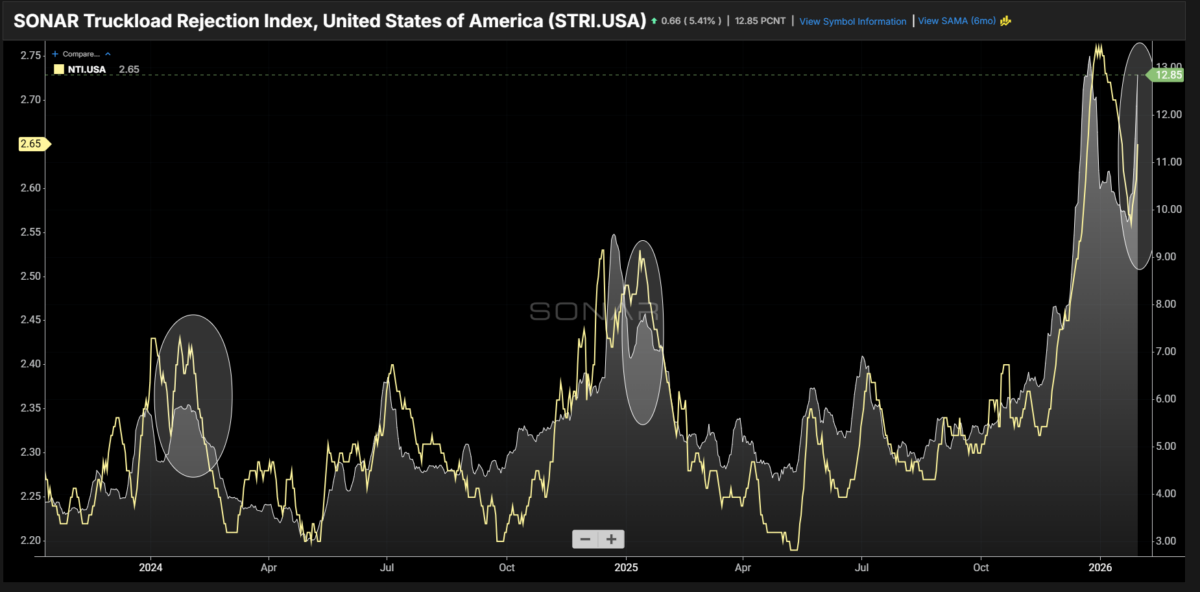
Chart of the Week: SONAR Truckload Rejection Index, National Truckload Index – USA SONAR: STRI.USA, NTI.USA
Winter weather has once again asserted itself as the undisputed champion of transportation market disruption in the U.S., driving tender rejections and spot rates higher during a period when both would normally be in retreat. This marks the third consecutive year—and four of the past six—in which winter storms have caused large-scale transportation service disruptions and spot rate inflation, while tropical systems have had a fairly muted influence.
Tender rejection rates—the share of contracted loads that carriers decline—jumped from 9.75% on January 21 to 12.19% on January 28. This spike occurred even as the SONAR Truckload Rejection Index (STRI) had been slowly easing from its holiday peak.
For context, the STRI averaged 5.35% from February through October last year and 4.5% over the same period in 2024. In other words, current tender rejection rates are elevated and signal mounting challenges for carriers trying to meet capacity commitments. Because tender rejections are less influenced by negotiation or sentiment, they offer a more objective measure of trucking market disruption. Historically, values above 8–9% are associated with tighter and more difficult market conditions.
Spot rates—another key indicator of truckload market health, though more nuanced and emotionally driven—also moved higher. The National Truckload Index (NTI) rose nearly 3% over the past week. The more muted response in spot rates relative to rejection rates suggests that shippers have not yet been forced fully into the spot market, or that a peak sense of urgency has yet to emerge.

This year’s major storm, Winter Storm Fern, ushered arctic air into the Gulf Coast and deposited a broad swath of snow and ice from New Mexico to New England. In terms of both surface impacts and extreme temperatures, Fern was arguably the most severe storm in recent years. Widespread business closures followed, including Caterpillar plants in Mississippi—disruptions that will likely create production backlogs and add further pressure on transportation networks as companies work to recover lost time.
Severe winter weather is especially hazardous for trucking operations. Even the most experienced drivers must contend with treacherous road conditions and share highways with motorists unaccustomed to driving in snow and ice. Extreme cold also accelerates wear and tear on equipment. In short, winter storms dramatically increase the cost and risk of operating—an impact that is often understated.
When heightened urgency collides with slower operating speeds and reduced network efficiency, tender rejection and spot rates tend to rise sharply.
While it is far too early for a full post-mortem on Winter Storm Fern, initial data suggests it could be the most disruptive event since the 2021 arctic plunge that crippled the Texas power grid.
The past two years offer a rough blueprint for how markets may respond, though the current freight environment appears far more fragile. In 2024, tender rejection rates peaked at 9.8% ahead of the storm season. In 2023, the STRI began near 4.7%, climbed to 5.9%, and took nearly six weeks to fall back below its starting level.
Last year’s storms were notably weaker, primarily affecting the lower Midwest and pushing the STRI from 6.9% to 7.74%. The market recovered quickly by the end of January as temperatures normalized.
This year’s system, however, was significantly more severe than either of the prior two. Many areas, including Nashville, remain in recovery mode more than a week later. Compounding the issue, the freight market has lost a meaningful amount of capacity over the past year, with roughly 5,500 operators exiting, according to FMCSA data.
The prolonged freight recession has thinned the carrier base to the point where little buffer capacity remains. When combined with the severity of this storm and the persistence of extreme cold, a full market recovery may be delayed until March.
While February is typically a slower month for freight activity—potentially easing the recovery—the tone has been set for a much bumpier 2026 transportation market during what is traditionally considered the offseason.
About the Chart of the Week
The FreightWaves Chart of the Week is a chart selection from SONAR that provides an interesting data point to describe the state of the freight markets. A chart is chosen from thousands of potential charts on SONAR to help participants visualize the freight market in real time. Each week a Market Expert will post a chart, along with commentary, live on the front page. After that, the Chart of the Week will be archived on FreightWaves.com for future reference.
SONAR aggregates data from hundreds of sources, presenting the data in charts and maps and providing commentary on what freight market experts want to know about the industry in real time.
Brokerage Compliance Symposium
The day before F3. Every compliance issue you face - fraud exposure, carrier liability, FMCSA rules, cargo theft, insurance gaps - navigated by attorneys and operators defining best practices in a changing industry.
F3 Awards Dinner
The night before F3. FreightTech100 companies honored. FreightTech 25 and Shipper of Choice winners revealed live. Cocktail reception into dinner and live music - 300 industry leaders in one purpose-built room.
F3: Future of Freight Festival
Industry-defining keynotes, rapid-fire technology demos, and industry leaders networking in experiences across Chattanooga - plus the inaugural F3 Awards Dinner featuring the FreightTech and Shipper of Choice reveals.
The day before F3. Every compliance issue you face - fraud exposure, carrier liability, FMCSA rules, cargo theft, insurance gaps - navigated by attorneys and operators defining best practices in a changing industry.
The Signal at Chattanooga Choo Choo • Chattanooga, TN Register NowThe night before F3. FreightTech100 companies honored. FreightTech 25 and Shipper of Choice winners revealed live. Cocktail reception into dinner and live music - 300 industry leaders in one purpose-built room.
The Signal at Chattanooga Choo Choo • Chattanooga, TN Register NowIndustry-defining keynotes, rapid-fire technology demos, and industry leaders networking in experiences across Chattanooga - plus the inaugural F3 Awards Dinner featuring the FreightTech and Shipper of Choice reveals.
The Signal at Chattanooga Choo Choo • Chattanooga, TN Register Now