




Volumes were down but freight rates continued to move higher in January, according to monthly data from Cass Information Systems.
Cass’ (NASDAQ: CASS) multimodal shipments index declined 7.1% year over year (down 14.7% on a two-year comparison) to a reading not seen since 2009—the tail end of the Global Financial Crisis. Shipments were down 2% from December on a seasonally adjusted comp.
Severe winter weather and retailers holding less inventory to start the year weighed on shipment counts in the month. Some less-than-truckload carriers recently said the adverse weather negatively impacted shipments by about three percentage points. Earlier this month, the Logistics Managers’ Index showed inventory restocking occurred at a rate that was the “second-lowest for any January” as inventory holding costs remain high.
The Cass report said normal seasonal trends would place the shipments index 11% lower y/y in February, “although a rebound from the weather could support volumes above this.”
| January 2026 | y/y | 2-year | m/m | m/m (SA) |
| Shipments | -7.1% | -14.7% | -4.9% | -2.0% |
| Expenditures | 0.6% | -3.6% | -3.6% | 0.4% |
| TL Linehaul Index | 3.2% | 4.0% | 1.7% | NM |
Cass’ expenditures index, which measures total freight spend including fuel, increased 0.6% y/y and 0.4% seasonally adjusted from December (down 3.6% sequentially without the adjustment). A two-year-stacked decline of 3.6% was the smallest since July 2023.
Netting the change in volumes from the change in expenditures implies rates were likely up 8% y/y in January. Changes in mix, however, can also alter the data. (Cass no longer publishes an inferred rate index.)
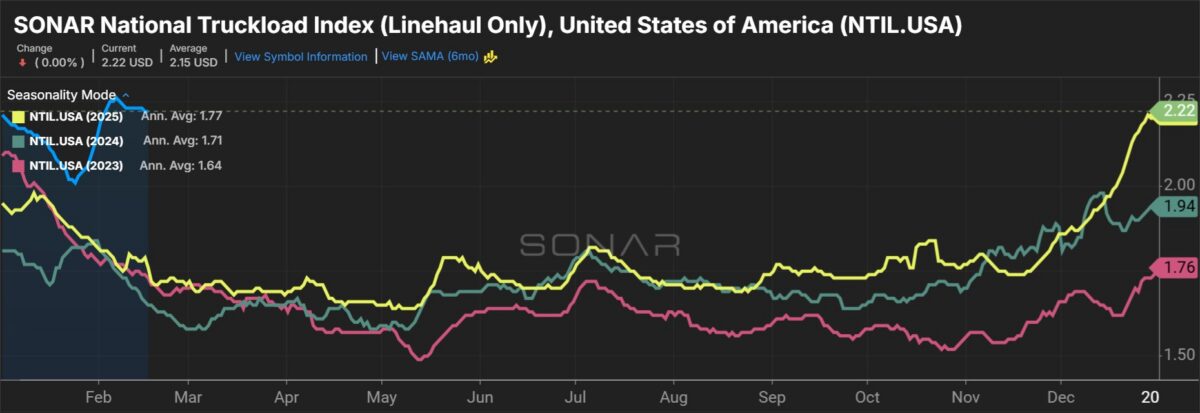
The TL linehaul index, which tracks rates excluding fuel and accessorial surcharges, increased 1.7% from December and came in 3.2% higher y/y. The index has been up sequentially for five consecutive months. January marked 13 straight months of y/y increases after 24 months of declines. The two-year-stacked reading was 4% higher.
The report pointed to poor weather as a catalyst for rates in the month, noting better weather could “lead to some trend reversion, but for February at least, spot rates are likely to accelerate.”
The TL linehaul index reflects for-hire spot and contract rates, but is “mostly comprised of contract rates.” The report acknowledged a changing market: “anecdotally we hear about more shippers initiating one-year bids, suggesting movement in the cycle beyond just weather effects.”
“Fleets are getting excited that the long-awaited recovery is here,” the report said. “Even 2% contract rate increases are a relief after four years of nothing or worse. While near-term reversion from the weather may slow the trend, we expect tighter capacity to lead to moderate truckload rate increases in 2026.”
During the fourth-quarter earnings season, TL carriers signaled an expectation for low- to mid-single-digit contractual rate increases this year. The low end represents expectations for index-based dedicated contracts, while the upper end reflects expected changes to one-way contracts.
Some analysts have indicated that the initial guidance from carriers may prove conservative given increased regulation of the driver pool (English-language proficiency requirements, non-domiciled CDL restrictions, and ELD and driver school crackdowns). Also, much larger rate increases are required, after years of cost inflation and depressed rates, for the group to restore margins.
Data used in the indexes comes from freight bills paid by Cass, a provider of payment management solutions. Cass processes $37 billion in freight payables annually on behalf of customers.
Brokerage Compliance Symposium
The day before F3. Every compliance issue you face - fraud exposure, carrier liability, FMCSA rules, cargo theft, insurance gaps - navigated by attorneys and operators defining best practices in a changing industry.
F3 Awards Dinner
The night before F3. FreightTech100 companies honored. FreightTech 25 and Shipper of Choice winners revealed live. Cocktail reception into dinner and live music - 300 industry leaders in one purpose-built room.
F3: Future of Freight Festival
Industry-defining keynotes, rapid-fire technology demos, and industry leaders networking in experiences across Chattanooga - plus the inaugural F3 Awards Dinner featuring the FreightTech and Shipper of Choice reveals.
The day before F3. Every compliance issue you face - fraud exposure, carrier liability, FMCSA rules, cargo theft, insurance gaps - navigated by attorneys and operators defining best practices in a changing industry.
The Signal at Chattanooga Choo Choo • Chattanooga, TN Register NowThe night before F3. FreightTech100 companies honored. FreightTech 25 and Shipper of Choice winners revealed live. Cocktail reception into dinner and live music - 300 industry leaders in one purpose-built room.
The Signal at Chattanooga Choo Choo • Chattanooga, TN Register NowIndustry-defining keynotes, rapid-fire technology demos, and industry leaders networking in experiences across Chattanooga - plus the inaugural F3 Awards Dinner featuring the FreightTech and Shipper of Choice reveals.
The Signal at Chattanooga Choo Choo • Chattanooga, TN Register Now