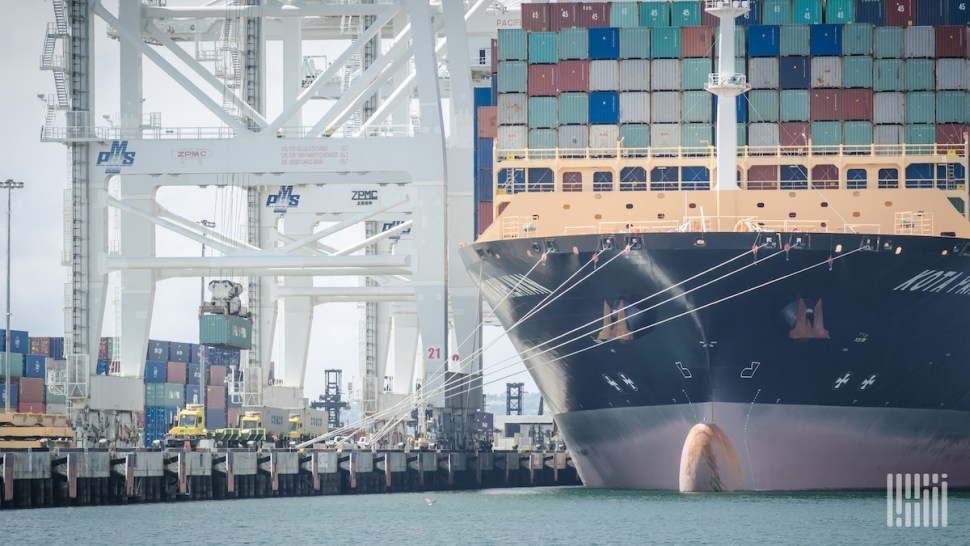
Weakening import demand and the global tariff war stoked by President Donald Trump continue to push down on container rates on critical Asia-U.S. trade lanes.
Tariffs have resurfaced as a significant influence on consumer prices and freight costs, said analyst Freightos in an update, with inflation in the U.S. ticking up by 2.7% in June as the effects of import tariffs are beginning to manifest more significantly.
Importers, who previously managed to mitigate these impacts through strategic frontloading in response to various global disruptions, including the pandemic and trade conflicts, are now facing the expiration of such buffers. Concurrently, the European Union is preparing to impose retaliatory tariffs on $84 billion worth of U.S. goods as Washington threatens 30% tariffs as of August 1. But Brussels has said it will delay those levies in hopes of striking a deal with the Trump administration.
On the cost front, the freight rates are experiencing a distinctive trend. Despite disruptions like those in the Suez Canal, the reduced demand has kept ocean rates under pressure. The typical peak season has not spared the industry, as evidenced by a 24% reduction in Asia–U.S. West Coast rates to $2,369 per forty foot equivalent unit, while Asia–U.S. East Coast prices slipped by 5% to $4,888 per FEU. Moreover, Asia–Mediterranean freight prices fell by 4% to $3,802 per FEU.
Asia–Northern Europe routes have defied this decreasing trend, with rates climbing by 4% to $3,509 per FEU as Asian manufacturers likely find new business outside the American market.
The shipping industry has been quick to adapt, with carriers aggressively cutting trans-Pacific capacity by almost a quarter. This measure aims to align the supply with the diminished demand and stabilize the business, which has been reeling under the dual pressures of logistical barriers and price volatility.
In regions beyond the immediate economic tussle, strategic investments and partnerships are forecasted to revitalize trade infrastructures. For instance, signs of economic reconstruction are visible in Syria, which has embarked on an $800 million partnership with UAE-based port terminal operator DP World to enhance its Tartous facilities. This development mirrors global logistics players seeking to capitalize on eased sanctions and potential new trade routes to establish footholds in burgeoning markets.
Find more articles by Stuart Chirls here.
Related coverage:
Report: White House maritime chief leaving
Ports back bill to limit Customs charging for inspection services
FMC investigating Port Houston pacts with container carriers
Brokerage Compliance Symposium
The day before F3. Every compliance issue you face - fraud exposure, carrier liability, FMCSA rules, cargo theft, insurance gaps - navigated by attorneys and operators defining best practices in a changing industry.
F3 Awards Dinner
The night before F3. FreightTech100 companies honored. FreightTech 25 and Shipper of Choice winners revealed live. Cocktail reception into dinner and live music - 300 industry leaders in one purpose-built room.
F3: Future of Freight Festival
Industry-defining keynotes, rapid-fire technology demos, and industry leaders networking in experiences across Chattanooga - plus the inaugural F3 Awards Dinner featuring the FreightTech and Shipper of Choice reveals.
The day before F3. Every compliance issue you face - fraud exposure, carrier liability, FMCSA rules, cargo theft, insurance gaps - navigated by attorneys and operators defining best practices in a changing industry.
The Signal at Chattanooga Choo Choo • Chattanooga, TN Register NowThe night before F3. FreightTech100 companies honored. FreightTech 25 and Shipper of Choice winners revealed live. Cocktail reception into dinner and live music - 300 industry leaders in one purpose-built room.
The Signal at Chattanooga Choo Choo • Chattanooga, TN Register NowIndustry-defining keynotes, rapid-fire technology demos, and industry leaders networking in experiences across Chattanooga - plus the inaugural F3 Awards Dinner featuring the FreightTech and Shipper of Choice reveals.
The Signal at Chattanooga Choo Choo • Chattanooga, TN Register Now