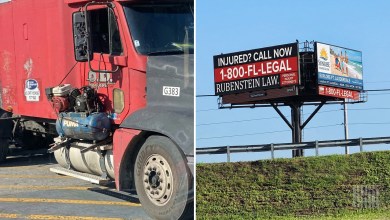
The driver involved in the 10-fatality Alabama crash is back in business and still crashing
A dangerous driver is still in a truck with his own DOT number, operating under someone else’s authority.
The seventh installment in FreightWaves’ investigation into America’s trucking insurance crisis reveals that the apparent diversity of the commercial truck insurance market is an illusion. Behind dozens of subsidiary names filing BMC-91s with FMCSA sit a small number of Fortune 500 holding companies. The concentration of risk is worse than anyone in the industry realizes.
The Entry-Level Driver Training regulations took effect in February 2022 after years of development and industry lobbying. The result was a federal training standard that requires no minimum hours of instruction, relies on self-certification at every checkpoint, and leaves every meaningful decision about actual driver competency to the fifty states, each operating in fifty different ways. The fraud factories did not slow down.
The Supreme Court ruled 6-3 that IEEPA does not authorize the President to impose tariffs. Within hours, the White House invoked Section 122 of the Trade Act of 1974 to impose a new 10% global surcharge, later raised to 15%. Up to $175 billion in collected duties now sits in legal limbo. Section 232 tariffs on steel, aluminum, and heavy trucks remain untouched. For the freight industry, the ruling didn’t end the trade war. It changed the weapons.
When a truck kills someone, we ask who was driving. We never ask who insured them. That question tells you more about what went wrong than anything else in the crash file.
Executive orders, rulemakings, legislation, and court challenges all operate on different timelines with different powers and different guardrails. Yesterday’s historic Duffy-Barrs press conference was the biggest enforcement announcement in a generation, and it still has to survive the process. Here’s why, and what comes next.
Our investigation reveals that 5% of carriers, as identified by their insurers, account for nearly a third of all truck crashes. No federal or state law requires insurers to review a single page of safety data before binding a policy.
The 287(g) program has turned local law enforcement into immigration officers across 40 states. Compliant hiring is not defensible hiring. Here’s the difference, and why it matters now more than ever.
For the last few years, if you’ve followed trucking headlines, you’d think the entire industry is falling apart. Fraud schemes. Cargo theft. Crash investigations. CDL scandals. Bankruptcy filings. Rate collapses. Regulatory fights. Scroll your feed long enough and it starts to feel like trucking is nothing but dysfunction. But that isn’t the full story. It […]
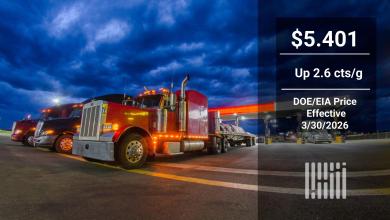
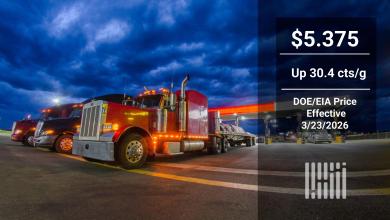
The benchmark price used for most fuel surcharges rose for the fifth straight week.
American agriculture rarely makes front-page freight headlines, yet it quietly underpins a significant portion of trucking demand. Grain, livestock, fertilizer, seed, feed, refrigerated meat, packaged goods, ethanol, farm equipment—entire freight ecosystems depend on a stable farm economy. Recent reporting has highlighted a sharp rise in farm bankruptcies and growing concern from agricultural leaders about systemic […]
The freight market does not suffer from a lack of opinions. It suffers from a lack of structured conversations. Broker transparency has become one of the most debated topics in trucking, often framed in emotional terms and amplified by social media soundbites. Recently, I sat down with Chris Jolly, known widely as the Freight Coach, […]
When I was a teenager working at a Subway in Sumter, South Carolina, I used to get corrected for something that seemed small at the time. I would build a sandwich, stack it high, and make it look generous. My boss would walk by and say, “That’s too many tomato slices.” I didn’t understand it […]
You can’t own a fishing boat, fly an airplane, broadcast a radio signal, split an atom, or drill for oil in America without proving you’re an American. But you can operate an 80,000-pound commercial motor vehicle on every highway in every state in the nation without being a citizen of this country, or even setting foot in it. Welcome to the American trucking industry, where the door isn’t just open. It’s been taken off the hinges.
For the better part of three plus years, most small carriers and owner-operators have felt like they’ve been grinding uphill in soft dirt. Rates fell, truckload volumes cooled and tender rejections disappeared. All while new authorities flooded in and every time it looked like things might turn, something else pushed it back down to a […]
The Commercial Vehicle Safety Alliance has approved 17 changes to the 2026 North American Standard Out-of-Service Criteria that will take effect April 1, 2026, and while some updates are technical, several directly affect how drivers and small fleets will be inspected on licensing, ELDs, brakes, cargo securement, wheels and even hazardous materials placarding. On December […]
For decades, insurance was the one thing you couldn’t fake your way past to start a trucking company. That’s no longer true. As instant-issue coverage and $300 authority fees make it easier than ever to place 80,000 pounds on public highways without verification, a scalable, pre-authority risk-control model could restore the gate the industry lost without adding a single federal employee to the payroll.
A new legal battle is underway following the U.S. Department of Transportation’s final rule tightening eligibility standards for nondomiciled commercial driver’s licenses, setting the stage for continued litigation in the D.C. Circuit Court of Appeals. One day after the Federal Motor Carrier Safety Administration published its final rule formalizing restrictions on nondomiciled CDLs, a coalition […]
My investigation found 76 Risk Retention Groups insure nearly 30,000 motor carriers linked to more than 6,300 fatal crashes, all without state guaranty fund protection for crash victims. The findings come as reports indicate that major insurers, including Chubb and AmTrust, are exiting the Chicago trucking market, funneling high-risk carriers into RRGs that have already incurred $199 million in unpaid losses and multiple insolvencies.
It’s a win.
The non-domicile CDL final rule eliminates EADs as a pathway to a commercial license and restricts eligibility to H-2A, H-2B, and E-2 visa holders. With 97 percent of the current 200,000 non-domiciled CDL holders unable to qualify under the new standard, expect 30,000 to 40,000 drivers removed from the commercial pool every year.