
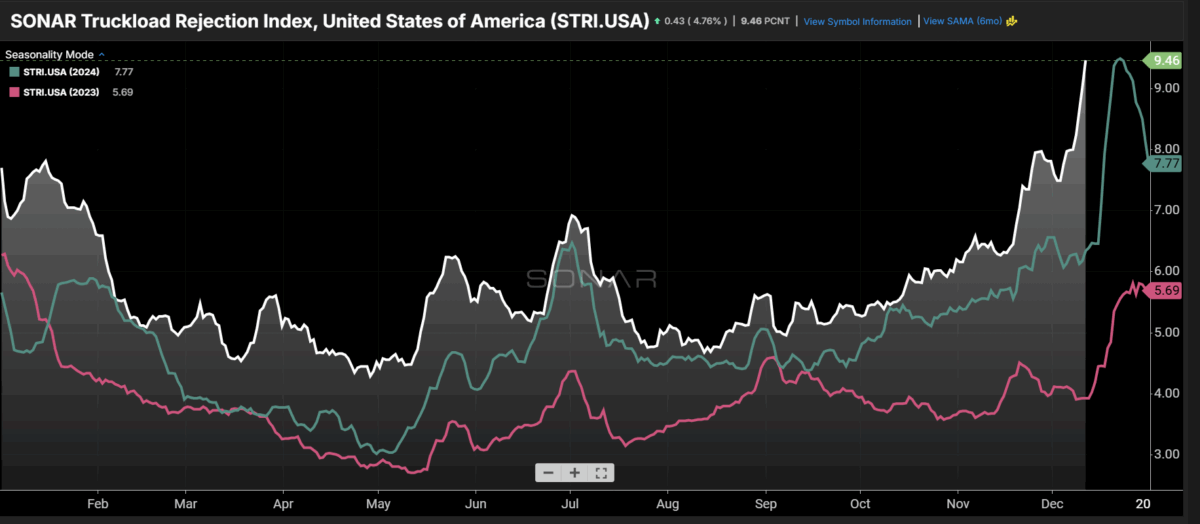
Chart of the Week: SONAR Truckload Rejection Index – USA SONAR: STRI.USA
The SONAR Truckload Rejection Index (STRI), released only a few weeks ago, has already surpassed last year’s peak Christmas reading of just under 9.5%. Values above roughly 7-8% generally signal an inflationary truckload market in which capacity is insufficient. While this alone highlights the past year’s capacity erosion, the absence of the typical post-Thanksgiving lull is equally notable. It’s difficult to declare a definitive end to the prolonged freight recession given the seasonal context, but this is yet another indication that we are nearing a market inflection point — if not already there — driven primarily by supply-side reductions.
Market turns are rarely identifiable in real time. Hindsight provides the context and distance needed to determine whether a move is merely a blip or the beginning of a full-blown transition. What this freight market still lacks, however, is the one factor present in every previous tightening: strong demand.
While the recent surge in rejection and spot rates is both impressive and noteworthy, a seasonal jump alone is not enough to confirm a market flip. Demand throughout the months leading into the holiday shipping season was relatively soft.
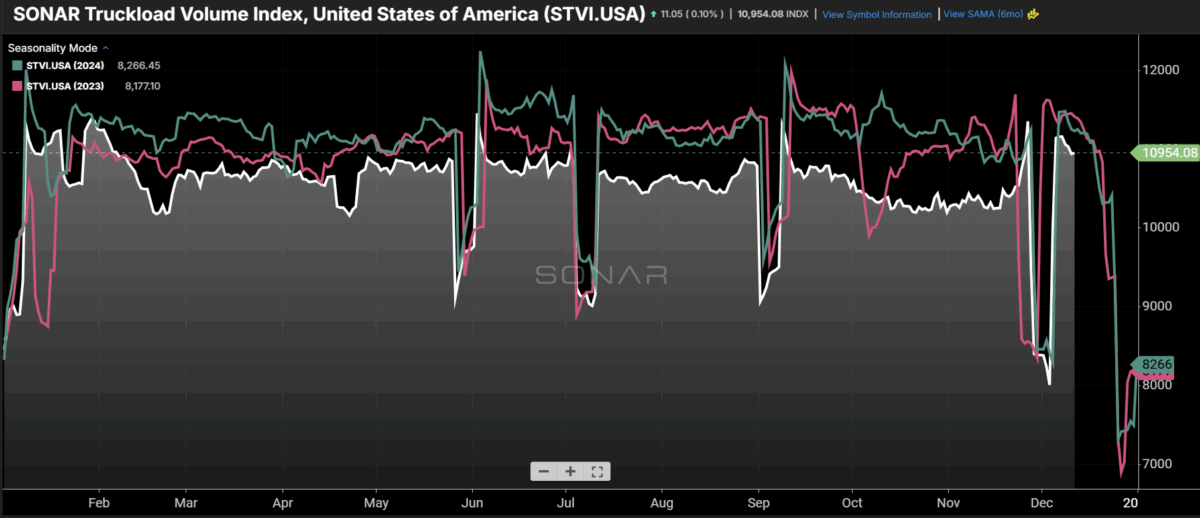
The SONAR Truckload Volume Index (STVI) — another recently introduced, expanded version of the Outbound Tender Volume Index (OTVI) — averaged 5–7% lower year over year through most of October and early November. The seasonal surge has outperformed that baseline, narrowing the annual decline to roughly 2–3%, but the improvement has not been strong or sustained enough to signal a structural shift.
On last week’s Freightonomics, Dr. Zac Rogers, co-author of the Logistics Managers’ Index (LMI), noted that warehouse utilization contracted for the first time ever in November.

The LMI is measured on a 100-point scale, with values below 50 indicating contraction and values above 50 signaling expansion. It’s normal for firms to use less warehouse space as they draw down seasonal inventories, but the magnitude of this shift is notable, and the reasons are not entirely clear.
Inventory levels are critical for trucking companies to monitor, as they offer insight into demand expectations and whether shippers are operating with lean, just-in-time inventory strategies or more buffered, just-in-case approaches. The former typically favors trucking, as intermodal becomes less attractive due to longer transit times.
The stronger-than-expected seasonal drawdown may simply reflect higher inventory carrying costs, with shippers reducing on-hand goods to limit year-end tax burdens. But the concurrent surge in truckload demand suggests some firms may have been caught off guard by a more robust holiday season than anticipated.
Amazon’s Prime event set new records in October despite declining consumer confidence. Dr. Rogers pointed out that confidence metrics have become increasingly influenced by political sentiment over the past year, making them less reliable as indicators of spending behavior.
And while sentiment toward the economy remains lukewarm, the U.S. has not entered a recession. The Fed cut interest rates last week and raised its GDP growth forecast for next year to 2.4%.
There are therefore reasons for cautious optimism regarding demand in the coming year, with additional potential tailwinds on the horizon, including tax cuts scheduled to take effect in 2026.
Even if demand does not meaningfully strengthen, tender rejections signal that the truckload market has become—and continues to become—increasingly vulnerable. Rising regulatory pressure will further accelerate capacity attrition, though the primary driver remains insufficient rates and soft demand forcing carriers out of the market.
About the Chart of the Week
The FreightWaves Chart of the Week is a chart selection from SONAR that provides an interesting data point to describe the state of the freight markets. A chart is chosen from thousands of potential charts on SONAR to help participants visualize the freight market in real time. Each week a Market Expert will post a chart, along with commentary, live on the front page. After that, the Chart of the Week will be archived on FreightWaves.com for future reference.
SONAR aggregates data from hundreds of sources, presenting the data in charts and maps and providing commentary on what freight market experts want to know about the industry in real time.
Brokerage Compliance Symposium
The day before F3. Every compliance issue you face - fraud exposure, carrier liability, FMCSA rules, cargo theft, insurance gaps - navigated by attorneys and operators defining best practices in a changing industry.
F3 Awards Dinner
The night before F3. FreightTech100 companies honored. FreightTech 25 and Shipper of Choice winners revealed live. Cocktail reception into dinner and live music - 300 industry leaders in one purpose-built room.
F3: Future of Freight Festival
Industry-defining keynotes, rapid-fire technology demos, and industry leaders networking in experiences across Chattanooga - plus the inaugural F3 Awards Dinner featuring the FreightTech and Shipper of Choice reveals.
The day before F3. Every compliance issue you face - fraud exposure, carrier liability, FMCSA rules, cargo theft, insurance gaps - navigated by attorneys and operators defining best practices in a changing industry.
The Signal at Chattanooga Choo Choo • Chattanooga, TN Register NowThe night before F3. FreightTech100 companies honored. FreightTech 25 and Shipper of Choice winners revealed live. Cocktail reception into dinner and live music - 300 industry leaders in one purpose-built room.
The Signal at Chattanooga Choo Choo • Chattanooga, TN Register NowIndustry-defining keynotes, rapid-fire technology demos, and industry leaders networking in experiences across Chattanooga - plus the inaugural F3 Awards Dinner featuring the FreightTech and Shipper of Choice reveals.
The Signal at Chattanooga Choo Choo • Chattanooga, TN Register Now