




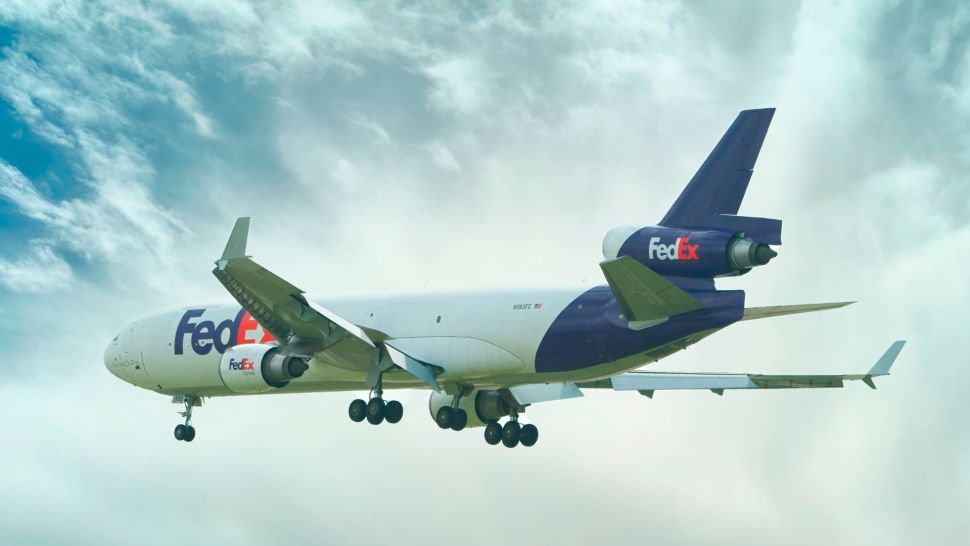
FedEx expects to incur $175 million in extra costs to overcome lost capacity from the mandatory grounding of its MD-11 air cargo fleet during the second half of the fiscal year ending May 31 and now anticipates the flying prohibition will be lifted sometime in the spring, Chief Financial Officer John Dietrich said Thursday.
The fleet update came as FedEx Corp. blew past expectations for the second quarter behind strong yields and volumes for the core package business and continued savings from a multiyear streamlining campaign.
The regulatory grounding of 28 large cargo jets, including three spares, on Nov. 8 to address a potentially unsafe condition on all McDonnell Douglas MD-11 aircraft following the crash of a UPS plane, reduced adjusted operating income by $25 million during the quarter, executives said in a presentation to analysts. Investigators discovered structural fatigue cracks in a pylon that held the engine to the wing of the destroyed UPS aircraft and authorities have yet to issue instructions to airlines on how to inspect their fleets.
“Our current outlook reflects that those aircraft will return to service in the fourth quarter,” Dietrich said. FedEx’s fiscal year fourth quarter runs from March to the end of May.
His comments are the first public indication from any party about the timeline for completing safety inspections. It should be noted that Dietrich suggested shortly after the UPS crash that planes could be quickly inspected and begin to return to service within a few weeks before aviation authorities determined a fleet-wide risk was more serious than previously thought.
FedEx immediately lost 4% of its global air cargo capacity during the busiest shipping season of the year. It implemented contingency plans, such as redeploying larger aircraft, consolidating flights, adjusting the timing of scheduled maintenance, utilizing more domestic trucking and hiring third-party airlift to minimize service disruptions. The adjustments have inconvenienced pilots and impacted airline operations, as FreightWaves reported, but FedEx has been able to maintain shipment flows with few delays.
The $25 million profit cut over the final three weeks of November barely scratched FedEx’s overall earnings, but “we expect meaningful headwinds in the second half from our MD-11 groundings, primarily in Q3,” Dietrich said. Most of the financial hit will happen this month as FedEx scrambles to meet demand from companies rushing goods to stores for holiday sales and to meet end-of-year project deadlines.
“In December, we’ll have significantly higher costs incurred on the MD-11 at the peak season. It’s an expensive time of year to be getting outsourced lift to begin with, let alone when you have a fleet grounded,” Dietrich told the market analysts.
He said FedEx expects an additional $150 million in costs for engaging partner airlines to provide dedicated transportation services, on top of the $25 million incurred in November.
“Our first priority will always be safety above all and that’s the principle which we have built. We are working hand-in- hand with the authorities on the protocol to get these aircraft back in flight. I was there in the MD-11 hangar just on Tuesday night. We have a phenomenal set of aircraft technicians who are working on it, and we’re waiting for the right protocol to get it released,” CEO Raj Subramanian added.
Robust profit
With the business plan delivering strong growth despite a turbulent macroeconomic environment, management raised the lower end of its full-year guidance to between $17.80 and $19 earnings per share (up from $17.20), with revenue growth of 5% to 6%.
Revenue during the second quarter, ended Nov. 30, was $23.5 billion, up 7% year over year, while adjusted operating income grew 17% to $1.6 billion, according to results issued after the market’s close. The company delivered $4.82 in adjusted earnings per share, up 19% year over year versus an analysts’ consensus gain of 2%. Revenue beat Wall Street’s estimate by $700 million.
The stock was up 1.5% in aftermarket trading to $291.50 per share.
The Federal Express segment (formerly Express, FedEx Ground and FedEx Services), which is responsible under a new organizational structure for moving express and deferred ground parcels and freight shipments, generated an 8% increase in revenue, with nearly half the revenue growth coming from B2B services, Subramaniam said. The company won incremental business from BMW, underscoring a new focus on the automotive sector. Healthcare and AI hyperscalers are also key focus sectors. Express profit margin ticked up 1%.
Chief Customer Officer Brie Carere credited the profit gains to FedEx placing more sales and operational attention on B2B business, which is more profitable than direct-to-consumer parcels, for the past year, and implementing rate and surcharge increases. A general rate increase of 5.9% goes into effect next month and FedEx expects it to stick for most customers that aren’t big enough to negotiate discounts.
The network optimization strategy, which is contributing to the $1 billion in expected savings this year, has resulted so far in the consolidation of 355 express and ground locations in the United States and Canada, as of Nov. 30. Those facilities now handle about a quarter of the average daily parcel volume. FedEx has also closed 150 parcel delivery centers. Contract carriers are handling pickup and delivery of packages in some locations, while employee couriers handle others. The restructuring in Canada was completed earlier this year and FedEx expects to finish implementing the U.S. facility integration by the end of calendar year 2027, the company said.
Domestic package average daily volume growth was 6% during the quarter. International export package volumes declined 1% as the end of the de minimis tariff exemption and other tariffs negatively impacted U.S. imports. FedEx continues to shift its network to areas of stronger demand. As in the first quarter, the company relocated 25% of its overnight express flights from the trans-Pacific region to the Asia-Europe trade lane.
Domestic package revenue increased 11.7% to $13.4 billion. International export revenue increased 2.6% to $3.9 billion and international domestic revenue was up $100 million to $1.3 billion. Overall, package yields were up 4% behind base rate and surcharge increases.
Despite the downtick in international export volume the yield grew 3% as FedEx focused on higher quality revenue and higher weight per shipment as the end of de minimis encouraged shippers to tender larger shipments instead of individual packages.
Carere said FedEx is seeing high single-digit growth in peak season volumes from the forecasted amount, driven by small-and-medium size customers. Larger retailers are slightly below forecasts, she added.
FedEx remains on track to spin off its less-than-truckload business, FedEx Freight, on June 1.
Click here for more FreightWaves/American Shipper stories by Eric Kulisch.
RELATED STORIES:
FedEx slow to rebook pilots’ hotel rooms amid MD-11 grounding
FedEx scrubs MD-11 flights for December as crash inspection drags on
FedEx redeploys air fleet after US ends parcel tariff exemption
Brokerage Compliance Symposium
The day before F3. Every compliance issue you face - fraud exposure, carrier liability, FMCSA rules, cargo theft, insurance gaps - navigated by attorneys and operators defining best practices in a changing industry.
F3 Awards Dinner
The night before F3. FreightTech100 companies honored. FreightTech 25 and Shipper of Choice winners revealed live. Cocktail reception into dinner and live music - 300 industry leaders in one purpose-built room.
F3: Future of Freight Festival
Industry-defining keynotes, rapid-fire technology demos, and industry leaders networking in experiences across Chattanooga - plus the inaugural F3 Awards Dinner featuring the FreightTech and Shipper of Choice reveals.
The day before F3. Every compliance issue you face - fraud exposure, carrier liability, FMCSA rules, cargo theft, insurance gaps - navigated by attorneys and operators defining best practices in a changing industry.
The Signal at Chattanooga Choo Choo • Chattanooga, TN Register NowThe night before F3. FreightTech100 companies honored. FreightTech 25 and Shipper of Choice winners revealed live. Cocktail reception into dinner and live music - 300 industry leaders in one purpose-built room.
The Signal at Chattanooga Choo Choo • Chattanooga, TN Register NowIndustry-defining keynotes, rapid-fire technology demos, and industry leaders networking in experiences across Chattanooga - plus the inaugural F3 Awards Dinner featuring the FreightTech and Shipper of Choice reveals.
The Signal at Chattanooga Choo Choo • Chattanooga, TN Register Now