




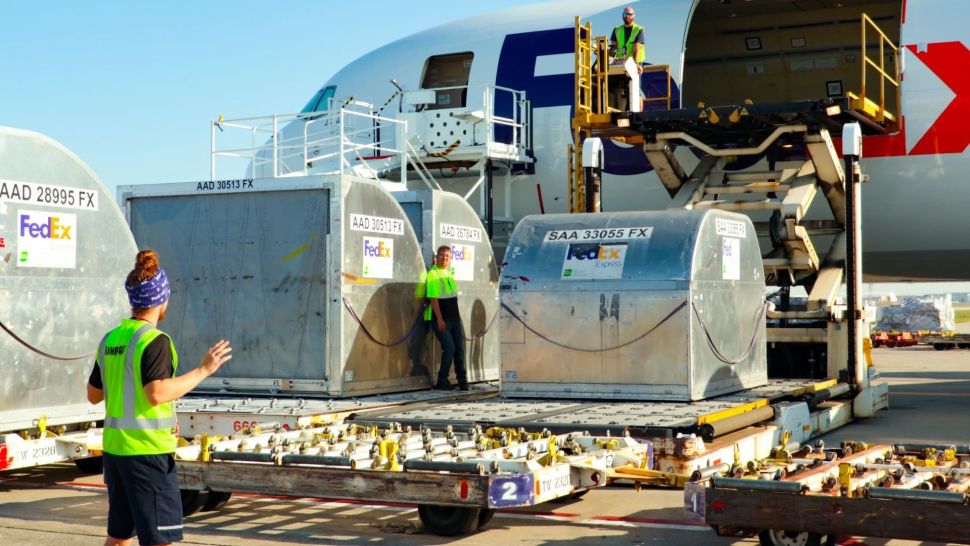
FedEx Corp. has expanded its intra-Asia air network with two new routes, adding additional capacity and transportation options for regional shippers as it redeploys aircraft to areas of high demand in response to tariff-impacted volume declines from Asia to the United States.
The move comes on the heels of a similar decision by rival UPS to increase flight frequencies and reposition larger freighters on certain routes within Asia.
FedEx (NYSE: FDX) reduced freighter activity out of Asia to the United States by 25% in the fiscal quarter ended Aug. 30 because the high tariffs imposed this year by the U.S. government sapped direct-to-consumer retail demand, executives said on the company’s earnings call last month. The company reported a $150 million profit hit from reduced revenue out of China due to the elimination of duty-free de minimis treatment for low-value e-commerce shipments, which are now subject to double-digit import fees.
On Tuesday, FedEx announced the introduction of a weekly flight connecting Incheon International Airport in Seoul, South Korea, with Hanoi, Vietnam. From Hanoi, the flight will go to FedEx’s Asia-Pacific hub in Guangzhou, China — a transshipment point for flights across Asia and to Europe. The new flight will reduce transit times by one day for shipments from northern Vietnam to Asian and European destinations.
The express carrier has also launched a direct flight between Seoul and Taiwan, operating seven times per week, on a key trade lane for high-tech and e-commerce products. The new service supports customers such as CJ Olive Young, a leading health and beauty retailer in South Korea, that aim to reach new international markets, FedEx said. (FedEx is also providing end-to-end logistics support for Olive Young’s recent expansion into the United States, selling directly to consumers on its e-commerce platform.)
The Vietnam route uses a Boeing 767 freighter while the Taiwan route mainly uses MD11s and a Boeing 777 on Sundays, spokesman Jonathan Lyons said.
“Asia’s trade landscape is evolving rapidly,” said Kawal Preet, president of FedEx Asia Pacific, in a news release. “We’re responding by strategically investing in our network to create stronger connections for businesses within the region and unlocking new pathways for growth, driven by the need to adapt to diversifying supply chains, rising regional economies, and an e-commerce landscape being reset by changing customer behaviors and market dynamics.”
FedEx said the new air freight lanes meet growing demand in a region experiencing strong e-commerce trade growth ahead of the peak holiday shopping season and shifting trade flows. High-value technology exports from Southeast Asia are also on the rise. Intra-Asia trade accounted for nearly 60% of Asia’s total exports, according to a United Nations report, and the ASEAN countries have emerged as China’s largest trade partner, with bilateral trade reaching $963 billion in 2024, Chinese government figures show.
UPS (NYSE: UPS) recently added flights between Shenzhen, China, and Sydney, Australia, and upsized aircraft flying between Hanoi and Shenzhen. Earlier this summer, UPS volumes on the China-U.S. trade corridor dropped 35%, the company reported.
FedEx also unveiled earlier this week a new air freight route between Dublin and Indianapolis that is targeted at supporting healthcare and medical device companies. Early last month, it began its first dedicated cargo flight to Saudi Arabia from the U.S. and Europe.
DHL Express has also seen volumes from China and Hong Kong to the United States fall about 30% year over year, FreightWaves previously reported.
Write to Eric Kulisch at ekulisch@freightwaves.com.
RELATED STORIES:
Click here for more FreightWaves/American Shipper stories by Eric Kulisch.
FedEx debuts air freight service connecting Dublin and Indianapolis
UPS boosts intra-Asia air capacity as US volumes wane
DHL surges customs agent hiring as new tariffs confuse importers
Brokerage Compliance Symposium
The day before F3. Every compliance issue you face - fraud exposure, carrier liability, FMCSA rules, cargo theft, insurance gaps - navigated by attorneys and operators defining best practices in a changing industry.
F3 Awards Dinner
The night before F3. FreightTech100 companies honored. FreightTech 25 and Shipper of Choice winners revealed live. Cocktail reception into dinner and live music - 300 industry leaders in one purpose-built room.
F3: Future of Freight Festival
Industry-defining keynotes, rapid-fire technology demos, and industry leaders networking in experiences across Chattanooga - plus the inaugural F3 Awards Dinner featuring the FreightTech and Shipper of Choice reveals.
The day before F3. Every compliance issue you face - fraud exposure, carrier liability, FMCSA rules, cargo theft, insurance gaps - navigated by attorneys and operators defining best practices in a changing industry.
The Signal at Chattanooga Choo Choo • Chattanooga, TN Register NowThe night before F3. FreightTech100 companies honored. FreightTech 25 and Shipper of Choice winners revealed live. Cocktail reception into dinner and live music - 300 industry leaders in one purpose-built room.
The Signal at Chattanooga Choo Choo • Chattanooga, TN Register NowIndustry-defining keynotes, rapid-fire technology demos, and industry leaders networking in experiences across Chattanooga - plus the inaugural F3 Awards Dinner featuring the FreightTech and Shipper of Choice reveals.
The Signal at Chattanooga Choo Choo • Chattanooga, TN Register Now