A U.S.-flag ocean line says Jones Act carriers provide vital, reliable services and helps assure national security as President Donald Trump suspended the shipping law that bars foreign carriers from operating services between U.S. ports.
“Jones Act carriers have invested billions in vessels, terminals, and port infrastructure serving Puerto Rico,” said Trailer Bridge, in a February blog post. “These are not opportunistic deployments based on short-term rate swings. They represent long-term commitments to the trade, including modern vessels, LNG-powered ships, specialized equipment, and dedicated terminal operations.”
Trump on Wednesday paused the law for 60 days in a bid to bring down fuel and other prices that soared after Iran blocked tankers from the Strait of Hormuz. About 20% of the world’s crude oil moves through the narrow waterway from Persian Gulf suppliers.
“We strongly oppose the Trump Administration’s decision to issue a blanket 60-day waiver of the Jones Act,” the International Longshore and Warehouse Union said in a statement. “A blanket Jones Act waiver such as this undermines our national security, weakens military readiness and shifts critical maritime work to foreign vessel operators. During a time of heightened international conflict and uncertainty, opening U.S. waterways to foreign vessels is a dangerous move for the U.S. mariners we represent.”
The union urged the Administration and Congress to pause the waiver and work with stakeholders – including labor – to develop long-term solutions.
Part of the federal Merchant Marine Act of 1920, the Jones Act was enacted to strengthen U.S. shipbuilding after World War I. For shipping, it stipulates that cargo transported between U.S. ports, or coastwise trade, move on U.S.-built, -flagged and -owned vessels, operated by U.S. crews.
The law aimed to not only ensure economic stability but also national security. “A robust U.S.-flag fleet ensures the country has ships and skilled crews available during times of war, emergency, or natural disaster,” the Jacksonville, Fla.-based company said.
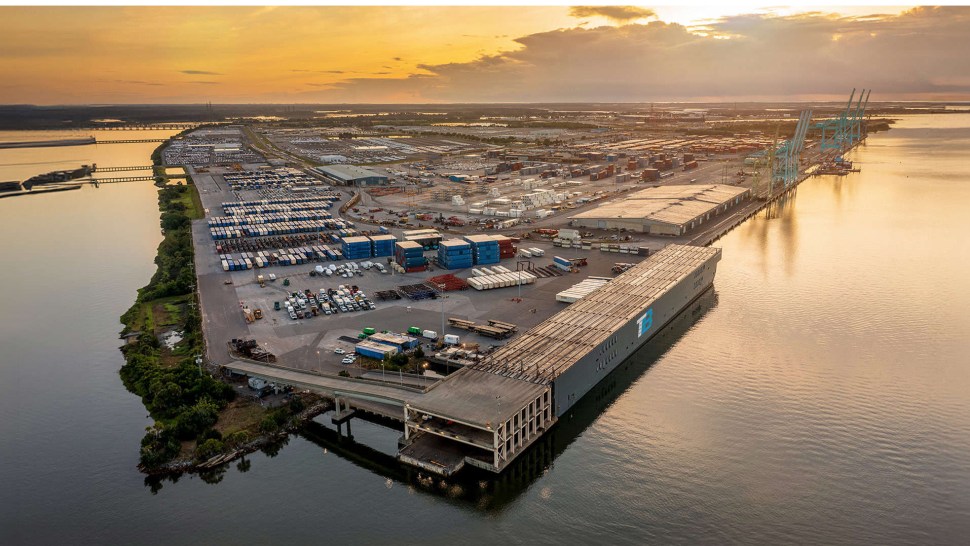
The Jones Act covers all domestic maritime trade between U.S. ports including Alaska, Hawaii, and the territories of Guam, and Puerto Rico, the last a focus of Trailer Bridge services. The island is also served by Jones Act carriers TOTE Group and Crowley, based out of the Port of Jacksonville. National Shipping of America operates out of Houston. Matson, Pasha Hawaii and tanker operator Keystone Shipping also operate Jones Act-compliant ships.
“Because Puerto Rico relies heavily on ocean freight for essential goods including food, medicine, fuel, construction materials, and retail inventory, the Jones Act plays a central role in the island’s supply chain,” Trailer Bridge said.
Trailer Bridge in 2022 signed long-term lease agreements with both the Jacksonville Port Authority and Puerto Rico Ports Authority “signaling its long-term commitment to the Puerto Rico trade.”
Analysts generally say the Jones Act suspension will only trim fuel prices by a few cents per gallon at most, and any effect will be modest and slow to show up.
The Jones Act has also been criticized as protectionist, and that it raises prices for some products through higher shipping costs.
But TrailerBridge counters by saying that the freight cost issue is best considered in a broader context as only one component of total landed cost and supply chain risk.
“Jones Act carriers serving Puerto Rico operate dedicated trade lanes with fixed, frequent sailings,” the company stated. “This provides predictable capacity between the mainland and the island. In markets dependent on global carriers, capacity can shift based on international demand cycles. In the Puerto Rico trade, Jones Act carriers are committed to serving the lane, which supports greater rate stability over time.”
Because Puerto Rico is treated as domestic trade, TrailerBridge added, cargo is not subject to international customs delays when moving from the mainland. “That domestic designation supports streamlined documentation and more consistent transit planning.
In times of global shipping disruption, Puerto Rico’s domestic ocean shipping network provides insulation from international volatility.”
Furthermore, international lines service Puerto Rico under laws, labor standards and safety frameworks of their flag state. Jones Act carriers such as TrailerBridge operate under U.S. Coast Guard oversight; comply with U.S. labor laws; employ American mariners; and invest in U.S.-built vessels and infrastructure.
TOTE Chief Executive Tim Nolan has said that the Jones Act gives the company “confidence and stability” to invest in new ships and fleet upgrades, including LNG‑powered vessels for Puerto Rico and Alaska trades. It provides long‑term predictability that enables significant private investment and results in “stability” and “reliability” for the markets TOTE serves.
When evaluated purely on per-container ocean rates, says TrailerBridge, comparisons can oversimplify the full economic picture.
“For Puerto Rico, an island dependent on maritime trade, the value of continuity, predictability, and resilience must be part of the equation.”
This article was updated March 20 to add a statement from the ILWU.
Read more articles by Stuart Chirls here.
Related coverage:
Largest container line makes major move into tanker market
From containers to doorsteps: Maersk’s push Into parcel logistics
Brokerage Compliance Symposium
The day before F3. Every compliance issue you face - fraud exposure, carrier liability, FMCSA rules, cargo theft, insurance gaps - navigated by attorneys and operators defining best practices in a changing industry.
F3 Awards Dinner
The night before F3. FreightTech100 companies honored. FreightTech 25 and Shipper of Choice winners revealed live. Cocktail reception into dinner and live music - 300 industry leaders in one purpose-built room.
F3: Future of Freight Festival
Industry-defining keynotes, rapid-fire technology demos, and industry leaders networking in experiences across Chattanooga - plus the inaugural F3 Awards Dinner featuring the FreightTech and Shipper of Choice reveals.
The day before F3. Every compliance issue you face - fraud exposure, carrier liability, FMCSA rules, cargo theft, insurance gaps - navigated by attorneys and operators defining best practices in a changing industry.
The Signal at Chattanooga Choo Choo • Chattanooga, TN Register NowThe night before F3. FreightTech100 companies honored. FreightTech 25 and Shipper of Choice winners revealed live. Cocktail reception into dinner and live music - 300 industry leaders in one purpose-built room.
The Signal at Chattanooga Choo Choo • Chattanooga, TN Register NowIndustry-defining keynotes, rapid-fire technology demos, and industry leaders networking in experiences across Chattanooga - plus the inaugural F3 Awards Dinner featuring the FreightTech and Shipper of Choice reveals.
The Signal at Chattanooga Choo Choo • Chattanooga, TN Register Now