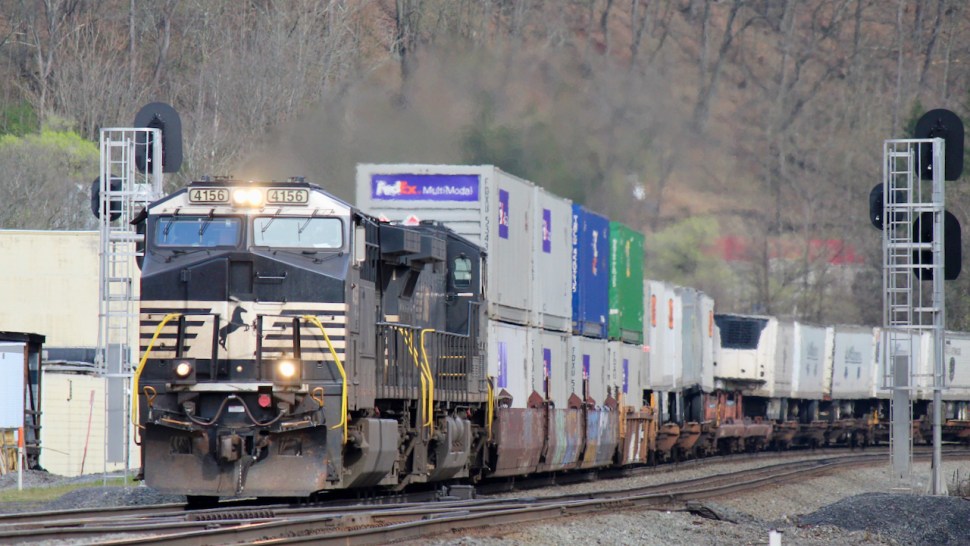
Heightened intermodal competition took a toll on Norfolk Southern’s volume, revenue, and profits in the fourth quarter.
The 7% drop in intermodal volume drove a 4% decline in overall traffic as NS (NYSE: NSC) lost container business to rival CSX (NASDAQ: CSX), which launched an intermodal alliance with BNSF Railway (NYSE: BRK-B) last summer.
NS Chief Executive Mark George said the fourth quarter played out amid a softer volume environment than had been predicted. “But even so, we controlled the controllables,” he said on the railroad’s earnings call on Thursday morning. “Costs landed exactly in line with the guidance we provided last quarter, reflecting disciplined execution across the company. And while there’s been heavy external attention around the merger, I’m really proud that the team maintained its focus on the business — prioritizing safety, dependable service, and strong cost control.”
George noted that NS was able to move 3% more gross ton-miles in 2025 with 4% fewer employees.
Union Pacific (NYSE: UNP) and NS plan to file a revised merger application with the Surface Transportation Board in March. The tie-up, if approved, would create the first transcontinental railroad.
Quarterly operating income declined 17%, to $937 million, as revenue decreased 2%, to $3 billion. Adjusted for one-time items — including ongoing costs related to the 2023 East Palestine, Ohio, hazardous materials derailment, merger-related expenses, and gains on line sales in 2024 — operating income was down 3%, to $1 billion. Earnings per share declined 11%, to $2.87, but were up 6%, to $3.22, on an adjusted basis.
The railroad’s fourth-quarter operating ratio was 68.5%, up from 62.6% in the fourth quarter of 2024, which included line sales income. The adjusted operating ratio was 65.3%.
Although intermodal traffic was down, NS was able to notch gains in merchandise and coal business. Both were up 1% for the quarter.
Declining export metallurgical coal pricing, however, contributed to an 11% decline in coal revenue. And the increased intermodal competition, meanwhile, represents a 1% revenue hit.
“I’ve told the team we’re gonna fight like hell for quality revenue here. So we want to go get attractive carloads, and we want to try to optimize our revenue line as best as we can,” George said. “We’re not sitting back and taking body blows. So we’re gonna fight like hell.”
Chief Commercial Officer Ed Elkins said the UP-NS interline service linking Kansas City with Louisville, Ky., and the launch of double-stack service to New England over CSX trackage rights were two examples of how NS is fighting back. “There’s more in the pipeline,” he said.
NS posted its best safety figures in more than a decade in 2025 thanks to the deployment of new technology such as train inspection portals, automated track inspection, wheel inspection systems, and an improved emphasis on employee safety, executives said.
The FRA reportable injury rate improved 15%, reportable train accidents were down 31%, and the railroad’s mainline derailment rate led the industry, Chief Operating Officer John Orr said. The railroad experienced zero mainline derailments in the fourth quarter.
The railroad’s key operating metrics — including average train speed, terminal dwell, and intermodal and merchandise service compliance — were largely the same as the fourth quarter of 2024.
NS boosted its three-year cost reduction target to $650 million, up from $550 million when the forecast was issued in 2024. The railroad exceeded its $150 million 2025 target by $66 million and has added $50 million to its 2026 cost savings goal, Orr said.
Executives said competition from CSX and BNSF as a result of the UP-NS merger proposal will continue to hurt volumes this year.
“As we move through 2026, the demand environment remains unclear, but we are steadfastly focused on prioritizing the safety of our employees and communities, delivering consistent customer service, and driving further productivity gains to contain our costs in any volume environment,” George said.
NS expects to reduce its capital spending this year by 14%, to $1.9 billion.
For the full year, overall NS volume was flat. The railroad’s operating income was up 7%, to $4.4 billion, but was up 3% on when adjusted for one-time items. Revenue was flat for 2025, at $12.2 billion.
Earnings per share increased 10%, to $12.75, but increased 5% on an adjusted basis.
Norfolk Southern’s operating ratio was 64.2%, a 2.2-point improvement over 2024. On an adjusted basis, the operating ratio was 65%, down from an adjusted 65.8% in 2024.
Subscribe to FreightWaves’ Rail e-newsletter and get the latest insights on rail freight right in your inbox.
Related coverage:
Clean sweep for weekly rail freight improvement
Brokerage Compliance Symposium
The day before F3. Every compliance issue you face - fraud exposure, carrier liability, FMCSA rules, cargo theft, insurance gaps - navigated by attorneys and operators defining best practices in a changing industry.
F3 Awards Dinner
The night before F3. FreightTech100 companies honored. FreightTech 25 and Shipper of Choice winners revealed live. Cocktail reception into dinner and live music - 300 industry leaders in one purpose-built room.
F3: Future of Freight Festival
Industry-defining keynotes, rapid-fire technology demos, and industry leaders networking in experiences across Chattanooga - plus the inaugural F3 Awards Dinner featuring the FreightTech and Shipper of Choice reveals.
The day before F3. Every compliance issue you face - fraud exposure, carrier liability, FMCSA rules, cargo theft, insurance gaps - navigated by attorneys and operators defining best practices in a changing industry.
The Signal at Chattanooga Choo Choo • Chattanooga, TN Register NowThe night before F3. FreightTech100 companies honored. FreightTech 25 and Shipper of Choice winners revealed live. Cocktail reception into dinner and live music - 300 industry leaders in one purpose-built room.
The Signal at Chattanooga Choo Choo • Chattanooga, TN Register NowIndustry-defining keynotes, rapid-fire technology demos, and industry leaders networking in experiences across Chattanooga - plus the inaugural F3 Awards Dinner featuring the FreightTech and Shipper of Choice reveals.
The Signal at Chattanooga Choo Choo • Chattanooga, TN Register Now