




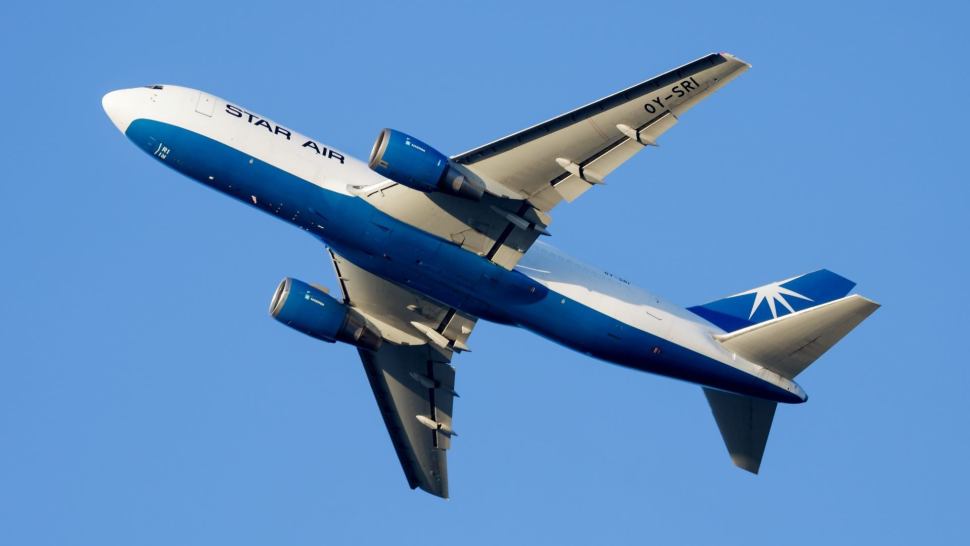
The cargo airline owned by Danish shipping powerhouse A.P. Moller-Maersk will soon deploy its first Boeing 777 freighter on an existing route between Europe and China, injecting a dose of capacity as businesses face limited access to dedicated freighter service in a tight market.
Maersk Air Cargo accepted its first 777 freighter from Boeing following a handover ceremony in Seattle, the company announced Friday. The aircraft is scheduled to arrive at its home base in Billund, Denmark, on Saturday. Maersk said the second of two freighters on order will be delivered later this quarter.
The 777s will be deployed between Billund and Hangzhou, China – a route currently served daily with Boeing 767 aircraft. The 777 schedule will start with three weekly flights and increase to six flights per week when the second jet joins the Maersk fleet. Maersk didn’t give a specific date for entry into service, but both planes are expected to be ready for the upcoming peak shipping season.
Executives said the large 777s will increase operating efficiency because of their ability to carry more goods than the 767, which is a medium widebody freighter.
“With this step we are entering the premier league of cargo aviation. The B777F can transport more than double the payload on each flight compared to our 767Fs, and it is the most fuel-efficient aircraft in the world with the GE90 engines,” said Lars Jordahn, head of Maersk Air Cargo, in a news release.
Maersk Air Cargo has become a mid-major freighter operator, with 20 Boeing 767 cargo jets in its fleet in addition to the 777s. A portion of those aircraft operate under contract for UPS and other express carriers in Europe. In 2022, Maersk’s in-house airline branched out to provide airlift for its own customers as part of a strategic shift from a pure port-to-port ocean carrier into a global integrated logistics company with door-to-door delivery capabilities.
Management’s stated intent is to haul one-third of the company’s air tonnage with its own controlled freighters, including aircraft operated by partners under long-term charter agreements. Other shipments are booked by the airfreight forwarding department on commercial flights.
The airfreight market is in the midst of a sustained recovery after a 16-month downturn that lasted until the third quarter of last year. Year-to-date cargo volumes are up about 12% from the same period a year ago and have remained strong into the traditionally slow summer months, according to market researchers. Demand for all-cargo aircraft has remained strong even with a post-COVID influx of passenger belly capacity pushing down rates because many shippers want the schedule reliability and focus on manufacturing centers that passenger airlines don’t consistently offer.
Many businesses in Europe and North America are scrambling for freighter space, especially as e-commerce platforms and logistics providers increasingly book entire aircraft or space blocks under multimonth contracts. Demand has intensified this year because of the effective closure of the Red Sea passageway by Houthi rebels in Yemen, which has pushed more shipments to air to avoid longer voyages and port congestion in Asia and Europe.
“Due to the disruptive environment in logistics, a rising number of cargo owners are choosing to reduce the number of service providers in their supply chain. Increased visibility across fewer providers enables the cargo owners to react more swiftly … in case of disruption. Availability of airfreight capacity and full asset control” increase flexibility and resilience, said Narin Phol, chief product officer for logistics and services at Maersk.
The Boeing 777F can fly up to 4,970 nautical miles and carry a maximum payload of 112.5 tons. The main deck fits pallets up to 9.8 feet high, and both cargo decks are temperature controlled.
Maersk Air Cargo last month introduced three-times weekly service between its hub at Chicago Rockford airport (RFD) and Zhengzhou, China, with a connection in Seoul, South Korea, utilizing 767-300 aircraft. It also operates six times per week between RFD and Hangzhou via Seoul. The airline entered the U.S. market in late 2022, opening a route between Seoul and the Greenville-Spartanburg airport in South Carolina (GSP) and subsequently adding Shenyang, China, as a destination. Maersk contracts with Miami-based Amerijet to operate those flights on its behalf.
The company is training its own pilots to fly the 777 cargo jets.
North American footprint
Maersk in April opened a 90,000-square-foot airfreight warehouse near Miami International Airport to facilitate cargo transfers between Asia and Latin America, with most shipments being trucked from RFD and GSP for consolidation and booking on other airlines. Maersk also has airfreight stations near the Atlanta, Los Angeles and Chicago O’Hare airports.
Earlier this year, Maersk Air Cargo began flying into the United Kingdom on a scheduled and charter basis after receiving permission to temporarily operate a handful of 767 cargo jets on routes between Billund and Birmingham, England.
Maersk continued its fleet and infrastructure expansion even as other cargo airlines shelved growth plans in response to last year’s soft market conditions.
RECOMMENDED READING:
Air cargo surge could be at expense of peak season
Maersk airline prepares to deploy first 777 freighters for peak season
Brokerage Compliance Symposium
The day before F3. Every compliance issue you face - fraud exposure, carrier liability, FMCSA rules, cargo theft, insurance gaps - navigated by attorneys and operators defining best practices in a changing industry.
F3 Awards Dinner
The night before F3. FreightTech100 companies honored. FreightTech 25 and Shipper of Choice winners revealed live. Cocktail reception into dinner and live music - 300 industry leaders in one purpose-built room.
F3: Future of Freight Festival
Industry-defining keynotes, rapid-fire technology demos, and industry leaders networking in experiences across Chattanooga - plus the inaugural F3 Awards Dinner featuring the FreightTech and Shipper of Choice reveals.
The day before F3. Every compliance issue you face - fraud exposure, carrier liability, FMCSA rules, cargo theft, insurance gaps - navigated by attorneys and operators defining best practices in a changing industry.
The Signal at Chattanooga Choo Choo • Chattanooga, TN Register NowThe night before F3. FreightTech100 companies honored. FreightTech 25 and Shipper of Choice winners revealed live. Cocktail reception into dinner and live music - 300 industry leaders in one purpose-built room.
The Signal at Chattanooga Choo Choo • Chattanooga, TN Register NowIndustry-defining keynotes, rapid-fire technology demos, and industry leaders networking in experiences across Chattanooga - plus the inaugural F3 Awards Dinner featuring the FreightTech and Shipper of Choice reveals.
The Signal at Chattanooga Choo Choo • Chattanooga, TN Register Now