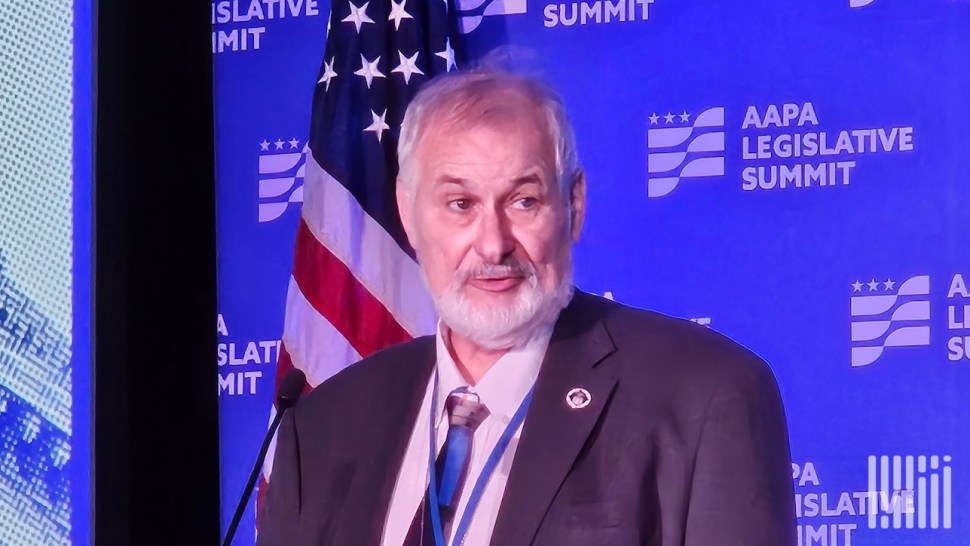
WASHINGTON — The newly-appointed chief of the Maritime Administration called for a complete rebuild of the American industrial shipping complex, in order to reclaim its position as a world power in ocean transportation and shipbuilding.
“Today, the United States produces less than 1% of global commercial ships, we have not built a ship for exports since 1960 so in terms of the international market, we produce exactly…zero,” Marad Administrator Stephen Carmel told the Association of American Port Authorities at its recent legislative summit. “But, that is the market we need to target if we want to be able to produce at scale.”
U.S.-flag ships carry less than 2% of the country’s international commerce “and not one molecule of international trade in energy,” he said, which has been “completely outsourced” to foreign companies.
The problem, Carmel said, isn’t just with shipyards, or port or ship management. It’s a management system problem, and a structural disengagement from the international American maritime ecosystem.
“Shipbuilding flows from cargo, and cargo follows logistics networks. So, I want to rebuild the American maritime capability.
“We must rebuild the entire maritime ecosystem.”
The birth of that system can be traced to 1818, Carmel said, when the Black Ball Line introduced the radical concept of scheduled sailings even when ships weren’t full, which would come to be known as liner shipping.
“A year later, when that system worked, the United States became one of the great maritime powers of the world,” he said. “The challenge before us today is to rebuild that system for the 21st Century.”
The U.S. Maritime Action Plan (MAP) recently released by the Trump administration is designed to do exactly that.
Carmel, who was appointed in 2025 by President Donald Trump to lead Marad, which regulates shipping with the Federal Maritime Commission, said that the MAP is built around four pillars:
- Rebuilding American shipbuilding
- Ship repair capacity
- Reforming and expanding the maritime workforce
- Protecting the maritime industrial base, and strengthening national security and maritime resilience.
The pillars are not isolated programming, Carmel said, but designed to reinforce one another, to rebuild the entire maritime ecosystem.
Ports are at the center of that ecosystem, and include the Great Lakes, inland waterways and seacoasts — what Carmel said is by far the largest and most economically integrated waterway system in the world. “The system is just as important as how many Navy ships we can deploy at one time, but that’s often forgotten,” he said.
Carmel, a former executive at Maersk Line and graduate of the U.S. Merchant Marine Academy who received his first command, of a dry bulker, at 26, highlighted MAP initiatives that directly involve port communities.
The first, Maritime Prosperity Zones, are intended to cluster maritime industrial activity, shipbuilding, logistics repair capacity and cargo generation around key port regions. Ports wills serve as anchor institutions for those zones.
Second, expanded cargo generation. The plan proposes cargo preference policies designed to ensure that more cargo flows through the American maritime enterprise, cargo Carmel termed the “lifeblood” of the maritime system. “Without cargo, ships do not sail and ports cannot grow,” he said, “While expanding cargo preference, rigorously enforced, is part of that solution, it is only a small part of the rebuilding.”
Carmel said that maritime enterprise means carrying the nation’s commerce, and that the MAP moves the U.S. in that direction.
“The U.S. flag merchant marine has two roles: Carry our nation’s commerce and, when called upon, carry our nation to war. That’s it, full-stop. We must do those two things without failure to achieve maritime dominance.”
The MAP emphasizes digital supply chain visibility and logistics modernization, and Carmel said ports will play a leading role in deploying new technology that improves cargo tracking, logistics coordination and national supply chain awareness.
The plan recognizes the growing nature of digitally deliverable trade and the critical nature of subsea cable infrastructure, and the lack of U.S. capability there. China, for one, has deployed cargo ships to drag their anchors and damage undersea communications cables. Said Carmel, “Data is a 21st century version of cargo, and physical trade through your ports will not happen if the subsea network is compromised.”
The MAP includes major initiatives in maritime workforce development, expanded training pipelines and apprenticeships, providing critical grounds for the next generation of American workers.
Carmel told the conference that ports are central to the execution of the plan.
“Innovation is a structural feature upon which our future must be built, and another core idea is that innovation must become structural in the U.S. maritime system. We no longer need to not only be innovative, but we need to reinvent the very nature of innovation — the match of challenges of the 21st and then 22nd centuries.”
Rapid technological change in maritime logistics and shipping ranges from autonomous vessel technology, digital cargo visibility, advanced fuels and energy systems to robotic terminal operations and next generation propulsion technologies. Carmel said innovation is not about any single technology, but about creating a system where innovation happens continuously and spontaneously.
Carmel said ports are natural laboratories for that innovation, where logistics networks converge, where digital systems meet physical cargo flows and where operational innovation becomes reality.
It will not be long, he predicted, when small, nuclear reactor-powered ships, or SNRs, call U.S. ports. “That means moving forward or be left behind. And that is not an option.”
But, it’s not enough for maritime innovation to develop in scale, said Carmel, it must be led by the armed forces where “our new strategic currency must be resilience.”
He said that the Covid supply chain mess was “a mere snippet” of what might happen in a conflict with China. He described the Chinese “theory of victory” of systems destruction warfare, where attacking infrastructure that allow the military to fight rather than going toe-to-toe with the U.S. military, “and that means the front line of that war will be Main Street U.S.A., as our supply chains are attacked.”
The longtime model of optimizing American maritime economics primarily for efficiency, and low cost just-in-time supply chains and maximum throughputs worked in a stable world.
“But the world we operate in today is different. We are seeing geopolitical competition, intensified supply chains, fragmented energy markets destabilized and sea lanes becoming contested,” Carmel said. “And in that environment, resilience becomes strategic, infrastructure and lack of it is strategical failure. Resilience means diversified trade groups, flexible logistics networks, domestic repair capacity, surged shipping capability and ports capable of absorbing shocks and recovering without systemic failure.”
Carmel said execution of the MAP requires leadership from the port community, in three areas: First, identifying port Maritime Prosperity Zones and attracting investment in infrastructure. Second, piloting new logistics technologies such as digital visibility systems, automated cargo operations, and advanced energy infrastructure, along with a workforce filling high quality, good paying, stable jobs.
“We must purge from our discourse the notion that technology equates to job loss,” he said. “It does not need to, it should not, and if we are going to survive as an industry, it cannot.”
Third, engage actively in legislative processes as Congress considers policies to complement the MAP, including cargo generation initiatives, industrial-based investments and workforce development.
“And a system rather than stovepipe actions. The maritime system cannot be rebuilt by federal policy alone, and must be rebuilt by the entire maritime community, working together.”
The U.S. “was the greatest maritime power on earth, and then we let it slip away,” Carmel said. “I personally do not want to have to go through this again. What we do this time has to stick for 150 years. Now, we must seize the moment that history affords us and take it back.”
Read more articles by Stuart Chirls here.
Related coverage:
After Trump photo op, CMA CGM will re-flag 30 ships in France
Strait of Hormuz closure: How supply shocks threaten American crops
Why Strait of Hormuz maritime access is also its biggest weakness
Brokerage Compliance Symposium
The day before F3. Every compliance issue you face - fraud exposure, carrier liability, FMCSA rules, cargo theft, insurance gaps - navigated by attorneys and operators defining best practices in a changing industry.
F3 Awards Dinner
The night before F3. FreightTech100 companies honored. FreightTech 25 and Shipper of Choice winners revealed live. Cocktail reception into dinner and live music - 300 industry leaders in one purpose-built room.
F3: Future of Freight Festival
Industry-defining keynotes, rapid-fire technology demos, and industry leaders networking in experiences across Chattanooga - plus the inaugural F3 Awards Dinner featuring the FreightTech and Shipper of Choice reveals.
The day before F3. Every compliance issue you face - fraud exposure, carrier liability, FMCSA rules, cargo theft, insurance gaps - navigated by attorneys and operators defining best practices in a changing industry.
The Signal at Chattanooga Choo Choo • Chattanooga, TN Register NowThe night before F3. FreightTech100 companies honored. FreightTech 25 and Shipper of Choice winners revealed live. Cocktail reception into dinner and live music - 300 industry leaders in one purpose-built room.
The Signal at Chattanooga Choo Choo • Chattanooga, TN Register NowIndustry-defining keynotes, rapid-fire technology demos, and industry leaders networking in experiences across Chattanooga - plus the inaugural F3 Awards Dinner featuring the FreightTech and Shipper of Choice reveals.
The Signal at Chattanooga Choo Choo • Chattanooga, TN Register Now