
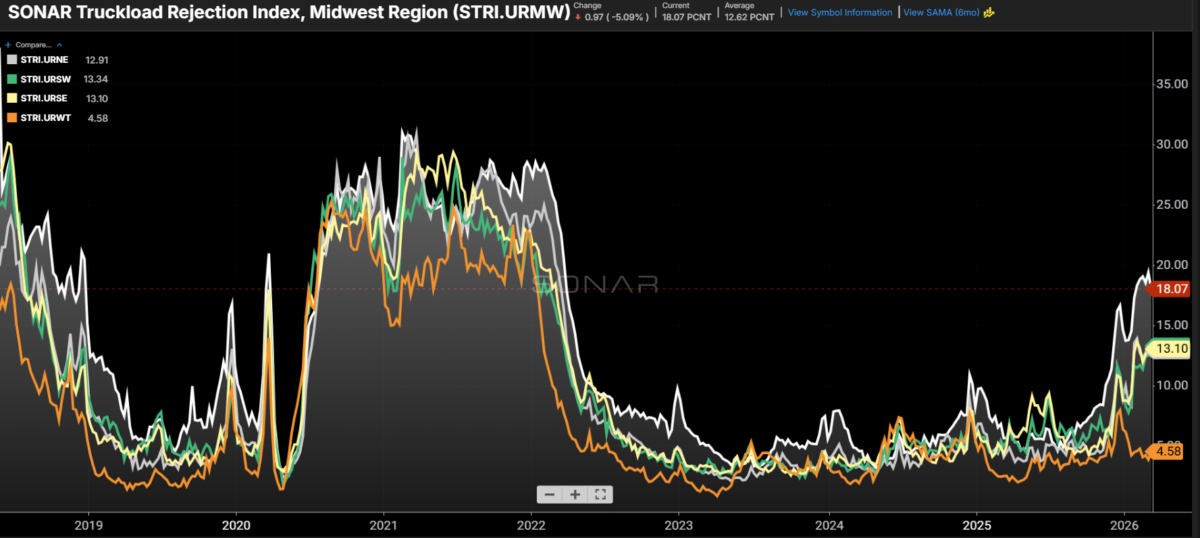
Chart of the Week: SONAR Truckload Rejection Index – Midwest, West Coast, Northeast, Southwest, Southeast SONAR: STRI.URMW, STRI.URWT, STRI.URNE, STRI.URSW, STRI.URSE
Regional truckload tender rejection rates typically move in sync, but the West Coast region — which includes California, Arizona and Nevada — has barely responded to recent disruptive events. Midwest tender rejection rates have remained above 18% for the past month, while West Coast rejection rates peaked near 5% in early February before retreating. What could be driving the divergence?
Seasonal low
The most obvious place to start is seasonality. Looking back over the past eight years, the West Coast regional rejection rate typically reaches its lowest levels in the first few months of the year. Much of this is tied to containerized imports, which also hit a seasonal low during this period and historically flow through the port complexes of Los Angeles and Long Beach.
Container imports into West Coast ports skew heavily toward retail goods and CPG. The retail season peaks in the fourth quarter, and most of these goods are ordered during the summer months in preparation. As a result, volumes moving inland from the coast typically peak in September and October.
The Lunar New Year — the largest holiday in China — also occurs in January or February each year, shutting down much of the country’s production for several weeks. This translates into lower surface transportation volumes. Demand typically returns in mid- to late March, but this year’s holiday occurred later than usual, which could push the rebound in import volumes into April.
Calmer weather
While the West has experienced its share of turbulent weather — including flooding rains and heavy snowfall in the Sierra Nevada — these events have not had a significant long-term impact on capacity. This is typical for the region, as the infrastructure surrounding major shipping facilities is rarely disrupted for extended periods.
Winter Storm Fern did not directly strike the Midwest, but many surrounding regions were affected. The disruption created numerous shipping and transportation network failures over the past month. Losing several days of production often leaves shippers with backlogs, while carrier networks fall out of balance due to uneven and unexpected demand.
The Southwest and Southeast were the regions most directly affected by the storm, yet the Midwest still recorded the highest rejection levels. This may simply reflect the fact that the region was already under strain.
Intermodal share
Perhaps the most straightforward explanation for the divergence between Midwest and West Coast rejection rates is the decline in long-haul or transcontinental truckload volume —the most rejected band — from the nation’s largest West Coast markets.
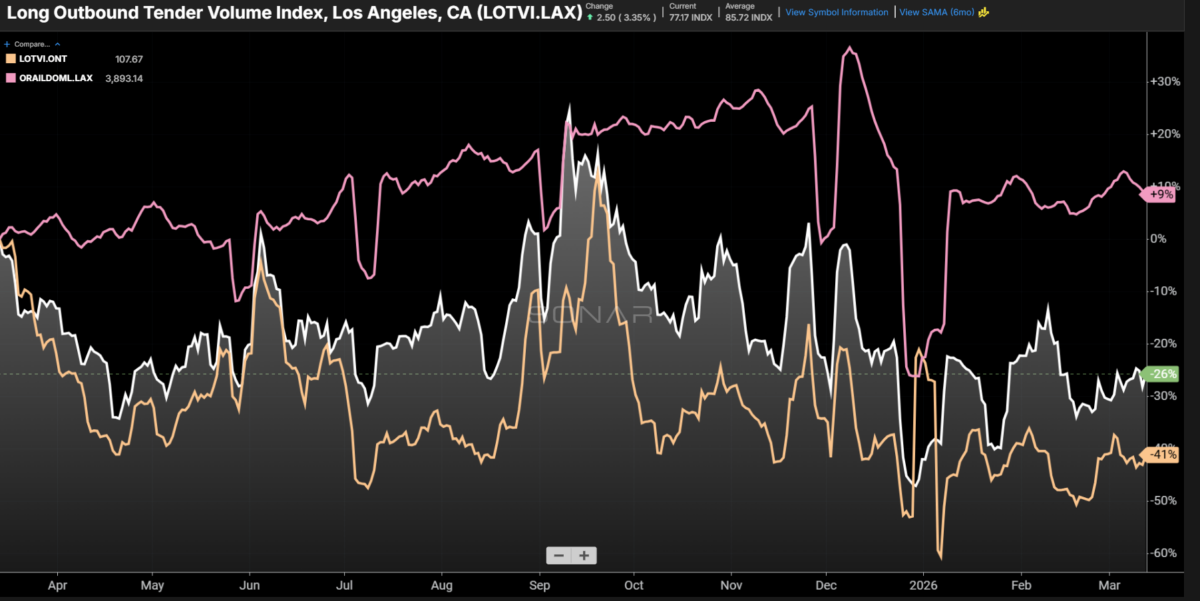
Tenders for loads moving more than 800 miles from the Los Angeles and Ontario markets remain down 20–40% year over year.
Intermodal conversion helps explain part of this shift. Loaded domestic intermodal volumes have averaged roughly 10% higher year over year in recent weeks. However, that trend has not been consistent throughout the year. International container demand has also been weaker than in 2025 for most of the year. This suggests that some level of demand loss in the region is keeping truckload capacity more available.
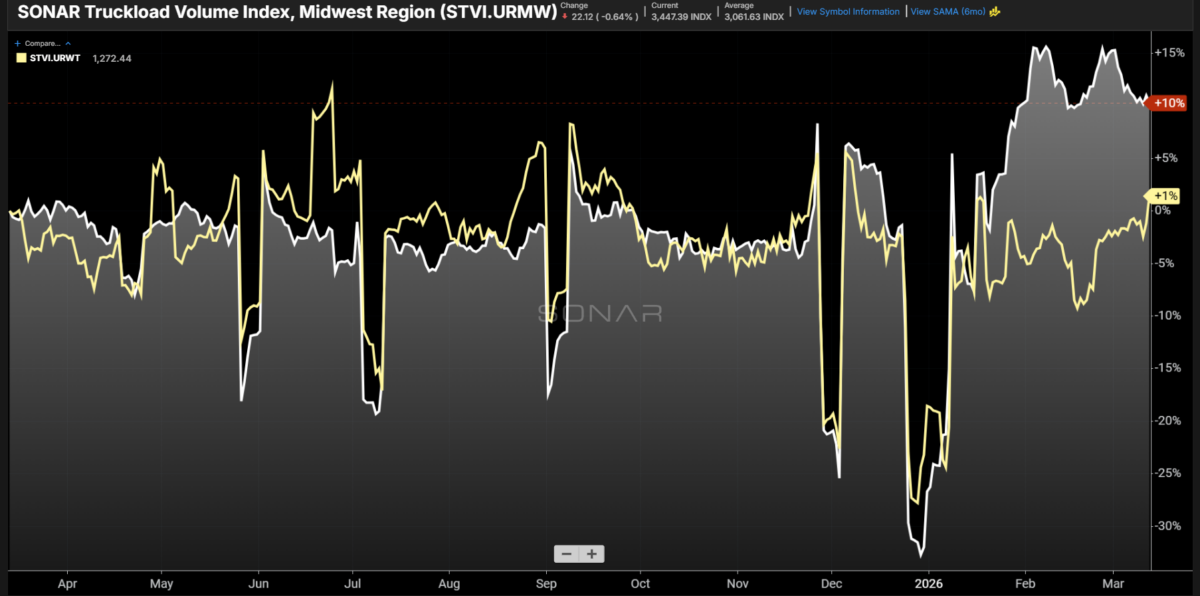
Some of that pressure shifts to the middle of the country as freight transitions off the rails. That may be reflected in tender volumes in the Midwest running roughly 10–15% higher than in the West. Manufacturing and industrial production could also be contributing to the disproportionate growth in demand.
Rate trends
Another intriguing potential contributor is the divergence in rate trends between Midwest and West Coast lanes.
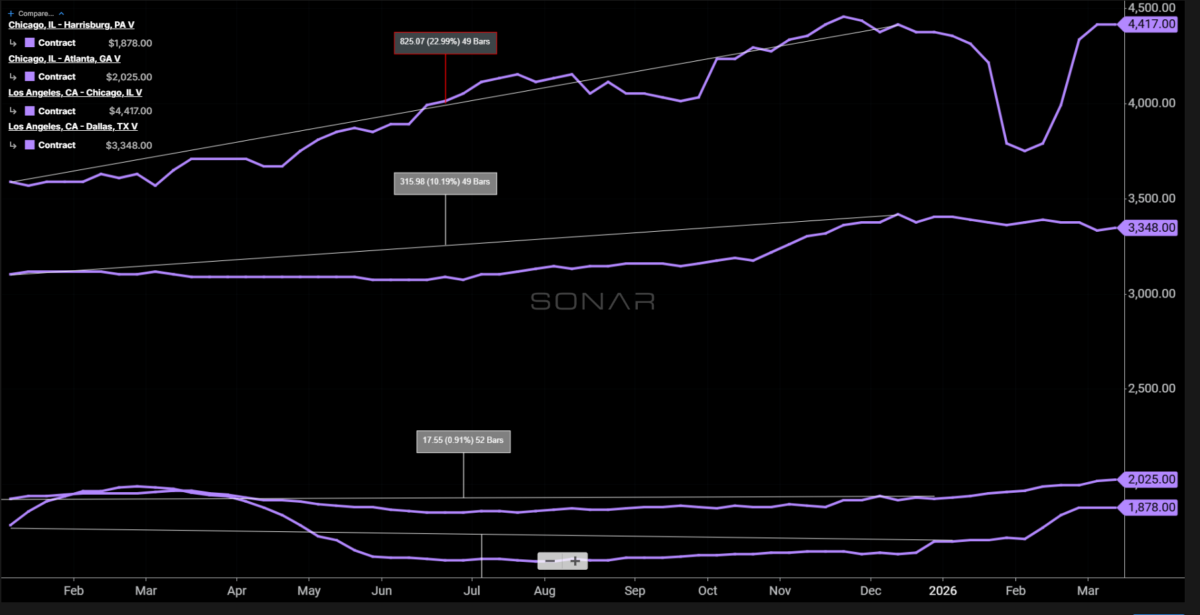
Invoice data suggests that contract rates out of long-haul Los Angeles markets were rising late last year, while rates originating in Chicago were flat to slightly lower. For example, dry van truckload rates from Los Angeles to Chicago increased more than 20% from the start of 2025 heading into the holiday season. Meanwhile, rates from Chicago to Harrisburg, Pennsylvania, declined roughly 3–4% over the same period.
Limited pressure throughout the year prevented many eastern U.S. lanes from seeing meaningful contract rate increases. By contrast, even though overall demand was soft, loads moving by truck out of Los Angeles often carried greater urgency.
This alone does not fully explain the divergence, but it may be contributing to higher contract tender acceptance rates in the region.
Regulatory pressure
Regulatory pressure may also be playing a role, though it is difficult to measure precisely. Data on the enforcement of non-domiciled CDLs, ELPs, ELDs, CDL-issuing institutions and immigration-related compliance at the state level remains limited. States have only recently begun collecting more structured information on these issues.
Enforcement pressure appears to have been elevated in parts of the Midwest, even prompting a lawyer to publish an article in the Serbian Times advising foreign-born drivers to avoid operating for a period last October. This does not conclusively prove that the Midwest has faced more regulatory pressure than the West, but it suggests the possibility of an unseen factor affecting regional capacity.
In reality, the divergence is likely the result of several factors working simultaneously. As import demand returns in the coming weeks and produce season begins, conditions could shift quickly, particularly as many shippers are operating with leaner inventories — adding yet another layer of pressure to an already fractured freight market.
About the Chart of the Week
The FreightWaves Chart of the Week is a chart selection from SONAR that provides an interesting data point to describe the state of the freight markets. A chart is chosen from thousands of potential charts on SONAR to help participants visualize the freight market in real time. Each week a Market Expert will post a chart, along with commentary, live on the front page. After that, the Chart of the Week will be archived on FreightWaves.com for future reference.
SONAR aggregates data from hundreds of sources, presenting the data in charts and maps and providing commentary on what freight market experts want to know about the industry in real time.
Brokerage Compliance Symposium
The day before F3. Every compliance issue you face - fraud exposure, carrier liability, FMCSA rules, cargo theft, insurance gaps - navigated by attorneys and operators defining best practices in a changing industry.
F3 Awards Dinner
The night before F3. FreightTech100 companies honored. FreightTech 25 and Shipper of Choice winners revealed live. Cocktail reception into dinner and live music - 300 industry leaders in one purpose-built room.
F3: Future of Freight Festival
Industry-defining keynotes, rapid-fire technology demos, and industry leaders networking in experiences across Chattanooga - plus the inaugural F3 Awards Dinner featuring the FreightTech and Shipper of Choice reveals.
The day before F3. Every compliance issue you face - fraud exposure, carrier liability, FMCSA rules, cargo theft, insurance gaps - navigated by attorneys and operators defining best practices in a changing industry.
The Signal at Chattanooga Choo Choo • Chattanooga, TN Register NowThe night before F3. FreightTech100 companies honored. FreightTech 25 and Shipper of Choice winners revealed live. Cocktail reception into dinner and live music - 300 industry leaders in one purpose-built room.
The Signal at Chattanooga Choo Choo • Chattanooga, TN Register NowIndustry-defining keynotes, rapid-fire technology demos, and industry leaders networking in experiences across Chattanooga - plus the inaugural F3 Awards Dinner featuring the FreightTech and Shipper of Choice reveals.
The Signal at Chattanooga Choo Choo • Chattanooga, TN Register Now