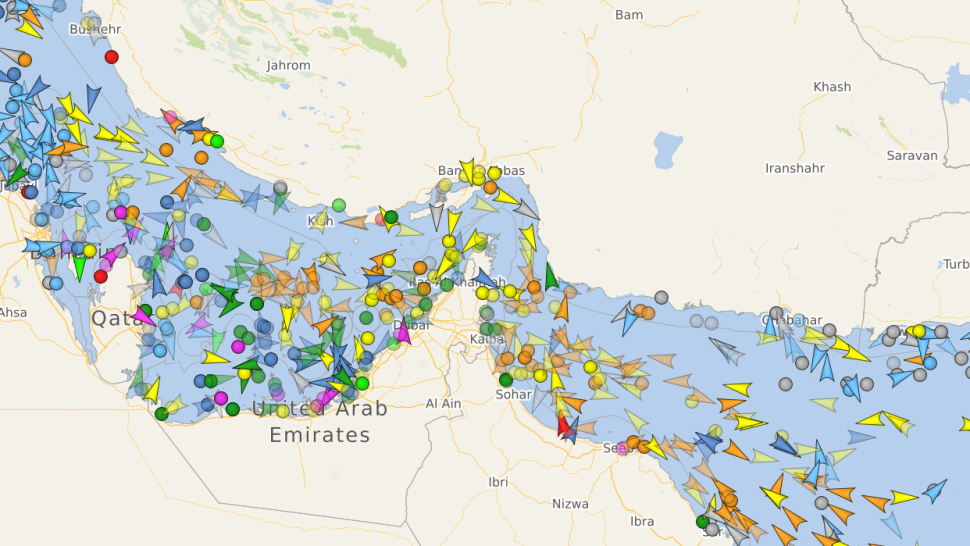
While plans to toll vessels could add as much as $1 per barrel to the price of crude oil transiting the Strait of Hormuz, container ships in the Persian Gulf remain trapped despite a ceasefire between the United States and Iran.
“Commercial shipping remains tightly constrained relative to pre-conflict levels and skews heavily toward outbound exits,” wrote
Destine Ozuygur, senior market analyst for Xeneta, in a LinkedIn post. “More importantly, transits are taking place within the selective guardrails of an Iran-operated tollbooth.”
Iran and the United States announced a two-week ceasefire Tuesday evening ahead of President Donald Trump’s deadline threatening Tehran with massive destruction.
About 20% of the world’s crude oil moves to markets through the Strait of Hormuz, and the blockade by Iran has throttled supply and sent prices of fuel soaring.
Reports have said that operators of some very large crude carriers (VLCCs), the most numerous in global commerce, have paid Iran $2 million per ship to ensure safe passage through the strait. Under a plan by Oman and Iran to make tolls permanent, a typical VLCC holding 2 million barrels of oil translates to a potential $1 dollar more per barrel charged to buyers on delivery, analysts estimate.
Brent crude prices rose as high as $110 a barrel on Monday only to fall to just over $90 following the ceasefire announcement.
The Federal Maritime Commission in recent weeks has rejected multiple requests from carriers asking to waive the 30-day waiting period to implement emergency fuel surcharges.
Vessel traffic through the strait has shown a steady increase, Ozuygur said, citing reports that 21 ships made the passage over the weekend. Xeneta has not yet confirmed any inbound or outbound container vessel transits since the ceasefire announcement.
“The monetization of passage through the strait is an unsettling reality that deeply influences what happens next in the scale and pace of any recovery,” she said. “Russia and China’s recent veto of the United Nations Security Council resolution to reopen the waterway increases the likelihood that this becomes the operating status quo.”
While tankers are limited by the location of oil production, Ozuygur said container shipping is already adapting.
“A tenuous ceasefire does not change the fact that liner networks have implemented structural adaptations. Since March 1, at least five services have introduced new connections to Jeddah and King Abdullah ports [In Saudi Arabia], or Mersin [in Turkey], with weekly capacity into Jeddah increasing by 19%.”
While a return to former routing patterns is possible, Ozuygur said liner networks have committed future schedules to alternate routings, with bookings two-plus weeks out having clear destinations.
Higher costs are likely with new routings that rely on intermodal solutions that are more complex, as trucking and rail move containers slower, and in smaller quantities.
The follow-on effect of persistent congestion can hamper U.S.-bound traffic moving through the ports of Nhava Sheva and Mundra in India.
At the same time, Ozuygur said, volatile fuel prices are pressuring stakeholders across the supply chain while boosting carrier margins.
“Whether we see a rapid return, or the more likely measured application of hybrid strategies in the next two weeks, there is no immediate sustained relief for shippers,” she said, adding bookings made today for the Persian Gulf will still carry the risk of renewed closure in two weeks’ time.
Read more articles by Stuart Chirls here.
Related coverage:
Trump budget boosts military shipbuilding spending by 242% to $65.8 billion
Montreal port chief exits after just two years on the job
34,000 shipping routes diverted from Hormuz disruption: Report
Maersk again turned down on request to fast-track emergency fuel surcharge
Brokerage Compliance Symposium
The day before F3. Every compliance issue you face - fraud exposure, carrier liability, FMCSA rules, cargo theft, insurance gaps - navigated by attorneys and operators defining best practices in a changing industry.
F3 Awards Dinner
The night before F3. FreightTech100 companies honored. FreightTech 25 and Shipper of Choice winners revealed live. Cocktail reception into dinner and live music - 300 industry leaders in one purpose-built room.
F3: Future of Freight Festival
Industry-defining keynotes, rapid-fire technology demos, and industry leaders networking in experiences across Chattanooga - plus the inaugural F3 Awards Dinner featuring the FreightTech and Shipper of Choice reveals.
The day before F3. Every compliance issue you face - fraud exposure, carrier liability, FMCSA rules, cargo theft, insurance gaps - navigated by attorneys and operators defining best practices in a changing industry.
The Signal at Chattanooga Choo Choo • Chattanooga, TN Register NowThe night before F3. FreightTech100 companies honored. FreightTech 25 and Shipper of Choice winners revealed live. Cocktail reception into dinner and live music - 300 industry leaders in one purpose-built room.
The Signal at Chattanooga Choo Choo • Chattanooga, TN Register NowIndustry-defining keynotes, rapid-fire technology demos, and industry leaders networking in experiences across Chattanooga - plus the inaugural F3 Awards Dinner featuring the FreightTech and Shipper of Choice reveals.
The Signal at Chattanooga Choo Choo • Chattanooga, TN Register Now