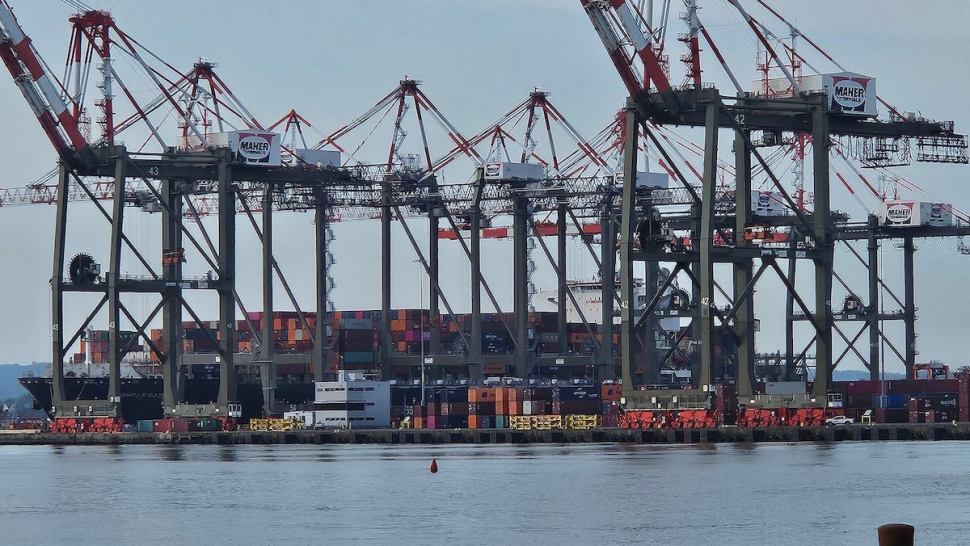
The Port Authority of New York and New Jersey on Thursday said it has reached an agreement to extend its lease with Maher Terminals, its busiest container terminal operator, for 33 years.
The port in an announcement said that the agreement, which runs through 2063, “represents a strategic investment in the continued growth and stability of regional trade infrastructure, while simultaneously advancing ambitious sustainability objectives and strengthening collaborative relationships between public and private stakeholders in the maritime industry.”
A cornerstone of East Coast commerce
The port, which serves as the first call for the vast majority of trans-Atlantic container lines serving the East Coast and is a key economic driver for the region, handled approximately $264 billion worth of goods in 2024, including 8.7 million twenty foot equivalent units (TEUs).
A 2024 study of maritime economic activity by the Shipping Association of New York and New Jersey found that port operations supported more than 580,000 industry jobs in the New York-New Jersey-Pennsylvania region.
“This landmark agreement delivers long-term stability for the port and our supply chain to ensure that it continues to drive economic growth and create good-paying jobs in our communities,” said New Jersey Gov. Phil Murphy, in the release. “Maher’s continued investment in greener technology – prioritizing innovation, modernization and growth – will help us meet the demands of the next generation.”
Port’s largest container operation
Maher is the gateway’s largest terminal operator with facilities spanning approximately 450 acres in Elizabeth, handling approximately 35% of the port’s container traffic in 2024. Unlike the port’s other container terminals, which are owned by ocean carriers and primarily serve their own vessels, Maher operates as a common-use terminal and serves Ocean Alliance members Evergreen (2603.TW), Cosco (1919.HK), CMA CGM and OOCL (0316.HK). In 2024 the liners accounted for capacity of 8.4 million TEUs, nearly a third of the global total. Maher is owned by Macquarie Infrastructure Partners III, a fund managed by Australia-based Macquarie Asset Management
The port said Maher’s common-use model also provides flexibility in a shipping industry characterized by shifting alliances, fluctuating trade volumes and evolving supply chain strategies. By maintaining a major terminal that welcomes vessels from multiple carriers, the port can accommodate changes in shipping patterns and carrier relationships without the disruptions that might otherwise occur if terminal capacity were more rigidly allocated to specific operators.
Long-term certainty and investment confidence
The port said that the long-term lease gives operators more confidence to make major investments in infrastructure and operations. In a time when trade has emerged as the most effective geopolitical weapon, ports along the East Coast are at the tip of the spear and have spent tens of billions of dollars in an arms race to capture global container traffic. By extending the lease term, the port has created conditions conducive to ongoing investment in terminal modernization and expansion.
“This lease extension is about getting ahead of the future,” said Port Authority Executive Director Rick Cotton. “Cargo volumes are growing, vessels are getting larger, and shippers are demanding more reliability than ever. By locking in sustained private investment and modernizing critical infrastructure, we’re making sure the East Coast’s busiest port is ready to move more goods, support more regional growth, and meet the demands of a more complex global economy.”
The authority said investment in modern, efficient terminal operations translate into faster vessel turnaround times, reduced congestion, and lower costs for shippers – advantages that ultimately flow through to consumers in the form of more competitive pricing and more reliable product availability. The infrastructure investments enabled by long-term lease certainty also support the port’s competitive position relative to other East Coast ports vying for the same cargo volumes.
Advancing sustainability and climate goals
Beyond operational and economic considerations, the lease extension incorporates significant commitments to environmental sustainability that reflect the growing importance of climate action in the maritime industry. Building on the authority’s sustainability initiatives, Maher Terminals has pledged to work towards net-zero greenhouse gas emissions in its operations. This commitment aligns with and supports the bi-state authority’s broader goal of reaching net zero agency-wide by 2050.
The collaborative framework established in the lease extension ensures that both the authority and Maher remain aligned in their commitment to maintaining the highest standards of safety and security, protecting workers, cargo, and the surrounding community from harm. The agreement also spells out performance standards and enhanced operational reporting as areas of collaboration.
Implications for regional and national trade
The long-term certainty provided by the lease extension contributes to the resilience of supply chains by ensuring continuity of operations at a critical node in the logistics network. Recent years have demonstrated the vulnerability of global supply chains to disruption, with port congestion, equipment shortages, and labor disputes creating bottlenecks that reverberated throughout the economy. By securing a long-term relationship with its largest terminal operator, the authority said it has taken a meaningful step toward insulating the port from potential disruptions that could arise from lease expirations, ownership changes, or contractual disputes.
The port also underscored the lease agreement’s importance for trade between the United States and Europe. The investments in infrastructure and operations enabled by the extension should contribute to faster, more reliable export services that support American businesses in their efforts to reach overseas customers.
This article was updated Dec. 19 to correct information on Maher’s ownership.
Find more articles by Stuart Chirls here.
Related coverage:
Despite headwinds, Port of Los Angeles nears 10M TEUs
ONE returns to Red Sea with new service
Report: China demands control of Panama ports operator
Carriers look to higher rates, fewer sailings on key Asia-US route
Brokerage Compliance Symposium
The day before F3. Every compliance issue you face - fraud exposure, carrier liability, FMCSA rules, cargo theft, insurance gaps - navigated by attorneys and operators defining best practices in a changing industry.
F3 Awards Dinner
The night before F3. FreightTech100 companies honored. FreightTech 25 and Shipper of Choice winners revealed live. Cocktail reception into dinner and live music - 300 industry leaders in one purpose-built room.
F3: Future of Freight Festival
Industry-defining keynotes, rapid-fire technology demos, and industry leaders networking in experiences across Chattanooga - plus the inaugural F3 Awards Dinner featuring the FreightTech and Shipper of Choice reveals.
The day before F3. Every compliance issue you face - fraud exposure, carrier liability, FMCSA rules, cargo theft, insurance gaps - navigated by attorneys and operators defining best practices in a changing industry.
The Signal at Chattanooga Choo Choo • Chattanooga, TN Register NowThe night before F3. FreightTech100 companies honored. FreightTech 25 and Shipper of Choice winners revealed live. Cocktail reception into dinner and live music - 300 industry leaders in one purpose-built room.
The Signal at Chattanooga Choo Choo • Chattanooga, TN Register NowIndustry-defining keynotes, rapid-fire technology demos, and industry leaders networking in experiences across Chattanooga - plus the inaugural F3 Awards Dinner featuring the FreightTech and Shipper of Choice reveals.
The Signal at Chattanooga Choo Choo • Chattanooga, TN Register Now