Ocean shipping operations remain stable across the global market, with rising fuel costs and availability the main factors impacting other lanes, an analyst says.
“We are approaching six weeks since Iran closed the Strait of Hormuz, and only a few vessels per day are being allowed through,” said Freightos analyst Judah Levine, in a weekly note to clients. “Ships that are transiting are doing so via coordination with Iran and possibly payments ahead of time.”
Traffic included a CMA CGM container vessel, the first from one of the major European carriers.
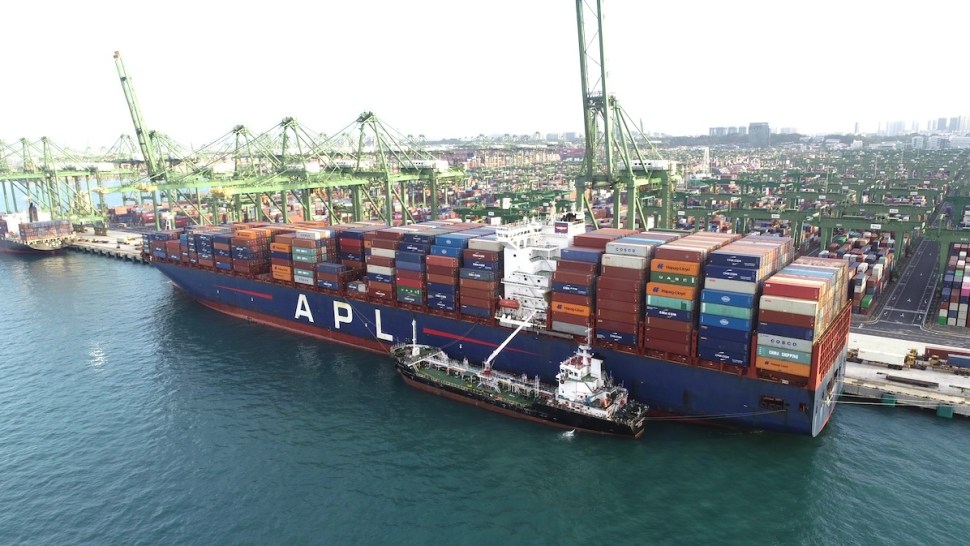
Rising fuel costs and supplies at major bunker centers such as Singapore are top concerns for carriers. Maersk (OTC: AMKBY) this week for the third time in a month asked the Federal Maritime Commission to waive the 30-day waiting period to implement emergency fuel surcharges. The regulator twice denied the liner’s earlier requests.
Iran on Wednesday turned away a tanker attempting to enter the strait, threatening attacks on shipping after accusing the United States of violating the ceasefire agreed to just hours before. Other reports say Iran is charging as much as $2 million per vessel for safe passage.
“The situation in and around the Strait of Hormuz remains uncertain, and it is not yet clear whether the announced opening will be sustained,” said Hapag-Lloyd, in a statement. “The safety of our crews and personnel ashore remains our top priority. Based on our current assessment, we will continue to avoid transiting the Strait of Hormuz for the time being.”
A BBC report said Iran was providing some vessels with a guide to avoiding mines in the waterway.
Despite weak demand in the period between Lunar New Year and peak season, Levine said trans-Pacific spot container rates to the West Coast have climbed $700 per forty foot equivalent unit (FEU) and nearly 40% since just before the start of the war in late February to more than $2,400 per FEU. Asia-North Europe rates are up 20% and $500 to $2,900 per FEU.
Rising rates have dashed earlier expectations that a growing fleet and overcapacity would hinder carriers’ attempts to keep rates above 2025 levels, when tariff fears spurred frontloading and record volumes.
“Up until the start of the war in Iran average trans-Pacific spot prices were more than 50% lower than in January and February 2025, and Asia-Europe rates were 30% down year on year,” Levine said.
Since the end of February those rates have surpassed last year’s prices, and are now 8% higher for Asia-U.S. West Coast and 22% higher for Asia-Europe.
“At the same time, the downward pressure on rates from current supply-demand dynamics may be limiting the degree to which fuel surcharges and various other fees and GRIs (General Rate Increases) are succeeding to push rates up, with reports of carrier discounts as well as benchmark levels well below announced FAKs (Freight All Kinds) rates.
Levine quoted reports citing a month’s supply of fuel remaining in Singapore, the world’s busiest bunker hub, though Rotterdam, the world’s second biggest, remains supplied.
“If the war stretches on, carriers could start to slow steam or blank sailings to reduce fuel consumption, which could put additional upward pressure on rates,” he said.
Read more articles by Stuart Chirls here.
Related coverage:
New tolls could add $1 a barrel to Hormuz oil
Trump budget boosts military shipbuilding spending by 242% to $65.8 billion
Montreal port chief exits after just two years on the job
34,000 shipping routes diverted from Hormuz disruption: Report
Brokerage Compliance Symposium
The day before F3. Every compliance issue you face - fraud exposure, carrier liability, FMCSA rules, cargo theft, insurance gaps - navigated by attorneys and operators defining best practices in a changing industry.
F3 Awards Dinner
The night before F3. FreightTech100 companies honored. FreightTech 25 and Shipper of Choice winners revealed live. Cocktail reception into dinner and live music - 300 industry leaders in one purpose-built room.
F3: Future of Freight Festival
Industry-defining keynotes, rapid-fire technology demos, and industry leaders networking in experiences across Chattanooga - plus the inaugural F3 Awards Dinner featuring the FreightTech and Shipper of Choice reveals.
The day before F3. Every compliance issue you face - fraud exposure, carrier liability, FMCSA rules, cargo theft, insurance gaps - navigated by attorneys and operators defining best practices in a changing industry.
The Signal at Chattanooga Choo Choo • Chattanooga, TN Register NowThe night before F3. FreightTech100 companies honored. FreightTech 25 and Shipper of Choice winners revealed live. Cocktail reception into dinner and live music - 300 industry leaders in one purpose-built room.
The Signal at Chattanooga Choo Choo • Chattanooga, TN Register NowIndustry-defining keynotes, rapid-fire technology demos, and industry leaders networking in experiences across Chattanooga - plus the inaugural F3 Awards Dinner featuring the FreightTech and Shipper of Choice reveals.
The Signal at Chattanooga Choo Choo • Chattanooga, TN Register Now