The Shipper Rate Report — presented in partnership with Trimble — is a quarterly publication using SONAR datasets to create the most in-depth rate and demand outlook for shippers. The insights within this paper are curated by the market experts at FreightWaves and backed by the proprietary data and analytics housed in SONAR’s platform.
Key areas of exploration include:
Q2 2025 review of truck capacity (supply) and load volumes (demand)
Review of trucking rates
Trucking forecast for Q3 2025
Complete the form below to download your complimentary copy.
Convenience store giant Wawa offers parking at new travel centers, but no showers
There’s a new company entrant into the truck stop/travel center business with deep pockets, which means there’s a new supplier of truck parking: Wawa.
The mostly mid-Atlantic convenience store chain, whose fans can be almost obsessive about the business, opened its first travel center Wednesday in Hope Mills, North Carolina. While North Carolina is not seen as the heart of Wawa country, which is more likely to be thought of as Pennsylvania, Maryland and New Jersey, Privately-owned Wawa said in a prepared statement announcing the Hope Mills travel center that it is the company’s 15th store in the Tar Heel State.
Despite that limited footprint relative to its larger areas, Wawa decided that is where it would establish its first travel center that will have features servicing truck drivers.
Wawa also has two travel centers under construction, one in Richmond, Indiana and the other in Lima, Ohio.
The “prototype” for existing Wawa stores is between 5,500 and 6,000 square feet, a Wawa spokeswoman said in an email to FreightWaves. But the travel centers are just over 8,000 square feet. She added in response to queries from FreightWaves that there are no plans to convert existing stores to travel centers.
There will be 18 parking spots at the North Carolina facility. However, serving as a long-term parking answer–overnight or for multiple hours of rest during the day–is not a priority on the Wawa agenda for drivers as of now.
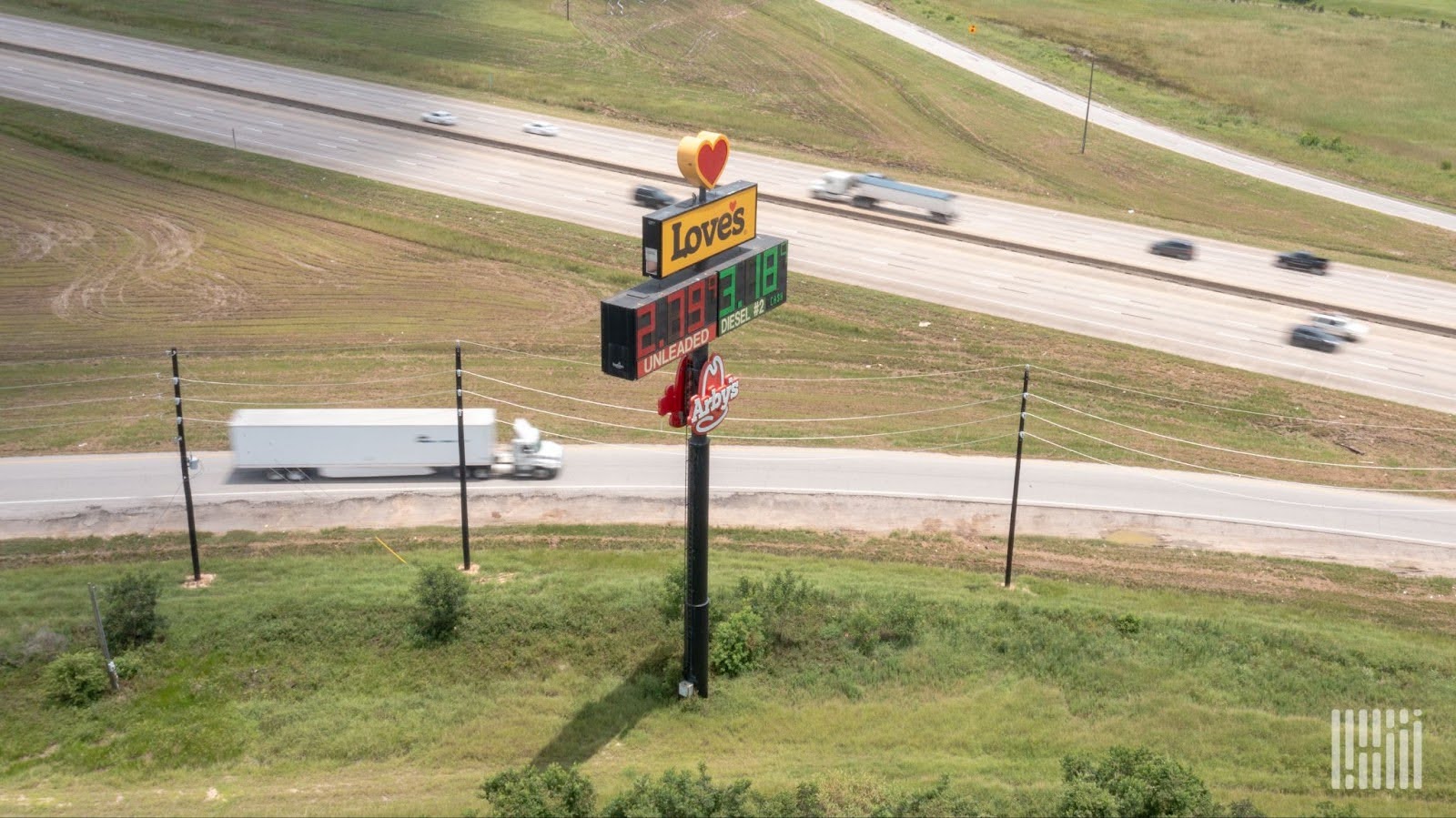
As a point of contrast, Love’s Travel Stops said Thursday is had opened a new outlet in Tulia, Texas. It added 59 truck parking spaces and is more than 12,000 feet. It also has four showers.
“While designed primarily for the short-haul professional driver segment and mid-trip pit stops for the long-haul segment, professional drivers are welcome to park overnight,” the spokeswoman said.
A key feature of travel centers that do cater to long-haul drivers are showers. But Wawa is not planning to add showers to its travel centers at present, the spokeswoman said.
The parking will be free at the travel center, she added. There also is a truck scale onsite.
The Hope Mills facility will accept OTR payments. It has six “high speed” diesel fuel lanes. For passenger vehicles, it will have 20 fueling outlets and 24 EV charging stalls. Refilling air also will be free.
Although Wawa is not necessarily known as primarily servicing trucks, the spokeswoman said it does offer diesel at more than 970 of its other outlets.
Marsh launches BrokerSafe to help freight brokers confront rising legal and insurance risks
Freight brokers have long been considered intermediaries in the transportation chain, more akin to travel agents than carriers. But in recent years, that role has shifted under the weight of litigation trends and the surge of nuclear verdicts that have redefined liability across the industry.
Marsh, a leading insurance broker and risk advisor, is stepping in to provide freight brokers with a tailored insurance solution designed to address the heightened exposure they now face with BrokerSafe.
For decades, freight brokers operated under the assumption that liability largely rested with carriers, with insurance serving as a backstop for operational risks. That changed dramatically following the 2020 Miller v. C.H. Robinson case, which opened the door for plaintiffs to pursue brokers directly in negligence claims.
Janelle Griffith, North American logistics practice leader at Marsh said in an interview with FreightWaves. “Historically, brokers weren’t responsible for anything outside of F4A safety. But after 2020, brokers were being pulled into litigation, and nuclear verdicts automatically started to rise.”
These verdicts, often exceeding $10 million, have upended traditional insurance practices and made brokers prime targets for plaintiff attorneys who view them as the deeper pockets in the supply chain. Griffith said. “Exposure in the past was minimal. Now it’s expanded, negligent hiring, carrier vetting, and other gray areas are being pushed into courtrooms.”
The result has been a wave of insurance challenges. Many insurance carriers in the market either reduced their appetite for liability policies or withdrew altogether, just as brokers were becoming more exposed.
Marsh recognized that gap and developed BrokerSafe as a domestic insurance facility to give brokers coverage that reflects their true level of exposure. Unlike many policies traditionally written out of London, BrokerSafe’s structure is rooted in U.S. underwriting, providing brokers access to markets that had previously been reluctant to participate.
At its core, BrokerSafe is not about eliminating risk but about giving brokers tools to manage it. “What we do doesn’t make the exposure change,” Griffith said. “It’s how you protect yourself and mitigate against the exposure. We looked at the landscape, saw that brokers needed coverage, and brought together technology and relationships to create an insurance facility where underwriters are well-versed in freight brokerage.”
Technology plays a central role in BrokerSafe’s value proposition. By leveraging data transparency, Marsh has been able to help underwriters understand the nuances of broker operations. That visibility builds confidence and enables more comprehensive coverage.
“The insurance industry didn’t understand freight brokers,” Griffith explained. “What BrokerSafe does is show the true exposure through data. That allows underwriters to get comfortable and expand coverage. Technology was the real driver behind it.”
Auto liability coverage is particularly critical. When a carrier is involved in a crash, plaintiffs often pursue both the carrier and the broker to maximize recovery. Griffith stressed the distinction. “Brokers are dealing with it on two fronts: nuclear verdicts on the auto liability side and the rising costs of cargo theft on the other. Auto liability coverage for brokers is like truckers’ liability, but it recognizes the reality that brokers are now pulled into these cases too.”
Still, Marsh emphasizes that BrokerSafe is not a catch-all solution. Rather, it is one component of a broader risk management strategy.
Marsh and BrokerSafe advise brokers to document carrier vetting processes, invest in compliance systems, and adopt technology that enhances transparency. “Our primary goal is to advise clients on how to mitigate exposure,” Griffith said. “Risk management is different than insurance. Insurance covers the black and white, but we also help with the gray.”
As the freight brokerage sector grapples with razor-thin margins and increasing legal scrutiny, insurance is emerging as the silent support for the supply chain. BrokerSafe’s launch signals an acknowledgment of the evolving risks brokers face and an effort to stabilize coverage at a time when it is most needed.
“We’ve cracked the code,” Griffith added. “By meeting brokers where they are, bringing in technology, and creating bespoke underwriting, we’ve been able to give them the protection they need to keep the supply chain moving.”
Stonepeak buys Fort Worth logistics properties
Infrastructure-focused investment firm Stonepeak announced it has acquired two logistics properties in Fort Worth, Texas totaling 748,000 square feet of space.
The acquired sites are located in the Alliance submarket of Fort Worth and sit in close proximity to a nearby cargo airport, two Class I railroads and a BNSF Railway (NYSE: BRK.B) intermodal terminal.
The New York-based private equity firm highlighted anticipated growth in the Dallas-Fort Worth area, noting that its population of more than 8 million is projected to grow at a rate three times the national average through 2030.
“We are excited to add these assets to our growing portfolio and to expand our footprint in DFW,” said Phill Solomond, Stonepeak’s head of real estate, in a news release. “We believe that high-quality real estate adjacent to transport infrastructure will continue to outperform given its mission-critical role in local and national supply chains.”
Stonepeak has acquired 7.7 million square feet of logistics space since April 2024, including notable additions in major freight corridors like Dallas, Houston and Chicago. The firm’s latest acquisitions follow a flurry of activity from 3PLs in the warehouse leasing market.
The logistics industry has replaced retailers and e-commerce companies as the most active buyer group of industrial space, according to recent industry research reports. Further, 3PLs were occupiers of more 1-million-square-foot-plus properties than any other industrial vertical during the first half of this year.
How to Use Oil Sample Reports to Predict Failures Before They Happen
If you’re running trucks and not pulling oil samples, you’re missing a critical opportunity to catch something before it becomes a bigger issue. Oil samples are one of the cheapest, most reliable ways to see inside your engine without tearing it apart. Too many small fleet owners and operators look at oil changes as a simple drain-and-fill job, but miss the chance to gather the kind of information that can save them from a $15,000 overhaul or worse. An oil sample report tells a story—about wear metals, contamination, and additives. Learn to read that story, and you’ll spot engine failures before they strand you on the side of the highway or eat your profit margin alive.
Why Oil Samples Matter
Your engine is always shedding tiny amounts of material as it runs. Bearings, pistons, cylinder liners—they all wear, and those particles end up in your oil. On top of that, soot, coolant, fuel, and water can sneak into the system. Left unchecked, those contaminants accelerate wear and shorten the life of the engine. Oil analysis doesn’t just say your oil is dirty. It identifies the type of dirt, where it’s coming from, and how quickly the problem is progressing. That turns a mystery breakdown into a predictable event you can manage.
Think of it this way: a doctor uses bloodwork to find issues you can’t see yet. Oil sampling is your truck’s blood test. Skip it, and you’re guessing. Run it consistently, and you’re managing with facts.
What an Oil Sample Report Actually Tells You
An oil sample report breaks down into categories. Each one is a clue:
Wear Metals – Iron, copper, lead, chromium, aluminum. These tell you what part of the engine is wearing. High iron points to cylinder liners, copper shows bearing wear, lead may signal main bearings, and chromium can mean ring or liner wear.
Contaminants – Fuel dilution, coolant, dirt, and water. Fuel in the oil thins viscosity and wrecks lubrication. Coolant points to head gasket leaks or liner issues. Dirt usually signals an air filter problem, which eats cylinders alive.
Additives – The sample will also show if the additives in the oil—zinc, calcium, magnesium—are still active. This tells you whether your oil change intervals are realistic.
Viscosity – Is the oil still the grade it started as, or has it broken down? Thin oil loses protection, thick oil stresses pumps.
Each report isn’t just a yes or no. It’s a trend line. One high copper reading might be noise. Three samples in a row trending upward? That’s a warning.
(Photo: The Truckers Report: This isn’t just a lab report — it’s an early warning system. High lead levels like these can indicate bearing wear before it shows up on the road. Oil sampling gives you time to fix small problems before they become engine failures.)
How to Build a Routine Sampling Program
Pulling one sample isn’t enough. You need consistency. Here’s how to build a routine that actually works:
Sample On Regular Milestones– Don’t skip. Sampling only sometimes won’t give you trends.
Pull Samples Correctly – Take the sample mid-drain or with a vacuum pump, not from the bottom of the pan where sludge settles and the gunk lives. A bad sample gives you bad data.
Use the Same Lab – Different labs use different baselines. Stick with one so your numbers stay consistent.
Track Reports in a Log – Keep every report tied to that engine’s VIN. Build a trend history you can review quickly.
Set Review Intervals – Don’t just collect reports. Have a set time—yearly or quarterly—where you or your maintenance manager reviews them side by side.
The more disciplined your program, the easier it becomes to spot issues early.
How to Read and Act on the Numbers
Reports usually come back color-coded—green for normal, yellow for caution, red for critical. Don’t panic at one yellow. Look at the pattern. Is copper up one time and back down the next? Or is it climbing sample after sample? Trends matter more than single numbers.
When you see a yellow or red trend:
Confirm the Data – Pull another sample to verify it’s not a bad pull.
Schedule Inspection – Don’t ignore it. Get a mechanic to check the suspected component.
Adjust Maintenance – If your oil additives are depleting too fast, shorten your oil drain intervals.
Document the Action – Keep notes on what you found and fixed. This builds a history that helps you manage the asset long-term.
The goal isn’t just spotting issues. It’s closing the loop—sample, read, act, document.
Oil Sampling as a Business Tool
This isn’t just about engines. Oil sampling changes your business math:
Predictability – You plan repairs instead of reacting to breakdowns.
Resale Value – Buyers pay more for equipment with a full sampling history that shows the engine is healthy.
Extended Drain Intervals – Confidently push drains longer when reports show the oil is still strong, saving you thousands a year across a fleet.
Risk Reduction – No surprises on the road means fewer tow bills, late deliveries, and downtime costs.
The numbers from an oil report aren’t just technical. They’re financial. They decide whether your truck makes you money or eats it.
FINAL WORD
Oil sampling isn’t optional if you want to run like a professional. It’s the cheapest form of insurance you’ll ever buy for your engines. An inexpensive test tells you more than a mechanic can without tearing the motor down. But it only works if you’re disciplined—consistent sampling, organized tracking, and acting on the data. If you skip, you’re gambling. If you commit, you’re running with clarity. Build oil analysis into your maintenance routine, treat every report like a performance review for your engine, and you’ll cut failures before they ever see the highway. That’s how you protect uptime and profit.
From Beer to Sneakers: How Box Trucks Fuel a Freight Crime Epidemic
This article is contributed content. It does not reflect the views or opinions of FreightWaves or any of its subsidiaries.
In April 2024, federal prosecutors in the Southern District of New York took down what they called a “beer theft enterprise.” A crew slipped into railyards across four states, loading thousands of cases of Corona and Modelo into U-Haul box trucks for resale in the Bronx. Ten months later in Arizona, thieves stopped a moving freight train by cutting its air hoses, then hauled off nearly 2,000 pairs of unreleased Nike sneakers valued at $440,000. Their getaway vehicles? Another U-Haul box truck, plus a van.
These headlines sound cinematic, but they highlight an uncomfortable truth: the box truck has become one of the most effective tools for organized freight theft. Cheap to rent, easy to disguise, and rarely questioned, these vehicles slip through security systems designed for 53-foot trailers.
(Source: Freight Fraud Task Force Team)
Why Box Trucks Are the Perfect Blind Spot
Box trucks are cheap to rent, available on demand, and require no commercial driver’s license. They blend in everywhere from strip mall parking lots to warehouse docks. Most gate security and facility processes are built around the 53-foot trailer threat profile, so a smaller truck, especially one with a well-worn rental logo, often rolls through with minimal or no verification. The result: thieves can move fast, keep a low profile, and vanish into normal traffic before anyone realizes the load is missing.
Cases That Prove the Point
Arizona, February 2025: a freight train loaded with unreleased Nike sneakers was forced into an emergency stop after thieves cut the air hoses. In under twenty minutes, 2,000 pairs of shoes, worth $440,000, were ripped out of that train and shoved into a U-Haul and a van. A verified pickup system would have slammed the brakes on this before a single box hit the pavement.
By May 2025, Amazon Relay got hit by one of the most outrageous scams yet: a single operator fabricated 23 trucking identities and billed out more than 1,000 phantom loads. The payout was over $3 million. A carrier PIN system would have flagged every single fake and shut it down instantly.
Consumers are targets too. In December 2023, phony moving companies spread across New York, New Jersey, and Pennsylvania. They baited people with cheap rates, loaded straight trucks with personal belongings, and then jacked up the price once everything was in their possession. Families were extorted and damages topped $3 million. A verified code release would have slammed that door shut.
Even the grocery aisle is under attack. In April 2025, a fake broker stole a carrier’s identity to grab 280,000 eggs worth $100,000. The load was supposed to go from Maryland to Florida. Instead the thieves demanded ransom. With identity verification, that freight never would have left the dock.
This is not an isolated problem: CargoNet logged nearly 3,800 cargo thefts in 2024. That is a 26 percent jump in a single year. Identity-based theft has exploded from 8 percent of cases in 2020 to nearly one third of all thefts in 2024. The pattern is undeniable.
And it is also global. Coffee has been hammered from Europe to the United States. In Italy, $300,000 worth of green coffee beans vanished with fake paperwork. In the U.S., rented box trucks rolled away with stolen coffee, triggering real ripple effects in wholesale pricing. Arabica futures spiked and roasted coffee prices climbed more than 15 percent year-over-year – all because access was weak and verification was ignored.
The lesson is brutal. If criminals can manipulate identity and access, they will steal anything. Beer. Shoes. Eggs. Your family’s entire home. Everyday commodities turn into easy cash. The only real defense is to lock freight behind verified identity and enforce it everywhere.
The Technology Gap
Here is the part no one likes to admit. Our industry’s weakest link is not just the thief with bolt cutters. It is the fact that many brokers, shippers, and carriers are operating with tools that belong in another decade.
Too many companies still send contracts and load confirmations through Gmail or Yahoo. Others run their entire operations out of Excel, without a secure TMS. Some cannot even configure their own company email domain, let alone deploy two-factor authentication. It is not just a bad look, it is an open invitation to fraudsters who thrive on low barriers.
Meanwhile, modern tools like McLeod, Project44, or TriumphPay offer identity safeguards that are widely underused. Instead of implementing secure pickup codes, many facilities still rely on printed bills of lading that can be faked in under five minutes with a copy machine. Criminals know this. They plan for it. And they exploit it daily.
The gap is not just about money. It is about mindset. Adopting secure communication platforms, verified dispatch systems, and strong ID verification should be as basic as locking your front door. Yet we continue to see organizations treat it as optional. That hesitation is costing the industry billions.
Why You Don’t Hear About It More
(Source: Freight Fraud Task Force Team)
The CNBC investigation on organized cargo theft (May 2025) made one thing clear: the stories that make headlines are just a sliver of what is actually happening. Companies would rather quietly patch over a loss than admit it happened; public reports raise customer doubts, and nobody wants their name tied to failure. Even the way cases are categorized helps keep them hidden. A theft involving a box truck often gets lumped under the broad label of “cargo theft,” stripping away the detail that shows how common the pattern really is. Many claims are closed quickly once insurance pays out, filed away by adjusters without ever surfacing in the industry’s collective memory. And for shippers or brokers, there is always the sales problem: admitting that a thief slipped past your processes is not exactly a pitch you want to put in front of customers.
Organized crews have learned to exploit this silence. They know that even major thefts can vanish into spreadsheets and claims paperwork, never becoming public lessons that might help others catch on. Every time a loss is buried, it makes the next box truck heist that much easier.
The Ripple Effect on Costs
Freight theft does not end with a headline or a single stolen truck. It drives up costs for everyone. After the 2024 beer theft cases, distributors reported rising insurance premiums and tighter controls that translated into higher costs per case. With the Nike train theft, analysts noted that limited edition sneaker resale values surged by nearly 40 percent because legitimate supply was disrupted. Coffee prices saw spikes of more than 15 percent year-over-year in part due to theft, layered on top of climate and supply chain issues. Egg theft may seem small by comparison, but even that created localized shortages and drove wholesale prices up by 5 to 8 percent in affected markets.
When theft becomes systemic, it is the consumer who ultimately pays. Whether it is a family in New Jersey buying groceries, a college student in Arizona trying to get a pair of sneakers, or a coffee shop in Chicago paying higher wholesale costs, the fraud is already reaching into everyday wallets.
What Solutions Work
The answer is not complicated, but it does require courage and commitment. Real change in how we prevent fraud starts with tightening the basics. PIN codes tied directly to verified carriers and drivers are one of the simplest but most effective safeguards available. By linking identity and authorization at the driver level, companies can eliminate one of the easiest entry points for fraudsters: impersonation. It’s a straightforward tool, but one that requires buy-in and consistent enforcement across the supply chain.
In addition to PIN codes, multi-factor authentication should become a non-negotiable standard for both dispatch operations and facility entry. Passwords alone no longer provide meaningful protection, and the logistics sector cannot afford to lag behind other industries in adopting stronger digital security practices. Whether it’s text-based verification, app-based approvals, or biometric authentication, adding another layer of verification closes off many of the vulnerabilities criminals currently exploit.
Equally important is the way brokers are vetted. Fraud thrives in environments where trust is assumed rather than verified. Platforms such as Carrier411, FreightValidate, and Carrier Assure exist precisely to address this gap, yet too many businesses still treat them as optional. Stronger vetting, applied consistently, gives shippers and brokers the confidence that the carrier or partner they’re working with is legitimate.
Another simple but often overlooked fix is phasing out consumer email domains for business operations. Free email accounts like Gmail, Yahoo, and Outlook are convenient, but they’re also easily spoofed or abused by bad actors. When a business relies on consumer domains, it sends a signal – whether intentional or not – that security is not a priority. Shifting to domain-based business email is not only more secure but also projects professionalism and credibility to customers and partners.
Most importantly, we must shift as an industry to place greater value on accuracy than on expediency. Speed has long been treated as the lifeblood of logistics, but speed without accuracy is an invitation to fraud. Technology can flag anomalies, but it cannot replace sound judgment. A pickup code, an identity verification tool, or a tracking system is only as strong as the person interpreting its results. If the operator is not trained to recognize warning signs, the tool becomes a checkbox instead of a safeguard. Accuracy demands discipline, training, and a willingness to slow down when something feels wrong. Until the industry shifts its culture from “move it fast” to “move it right,” thieves will continue to exploit the cracks we leave wide open.
When combined, these measures are not revolutionary; they’re practical, proven steps that simply require the industry to take them seriously. Courage comes in making the decision to move away from “business as usual.” Commitment comes in enforcing these standards consistently, even when it feels inconvenient. If companies are willing to do both, we can significantly reduce the opportunities fraudsters have to exploit the system.
(Source: Freight Fraud Task Force Team)
Last Stop
Box trucks themselves are not the problem. They are an everyday workhorse for deliveries, moving services, and legitimate freight. The problem is that thieves have figured out how to weaponize their invisibility. Our industry cannot afford to let them keep exploiting the gaps.
If we want to stop reading headlines about beer heists, egg diversions, and disappearing sneakers, we have to close the blind spots. That means modernizing the way we handle identity, demanding more from our partners, and refusing to treat fraud as inevitable.
The humble box truck should not be a thief’s golden ticket. With the right safeguards, it will go back to being what it was always meant to be: a tool that keeps freight moving.
Flexport Partners with BlackRock to provide $250 million in supply chain financing
There is an intricate relationship between liquidity and logistics, and Flexport has worked that relationship into something tangible. Flexport has secured up to $250 million in supply-chain financing through a new partnership with funds and accounts managed by BlackRock. Executed by Flexport Capital, the company’s financial services arm, this infusion is designed to deliver working-capital flexibility embedded directly into the logistics flow.
This expanded access to capital empowers businesses to navigate the often treacherous gap between purchasing inventory and realizing sales, a gap that has become more pronounced amid heightened tariffs, tighter operating margins, and evolving trade dynamics.
Flexport is offering more than traditional inventory financing. The support spans term loans, asset-based lines of credit, tariff financing, and other financial instruments, all accessible at key junctures, from supplier pick-up through final delivery, without the burdensome documentation typical of conventional lending.
Stuart Leung, Flexport’s CFO, framed the initiative as a response to a foundational challenge in global trade: “Global trade runs on cash flow, and too many great businesses fall behind simply because they can’t fund the gap between when they buy inventory and when they sell it. Together with BlackRock, Flexport Capital offers businesses more access to flexible capital to help them scale.”
Since its 2017 launch, Flexport Capital has disbursed more than $2 billion in financing, achieving an impressive annual growth rate of 71% over the past five years.
A track record that reflects the growing demand among businesses eager to keep goods moving, accelerate growth cycles, and seize market opportunities, all while avoiding the equity drain that frequently accompanies traditional financing models.
In an era defined by fluctuating tariffs, fragmented supply chains, and compressed working capital cycles, solutions that integrate financial flexibility with operational efficiency have become indispensable.
Flexport’s evolution, first as a logistics and tech platform, now increasingly as a credit partner, reflects a broader shift in supply-chain ecosystems. Providers and forwarders are no longer movers of goods; they’re becoming a true partner that help businesses manage and scale their operations with fluidity.
With this partnership, Flexport deepens its value proposition: offering a logistics infrastructure that not only transports inventory but finances it too.
Mexico proposes 50% tariff on Chinese imports; bans shoes, small packages
Mexico’s government plans to impose a 50% tariff on imports from China as part of its 2026 budget proposal, aiming to protect domestic manufacturers while responding to U.S. pressure, Bloomberg reported Wednesday.
The levy would apply to a wide range of products, including cars, textiles and plastics. Mexico imported more than $51.4 billion in Chinese goods last year, nearly 20% of its total imports, according to government data.
The Trump administration has accused Mexico of serving as a backdoor for Chinese goods to enter the U.S. and avoid American tariffs. Mexican officials have denied the allegation.
President Claudia Sheinbaum did not address the tariff proposal during her daily news conference Thursday. The U.S. and Mexico recently extended an existing trade deal for 90 days, keeping a 25% tariff rate on Mexican goods in place instead of increasing it to 30% under the Trump administration’s global “reciprocal” tariff policy.
In a separate move, Mexico announced Thursday an immediate ban on finished footwear imports, citing unfair competition that has hurt its domestic shoe industry.
“Finished footwear can no longer be imported into Mexico temporarily, because it is damaging that industry,” Economy Secretary Marcelo Ebrard said. The suspension, he added, will strengthen local production and safeguard jobs in key regions.
Mexico also said Wednesday it would suspend small-package shipments to the U.S. through its postal service, ahead of Washington ending a tariff exemption for low-value imports. Known as the de minimis exemption, the rule allows packages worth less than $800 to enter the U.S. duty free.
The change, which takes effect Friday, is expected to hit China-based e-commerce platforms such as Shein and Temu, which have relied on the exemption to ship products directly to American consumers. Several European postal services have already made similar moves.
Scaling Your Fleet Isn’t the Goal — Scaling Profit Is
Scaling With Sanity: Financial Management for Multi-Truck Fleets wasn’t about spreadsheets and theory. It was about what actually happens when your business outgrows your personal bank account. And if you’re pushing past three to five trucks without a real financial structure in place, you’re not scaling — you’re gambling.
“More Trucks Should Mean More Profit — Not More Problems”
We kicked things off with a gut check: if your fleet is growing but your bank balance isn’t, something’s broken. And it’s not the market — it’s your math.
As your fleet expands, your cost per mistake gets bigger. You’re no longer dealing with $300 fuel days or one driver calling out. You’re managing payroll, insurance, repairs, tires, and taxes for multiple units — and if you don’t have visibility and discipline, those trucks will eat you alive from the inside out.
This class broke down exactly how to fix that — before it’s too late.
Here’s What We Covered in Class
The Truth About Revenue vs. Profit
We put to rest one of the biggest lies in trucking: that revenue equals success.
It doesn’t.
A carrier doing $80,000/month in top-line revenue but walking away with $3,000 net isn’t winning. They’re surviving.
We drilled into the gross vs. net vs. operational cash flow triangle and showed students how to separate vanity numbers from real margins. Because trucks don’t run on revenue — they run on profit. And too many carriers don’t know what that profit actually is.
Truck-by-Truck Financial Visibility
If you’ve got four trucks and can’t tell me what each one nets per week, you’ve already lost the game.
We walked through how to break down each truck as its own profit center:
Revenue per truck
Fuel and maintenance per truck
Driver pay structure
Load volume
Downtime tracking
Why? Because averages lie. One truck might be carrying the other three — and if you don’t know which one, you can’t fix it.
Fixed Costs vs. Variable Costs — And Why You Need Both
We gave students a breakdown tool to calculate their fixed cost per truck per week — and explained why cash flow dies when fixed costs outrun utilization. If you’ve got four trucks but only two consistently running, your fixed costs don’t drop — your margins do.
The Weekly Rhythm of Financial Control
One of the most valuable takeaways? The Weekly Financial Cadence.
This is the system that turns financial chaos into control:
Monday: review last week’s profit/loss per truck
Tuesday: flag any upcoming big expenses (tires, service, insurance)
Wednesday: check receivables (what’s owed to you)
Thursday: confirm payroll, match to revenue
Friday: cash forecast next 14 days
We’re not talking about doing taxes here. We’re talking about staying alive and keeping your wheels turning.
Scaling Without Leaking
Scaling a fleet is like filling up a jug with holes. If you don’t plug the leaks before adding trucks, you’re just moving faster toward failure.
We taught carriers how to identify common financial leaks:
Late invoices
Overpaying drivers
Unnecessary detention and layover losses
Maintenance neglect turning into big repairs
And we showed them how to use real KPIs to flag issues before they bleed out profit.
We host a brand-new class every two weeks with real tools, real walkthroughs, and real strategies built specifically for small fleet owners.
This is your training ground.
If you missed this session, you can still catch the replay—and we’ll see you in two weeks for the next one.
Heavier, Slower, Broke — The Real Cost of Saying Yes to Everything
On paper, a 35,000-pound load and a 45,000-pound load might not seem that far apart. But in the real world, that 10,000-pound difference could be the reason your bank account feels thinner at the end of the month. The heavier the freight, the harder your engine works, the more fuel you burn — and the faster your margin disappears.
Let’s break it down like it actually affects your wallet.
Understanding the Fuel Curve – It’s Not Flat
Here’s your baseline:
Fuel price: $3.50/gallon
Truck average (We are using a round number here so you will need to calculate your own per your spec): 7.0 MPG when pulling 35,000 lbs on flat land
Every gallon gives you 7 miles. That means every mile costs you $0.50 in fuel.
But here’s the key: for every additional 1,000 pounds of freight, you’ll lose roughly 0.1 MPG — especially once you get above the 30,000 lb mark. This comes from thousands of ELD logs and real-world averages from owner-operators running heavy.
So the math looks like this:
Load Weight
MPG
Gallons Needed (1,000 mi)
Fuel Cost
35,000 lbs
7.0
143 gal
$500
40,000 lbs
6.5
154 gal
$539
45,000 lbs
6.0
167 gal
$585
That’s $85 more in fuel costs for the exact same run — just because of 10,000 extra pounds.
Now multiply that by 10 trips this month. That’s $850 lost.
Do 40 heavy trips this quarter? That’s $3,400 you just handed over to the fuel pump.
The Terrain Multiplier – Why Hills Make It Worse
Weight alone is only half the story. Add terrain, and the cost swings even wider.
Here’s how MPG typically drops by terrain and weight:
35,000 lbs on flat ground → 7.0 MPG
35,000 lbs in the mountains → 6.0 MPG
45,000 lbs on flat ground → 6.0 MPG
45,000 lbs in the mountains → 5.0 MPG
Let’s compare the same 1,000-mile trip again:
Load
Terrain
MPG
Gallons
Fuel Cost
35k
Flat
7.0
143
$500
35k
Mountain
6.0
167
$585
45k
Flat
6.0
167
$585
45k
Mountain
5.0
200
$700
You’re now paying $200 more to haul the same freight through the Rockies than if it was 10,000 lbs lighter on flat terrain.
And that’s before you even touch brakes, suspension, transmission temps, or added maintenance from pulling hard on grades.
Every Extra 1,000 lbs – The Real Cost Breakdown
To make it plain: every 1,000 pounds you add over 35,000 lbs costs you roughly $8–$10 in fuel for every 1,000 miles.
Let’s show the step-by-step breakdown with real numbers:
MPG
Gallons Used (1,000 mi)
Fuel Cost @ $3.50
Extra Cost vs 7.0 MPG
7.0
143
$500
–
6.9
145
$508
+$8
6.8
147
$515
+$15
6.7
149
$522
+$22
6.6
152
$532
+$32
6.5
154
$539
+$39
6.4
156
$546
+$46
6.3
159
$556
+$56
6.2
161
$563
+$63
6.1
164
$574
+$74
6.0
167
$585
+$85
And this is assuming zero idling, no traffic, and no sitting at a shipper. In real-world conditions, you could burn even more.
Negotiating When Load Weight Is the Hidden Cost
This is where most owner-operators get played. A broker calls you with a load paying $2.25 a mile and says, “It’s only going 1,000 miles — easy run.”
What do they leave out? It’s 45,000 pounds. And you’re headed straight through I‑40 in Tennessee.
Suddenly, your $2.25 a mile turns into $2.00 after fuel. Now you’re flirting with breakeven — or worse.
So what do you do?
Show the Math
Tell the broker:
“At 45,000 lbs this load costs me $85 more in fuel than if it were 35k. I need another 8–10¢ per mile to cover that, or this run isn’t profitable.”
Leverage the Terrain
Say:
“If this was flat land, I’d roll with your offer. But I’m pulling mountain grades with full weight. I need $2.45 a mile minimum to make it worth the burn.”
Offer Alternatives
Try this:
“If you’ve got something under 40,000 pounds in the same lane, I can do it at your price. If we’re talking maxed out, the rate’s gotta reflect that.”
Back It With Data
Use your ELD. Keep a log of your MPG by weight class and route. Heck, even offer to send brokers screenshots of your performance and receipts if you need to prove the point.
Once you speak in numbers, it’s hard for them to argue — because now you’re negotiating from fact, not feeling.
The Mindset Shift That Protects Your Margin
Every time you roll with a heavy load at a light rate, you’re donating money to the market.
In today’s freight environment, profit doesn’t come from booking more — it comes from booking smarter.
Don’t chase miles.
Don’t ignore weight.
Don’t forget the terrain.
Because here’s the truth: That “good paying load” isn’t good if it burns more than it earns. And that happens faster than most drivers realize.
Closing – What Smart Operators Already Know
Weight isn’t just about your axle positions and scale ticket. It’s about your fuel strategy, your maintenance schedule, your negotiation posture, and your net profit.
The difference between a 6.0 and a 7.0 MPG average is the difference between growing your business and just surviving another month.
So from now on, before you accept that load:
Ask for the weight.
Look at the terrain.
Do the math.
And protect your fuel margin like your business depends on it.