Small Fleets, Brokers Hold Steady Optimism Despite Freight Market Headwinds

Truckstop.com/Bloomberg Intelligence midyear survey reveals industry resilience as carriers and brokers navigate challenging conditions. The freight industry’s grassroots operators aren’t throwing in the towel just yet. Despite revenue challenges and tariff concerns, 85% of carriers and 83% of brokers expect volumes to rise or stay flat over the next six months.

A challenging first half of 2025 left many carriers and brokers scrambling to maintain margins or recover from what seems like a year-long, never-ending bloodbath. A new midyear survey from Truckstop.com and Bloomberg Intelligence shows the small fleet and brokerage community remains cautiously optimistic about the months ahead.

The survey, which captured responses from 204 carrier firms and 185 brokerages, paints a picture of an industry that’s been battered but not broken. While revenue growth has been elusive for most, only 16% of carriers and 36% of brokers reported year-over-year gains; the majority still believe better days are coming.

“Many carriers and brokers remained optimistic through the first half of 2025 despite facing difficulties,” said Todd Markusic, customer insights manager at Truckstop.com. “While the freight market underperformed in the second quarter, with no clear resolution for how tariffs will impact the economy, many in the industry are expecting a recovery in the next six months.”

That optimism translates into concrete expectations: 85% of carriers and 83% of brokers believe freight volumes will either increase or remain flat over the next six months.

Rates remain the wild card

For carriers, the rate environment continues to be a mixed bag with heavy doses of uncertainty.

Only 17% said rates have improved since the second quarter of 2024, though 42% expect rates to climb in the third quarter. That’s down 13 percentage points from first-quarter expectations, suggesting the reality of a prolonged soft market is setting in.

Nearly half of carriers, 48%, admitted they’re unsure when rates will finally bottom out, a seven-point increase from the first quarter. Yet 84% still believe rates will either rise or hold steady over the next six months.

The load volume picture is slightly more encouraging. Among carriers, 56% said volumes during the second quarter were up or flat compared to the same period last year, and 79% expect their revenues to remain stable or increase over the next six months.

Brokers, meanwhile, are painting a more positive picture of their market conditions.

Comparing the first half of 2025 to the same period last year, 39% of brokers said spot rates increased, while 78% reported contract rate improvements. Revenue performance was similarly strong, with 72% seeing flat or positive revenue growth during the first half.

Most brokerages are operating on 15% gross margins, and 69% believe their current margins are higher than both halves of 2024. Looking ahead, 82% expect gross margins to increase or stay flat over the next six months.

Demand divergence

The survey revealed a notable gap between how carriers and brokers view demand trends.

While 19% of carriers reported year-over-year load volume increases, 37% of brokers reported higher volumes. That disparity extends to forward-looking expectations: 52% of carriers expect demand to grow over the next three to six months, while 83% of brokers believe demand will be up or flat over the next six months.

The difference likely reflects brokers’ broader market visibility and their ability to shift between different carrier relationships as conditions change.

Tariff trouble weighs heavy

The specter of trade policy continues to cast a shadow over industry sentiment.

Carriers are increasingly concerned about tariffs delaying any meaningful freight recovery. Thirty-eight percent now believe tariffs will significantly hurt the industry, up from 30% in the previous quarter. Overall, 55% say tariffs will have at least some negative impact.

Brokers have also soured on the current administration’s policies. In December, 74% thought the administration would benefit trucking. Six months later, only 44% maintain that view.

Cautious capital allocation

Despite the generally optimistic outlook, financial pressures are forcing many operators to pump the brakes on growth investments.

Only 21% of carriers plan to purchase new equipment, down sharply from 38% in the first quarter. Similarly, just 40% of brokerage firms expect to hire additional brokers in 2025, compared to 52% in December 2024.

The pullback reflects the reality of operating in a margin-compressed environment where cash preservation often trumps expansion plans.

Workforce holding steady

Job satisfaction metrics suggest the industry’s human capital challenges aren’t getting dramatically worse, even if they’re not improving either.

Among brokers, job satisfaction dipped modestly to 78% from 83% in December. For carriers, satisfaction dropped more notably to 54% from 65% in the first quarter.

Still, only 10% of carriers are considering leaving the industry, a change of only 1 percentage point from 9% in the first quarter. Among brokers, just 6% expressed job dissatisfaction compared to 18% of carriers.

Small fleet focus

The survey targeted the industry’s grassroots operators, with 75% of carrier respondents operating five or fewer trucks. Flatbed carriers comprised the largest segment at 49% of responses.

On the brokerage side, firms with 1-50 employees accounted for 68% of respondents, representing the small to mid-sized brokerages that handle much of the industry’s spot market activity.

The persistence of optimism among these smaller operators, who typically feel market pressures first and most acutely, suggests the freight community’s belief in an eventual turnaround remains intact despite the challenging operating environment.

Whether that optimism proves justified will largely depend on how quickly broader economic conditions improve and trade policy uncertainties resolve. For now, the industry’s grassroots operators are hunkering down and betting that better times are ahead.

101 Guide to Truck Chain Laws Heading Into Winter 2025

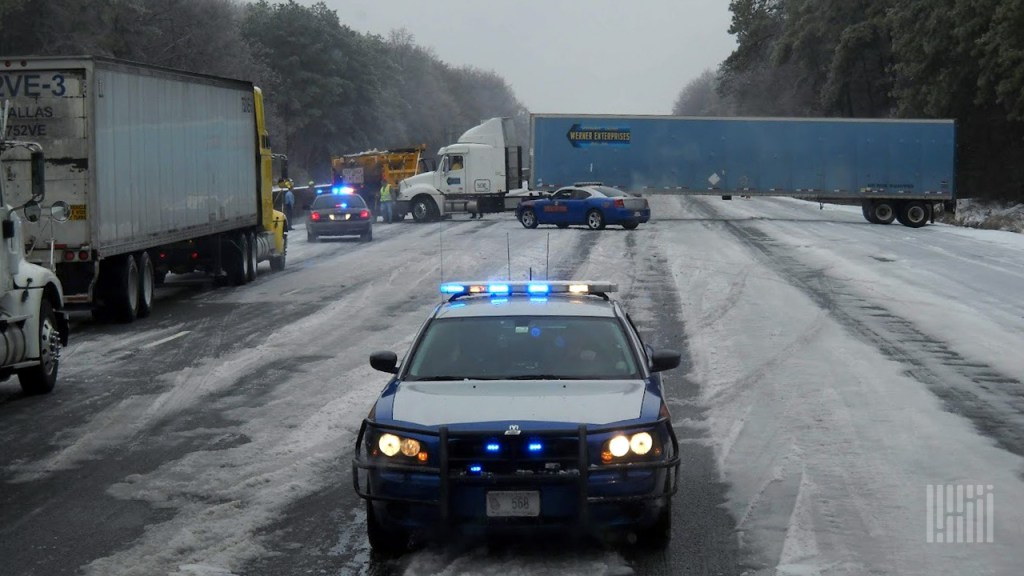
Summer’s winding down, and believe it or not, we’re less than a month away from Colorado’s annual chain law taking effect September 1. That means it’s time for another round of the trucking industry’s least favorite winter ritual: getting familiar with the patchwork of state chain laws that can make or break a driver’s day and wallet.

Chain law ignorance isn’t a defense. With some states now issuing fines approaching $900 for a single violation and penalties that can top $1,000 for blocking highways, understanding when to carry, when to install, and how to use chains properly has become a critical safety and financial issue for every driver running freight through snow country.

The big picture on chain requirements

Chain laws across the country generally fall into three categories: when you must carry chains, when you must use them, and when you absolutely cannot use them. But the devil’s in the details, and those details vary wildly from state to state.

The enforcement periods alone range from Colorado’s September 1 through May 31 mandate to more limited seasonal requirements in other states. Some states like Nevada don’t require drivers to carry chains during specific periods but mandate their use when conditions warrant and signs are posted.

Generally, only one set of snow chains is needed on any semi-trailer, regardless of the number of axles, to meet most state and local requirements; however, trucks in California may need up to eight chains in the wintertime to comply with their requirements.

For commercial drivers, the stakes are different than passenger vehicles. There is no exemption for heavy-duty commercial vehicles (over 6,500 pounds gross weight) equipped with snow tires. Chains must be installed on heavy-duty commercial vehicles whenever chain controls are posted.

States with the strictest laws

Colorado: The gold standard of chain enforcement

Colorado leads the pack with the most comprehensive and strictly enforced chain law in the country. Colorado’s commercial vehicle chain law applies to every state, federal and interstate highway within Colorado’s borders.

The key dates and requirements:

  • Enforcement period: September 1 through May 31
  • I-70 carry requirement: All trucks must carry sufficient chains between mile marker 259 (outside Golden) and mile marker 133 (Dotsero)
  • Installation requirement: All four drive tires must be chained when conditions warrant

The penalty structure is equally serious:

  • $50 plus $16 surcharge for not carrying chains when required
  • $500 plus a $79 surcharge for not installing chains when required
  • $1,000 plus a $156 surcharge for blocking the highway as a result of not installing chains

Colorado operates two levels of chain laws:

  • Level 1/Code 17: Single-axle combination vehicles must chain up all four drive tires; other commercial vehicles need snow tires or chains
  • Level 2/Code 18: All commercial vehicles with four drive tires must chain up

Oregon

The Oregon Department of Transportation (ODOT) says beginning Sept. 25, the fine for commercial vehicle drivers not using chains when required is a minimum of $880. That represents one of the steepest penalties in the country for chain violations.

Oregon’s law applies to all highways in the state. Signs will tell truckers when they are required to carry chains and when they are required to use them. Truckers will need to have six chains on hand to comply in Oregon.

California

California doesn’t require carriers to carry chains during specific periods, but when chain controls are in effect, compliance is mandatory and enforced through checkpoints.

Drivers must stop and put on chains when highway signs indicate chains are required. Drivers can be cited by the California Highway Patrol and fined if they don’t comply. Drivers will usually have about a mile between “chains required” signs and the checkpoint to install your chains.

When these screens are present, all heavy-duty trucks must stop and show Caltrans personnel that they have the required chains on board to proceed. Trucks without chains will be directed to return to a lower elevation until the weather improves.

California uses a three-tier system:

  • R1: Chains required on drive axles except for 4WD vehicles
  • R2: Chains required on all vehicles except 4WD with snow tires
  • R3: Chains required on all vehicles, no exceptions

Washington

According to Washington’s chain law, “all vehicles with a gross vehicle weight of 10,000 pounds or more shall carry a minimum of two extra chains for use if road conditions require the use of more chains, or if chains in use are broken or otherwise made useless.”

Washington also mandates specific chain construction: chains must have at least two side chains with sufficient cross chains of hardened metal attached so that at least one cross chain touches the road surface at all times.

Nevada

Nevada doesn’t require commercial drivers to carry chains at any time of year. Truckers are required to chain up on any street or highway in the state during icy or snowy conditions, as indicated by roadside message signs.

The fine structure is more modest but still meaningful. The fee for not chaining up is usually $58, in addition to court fees, which vary from county to county.

State-by-state requirements snapshot

States with specific enforcement periods:

  • Colorado: September 1 – May 31 (I-70 carry requirement)
  • Idaho: November 15 – April 30 (chains permitted)
  • Montana: October 15 – April 15 (chains permitted)
  • Utah: October 1 – April 30 (restriction authority)

States requiring chains when conditions warrant:

  • California, Nevada, Oregon, Washington, Wyoming, New Mexico, Arizona, and most other mountain states

States with seasonal restrictions:

  • Alaska: Complex restrictions based on latitude and highway
  • North Dakota: November 15 – April 30 only
  • Wisconsin: November 15 – April 30 only

Fines and penalties by state:

  • Oregon: $880 minimum
  • Colorado: $50-$1,000+ depending on violation
  • Utah: Up to $1,000 (Class B misdemeanor)
  • Nevada: $58 plus court costs
  • Washington: Up to $750 for highway closure violations

Chain types: What works and what doesn’t

Not all chains are created equal, and state laws often specify acceptable types.

Metal chains that consist of two circular metal loops, one on each side of the tire, connected by at least nine evenly spaced loops across the tread. Dual tire chains are acceptable.

Acceptable traction devices include:

  • Traditional link chains: Most durable and widely accepted
  • Cable chains: Lighter weight but may not meet all state requirements
  • Automatic tire chains: Pneumatically deployed from the cab
  • AutoSocks: Textile devices are accepted in some states like Colorado
  • Wheel sanders: Systems that drop sand for traction

Tire traction devices are defined in the California Vehicle Code (VC) Section 605 as “devices or mechanisms having a composition and design capable of improving vehicle traction, braking, and cornering ability upon snow or ice-covered surfaces,” and include conventional link-type tire chains and cable chains, as well as other less conventional devices such as “Spikes Spyder.”

What doesn’t count:

  • Studded tires (not considered traction devices in most states)
  • Snow tires alone (insufficient for commercial vehicles in most chain law situations)

Installation basics

Snow chain laws are volatile, snow chain installation is quick and easy, only taking about 10 minutes. Doing it safely and correctly is crucial.

Basic installation steps:

  1. Find safe, level ground away from traffic before adverse conditions hit
  2. Lay chains flat with hooks and latches facing up
  3. Drape over the tire ensuring even distribution across the tread
  4. Secure inside connections first, ensuring proper tension
  5. Connect outside fasteners and adjust tensioners
  6. Drive forward a few feet and recheck all connections

Critical installation points:

  • Chains must be installed on the drive axle. All-wheel drive vehicles and 4-wheel drive vehicles may have chains installed on either drive axle, but the rear axle is preferred
  • Drive tires receive power from the engine and are typically located on the rear of the tractor
  • You must have at least one axle chained if the trailer is equipped with brakes

Speed limitations:

Remember that all truck tire chains are designed for slower speeds, not normal highway speeds. It is recommended that you travel no faster than 30-35 mph after your chains are installed.

The business case against chaining

While chain laws exist for safety reasons, many carriers are taking a different approach to winter driving.

Some fleets don’t require drivers to use chains. If the roads are bad enough, they want their drivers to get off the roads and get to safety. If their drivers ever feel unsafe driving in the road conditions, they’re encouraged to report it to their driver managers and park until the road conditions improve. Not all fleets operate that way.

The reasoning is practical: Chains can damage your truck, your trailer, and the road. You can only go between 25 and 30 mph with them on, so you won’t make it far.

Driving with tire chains on is a rough ride. If they come loose, they can cause significant damage to your truck and tires. You can pop tires, tear up your truck, or lose mud flaps.

The operational costs add up:

  • Drivers are not paid to apply tire chains. The process can take anywhere from 15 minutes to over an hour, depending on how the chains are used, how many are required and if the weather is slowing the application.
  • A truck can take up to 6 chains, but those add a lot of weight. You could be looking at 1000 pounds added to your gross vehicle weight.
  • Maximum speeds of 30 mph significantly extend transit times

Chain law violations can have long-term career implications.

Getting a ticket for violating chain laws is serious for truck drivers. Failing to pay a fine or show up in court on a predetermined date could lead to the suspension of your CDL. Beyond fines, the safety implications are real. Drivers who fail to chain up when required and subsequently cause accidents or block highways face additional liability beyond the initial fine.

Depending on how hard it was snowing when it came time to chain up, it can take about 45 minutes to an hour. The alternative might be a fatal crash. 

Planning ahead

As we head into the 2025-26 winter season, preparation is key:

Before you roll:

  • Check DOT websites for current chain law information in your route states
  • Verify your equipment meets state-specific requirements
  • Practice installation in good weather conditions
  • Identify safe chain-up areas along your regular routes

Equipment considerations:

  • Ensure you have the right size and type for your specific tires
  • Carry extra chains for breakage situations (required in some states)
  • Include tensioners and adjustment tools
  • Consider alternatives like AutoSocks, which are accepted

Route planning:

  • Monitor weather forecasts and road conditions
  • Build extra time into schedules during chain season
  • Identify alternative routes that may avoid chain requirements
  • Plan for potential delays or parking situations

The bottom line is clear: chain laws are here to stay, penalties are getting stiffer, and the complexity isn’t decreasing. Whether your company policy is to chain up and keep rolling or park and wait it out, understanding the legal landscape is essential for every driver who operates in winter weather states.

As the saying goes in trucking, there are two types of drivers: those who know how to put on chains, and those who are about to learn. With September 1 just around the corner, now’s the time to make sure you’re in the first category.

GoodShip raises $25 million in Series B funding round

GoodShip has announced a successful Series B funding round, raising $25 million to boost its innovative AI-powered freight management platform. Based in Bellevue, Washington, the company aims to revolutionize the transportation industry by shifting away from traditional spreadsheet-based operations toward a more integrated, data-driven approach.

GoodShip’s impressive growth trajectory paved the way for this new round of funding, which was spearheaded by Greenfield Partners and saw the participation of returning investors like Bessemer Venture Partners, Ironspring Ventures, Chicago Ventures, and FUSE VC. The funding follows a phenomenal year where GoodShip’s revenues multiplied tenfold, a clear sign of its expanding presence in the industry.

The core of GoodShip’s offering lies in its ability to unify disparate data and streamline operations across enterprise shippers. Notable clients such as Tropicana, KeHe Distributors, and Kellanova have already reported significant benefits, including a reduction in transportation costs by 3–5% and a notable 20% decrease in late shipments. This translates into millions of dollars in annual savings, underscoring the platform’s effectiveness.

CEO and co-founder Ryan Soskin highlighted the transformative potential of GoodShip, stating, “For too long, freight management has been a black box—decisions made reactively and data scattered across countless systems. GoodShip changes that by unifying data, surfacing the insights that matter, and giving teams smarter, more automated ways to procure and optimize their networks.”

The new capital injection will allow GoodShip to expand its platform capabilities, enhance AI-driven solutions, and further embed automation into freight operations. This strategic focus aims to improve decision-making support, streamline processes, and advance toward fully automated execution of freight networks.

“The freight industry is moving toward a new operating standard,” said Itay Inbar, Principal at Greenfield Partners, adding that, “GoodShip is redefining a trillion-dollar industry with a novel approach and rapid AI innovation – unifying procurement and visibility in a platform that’s already proving its value at enterprise scale across the world’s largest shippers.” 

As part of its growth strategy, GoodShip is expanding its team and operations, establishing a new headquarters in Bellevue. This effort is aimed at deepening relationships with its enterprise clientele and continually delivering value across the supply chain.

With its total funding now exceeding $40 million, GoodShip is set to strengthen its leadership position and continue redefining the freight orchestration landscape.

EPA aims to keep diesel trucks on the road

truck on the highway

The Trump administration has issued new guidance on diesel exhaust fluid (DEF) systems aimed at avoiding sudden engine shutdowns that sideline trucks and cost truckers money.

U.S. Environmental Protection Agency (EPA) Administrator Lee Zeldin on Tuesday announced the new guidelines, “developed in collaboration with manufacturers,” to ensure that existing diesel trucks, which use DEF to reduce nitrous oxide emissions, do not experience sudden engine failures, known as “derates,” after running out of the fluid.

Starting with model year 2027, all new diesel on-road trucks must be engineered to avoid sudden power loss and resulting derates after running out of DEF.

“We have heard loud and clear from small businesses across the United States that the current DEF derates are unacceptable,” Zeldin said.

“It is unacceptable that farmers, truckers, construction workers, and many other small businesses continually experience failures of diesel-powered equipment when they need it most – costing millions of dollars in lost productivity.”

DEF derates before and after new guidelines. (Source: EPA)

Current DEF and selective catalytic reduction (SCR) systems employ engine derates that force a truck to reduce speed to as little as 5 mph or become inoperable within hours of a DEF-related fault.

“Although this derate strategy was intended to ensure compliance with EPA’s Tier 4 Emissions Standards, it has caused needless frustration, operational delays, and real economic hardship for countless farmers, truckers, and equipment operators,” the agency stated.

Under the new guidance, a warning light appears for 650 miles after a fault is detected, with only gradual engine derates occurring over a total of 8,400 miles or 160 hours, ending with the engine slowing to 25 mph (see table).

The extended period is expected to give truck drivers much more time to diagnose and fix system problems.

“EPA’s guidance establishes more common sense inducement schedules that will help drivers maintain safe control of their vehicles as they diagnose and remedy faulty DEF/SCR systems,” commented Owner-Operator Independent Drivers Association President Todd Spencer.”

“More flexible inducement speeds and times will help truckers finish their trips, plan for necessary maintenance, and avoid parking their truck for an extended period simply because of a false alarm. Nonsensical inducement rules have sidelined small-business truckers for too long and this accelerated relief shows what can be achieved when regulators hear directly from the people doing the job.”

How Diesel Exhaust Fluid is Impacting the Trucking Industry

Fuel-Saving Strategies Worth Trying in 2025

Raw component costs send diesel exhaust fluid prices soaring

Click for more FreightWaves articles by John Gallagher.

Rebecca Tinucci named CEO of Uber Freight

Uber Freight truck driving down a highway

Uber Freight announced Tuesday the appointment of Rebecca Tinucci as chief executive officer. Tinucci succeeds founder and chief executive officer Lior Ron, who will become chairman while also taking on a new role as chief operating officer of Waabi, an autonomous trucking technology company. 

Uber is a major investor in Waabi, with the release noting its continued commitment to innovation across logistics and autonomous technologies.

Tinucci brings extensive experience from Tesla, where she served as the senior director of charging infrastructure. In her previous role at Tesla, she transformed the global charging organization into a profitable multi-billion-dollar business and led industry-wide collaborations that established North American standards for electric vehicle infrastructure.

Most recently at Uber, she spearheaded the company’s global electrification strategy, developing partnerships across energy and mobility sectors to advance zero-emission goals.

“Uber Freight has built something truly special — a platform that changes the game for shippers, carriers, and the entire industry,” said Tinucci in a press release. “I couldn’t be more excited to roll up my sleeves with this team to keep raising the bar for our customers and showing the market what’s next.”

Under Ron’s nine-year leadership, Uber Freight evolved from a startup within Uber to a global logistics platform managing over $20 billion in freight under management. The company developed multiple products including Uber Freight TMS, Exchange, Powerloop, and the recently launched Insights AI.

“Uber Freight was born from my belief that logistics could be radically transformed through technology,” said Ron. “Rebecca is a proven leader who brings strong operational chops, customer empathy, and platform thinking. I’m thrilled to support her as she takes the helm for Uber Freight’s next chapter.”

Through Uber Freight’s managed transportation services, the company serves one in three Fortune 500 companies, including Colgate, Nestlé, and Anheuser-Busch InBev.

Tinucci will make her first public appearance as CEO at Deliver 2025, Uber Freight’s flagship customer event scheduled for September.

Waabi appoints Lior Ron as COO amid commercial push

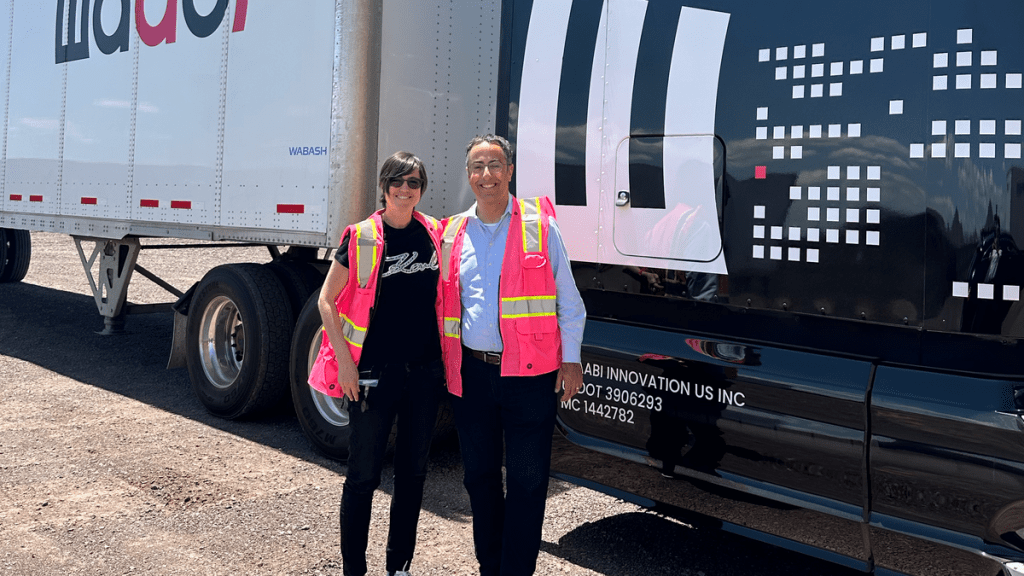
Two people wearing bright pink safety vests and smiling while posing in front of Waabi-branded semi-truck trailers on a sunny gravel lot.

Waabi has announced the appointment of former Uber Freight CEO Lior Ron as the company’s chief operating officer. The appointment comes as Waabi prepares for a driver-out milestone by the end of the year, followed by a commercial launch and scaling operations with major partners including Volvo and Uber Freight.

“This really signifies that Waabi is moving from the R&D phase that we were in into commercialization and scale,” Waabi’s founder and CEO Raquel Urtasun told FreightWaves in an interview. “And there is no other leader that I could think of that would be better suited to partner with in this new journey of the company.”

The transition is part of a broader industry shift from digital logistics solutions to physical autonomous applications. “I think of my first decade in logistics with Uber Freight as building the digital infrastructure of the industry, and helping build that. The next decade is going to be about building the autonomy infrastructure of the industry and making that a commercial reality,” Lior Ron told FreightWaves.

During Ron’s tenure at Uber Freight, he served as founder and CEO, growing the company into an end-to-end logistics platform generating over $5 billion in annual revenue. In his new role at Waabi, Ron will focus on go-to-market strategy, scaling existing partnerships, and bringing new collaborations to the company’s portfolio.

“I think for me, it really starts from the deep belief that autonomy is here and the technology is ready, and it’s time to scale,” Ron told FreightWaves. “It’s time to actually make this a commercial reality, a solution reality, a supply chain reality that will fundamentally alter the shape of supply chain and logistics over the next decade.”

Uber Freight is both a partner and investor in Waabi.

“Uber Freight is a big partner of Waabi. No changes there. We’re looking forward to continuing to scale the Waabi driver on the Uber Freight network, and we see a lot of opportunities to continue that collaboration. So this is definitely sort of done in coordination, but it’s also a personal choice of mine, because, as I articulated, it’s something that I fundamentally believe is the future,” Ron added.

Urtasun added, “We have a partnership with Uber Freight that will continue full steam ahead as well. We’ll go to market. It’s more than Uber Freight—you know, direct-to-customer is important for us as well. But we fundamentally believe that Uber Freight is a great partner in our future.”

The appointment follows several major Waabi milestones, including a strategic partnership with Volvo Autonomous Solutions and technical breakthroughs in simulation technology. Waabi World, the company’s neural simulator, recently achieved a 99.7% simulation realism score, while the company also unveiled Mixed Reality Testing as an alternative to closed-course testing.

For the team at Waabi, the timing could not have been better, as both OEMs and autonomous technology companies appear to be converging on timelines for mass production and commercialization over the next two years. The next challenge, and one Ron hopes to tackle, is turning that technology into an operational reality.

“The time to engage on that is now, because that technology is ready. Autonomy is ready for prime time. Driver-out soon. Truck OEMs are ready, and they’re all making their own plans on when they’re going to start mass production, but it’s going to be in the foreseeable near future. So if you’re looking at a 12- to 24-month purchasing decision cycle in logistics by big shippers and big carriers,” said Ron.

Intermodal veteran Cannizzaro to OCEMA carriers group as deputy executive director 

The Ocean Carrier Equipment Management Association (OCEMA) announced that Rob Cannizzaro was named as deputy executive director, effective August 1.

Washington-based OCEMA is an association of 10 international ocean common carriers that provides a forum for its members to discuss operational, safety, and related matters pertaining to the intermodal transportation of ocean freight within the U.S. Its subsidiary, United Intermodal Enterprises, LLC (UIE LLC), owns the South Atlantic Chassis Pool, the largest fully interoperable single provider chassis pool in the U.S. 

Rob Cannizzaro

Cannizzaro most recently served as principal advisor at Cannizzaro Intermodal Advisors LLC, which consults on global containerized freight transportation. Prior to that, he was chief operating officer at the Intermodal Association of North America (IANA), the intermodal transportation trade group, where he led operations and business development, including industry technology products and services. 

Cannizzaro also spent more than 25 years in port, terminal, and ocean carrier operations as an executive with Virginia International Terminals, CMA CGM, and Hamburg Sud. In 2024, he was appointed by Commerce Secretary Gina Raimondo to serve on the Advisory Committee on Supply Chain Competitiveness and also serves on the board of the Containerization and Intermodal Institute. 

He reports to Jeffrey Lawrence, OCEMA executive director.

Find more articles by Stuart Chirls here.

Related coverage:

China volumes, tariff anxiety helps surging US container imports challenge ’22 record

Retailers: Tariff-battered import volumes to be 5.6% weaker in 2025

Nothing can stop falling trans-Pacific container rates: Analyst

Savannah containers post best FY since pandemic

Chinese warship, coast guard vessel collide in busy shipping lane

Two Chinese military ships collided Monday while harassing a Philippines coast guard vessel in the South China Sea.

The incident, which was captured on video by the crew of the Filipino ship, pointed up the potential dangers to shipping in the region, through which 60% of global maritime trade passes.

The video showed the Chinese coast guard vessel pursuing the Philippines ship at high speed while firing a water cannon in the Scarborough Shoal, an increasingly common tactic by China as they try to intimidate other countries in an area it almost entirely seized from the Philippines in 2012. Beijing’s claim was later rejected by an international ruling.

The video shows the much larger Chinese warship slicing between the chase vessels and colliding with the Chinese coast guard vessel. Later footage and photos show the latter idle in the water with a crushed bow.

The Philippines coast guard said it saw Chinese crew in the bow area at the time of the incident, but could not say if there had been any injuries.

The China coast guard acknowledged that an incident had taken place, but did not mention the collision. 

Find more articles by Stuart Chirls here.

Related coverage:

Intermodal veteran Cannizzaro to OCEMA carriers group as deputy executive director 

China volumes, tariff anxiety helps surging US container imports challenge ’22 record

Retailers: Tariff-battered import volumes to be 5.6% weaker in 2025

Nothing can stop falling trans-Pacific container rates: Analyst

Americold opens $100M food hub in Kansas City

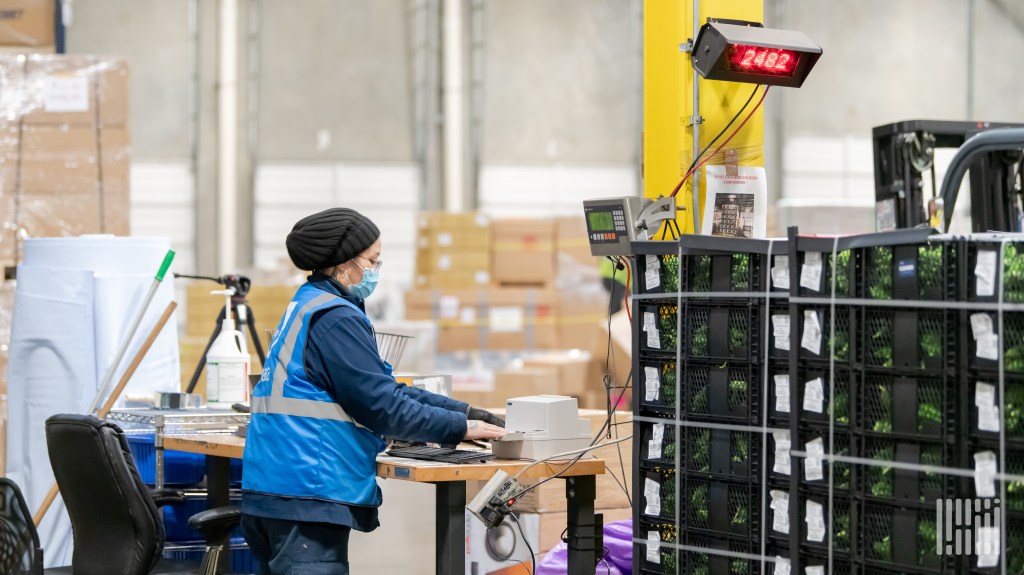
a worker inspecting a shipment at a cold storage facility

Cold storage provider Americold announced Tuesday that is has opened a 335,000-square-foot import-export hub in Kansas City, Missouri. The company partnered with Class I railroad Canadian Pacific Kansas City (CPKC) to develop the $100-million-plus facility.

The new site can handle containers exceeding 50,000 pounds and will provide USDA inspections to circumvent potential border delays. The location will directly cover a 300-mile radius for food storage and distribution and act as a consolidation point for long-haul shipments.

This is Americold’s (NYSE: COLD) first location on the CPKC (NYSE: CP) line. The site is touted as a key hub for CPKC’s single-line rail service for temperature-controlled shipments between the U.S. and Mexico.

“This is more than infrastructure – it’s a fully integrated solution that connects food producers to consumers faster and more efficiently,” said Americold CEO George Chappelle in a news release. “Simply put, we’ve unlocked a better way to move food.”

The new hub is expected to create 190 jobs in Kansas City.

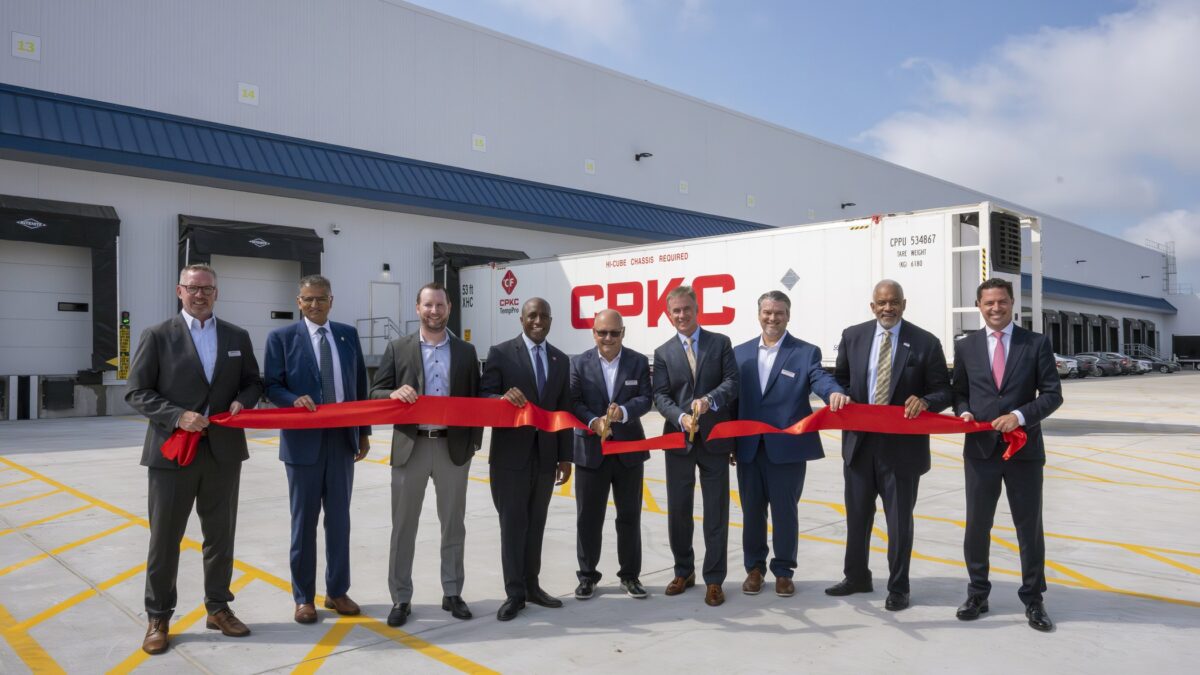
Photo: A ribbon-cutting ceremony at the new facility in Kansas City (Credit: CPKC)

“With direct rail connectivity through CPKC and a talented local workforce, this new facility highlights how strategic partnerships can reshape industries and accelerate innovation,” said Kansas City, Missouri Mayor Quinton Lucas. “We’re excited to be at the center of that transformation.”

Americold said the new location is part of a larger plan to open a network of import-export hubs through strategic partnerships with the goal to “improve how food moves from origin to destination.”

The company announced in May that it began construction on its first import-export hub in Canada. The location at Port Saint John in New Brunswick, Canada will be served by CPKC and global ports operator DP World.

“This facility is the first of many across our unrivaled North American network,” said CPKC President and CEO Keith Creel. “By combining Americold with our secure, single-line cross-border service, we have created a new refrigerated supply chain for our customers shipping food and other temperature-controlled products across Canada, the United States and Mexico.”

Americold’s portfolio includes 1.4 billion cubic feet of refrigerated space at 235 facilities throughout North America, Europe, Asia-Pacific and South America.

Subscribe to FreightWaves’ Rail e-newsletter and get the latest insights on rail freight right in your inbox.

More FreightWaves articles by Todd Maiden:

Benchmark diesel price down for third week in a row

The benchmark average retail diesel price fell Monday for the third week in a row, catching up to declines in futures markets that prevailed from the end of July and into August.

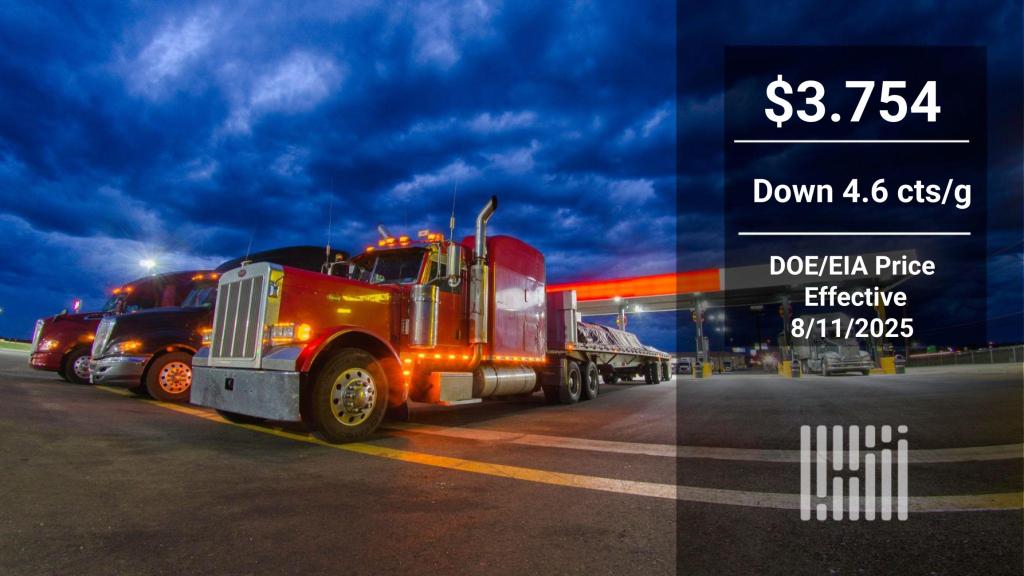
The Department of Energy/Energy Information Administration average weekly retail price, which is the basis for most fuel surcharges, declined 4.6 cents/gallon to $3.754/g. The price was published Tuesday and effective Monday. 

Besides being the third consecutive weekly decline, it was also the largest one-week slide since the end of June. The first two of those three were small declines, and the drop over the three weeks is just 5.8 cts/g. 

The futures price of ultra low sulfur diesel (ULSD) on the CME commodity exchange has been in a relatively tight range in the last week after an earlier decline in late July and going into the first days of August. After a recent high settlement of just over $2.50/g on July 21, the price has gradually drifted down, hitting a recent low settlement of $2.2502/g on August 5. Monday’s settlement was only slightly higher at $2.291/g.

Most commentary on the reason for the decline has been focused on the on-again, off-again nature of a possible agreement between Russia and Ukraine that would bring the war between the two countries to an end. 

Other factors include a gradually strengthening dollar coming on the heels of almost six months of declines. Oil prices tend to move in inverse direction to the movement of the dollar. The recent increases are said to be a factor in the downward direction of oil in the last two weeks.

One thing that has not happened is a flood of oil coming out of the OPEC+ group, despite its monthly unwinding of production cuts that have been in effect since spring 2023. 

In its latest monthly report, S&P Global Commodity Insights said OPEC+ production in July, after a huge increase in June, fell by 140,000 barrels/day in July, on the back of a drop of 190,000 b/d out of countries that are part of OPEC.

The increase in quotas that OPEC+ has been putting into effect for several months have been in the range of more than 400,000 b/d to 500,000 b/d. But lifting quotas and lifting production have been different processes, and as the SPGCI report shows, one does not necessarily follow the other. 

More articles by John Kingston

In brief comments, Trimble CEO introduces new product for matching capacity with shippers

Each driver’s payout in Lytx Illinois biometrics case will be between about $650 and $850

Truck sales in the second quarter might have been the worst performing metric of all