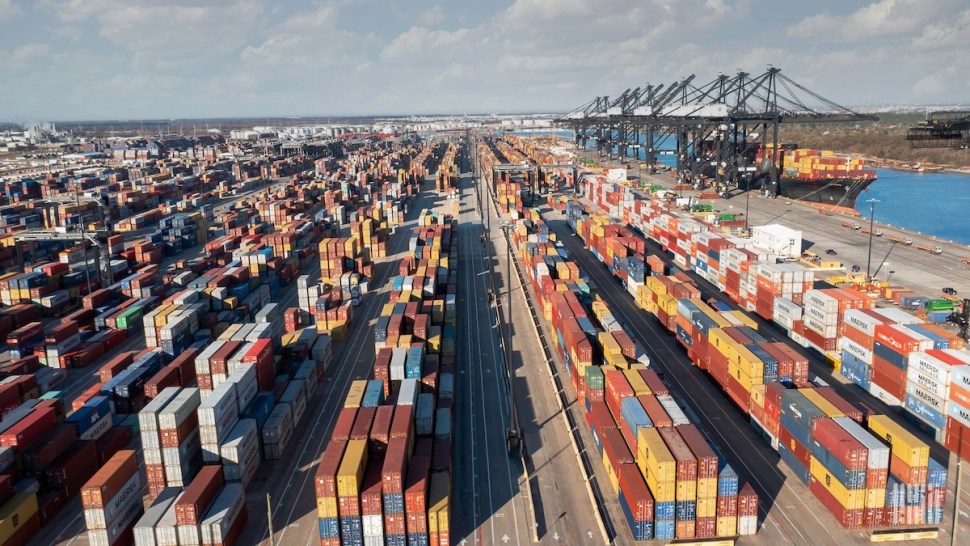
Ocean container spot rates on the benchmark Far East-U.S. route moderated their steep declines that saw an average 53% drop since June to destinations on the East and West coasts.
The latest update from shipping consultant Xeneta has market average spot rates from the Far East to U.S. West Coast at $2,098 per forty foot equivalent unit (FEU), down 3% from July 31, and $3,311 to the East Coast, 9% lower in that time.
Those declines compared to a 62% decrease to the West Coast since June 1, and 53% to the East Coast since June 15, after falling a further 9% since June 31, to $2,015 per FEU.
“Carriers have taken action to arrest the plummeting average spot rates on the trans-Pacific trade to the U.S. West Coast through strong capacity management, with blanked sailings now almost double the level in mid-June,” said Peter Sand, Xeneta chief analyst, in a research note.
“The dramatic spot rate decline has slowed in August so the stronger capacity management is having some success for carriers, but this is limited and not enough to stop the downward trajectory in coming months.
“With significant overcapacity in the global container shipping fleet and a muted forecast for demand, keeping spot rates elevated will be like holding back the tide, no matter how hard carriers try.”
The four-week rolling average of blanked sailings from the Far East to the U.S. West Coast has increased from 30,000 TEUs per week on June 22 to 57,000 TEUs on August 1.
And because no change in supply chains occurs in a vacuum, logistics providers have observed that the increased blankings have contributed to an uptick in serious ongoing congestion issues at some of the busiest Chinese container ports. That’s led to loaded boxes sitting on the docks, they said, as shippers use the ports as de facto warehouses while awaiting vessel capacity.
Xeneta said market average spot rates from the Far East to North Europe were $3,330 per FEU; and $3,372 from the Far East to the Mediterranean.
Far East to North Europe rates flattened after increasing 78% between May 31 and July 1, and prices are down 2% since then. Average spot rates from the Far East to the Mediterranean have declined a further 7% since July 31, and 26% since June 15.
The spread in average spot rates on Far East trades to North Europe and the Mediterranean are near equal at $42 per FEU. On June 1 that number was $1,765.
Since its container volumes to Europe remained strong through much of the summer, some observers have speculated that China was selling goods at drastic discounts, to keep its factories running after U.S. tariffs amounted to an embargo with its most important trading partner.
Find more articles by Stuart Chirls here.
Related coverage:
Savannah containers post best FY since pandemic
Maersk raises guidance on higher Q2 volumes
Container rates unmoved by latest tariff deadline
Shipbuilder sued by owner, operator of ship in deadly Baltimore bridge collapse
Brokerage Compliance Symposium
The day before F3. Every compliance issue you face - fraud exposure, carrier liability, FMCSA rules, cargo theft, insurance gaps - navigated by attorneys and operators defining best practices in a changing industry.
F3 Awards Dinner
The night before F3. FreightTech100 companies honored. FreightTech 25 and Shipper of Choice winners revealed live. Cocktail reception into dinner and live music - 300 industry leaders in one purpose-built room.
F3: Future of Freight Festival
Industry-defining keynotes, rapid-fire technology demos, and industry leaders networking in experiences across Chattanooga - plus the inaugural F3 Awards Dinner featuring the FreightTech and Shipper of Choice reveals.
The day before F3. Every compliance issue you face - fraud exposure, carrier liability, FMCSA rules, cargo theft, insurance gaps - navigated by attorneys and operators defining best practices in a changing industry.
The Signal at Chattanooga Choo Choo • Chattanooga, TN Register NowThe night before F3. FreightTech100 companies honored. FreightTech 25 and Shipper of Choice winners revealed live. Cocktail reception into dinner and live music - 300 industry leaders in one purpose-built room.
The Signal at Chattanooga Choo Choo • Chattanooga, TN Register NowIndustry-defining keynotes, rapid-fire technology demos, and industry leaders networking in experiences across Chattanooga - plus the inaugural F3 Awards Dinner featuring the FreightTech and Shipper of Choice reveals.
The Signal at Chattanooga Choo Choo • Chattanooga, TN Register Now