ArcBest’s Q2 results muted by headwinds in asset-light unit

ABF trailers at a terminal

Continued pressure on ArcBest’s truckload brokerage operations diluted the improvement seen at its less-than-truckload unit during the second quarter, leading to an earnings miss versus analysts’ expectations.

ArcBest (NASDAQ: ARCB) reported adjusted earnings per share of $1.98 for the second quarter. The result was 8 cents below the consensus estimate but 44 cents higher year over year. The adjusted result excluded items considered nonrecurring like costs from technology pilots and acquisition-related expenses.

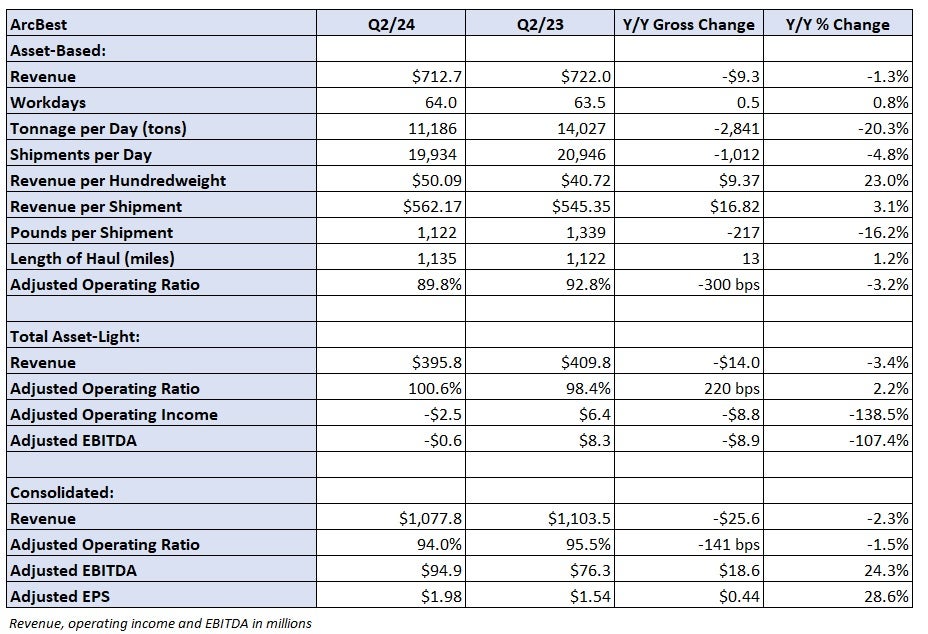
The company’s asset-based segment, which includes less-than-truckload operations (ABF Freight), reported revenue of $713 million, a 2% y/y decline on a per-day comparison. Daily tonnage fell 20% y/y but revenue per hundredweight, or yield, increased 23%. The drop in tonnage was the result of a 5% decline in daily shipments coupled with a 16% decline in weight per shipment. The lower shipment weight positively impacted the yield calculation.

The company ended heavy usage of a dynamic pricing model a year ago as Yellow Corp. (OTC: YELLQ) was teetering ahead of its ultimate closure. The strategy included repricing underutilized lanes at lower rates to keep the network full of freight. ABF has since been purging that lower-yielding transactional freight for shipments from higher-margin core accounts. The change has resulted in pronounced tonnage declines, which have mostly been offset by large yield increases.

The y/y tonnage declines have slowed from a high of 22% in May to 13% in July. Shipments from core accounts were up 14% y/y in the second quarter and tonnage was 11% higher. Tonnage is expected to decline again in the third quarter due to tough y/y comparisons. ABF lost some of the freight it initially picked up from Yellow to lower-cost providers, management from the company said Friday on its second-quarter call. The year-ago period also included a higher amount of project freight that will not recur this year.

Revenue per day in the segment was 1% higher y/y in July as tonnage fell 13% and yield improved 16%.

Contractual price renewals averaged 5.1% in the second quarter, which was in line with previous increases of 5.3% in the first quarter and 5.6% in the fourth quarter. The company expects to capture similar rate increases in the back half of the year.
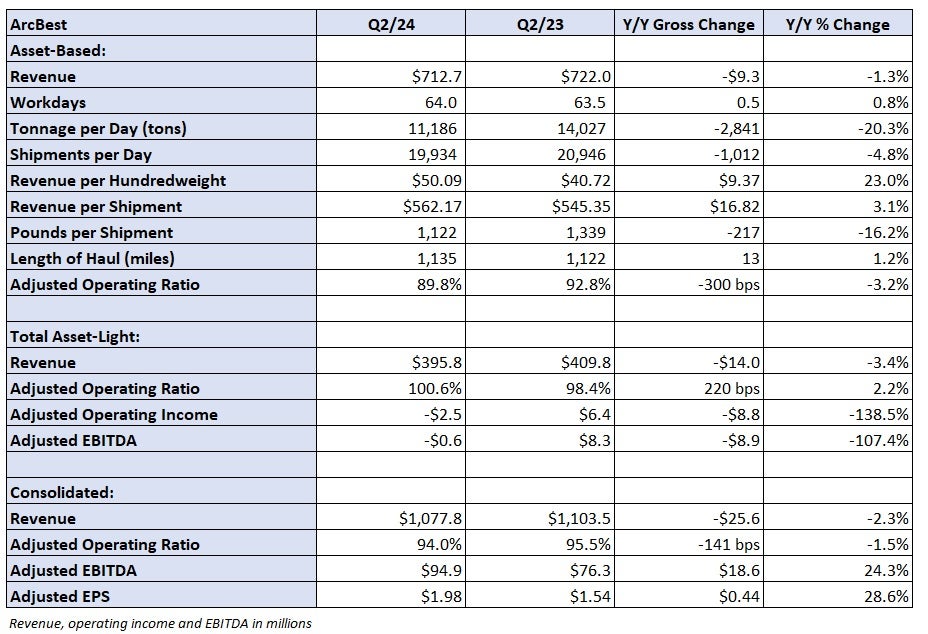
Table: ArcBest’s key performance indicators

The unit posted an 89.8% adjusted operating ratio, which was 300 basis points better y/y.

Salaries, wages and benefits expenses (as a percentage of revenue) increased 180 bps y/y. A front-loaded labor contract with its union employees was a headwind in the period. However, the wage increase for the second year of the contract (effective July 1) was less severe. The wage bump and the annual increase in benefits expenses (effective Thursday) represent a total increase of 2.7%.

Rents and purchased transportation expenses were down 420 bps as a percentage of revenue.

The LTL unit normally sees flat to 100 bps of OR improvement from the second to the third quarter. Given the wage increase as well as soft freight demand, the company is expecting no change this year. 

It normally sees up to 400 bps of OR deterioration from the third to the fourth quarter but the change is likely to be less severe this year due to favorable revenue opportunities in the pipeline and recent efficiency gains from productivity initiatives.

ArcBest acquired four terminals from Yellow’s estate, two of which it opened last month. The other two are expected to come on line this quarter. The company currently has 15% to 20% excess capacity (terminals, equipment and staff), which it said has prepared it for an eventual improvement in demand.

The asset-light unit, which includes truck brokerage, reported a fourth consecutive operating loss in the quarter. A $2.5 million adjusted operating loss compared to operating income of $6.4 million in the 2023 second quarter.

Revenue was down 3% y/y to $396 million (4% lower on a per-day comparison) as shipments per day increased 13% and revenue per shipment declined 15%. A mix shift favoring managed transportation revenue and a soft truckload market weighed on yields. The y/y declines in revenue per shipment narrowed as the quarter progressed. Revenue per shipment was down 10% y/y in July.

The topline trends appear to have moderated as revenue per day was down 1% from the first quarter (shipments per day declined 1.4% and revenue per shipment was flat sequentially). The unit is also seeing some improvement in operations as shipments per employee increased, leading to a decline in cost per shipment.

However, the company expects to book a similar operating loss in the asset-light segment during the third quarter. Higher purchased transportation costs due to higher carrier rates are compressing margins. Purchased transportation expenses as a percentage of revenue increased to 87% in July compared to 85.7% in the second quarter.

The company reiterated net capital expenditures of $325 million to $375 million for 2024. The capex budget includes $155 million in equipment purchases and $130 million for real estate projects. ArcBest will also invest in technology and upgrade dock equipment.

Shares of ARCB were down 11.1% at 11:28 a.m. EDT on Friday compared to the S&P 500, which was off 2.5%.

More FreightWaves articles by Todd Maiden

Georgia county’s suit against cargo ship that capsized in 2019 dismissed

A federal lawsuit filed against the owners and operators of a cargo ship that sank off the Georgia coast in 2019 has been dismissed at the request of a local county that had filed suit alleging it caused damage to the environment. 

The lawsuit, filed by Glynn County in the U.S. District Court for the Southern District of Georgia, was dismissed Thursday at the request of the county. The suit, filed in March 2022, alleged that the sinking of the Golden Ray cargo ship, which was carrying some $142 million worth of cargo when it capsized, caused environmental damage. 

The Marshall Islands-flagged roll-on/roll-off vehicle carrier sank on Sept. 8, 2019, after leaving the Port of Brunswick on its way to Baltimore. It was carrying more than 4,000 vehicles. 

The National Transportation Safety Board determined that an error by the chief officer led to the capsizing.

More on the Golden Ray:

Lawsuit settled in 2019 Golden Ray sinking off Georgia coast

Chief officer’s ballast level error blamed for Golden Ray capsizing

Investigator testifies Golden Ray violated stability regulations

Pilot radioed ‘I’m losing her’ as Golden Ray capsized

Leaking fuel polluted the St. Simon Sound. The ship was grounded near “environmentally sensitive areas” for migratory birds and shrimp, the lawsuit says. 

Salvage operations, which took two years, caused numerous fires and additional oil spills. Health officials in July 2021 issued warnings to those using the Sound for recreation. 

Glynn County relies on the Georgia coast to drive its tourism. Each year, tourists inject some $800 million into the county’s economy. The county is the center of the state’s shrimping industry and was once dubbed the “Shrimp Capital of the World.” 

The suit was dismissed with prejudice, meaning it cannot be brought back to court. 
Another lawsuit filed by local shrimpers, crabbers and business owners was dismissed earlier this year after parties agreed to settle.

Fourth consecutive month of decline in truck transportation jobs

Truck transportation jobs fell in July for the fourth consecutive month and now are 30,000 jobs less than where they stood a year ago. 

The four-month sequence of job declines in the truck transportation sector reported by the Bureau of Labor Statistics, following revisions, is a decline of 1,600 jobs in April, 6,800 jobs in May, 900 jobs in June and 2,400 jobs in July. 

At 1,544,700 seasonally adjusted jobs, truck transportation employment stands exactly 30,000 jobs less than where it was in July 2023.

At the other end of the spectrum was a stunning rise in warehouse jobs in July, combined with a revised figure for May that has taken up total employment in that sector by 16,200 jobs in just two months.

Warehousing and storage jobs rose 10,700 jobs to 1,794,900 jobs, according to BLS data. There were upward revisions for May and June as well, leading to a three-month gain of 23,600 jobs. 

The 10,700 gain in warehouse jobs in July was the largest since a 16,700 jobs increase in March 2022. That increase was near the tail end of the pandemic-inspired surge in warehouse jobs of about 645,000 that started the month after the April 2020 nadir of pandemic-related employment and its peak in May 2022. 

After that warehouse jobs peak, jobs in the sector fell 18 of the next 19 months. But they now have increased six of the last seven months.

In the same way that the national unemployment rate rose, so did the overall unemployment rate for Transportation and Warehousing, a classification that includes truck transportation and the warehouse sector. That rate was 5.7%, up from 4.8% a month earlier. However, that rate does tend to fluctuate considerably. Two months ago, it was 5.5%. 

Shannon Gabriel, the vice president of leadership solutions at TBM Consulting, looks to various data  points within the job searching platform of Indeed for evidence on the status of employment in the logistics sector.

In an email to FreightWaves, Gabriel said there were 1,284,233 resumes in transportation in Indeed with the status of “ready to work” on July 8. On Friday, she said that number was 1,098,522. 

That sort of trend flies in the face of a broad BLS report with a jump in the unemployment rate to 4.3% from 4% and one of the weakest one-month increases in job additions in a long time at 114,000 jobs. But Gabriel said that “given the economic growth of 2.8% last month, I anticipate the labor market to stabilize back closer to 4%, we will continue to see fewer people leaving jobs for new jobs due to layoff anxiety.”

David Spencer, VP of Market Intelligence at Arrive Logistic,  said the trend of declines could mean that “we are seeing carriers and drivers who had been patient throughout the duration of the ongoing downcycle throw in the towel after another lackluster peak season.”

“While there are signs of improvement in market conditions to be excited about, exactly when the spot market will become fruitful again in a sustained way is unclear,” Spencer said in an email to FreightWaves. “With many analysts now indicating a rate recovery may be another year away, it would make sense we continue to see a reduction in market participants from the carrier side.”

Mazen Danaf, senior economist with Uber Freight (NYSE: UBER), expressed a similar sentiment. “Carriers recognized the purely seasonal nature of the latest ump in spot rates, after which the market softened significantly after the Fourth of July” he said. “Despite the recent headcount reductions, the market remains far from equilibrium.”

Mazen also cited the one-month lag data on specific sectors, noting that in long-distance trucking in June, “employment also continued to fall, though it was still about 16K higher than the 2019 peak, which was back then an oversupplied market.”

In other highlights from the report:

–The not seasonally adjusted data for truck transportation rose 800 jobs, suggesting that most of the decline in the seasonally adjusted figure came from the BLS adjustment process. The BLS has described what goes into the seasonal adjustment as a process that “removes the effects of events that follow a more or less regular pattern each year. Over the course of a year, such events affect the rate of wage and benefit change. For example, wage and benefit adjustments in state and local governments, especially schools, are concentrated in the June-September period. Increases in the Social Security tax rate and earnings ceiling, when they occur, take effect in the December-March period.”

  • For an industry that has long been under pressure from regulators to add personnel, rail is trending in the opposite direction. June employment was revised down from its original report by 1,400 jobs, a relatively large amount for a sector whose month-to-month changes are measured in the hundreds at most. July jobs declined a further 200 jobs from that revised June figure, and May was revised downward by 500 jobs. The end result is that in July 2023, rail jobs were at 153,100 jobs. In July, they were 1,400 fewer jobs.
  • Workers in truck transportation worked longer and got paid less on average. For production and nonsupervisory employees in June — that data is on a one-month lag — the average hourly wage fell to $29.81 from $29.95, and the hours worked rose to 40.5 from 40 hours. 

More articles by John Kingston

Crackdown on BQE with WIM technology slashed overweight trucks by two-thirds

C.H. Robinson earnings again surprise to the upside; CEO cites operating model

Werner CEO Leathers says freight market inflection point may be close

Building an electrification business in reverse

When most fleets think about the electric grid, it’s about how much power they can get and when. Seed-stage startup Synop has another idea – making money by helping return unneeded power to utilities.

Seed-stage startup Synop found its niche in bidirectional charging. (Image: Synop)

Giving back (electricity) as a business

When Gagan Dhillon worked for Volvo Trucks North America, he saw an opportunity to create a TMS for electric trucks. No one was interested. Then he and longtime friend Andrew Bledge, formerly an Amazon Web Services software engineer, looked into bidirectional charging – essentially sending unneeded electricity back to the grid.

The Department of Energy paid for Baltimore Gas & Electric in Maryland to let owners of three Ford F-150 Lightning pickup trucks participate in a proof-of-concept with solar provider Sunrun to discharge their trucks for backup home power.

Synop has bigger plans.

“We are telling an energy management-for-fleets story where you have all these big battery packs and these vehicles,” Dhillon told me. “How do you manage that energy? How do you pull energy from different sources that drain the grid, and then send that energy back to the grid?”

Gagan Dhillon, co-founder and CEO of electrification startup Synop,saw electrification TMS as a possible business. But it only caught on as his company focused on bidirectional charging. (Photo: Synop)

It’s complicated. But SaaS businesses like Synop find working with utilities easier than fleets trying to rush hardware-based grid interconnection for a charging site that can be slowed by bureaucracy and supply chain disruptions.

Wait! We can make money at this?

An aha moment came when Dhillon and Bledge learned utilities would pay to recover power much the way plasma operations dole out debit cards for life-giving blood fluids many people can function without.

“We’ve seen utilities offer up to $15,000 a year per vehicle that they can have access to for a vehicle-to-grid demand,” Dhillon told me. “Those are pretty substantial numbers if you multiply them across a fleet.”

A single TMS that included a way to offload excess energy was far more attractive to bus fleet operators than just managing their electric vehicles and chargers.

“Sometimes in life timing is everything. We were able to win some early key customers,” Dhillon said. Fleets get most of the payout for energy they return. Synop gets less than 5%.

Prologis on board

Customers include real estate giant Prologis that is deep into electrification. Forum Mobility, backed by Prologis rival CBRE Investment Management, is also on board.

“[Prologis is] building out massive charging depots across their footprint of warehouses. And they are building these big behind-the-fence [charging] hubs. There’s immense power there,” Dhillon said. 

“They have a view into all of the charging that is available, the battery capacity that is available at these sites and eventually in Southern California, Northern California. They’re going to be able to discharge these vehicles at the optimal time, tap into that network and really turn this on for Class 8 use cases.”

Prologis endorses Synop on the Synop website.

“Scaling our charging-as-a-service offering for our customers incorporating electric vehicles has been made easier through Synop’s EV fleet and charging solutions,” said Henrik Holland, global head of Prologis Mobility. “Synop enables us to maximize uptime and minimize cost for our EV fleet customers.”

Taking the bus – so far

So far, Synop focuses on electric school buses from Daimler Truck North America’s Thomas Built Buses, Navistar’s IC Bus unit and Canada’s Lion Electric. Direct current fast-charging is a key. Level 2 charging at 240 volts is too slow.

School buses typically run the same routes in the mornings and afternoons with hours of downtime after the last student is dropped off. Why not offload unused energy and then recharge at lower rates overnight to be ready for the next day? (Photo: Synop)

In August 2022, electric school buses in Beverly, Massachusetts, returned energy to the grid for more than 80 hours. That offset demand on some of the summer’s hottest days.   

Synop is targeting drayage, which has similarities to school bus transportation – same routes, same times – albeit with cargo instead of kids.

“We’ve got about 400 Class 8 electric trucks on the platform today. But that number is going to continue to grow,” Dhillon said.

Synop Series A round on the way

Synop is about 3 years old. It has raised about $15 million in seed funding. A Series A round is coming, but Dhillon declined to get into details. As a SaaS business, Synop’s cash needs are less acute than those of a hardware manufacturer.

Even with a first-mover advantage and being regarded as such by utilities, would Synop consider a merger instead of going it alone?

“That’s always something you have to think about,” Dhillon said. “We’ve seen those opportunities in the three years we’ve been in business. So far we’ve said no to them. But you never know what the future holds.”


The march to pricer decarbonized diesel engines

A trucking industry guessing game is in full swing. When will fleets start pulling ahead purchases to beat hefty price increases coming with 2027 Environmental Protection Agency emissions rules? Or have they already begun?

“Strong truck orders provide more evidence of prebuying ahead of 2027 emissions standards, likely extending overcapacity a while longer,” Tim Denoyer, ACT Research vice president and senior analyst, said in June.

Paccar CEO Preston Feight demurred  on the OEM’s second-quarter earnings call July 23. “I think it depends on too many factors to weigh in on it,” he said.

Feight acknowledged that emissions-tightening regulations historically have affected buyer behavior. A 2027 EPA-compliant engine with a second selective catalyst reduction system could add $25,000 to $40,000 to the price of a new truck.

For fleets based in California, the California Air Resources Board’s Omnibus regulation mandates a 75% reduction in smog-forming nitrogen oxide emissions and a 50% reduction in particulate matter from heavy-duty on-road engines for the 2024-2026 engine model years compared to existing EPA standards.

Meeting the mandate

Paccar and Volvo Trucks North America recently announced variants of their big bore engines that will meet the Golden State requirements.

The Paccar MX-13 CARB engine for certain Kenworth and Peterbilt models uses a twin-canister selective catalytic reduction (SCR) aftertreatment and makes the most of emissions control systems.

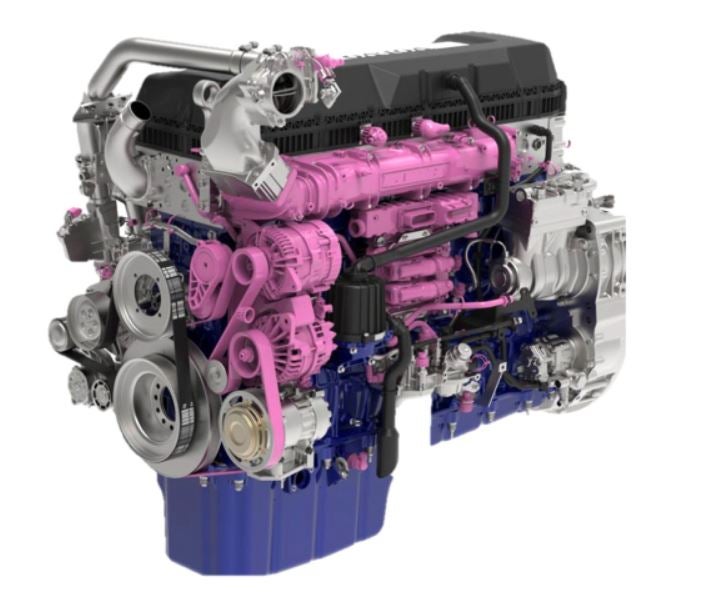
Volvo’s CARB 24-compliant engine features an advanced emission control system. It is integrated with a linear exhaust aftertreatment system whose parts can be individually serviced or replaced. Volvo also incorporated a 48-volt alternator to supply power to a 48-volt battery that powers the heater during startup and low-load situations.

A Volvo Trucks engine variant complies with the California AIr Resources Board nitrogen
oxide emissions regulations for 2024-2026 engines. (Image: Volvo Trucks North America)

Navistar’s International S13 integrated powertrain features a dual-stage SCR as its primary NOx emissions reduction technology. It has no exhaust gas recirculation cooler on the engine, so 100% of the exhaust flows to the turbocharger during normal operating conditions. The result is less soot and particulate matter.


Briefly noted …

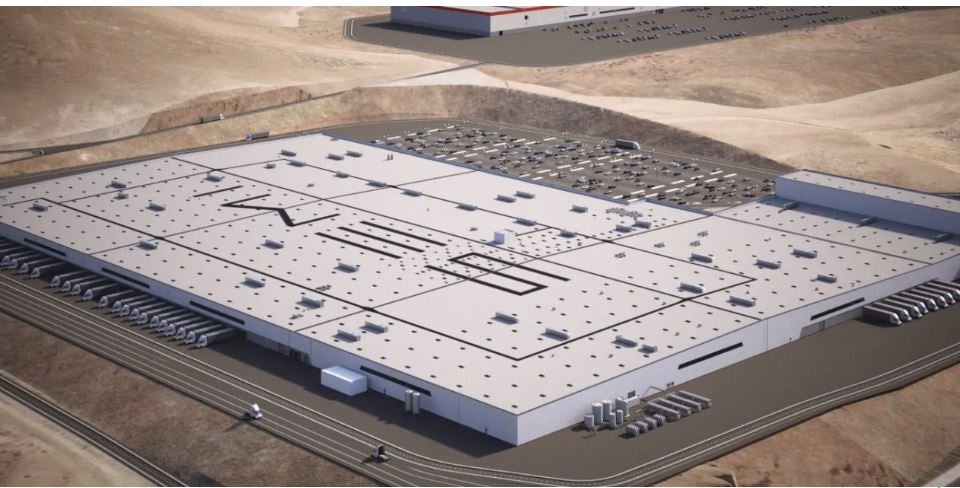
Tesla is showing a rendering of the plant in Nevada where it plans to build 50,000 Class 8 Semi electric trucks a year.

A rendering of the Tesla Semi plant in Nevada. (Image: Tesla/Dan Priestley)

Daimler Truck has begun customer trials of its Mercedes-Benz GenH2 fuel cell trucks with Air Products and Amazon, among others.

Allison Transmission demonstrated the new Cummins X15N natural gas engine paired with its 4000 Series fully automatic transmission covering 50,000 miles of hauling bulk cement in California.

Hyliion has signed a nonbinding letter of intent to build a 200-kilowatt Karno generator at a U.S. Energy renewable natural gas fueling station.

German Tier 1 automotive supplier ZF Friedrichshafen AG is pulling back from electrification in its home county. It expects to cut 11,000 to 14,000 jobs by the end of 2028. 


Truck Tech Episode No. 76: Zengistics brings peace of mind and tech-enabled efficiency to load management

Matt Zimmer of Zengistics discusses how infusing AI into the brokerage business drives efficiency and helps scale the business rather than as a tool to cut headcount.

Now is the time to use this discount offer for your Future of Freight Festival tickets in Chattanooga, Tennessee, this November.  

Nominations for the FreightTech 25 are open until Sept. 6. Winners will be announced at F3.
That’s it for this week. Thanks for reading and watching. Click here to subscribe and get Truck Tech delivered to your email on Fridays. And catch the latest episodes of the Truck Tech podcast and video shorts on the FreightWaves YouTube channel. Send your feedback on Truck Tech to Alan Adler at aadler@firecrown.com.

Drayage carrier notifies NJ independent contractors of changing business model

New Jersey independent contractors who haul freight under STG Drayage’s operating authority were notified Monday that they will no longer be tendered loads beginning in late November unless the truckers get their own authority through the Federal Motor Carrier Safety Administration and meet other requirements.

“After careful consideration of shifting market conditions and changing legal landscapes, STG Drayage plans to cease doing business in New Jersey with independent contractor owner-operators who operate under STG Drayage’s federal motor carrier operating authority as early as November 27,” according to the STG notice.

For drivers who want to bid on freight through STG Drayage’s property-broker affiliate, STG Transportation Solutions, they must obtain their own operating authority, fulfill various insurance requirements, and have proper placards on their tractor(s) reflecting that they have active motor carrier authority, register  tractor(s) under the Uniform Carrier Registration system, and obtain proper permits, plates, and registration cab cards, and hire drivers with commercial-vehicle licenses that meet FMCSA requirements. 

As of publication Friday, STG Logistics replied “no comment” to FreightWaves’ request seeking comment to its business-operations agreement with its New Jersey drayage drivers.

In December 2023, the New Jersey Department of Labor and Workforce Development Commissioner Robert Asaro-Angelo and New Jersey Attorney General Matthew J. Platkin filed the first lawsuit under a 2021 law that permits the state to file suit in New Jersey Superior Court against employers who have allegedly misclassified workers as independent contractors. 

According to the state’s complaint against STG Logistics and STG Drayage, the suit “seeks to halt the companies’ alleged practice of misclassifying drivers as independent contractors and to recover up to millions in back wages, penalties and fines for more than 300 truck drivers.”

The lawsuit also seeks damages for the companies’ alleged improper deductions from drivers’ pay.

The state’s attorney general’s office said that it had no comment due to “pending litigation” against the STG companies.

STG Logistics is a privately held California company headquartered in Bensenville, Illinois, while STG Drayage, a subsidiary of STG Logistics, is a Delaware limited liability company. Paul Svindland serves as CEO of STG Logistics. He declined to comment on the notice sent to STG’s New Jersey drayage drivers.

New Jersey’s labor law requires companies that hire independent contractors to use the “ABC test,” a three-pronged test to determine whether its workers are actually employees.

Trucking companies in New Jersey must prove that a driver is free from the control and direction of the hirer in connection with the performance of the work; the worker performs work that is outside the usual course of the hiring entity’s business; and the worker is customarily engaged in an independently established trade, occupation or business of the same nature as the work performed for the hiring entity.

The state’s DOL misclassification investigation initially focused on XPO Logistics Drayage drivers. However, XPO sold its intermodal operations to STG Logistics, owned by private equity investment firm Wind Point Partners, for around $700 million in 2022. As part of the purchase, XPO “assumed the liability for the seller’s past employment practices,” according to the NJDOL’s statement about the lawsuit.

Drayage drivers were required to purchase the trucks in their own names, according to the lawsuit, but were required to lease the trucks back to XPO. The suit alleges that the drivers had to display the company’s signage on their trucks despite the drivers paying for all of their expenses, including fuel. However, the drivers were prohibited from using their trucks to work for other companies without XPO’s written consent. 

“When employers unlawfully and callously toss their workers into the ‘independent contractor’ category, they are not only depriving them of a steady paycheck, [but] they are also stripping them of earned sick leave, workers compensation, minimum wage and more,” New Jersey Attorney General Matthew Platkin said in a statement after the lawsuit was filed. “These are national, profitable corporations with deep pockets who are padding their profits with illegal labor schemes, and they seem to have no plans to stop this kind of behavior.”

According to the statement, in August 2020, XPO paid the state nearly $894,000 “to resolve a prior NJDOL audit finding it failed to make required contributions to the Unemployment Compensation and Disability Benefits Funds from 2015 through 2018.”

In July, a New Jersey-based trucking company, Horseless Carriage Carrier of Paterson, which hauls luxury cars, agreed to pay a total of $455,000 in backpay and penalties. Eight drivers will receive $364,000 in unpaid wages, according to settlement agreement reached with the NJDOL over allegations the carrier misclassified its drivers as independent contractors. 

In 2022, Horseless Carriage Carrier was sold to McCollister’s Global Service. Frank Malatesta serves as the trucking company’s president. 

Do you have a news tip or story to share? Send me an email or message @cage_writer on X. Your name will not be used without your permission.

New Jersey trucking company files for Chapter 11
Illinois trucking company, brokerage file for bankruptcy liquidation
2 Miami trucking companies file for bankruptcy protection
SEC charges 2 executives in $112M trucking Ponzi scheme

First look: ArcBest’s Q2 misses consensus

An ArcBest dryvan trailer being pulled on a highway

Click for full report – “ArcBest’s Q2 results muted by headwinds in asset-light unit”

ArcBest reported second-quarter adjusted earnings per share of $1.98, 8 cents below the consensus estimate but 44 cents higher year over year. The result excluded items considered nonrecurring like costs tied to technology pilots and acquisition-related expenses.

ArcBest’s (NASDAQ: ARCB) asset-based segment, which includes results from its less-than-truckload subsidiary ABF Freight, reported revenue of $713 million, a 2% y/y decline on a per-day comparison. Tonnage per day was down 20% but revenue per hundredweight, or yield, increased 23%. The tonnage decline was the combination of a 5% decline in daily shipments and a 16% decline in weight per shipment.

The company is in the process of swapping transactional freight that carries a lower margin profile with shipments from its core customers, which carry higher yields. Shipments from core accounts increased 14% y/y (tonnage was 11% higher).

The unit recorded an 89.8% adjusted operating ratio, 300 basis points better y/y.

Asset-based revenue per day was up 1% y/y in July as tonnage fell 13% and yield improved 16%.

The asset-light unit, which includes truck brokerage, reported a $2.5 million adjusted operating loss in the period. Revenue was down 3% y/y to $396 million. Shipments per day increased 13%, with revenue per shipment down by a mid-teen percentage. A mix shift toward managed transportation and a weak overall truckload market are weighing on yields. The y/y declines in revenue per shipment narrowed as the quarter progressed and into July, which was down 10% y/y.

The company expects to book a similar operating loss in the unit during the third quarter.

ArcBest will host a conference call at 9:30 a.m. EDT on Friday to discuss second-quarter results. Stay tuned to FreightWaves for continuing coverage of ArcBest’s earnings report.

Click for full report – “ArcBest’s Q2 results muted by headwinds in asset-light unit”

More FreightWaves articles by Todd Maiden

FreightWaves Infographics: International Beer Day


To learn more, click HERE

Laredo to require carriers using border bridge to have $100 in account

The city of Laredo, Texas, recently passed an ordinance requiring all trucking companies using the World Trade Bridge to have $100 minimum in their automated vehicle identification (AVI) accounts in order to pay crossing fees.

The ordinance, which was unanimously approved by the city council on July 22, is aimed at ferreting out commercial operators whose empty accounts have resulted in their being forced to turn around on the U.S. side of the international bridge, causing massive delays and long lines for other truckers.

For commercial trucks, the fee to cross Laredo’s World Trade Bridge and the nearby Colombia Solidarity international Bridge can be up to $20.

“The anticipation will be that the new rule will greatly reduce and eventually eliminate turnarounds due to insufficient funds,” Laredo Mayor Victor Trevino said in an email to FreightWaves.

Trevino said when trucks have to make U-turns at the World Trade Bridge because of insufficient funds, it interrupts the flow of traffic, as well as hurts trade between the U.S. and Mexico

“The purpose of this is to avoid a loss of time, revenue and job creation due to turning trucks around because of insufficient funds,” Trevino said during the July 22 City Council meeting. “The reason for this is that it doesn’t make any sense that we’re having trucks carrying millions of dollars in goods, and then for $20, we’re going to send them back. It doesn’t make sense for international trade or for us or even for them. We need to implement this modification of this system to keep all the trucks flowing.”

Laredo officials recently met with Alicia Barcena, Mexico’s secretary of foreign affairs, who told them that every 10 minutes they see $27 million worth of commercial goods that support around 3,000 jobs crossing the World Trade Bridge from Nuevo Laredo, Mexico.

Nuevo Laredo is the sister city of Laredo, just across the U.S.-Mexico border.

“Now you take an eight- or 10-minute turnaround per truck, it may end up being a major loss,” Trevino said.

The port of entry in Laredo — which includes the World Trade and Colombia Solidarity bridges — is the No. 1 international gateway for U.S. trade among the nation’s 450 international gateways for trade, according to Census Bureau data analyzed by WorldCity.

Laredo recorded $29.3 billion in trade during May, according to the latest data from the Census Bureau. As of July 30, 228,482 commercial trucks crossed the World Trade and Colombia Solidarity bridges.

The Colombia Solidarity International Bridge is not included in the proposed $100 minimum balance ordinance.

Trevino said the Colombia bridge is not usually as busy as the World Trade Bridge, and doesn’t see as many traffic bottlenecks.

“The new rule is for the World Trade Bridge, and currently applicable to the World Trade Bridge only,” Trevino said. “Due to the volume of traffic at the World Trade Bridge, this is where the turnarounds (6-10 minutes) due to insufficient funds have the greatest detriment (based on the total value of goods and jobs supported by those goods per minute).”

The fee to use bridges is assessed using an AVI tag on cargo trucks that is linked to an account with the city. 

Trevino said he met with local trucking companies and associations to get their feedback on the ordinance.

“I have had several meetings within industry, including trucking companies, logistics companies and custom brokerage houses. This includes input from the members of the city’s Port Advisory Committee and COMCE Noreste (the Northeast Mexican Foreign Trade Council),” Trevino said.

Yvette Limon, bridge director for the city of Laredo, said when trucks arrive at the World Trade Bridge toll booths without enough funds in their accounts, bridge staff have to turn the trucks around, forcing them to go against traffic.

In the past, there were months when almost 600 trucks had to turn around because they were unable to pay the fee.

Limon said most trucking operators currently have less than $100 in their commercial AVI accounts with the city of Laredo.

“We have 5,149 commercial accounts. Out of those 5,000 accounts, we have 1,864, 36% that have a balance greater than $100,” Limon said at the July 22 council meeting. “That means 64% of the accounts have less than $100 in their AVI account. By making this change, it will affect the majority.”

One issue could be policing trucking operators that have less than the $100 minimum, Limon said. There are currently 267 AVI accounts with the city that have a negative balance. 

The city currently sends email blasts twice a month to customers to remind them of the different ways they can deposit funds into their accounts, Limon said.

“Keep in mind that the majority of our crossers are drayage. They make round and round trips throughout the day. By forcing them to keep a balance, that would also impose more work on bridge staff. How would we be able to monitor 3,000-plus accounts daily and notify them that their balance in their AVI account has dropped below $100?” Limon said.

Laredo City Councilwoman Vanessa Perez suggested a modification to the city’s AVI tag system that notifies trucking operators when their account balance is below $100.

“I would recommend that the burden not be on staff to be calling and checking up on the $100 minimum, that it could be like a computer modification to the system, that the system automatically requires that $100, so our staff doesn’t have the burden of calling them,” Perez said.

Council members said they would discuss how to monitor minimum balances in accounts at the next meeting.

First look: Amazon stock slides after projections for 3Q revenue

Amazon’s earnings, released after the market close Thursday, were notable on several key points. Among them:

  • Wall Street’s reaction was decidedly negative. At about 4:40 p.m. EDT, Amazon (NASDAQ: AMZN) stock was down about 4.4%, to $175.94. It had been down 1.56% on the day to $184.07. The decrease occurred even though its earnings per share under GAAP measurements of $1.26 beat consensus forecasts by 23 cts/share, according to SeekingAlpha.
  • The negative stock market reaction was reported to be primarily driven by the company’s guidance. Amazon said it expected net sales to be between $154 billion and $158.5 billion in the third quarter. But news reports said analysts had been forecasting third quarter net sales at $158.4 billion, citing Bloomberg data.
  • One piece of data not in the earnings but will likely be in the company’s 10Q, yet to be filed, is a significant gain on its shares of electric vehicle maker Rivian (NASDAQ: RIVN), according to Tomi Kilgore of Marketwatch. Kilgore, in a commentary on Amazon’s earnings, noted that Amazon owns more than 158 million shares of Rivian Automotive Inc. That stock at the end of the second quarter was $13.42, up 22.6% from where it closed at the end of the first quarter, $10.95. Kilogore noted that Amazon did disclose earlier this week that its investments in publicly traded companies were $2.525 billion at the end of the quarter. That was up from $2.117 billion at the end of the first quarter, and  Rivian’s increase in price has been a key contributor to the rise in that asset line, according to Kilgore.
  • Among the operating highlights cited by Amazon in its prepared earnings statement, the company said it “delivered to Prime members at its fastest speeds ever in the first half of the year.”
  • Key measurements showed significant growth compared to the prior year. Net product sales for Amazon were up 4.3%. Net service sales, which includes AWS, rose 4.7%. Operating income was up 91% and consolidated net income almost doubled, to $13.5 billion. 
  • In North America, net sales exclusive of AWS rose to $90 billion from $82.5 billion. News reports said CFO Brian Olsavsky, in a conference call with reporters after the release of the earnings, said Amazon “did come in a little short on revenue growth in North America vs. our internal estimates.” According to the reports, the CFO said consumers were ratcheting down what they were willing to pay and were buying cheaper products. “What we’re seeing is really around ASP and lower ASP in products selected by customers,” Olsavsky said, according to the products. “They are continuing to be cautious in their spending and trading down to lower (average selling price) products.” 
  • AWS net sales jumped to $26.3 billion from $22.1 billion a year ago, and with operating expenses holding relatively steady, operating income climbed to $9.33 billion from $5.36 billion a year ago. 
  • In the prepared statement that had few quotes from management in it, AWS and its adoption of AI stood out. “We’re continuing to make progress on a number of dimensions, but perhaps none more so than the continued reacceleration in AWS growth,” Andy Jassy, president and CEO of Amazon said. “As companies continue to modernize their infrastructure and move to the cloud, while also leveraging new Generative AI opportunities, AWS continues to be customers’ top choice as we have much broader functionality, superior security and operational performance, a larger partner ecosystem, and AI capabilities like SageMaker for model builders, Bedrock for those leveraging frontier models, Trainium for those where the cost of compute for training and inference matters, and Q for those wanting the most capable GenAI assistant for not just coding, but also software development and business integration.”

More articles by John Kingston

Ryder, reporting sluggish earnings growth, sees ‘trough’ in freight market

Backed by big companies and labor, Supply Chain Council debuts

Victory for a 3PL again — TQL — in case involving broker liability

Taking Care of Your Drivers – Taking the Hire Road

On the latest episode of Taking the Hire Road, host Jeremy Reymer sat down with Hope Zvara, founder and CEO of Mother Trucker Yoga, to talk about improving driver health and well being through daily exercise – and why that benefits carriers.

For several years, Zvara owned and operated a yoga school and a state-approved vocational school in Wisconsin teaching functional movement and yoga, but she says she knew that wasn’t her calling. 

When an investor asked if she had any ideas for helping truck drivers to stay healthy even while in the cabin, Zvara pitched “Mother Trucker Yoga” without hesitation, and from there went on to build and eventually buy out the organization.

Mother Trucker Yoga has now helped more than 200,000 drivers develop an exercise regimen and stay healthy.

“I believe it’s the little things in life, cumulatively, done repetitively over time, that change one’s holistic health,” Zvara said. 

The foundation of Zvara’s approach came from her own journey to health and wellness. “I’m in recovery myself. The quick fixes never worked for me,” Zvara said. “When I started to take things day by day, hour by hour, and for a portion of my life, minute by minute, I started to see that there was hope and that I didn’t have to live that way.” 

In her experience, it’s the people who focus on doing the little things right every day who are able to sustain change long term for physical, emotional and mental health. 

“When I compared Mother Trucker Yoga to the other players in the trucking industry, in my opinion, they were doing it wrong,” Zvara said of the yoga organization’s competitors.  

Focusing on weight loss numbers is not a holistic approach to health, according to Zvara. While some diets and exercises can see good results, the best and most sustainable changes to health are those that aren’t so black-and-white. 

“Small simple changes, done repetitively over time boost internal happiness and create confidence and momentum. It creates habits for a healthier lifestyle beyond trucking,” Zvara said. “That’s why I’m here.”

To engage with truck drivers and carriers, Mother Trucker continually evolves to meet their needs. Developing apps, hosting events, and keeping up with drivers on social media are all ways that the team tries to foster participation. 

On a higher level, Zvara says, working with companies to audit wellness programs has had a major impact. 

“We’ve audited many wellness programs this year, and less than 10% have sustained participation,” she said.  

When Mother Trucker Yoga audits companies’ wellness programs, the team provides key takeaways with practical steps toward improvement. Typically, Zvara says, their suggestions are simple and straightforward, but tend to have a profound impact on the engagement and effectiveness of wellness programs and driver health. 

Zvara’s next goal, in partnership with doctors, is to be able to change how healthcare is presented to drivers. 

“We’re creating a system where it’s all under one roof,” she said. “In the trucking industry, wellness is in one corner and healthcare in another, and they don’t communicate.” 

“In our programming, wellness, healthcare, and pharmacy all collaborate together and cooperate to keep drivers healthier overall. It saves companies 50 percent or more on healthcare costs,” Zvara added.

According to Zvara, what she does to distinguish Mother Trucker Yoga from competitors is to focus on relatively easy activities that drivers can do every single day to keep up momentum and make meaningful changes over time. “If you can’t do it in five minutes, I’m not going to teach it to you.”

The reason Zvara specializes in yoga as an avenue to introduce fitness into drivers’ routines is that it focuses on more than just physical fitness. “It teaches you to think about the mind, spirit and emotions. These things all have an impact on your overall health.” 

The philosophy of Mother Trucker Yoga is about creating positive cycles and feedback loops. The founder says, “If you can work on one thing, it can make you feel better about your choices and encourage more good choices.” 

“Maybe if you have back pain every time you get out of the truck, and one stretch five minutes a day helps alleviate that pain, you won’t be as miserable when you step into the truckstop,” she explained. “You might get a salad instead of a candy bar, and then once you’ve done that, go on a walk at the end of the day. With that serotonin and dopamine feedback loop, maybe you’ll call your family more and start to feel happier about all the little moments of your day.”

Those small breakthroughs add up, and that’s Zvara’s goal. “Making one consistent, small change can turn into a powerful cycle,” she said. 

Book recommendations: “365 Days of Kindness,” “Leadership Success in 10 Minutes a Day

Click here to learn more about Mother Trucker Yoga

Sponsors: The National Transportation Institute, Career Now Brands, Carrier Intelligence, Infinit-I Workforce Solutions, WorkHound, Asurint, Arya By Leoforce, Transportation Marketing Group, Seiza, Drive My Way, F|Staff, Trucksafe Consulting, Seated Social, Repowr