$8.75 million awarded in Small Shipyard Grants for 2024

The U.S. Department of Transportation’s Maritime Administration (MARAD) announced $8.75 million in grant awards to more than a dozen small shipyards through the Small Shipyard Grant Program on Thursday.

The funds will help 15 small shipyards across 12 states modernize, increase productivity, and expand local job opportunities, according to a news release from the U.S. DOT. The following shipyards are named to receive grant money for the following projects:

  • Birdon America Inc. Alabama Shipyard LLC, of Bayou La Batre, Alabama, will receive $997,065 to support the purchase of an automated welding system. 
  • Gulf Marine Repair, of Tampa, Florida, services government, commercial and noncommercial vessels in the South Florida region. They will receive $997,678 for their Dry-Dock Strengthening Project of the A.W. Hendry dry dock to increase lift capacity and serviceability.
  • Marisco Ltd., of Honolulu, will receive $584,563 to purchase an electric air compressor and plasma cutter. 
  • James Marine Inc., of Paducah, Kentucky, on the upper Mississippi River, will receive $460,500 to support the purchase of a 40-ton rough-terrain crane.  
  • C&C Marine and Repair LLC, of Belle Chasse, Louisiana, which has been successfully operating for more than 55 years in the Gulf Intracoastal Waterway, will receive $514,263 to purchase a Messer CNC Plasma Cutting Table.
  • Cooper Consolidated LLC, Convent-Mile 164 Shipyard, of Convent, Louisiana, will receive $368,440 to purchase a Bobcat track loader, four welding machines, a 9,000-pound-capacity telehandler and a backhoe tractor.
  • The General Ship Repair Corporation, of Baltimore, Maryland, is one of the largest commercial shipyards in the state of Maryland. They will receive $364,311 to support the purchase of a blast and paint shelter, ultra-high-pressure water-blasting unit, a mist/dry-blast unit and air dryer.  
  • Gulfship Apprenticeship LLC, of Gulfport, Mississippi, is a manufacturing facility and small shipyard. They will receive $4,547 to procure a CNC machine to teach students and assist the shipyard. 
  • WCT Marine & Construction Inc., of Astoria, Oregon, will receive $874,297 to purchase a 450-ton hydraulic self-propelled vessel transporter.
  • Philly Shipyard Inc., of Philadelphia, will receive $800,000 to support their shipyard apprentice program.
  • Rhoads Industries Inc., of Philadelphia, will receive $552,846 to support the expansion of their standard welding training program by adding modern mechanized welding systems.
  • Safe Harbor Marine Newport Shipyard LLC, of Newport, Rhode Island, repairs vessels from government to commercial clients, including passenger ferries, fishing vessels and marine towing vessels. They will receive $647,567 to purchase a 180-ton hydraulic self-propelled vessel transporter. 
  • Lighthouse Marine LLC, of Port Bolivar, Texas, on the Mississippi River, is set to receive $646,157 for a JLG Hybrid Telescopic Boom Lift, Grove 65-ton Rough Terrain Crane, welding machine, plasma cutter, as well as airless paint pump blasting and painting equipment upgrades. 
  • Inventech Marine Solutions LLC, of Bremerton, Washington, is a production facility located 8.5 miles from the Puget Sound via the Port Orchard marina. They will receive $378,079 to purchase an electric clean paint booth with blast and spray booths and two 10-ton and two 5-ton overhead bridge cranes. 
  • Motive Power Marine, of Tacoma, Washington, will receive $559,687 to support the acquisition of site electrical upgrades, an electric air compressor and a 12,000-pound-capacity telehandler. 

“Small shipyards are integral to the strength of America’s supply chains and the maritime industry” said U.S. Transportation Secretary Pete Buttigieg in the release. “With the grants announced today, the Biden-Harris Administration is delivering funding that will create jobs in cities and towns across the country, strengthen our commercial fleet, and add power to our national economy.”

The news release notes that since 2008, MARAD’s Small Shipyard Grant program has awarded $311.7 million in 365 grants to nearly 200 shipyards in 33 states and territories throughout the U.S.

“Continued investment in our small shipyards enables them to acquire the cutting-edge technologies needed to remain competitive elements of America’s maritime industry,” said Maritime Administrator Ann Phillips in the release. “These grants stimulate economic development by boosting opportunities for good jobs in the communities where shipyards are located.”

Hyzon focuses on US fuel cell market for survival

In its brief four-year history, Hyzon Motors has experienced far more stormy than sunny days. As it struggles to survive, the commercial fuel cell manufacturer is focusing on the U.S., where it sees hydrogen and zero-emission refuse trucks worth pursuing.

Chasing the SPAC money

A spinoff of Singapore-based Horizon Fuel Cell Technologies, Hyzon went public in July 2021 in a reverse merger with special purpose acquisition company Decarbonization Plus Acquisition Corp. It received $550 million in proceeds from the business combination, money long since spent.

Horizon sold a lot of fuel cells in China before standing up Hyzon in 2020. It took over General Motors’ former fuel cell research facility near Rochester, New York. Hyzon recently sold the location for $2.9 million.

The company chose the U.S. for the same reason that Willie Sutton robbed banks: It’s where the money was, former CEO Craig Knight told me during the height of the SPAC frenzy.

Hyzon retrofits Freightliner Cascadias with its hydrogen-powered fuel cell system. (Photo: Hyzon)

But building the business in the U.S. proved difficult. Those willing to try a retrofitted fuel cell truck didn’t want to pay for the privilege. So, Hyzon focused on the Netherlands, China,  Australia and New Zealand, where companies at least made deposits for trials. Knight maintained in 2022 those markets were farther along than North America. 

Hyzon exiting markets that keyed early success

On Monday, Hyzon said it is exiting Europe and Australia. It set aside $17 million to write down the value of equipment, cover other impairments and pay severance to an unknown number of employees. A company spokesperson declined to provide any details beyond what Hyzon reported in a news release and an 8-K filing with the Securities and Exchange Commission.

“This was a complex and difficult decision,” CEO Parker Meeks said in the news release. “Given the challenges of bringing new technology to market in an emerging industry, we believe we need to focus our efforts on the North American market and refuse industry as well as overseeing our large fleet trial programs which commence this summer.”

Hyzon’s focus is making fuel cells for upfitting conventional trucks and the refuse market in North America.

Government support for fuel cell-powered transportation in Europe and Australia has waned, according to Hyzon. It said many European countries have ended hydrogen subsidies. Hyzon units that make a cabover in Europe and a rigid platform in Australia are winding down. But Hyzon could return to those markets as a fuel cell supplier to OEMs.

The Hyzon Prime Mover offered in Australia, where Hyzon plans to wind down operations by the end of the year. (Photo: Hyzon)

Europe has ongoing hydrogen fuel cell activity. For example, Hylane in Germany rents fuel cell trucks, including Hyzon models and the Hyundai Xcient. The cellcentric joint venture of Daimler Truck and Volvo Group manufactures fuel cells for both companies. Production is planned in the second half of the decade.

The China problem

China, where Hyzon still has a presence, has proved difficult. Knight was fired as CEO in August 2022, and Hyzon co-founder and Chairman George Gu left his role after a short seller’s allegations that Hyzon fabricated fuel cell orders in China. That led to an SEC investigation. Hyzon agreed to pay the SEC $25 million over the phantom orders.  

Knight paid a personal fine of $100,000 and returned a bonus as part of the SEC proceeding. The agency said he should have had a better handle on what was happening in China. Knight has since returned to Horizon as an adviser on a project to develop electrolyzers to make green hydrogen.

The SEC investigation pushed Hyzon to the brink in 2022. But under Meeks, a former McKinsey practice leader, Hyzon cleared up many of its financial messes, fought off a delisting by the Nasdaq and restructured the business.

“Historically before the restructure that we had kicked off with the leadership change, we were spending too much on the vehicle side,” Meeks told me in June 2023. “We were not [placing] enough focus on the fuel cell side. And we were doing way too many different vehicle variants in way too many different places.” At its peak, Hyzon had a portfolio of 20 vehicles.

No reverse stock split in sight

With the days of easy money over, the company has struggled to raise additional capital. Its stock price has languished below $1 a share since January. Hyzon again faces delisting from the Nasdaq as soon as July 22. 

Hyzon applied July 5 to transfer from the Nasdaq’s highest-tier Global Select Market to the lowest-tier Capital Market, which has less stringent capitalization rules. That could help get an additional 180 days to get its stock price up. Hyzon’s cash and equivalents was about $82 million at the end of Q1. It will report Q2 results in early August.

Where numerous startups in similar situations have conducted reverse stock splits – swapping one new share for a multiple of existing shares to artificially raise their price above the Nasdaq threshold of $1 – Hyzon has not pursued such a move.

Though it ceded operational control as part of the SEC fallout, Horizon – which once had 60% of Hyzon’s equity – still has more than 40%. It sold more than 7 million shares between Feb. 5 and June 4, according to SEC filings.

For more than a year Hyzon has been open to being purchased. It has retained PJT Partners to help raise capital. If it cannot raise more money, Hyzon would consider additional layoffs and a possible bankruptcy reorganization.

A bigger stack

Under Meeks, Hyzon has delivered four retrofitted fuel cell-equipped trucks to Performance Food Group. The distributor and marketer of food and food-related products might come back for as many as 45 of Hyzon’s single-stack 200-kilowatt fuel cells if a demonstration proves out.

The 200-kW stack is unique compared to competitors like Bosch, cellcentric, Ballard and Cummins, which use multiple stacks to increase available power.

Hyzon’s unique fuel cell offering is a  200-kilowatt single stack. Competitors offer smaller stacks combined for higher power output. (Photo: Hyzon)

Meeks sees the refuse market, with its high-power needs and relatively short routes, as ideal for a fuel cell application. Hyzon announced a joint development agreement with New Way Trucks and unveiled the first hydrogen-powered refuse truck for the U.S. market at WasteExpo in May. It expects trials with major refuse collection fleets to begin this summer.


California spending port fine money on electric infrastructure

The ports of Long Beach and Los Angeles are beginning to spend money collected for containers hauled into and out of the ports by diesel-powered drayage trucks on heavy-duty electric truck charging infrastructure.

With a combined budget of $135 million, a group headed by the Mobile Source Air Pollution Reduction Review Committee will install 207 charging stations across eight locations. The ports of Los Angeles and Long Beach each committed $12.5 million.

“With more than 23,000 trucks working the harbor, the investment potential provided by the Clean Truck Fund rate is a key to our air quality efforts,” Port of Long Beach CEO Mario Cordero said in a statement.

The ports began charging $10 per twenty-foot equivalent unit and $20 per forty-foot equivalent unit under its Clean Truck Fund in April 2022. In November, each port contributed $30 million to the Hybrid and Zero Emission Truck and Bus Incentive Voucher Program to offset purchases of electric trucks.


Briefly noted …

Daimler Truck North America’s sales fell 5% in the second quarter compared to a year ago, but overall Daimler saw a 69% increase in electric trucks to 648.

Daimler Truck saw an overall decline in second-quarter sales, but electric vehicle deliveries of trucks like the eCascadia rose 69% in the period.

Nikola’s recent 1:30 reverse stock split achieved its desired result. The electric truck maker and hydrogen distributor regained compliance with Nasdaq, ending a second threat of delisting.

The Scioto Post in Ohio reports Kenworth is laying off several hundred workers at its   Chillicothe, Ohio, plant. A Kenworth spokesperson said the truck maker does not respond to speculation.

Volvo Group and Westport Fuel Systems are moving ahead with Westport’s High Pressure Direct Injection fuel system two-and-a-half years after Cummins chose not to pursue HPDI with Westport.

Cummins is receiving a $75 million Department of Energy grant – its largest individual award ever – to repurpose part of its engine plant in Columbus, Indiana, to make zero-emissions components and electric powertrain systems.


Truck Tech episode No. 73: Orange EV yard trucks proving ideal use case for electric trucks


Thinking about attending the Future of Freight festival in November? Here’s a discount offer to make your decision easy.


That’s it for this week. Thanks for reading and watching. Click here to subscribe and get Truck Tech delivered to your email on Fridays. And catch the latest episodes of the Truck Tech podcast and video shorts on the FreightWaves YouTube channel. Send your feedback on Truck Tech to Alan Adler at aadler@firecrown.com.

Freight ransom allegations rock brokerage industry

Nearly two dozen freight brokers say an Illinois trucking company and its network of “affiliated carriers” targeted their companies a few days before the Fourth of July holiday and are holding 36 confirmed loads hostage until ransom demands are paid. 

A source familiar with the situation said that number could rise to around 50 loads based on new information provided early Thursday by insurance and private investigators. On the basis of the additional information, the source estimates the total value of the missing loads may be as high as $5 million.

Since Monday, 22 freight brokerages have come forward with claims that their companies fell victim to an elaborate scheme allegedly orchestrated by Agility Express Inc. of Mundelein, Illinois, and its affiliate network of more than 24 carriers. Some brokers said they attempted to call law enforcement about their freight being held hostage, but claim they were told it appeared to be civil disputes with the carriers.

Leszek Wiech is listed as the new owner and president of Agility Express. Agility did not respond to FreightWaves’ telephone and email requests seeking comment.

An executive with a large freight brokerage who says one of his loads was hijacked by Agility or one of its affiliates said his team performed thorough vetting before using the carrier but no red flags appeared when his team booked the load. He notified his customer as soon as multiple brokers started posting about alleged missing or stolen loads associated with Agility.

“We use all of the major vetting tools and not one of them is 100% effective at identifying problem carriers,” the executive, who asked to remain anonymous, told FreightWaves. “This was a very coordinated effort by this group of carriers to take 50 loads in 10 days.”

While it’s not uncommon for bad actors in the transportation industry to hold high-value loads hostage in an effort to negotiate a higher rate, multiple sources said that wasn’t the case with these loads, which range from shipments of cardboard to plastic items to dry food products.

It is also unusual that Agility is acting as a debt collector on behalf of its affiliates. The company claims the targeted brokerages short-paid the motor carriers for loads they hauled or deducted fees from their pay for failing to arrive at their scheduled appointment times or for cases of product that were missing from loads, according to multiple sources.

The amount of unpaid debt allegedly owed to Agility and its affiliates ranges from a few hundred dollars to around $9,000 owed to a carrier that a broker suspected of double-brokering and paid the amount to the trucking company that actually delivered the loads. Some of the unpaid debts go back to 2019. After searching through their records, the brokers FreightWaves spoke to found the unpaid fees Agility and its affiliates were attempting to collect, but added that the carriers were aware of the brokerages’ policies for missing appointment times, missing cases of product or failing to properly secure loads in transit.

Some affected brokerages admit they are hesitant to acknowledge the situation publicly for fear of losing customers. 

Others told FreightWaves they have been transparent with their customers since the beginning but fear retaliation from Agility and its entities if their company names are published and they are among those refusing to pay the ransom.

“My philosophy is that bad news travels fast early, so as soon as we think a load might be in jeopardy, we tell our customers,” the logistics executive said. “Brokers have to report these guys as soon as they think something suspicious is going on because that’s the only way to shut these people down. Who knows if this could have saved another 30 to 40 loads from being stolen?”

Background on Agility Express

According to the business entity search on the Illinois secretary of state’s database, Siarhei Kutsko, who also goes by Serge Kutsko, filed incorporation paperwork for Agility Express with the state in September 2017, but sources said he sold the company to Wiech in June.

The carrier updated its business filing with the state on July 5. Kutsko named Adriana Havryliuk of Arlington Heights, Illinois, as the registered agent for the company, a role he previously held and listed Wiech as the new president of Agility Express. Both are listed at the same address in Arlington Heights.

The company’s MCS-150 form, which was updated on June 24 with the Federal Motor Carrier Safety Administration, states the company has five drivers and five power units. In its previous MCS-150 filings, the company said it had one driver and one tractor.

While several mid-to-large freight brokerages approved Agility Express to move their brokered freight, Logistic Dynamics’ Mike Cannistra said his company did not.

Cannistra, executive vice president of truckload for Buffalo, New York-based Logistic Dynamics (LDi), a third-party logistics company that specializes in transportation management and brokerage services, said Agility Express popped up on its radar about a week ago before the alleged scheme was launched, adding that his company declined to approve the carrier in its system.

He and his carrier development team noticed recent changes to Agility’s MCS-150 filing, which included a different telephone number and some additional updated information.

“We made some calls to the number Agility registered with the Department of Transportation but we were unable to verify them, and then a week later, we’re hearing about all this nonsense going on with the motor carrier,” Cannistra told FreightWaves.

He said he’s done quite a bit of research about the ongoing situation since brokerages started posting on various forums Monday about missing or stolen freight and naming Agility as the carrier involved.

“At this point, we don’t know if it’s just one person who bought all of these MC numbers and is going through the accounting records of the affiliates to find any outstanding debt or if they are all working together,” Cannistra said. “This isn’t something that’s going to end with Agility once all of these companies pay these fines and hostage and ransom payments. It’s just going to move down to the next crew that’s going to do this.”

To pay or not to pay?

As of Thursday, some freight brokerage executives told FreightWaves they are refusing to negotiate with Agility or its entities to recover their freight.

As of publication Friday, it was unclear how many brokerages had paid to retrieve their freight. However, a few said they were able to get their freight, while others report that one or two brokers who paid still haven’t recovered their freight. 

“Most of the brokers, from my understanding, just paid the ransom and took possession of the freight when and where they could,” a logistics specialist for a Midwestern freight brokerage, who didn’t want to be named, told FreightWaves. 

His company, like several other brokerages, was struggling to find trucks to cover loads before the Fourth of July holiday and found Agility, which didn’t appear to have any red flags at the time of booking.

“We all have similar stories about what happened when our freight wasn’t delivered on time and attempts to call or email Agility about the status of our loads, and we received similar emails stating that our brokerages owed one of its 24-plus affiliates a certain amount of money to be sent immediately via Comchek before negotiations would continue to retrieve our freight,” the logistics specialist said.

Brokers who agreed to pay to retrieve their freight say they were forced to sign a settlement and release agreement, which was obtained by FreightWaves, describing the situation as a civil dispute that “has arisen among the parties regarding the broker payments due to Agility not receiving reimbursement for services provided by Agility to broker per contract.” Other caveats in the agreement state the broker agrees “not to file any insurance claims once deliveries are made” and won’t file “reports to Carrier 411, Carrier Assure, Truck Stop or any similar entities, etc. about Agility or any Agility affiliate.”

Sources close to the situation allege that Chicago-based attorney Thaddeus “Ted” Gauza is representing Agility and its network of affiliates and drafted the settlement and release agreement.

Reached by telephone, Gauza told FreightWaves that he’s the “legal counsel for a number of trucking companies,” but declined to confirm whether Agility Express and its affiliates are his clients or if he drafted and sent the settlement and release agreements to brokers willing to pay the ransom amounts to recover their freight.

“I would not be in a position to make comments regarding anything involving legal matters on behalf of clients, if they are a part of it,” Gauza said.

According to Illinois Supreme Court records, Gauza’s law license was suspended for five months in 2013 after he represented the “purported sellers in a residential real estate transaction that turned out to be an attempted fraud on the true owners of the property.” The state’s highest court also cited that he “pled guilty to domestic battery and violated an order of protection.”

“I would be careful on the source you may have put your finger on that there may be a civil matter or a dispute here and why they are reaching out to media members,” Gauza said.

A year ago around the Fourth of July holiday, freight brokers said another Illinois-based company, One Step Logistics Inc. of Chicago, which is also an affiliate of Agility, was allegedly involved in a similar freight ransom scheme. After obtaining its common carrier authority in 2021, the trucking company stated that it had one driver and one power unit. However, on June 30, 2023, One Step Logistics updated its MCS-150 form to reflect that it had 25 drivers and 25 power units. Its common carrier authority was involuntarily revoked in August 2023, according to FMCSA data.

Veteran brokers in the industry said they have participated in multiple calls this week, including one with the Transportation Intermediaries Association, which represents third-party logistics professionals, about the current situation and efforts going forward to prevent this from happening again.

“I think this is just the tip of the iceberg of identifying what’s happening, and I don’t see an end in sight,” Cannistra said. “It’s an unfortunate reality of where we’re at in this industry with the amount of fraudulent people that operate in our network.”

The Bannon Report first reported on the ransom scheme allegations on LinkedIn.

Do you have a news tip or story to share? Send me an email or message @cage_writer on X. Your name will not be used without your permission.

Avianca Cargo, AeroUnion launch fleet upgrade with A330 freighter

All white cargo jet sits in front of an airport hangar.

Avianca Cargo recently received its first Airbus A330 converted freighter and placed it with Mexican affiliate AeroUnion to cover routes in Colombia, Mexico and the United States as part of a fleet modernization plan.

The cargo division of Colombian flag carrier Avianca operates six factory-built A330-200 cargo jets and agreed in May 2022 to lease two A330-200 and two A330-300 from CDB Aviation, the Irish subsidiary of China Development Bank. The first passenger-to-freighter conversion is an 18-year-old A330-300 that saw duty with China Eastern Airlines for a dozen years and was temporarily used as an auxiliary freighter by SmartLynx Malta during the Covid crisis.

AeroUnion’s first commercial flight with the A330-300 freighter was on July 4. The aircraft, which is based at Felipe Angeles International Airport outside Mexico City, has operated so far between key manufacturing centers in Mexico, Los Angeles and Bogota, Colombia, according to flight activity visible on Flightradar24. Avianca Group essentially considers AeroUnion its Mexican operation because of its large investment and minority rights in AeroUnion through subsidiary Tampa Cargo.

Executives say the aircraft will help meet growing transportation demand in Latin and Central America, which represents about 2.5% of the air cargo market. E-commerce has been a major driver for air cargo in the region. Air cargo volumes in Latin America are up 4% year over year, lagging other parts of the world. 

The addition to AeroUnion’s fleet will transport perishable products such as fruit and flowers, automotive components, mining and oil equipment, as well as e-commerce and parcel shipments for both partners.

Avianca Cargo plans to replace AeroUnion’s five aging freighters with the four A330s, which are being converted for CDB Aviation by Elbe Flugzeugwerke GmbH, a joint venture between Airbus and Singapore’s ST Engineering. The three remaining aircraft are scheduled to be delivered by mid-2025. 

The A330 now in service replaced one of AeroUnion’s two aging Boeing 767-200 freighters The Mexican carrier also operates an Airbus A300-600 and recently retired two other A300s. Management said during an April 30 earnings call with analysts that updating the fleet with the A330 converted freighters will improve operating efficiency by 10 points per aircraft. 

“The A330 is an ideal aircraft due to its higher volumetric capacity and lower environmental impact, attributed to enhanced fuel efficiency per ton,” said Diogo Elias, the head of Avianca Cargo, in a news release. The A330-300 offers 60% more capacity than the 767-200 converted freighter.

Avianca’s cargo revenue decreased 8.3% to $152 million in the first quarter, which the company attributed to lower rates resulting from rival Latam Airlines creating overcapacity in the market. In 2023, the airline generated 21% less cargo revenue than the prior year. The drop off was less severe than at other airlines that also were impacted by the global downturn in airfreight volumes. 

Click here for more FreightWaves/American Shipper stories by Eric Kulisch.

Twitter: @ericreports / LinkedIn: Eric Kulisch / ekulisch@www.freightwaves.com

Avianca’s new cargo focus serves it well in soft market

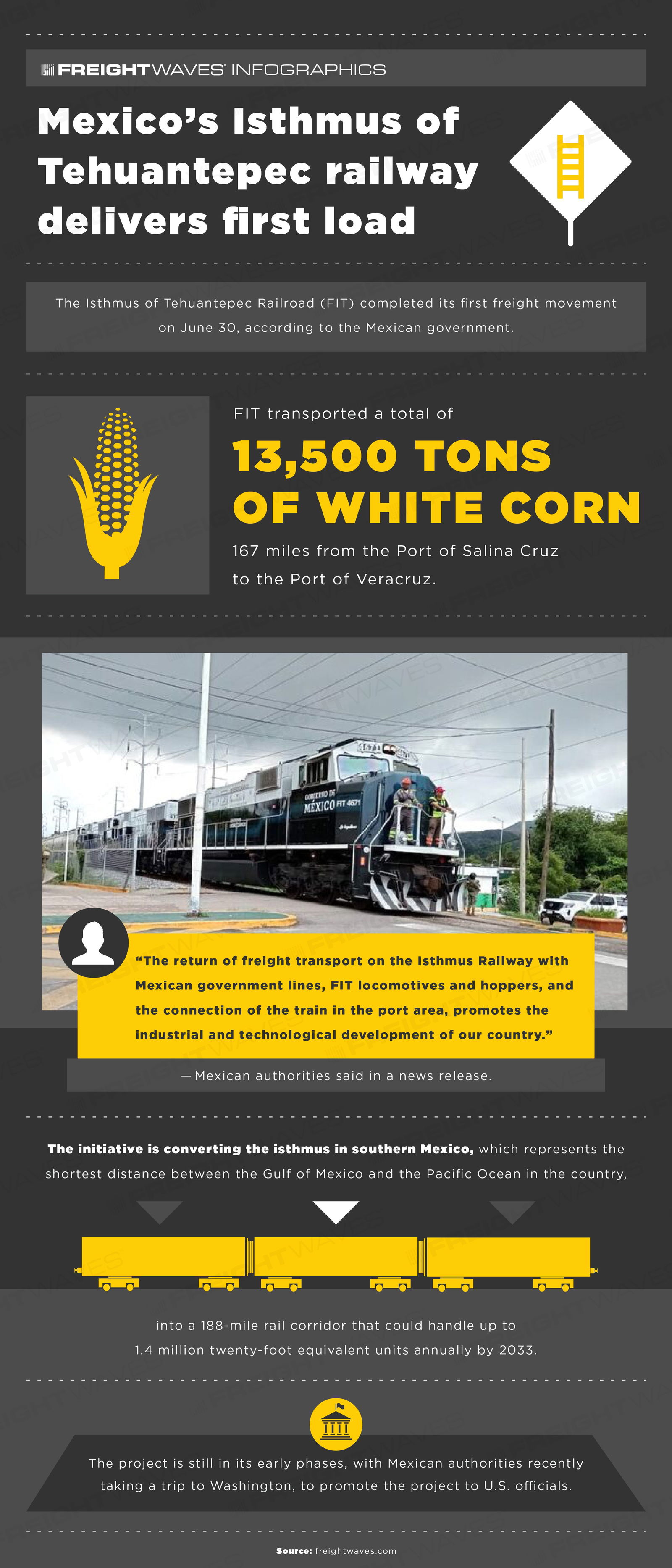
FreightWaves Infographics: Mexico’s Isthmus of Tehuantepec railway delivers first load


To view more FreightWaves infographics, click here

FreightTech Friday: p44 offers eBOLs for all LTL shipments

Visibility provider project44 announced it has implemented automatic electronic bills of lading for all of its less-than-truckload pickup requests as the LTL industry looks to expedite industry adoption of the National Motor Freight Traffic Association’s (NMFTA’s) eBOL standards.

“We are proud to contribute and continue to lead LTL API innovation, which includes eBOL,” Jett McCandless, founder and chief executive officer, told FreightWaves in an email. “We are thankful for the many carriers, LSPs and shippers that are committed to and continue to support this innovation.”

NMFTA’s Digital LTL Council has been pushing for standardized eBOLs to improve supply chain fluidity in the LTL industry. It has been developing API standards for the initiative since 2019.

The new standard aims to streamline communication, reduce errors and accelerate confirmation times. With a pledge deadline of July 20, 2024, the council anticipates industrywide adoption, driving significant operational benefits.

Project44 has hit that pledge deadline early, by 18 days, and has built its eBOL deliveries to allow LTL customers to use the technology without creating an additional API endpoint.

“Project44 has launched numerous successful betas to prove this level of standardization is possible and has value for both shippers and LTL carriers. … For a limited time, we are not charging for eBOLs to help continue accelerating industry adoption,” said Andy Grygiel, chief marketing officer.

The company has found cost savings for those who have adopted the NMFTA standard.

“Our analysis shows that LTL carriers can save $3-8 per shipment,” Grygiel said. “LTL carriers are also using eBOL adoption to drive strategic partnerships and pricing in general. We’ve heard directly from our strategic carrier partners that they will offer better rates for shippers who align with this approach. Additional savings come from efficiencies in [pickup and delivery], linehaul planning, reduced manual billing, improved invoicing accuracy and better customer service.”

Adopting these practices also aligns with project44’s sustainability goals, eliminating a large amount of wasted time and paper used in traditional BOL practices, which could lead to $470 million in savings for the LTL industry. 

Project44 has offered ocean emissions visibility for the past two years and added truckload emissions visibility earlier this year, now available in both North American and European truck markets.

“We are continuing to innovate in sustainability and will soon be offering LTL emissions visibility, a commitment to offering emissions monitoring for all modes. We have customers ready to use this product, including a global automotive leader,” said Grygiel.


Brief Bytes

AutoScheduler.AI, a warehouse management platform, announced Thursday a $6.5 million investment from Noro-Moseley Partners to fuel technology advancement and growth. The company recently launched AutoPilot Central, offering a comprehensive overview of multi-site data for centralized management. This enables executives to spot potential issues, assess shipment risks, and take proactive measures. The funds will improve AutoScheduler’s solutions, expand its team, and broaden its market reach.

Goodyear (NASDAQ:GT) recently introduced its Tires-As-A-Service solution, integrating premium tires, predictive insights and service networks into a subscription-based model. Targeted at commercial and last-mile delivery fleets in the U.S. and Europe, this service aims to improve total cost of ownership by outsourcing tire management and benefits including increased uptime, reduced vehicle breakdowns and lower fuel consumption. According to the company, recent pilots showed significant reductions in emergency breakdowns and inventory costs for fleets.

ODeX, a documentation and fintech platform for ocean freight shipping, announced it has expanded its services to Malaysia. The company currently services freight forwarders, carriers and customs in countries including the U.S., India, the United Arab Emirates, Ghana, Qatar, Bahrain, Kuwait, Nigeria, Senegal, Singapore and South Africa. Learn more about ODeX’s work from past FreightWaves coverage here.


FreightTech Friday: Japan’s proposed conveyor-belt highway

FreightTech Friday: Verified Carrier talks vetting tech

FreightTech Friday: Learn to Win raises $30M, captures the industry’s attention

Bid to block Biden independent contractor rule moves to federal appeals court

A case seen as the trucking industry’s primary legal assault against the Biden administration’s new independent contractor (IC) rule is now before the U.S. Court of Appeals for the 5th Circuit.

A group of Louisiana trucking companies and the state’s primary trucking association filed the initial lawsuit in the U.S. District Court for the Eastern District of Louisiana. The lead plaintiff is family-owned Frisard’s Transportation; the others are A&B Group, Triple G Express and the Louisiana Motor Transport Association.

The defendants are the U.S. Department of Labor (DOL) and several named individuals. They include Acting Secretary of Labor Julie Su, a Californian who is viewed as something akin to public enemy No. 1 by those who are pushing back against state and local efforts to make it more likely that a legal process would find a worker to be an employee rather than an IC.  

But the key indicator of the importance of the case is not the plaintiffs but the organizations that have filed friend-of-the-court briefs in support of Frisard’s and the other companies and associations. The lengthy list includes the American Trucking Associations, the National Retail Federation, the U.S. Chamber of Commerce and such free market advocacy groups as the Manhattan Institute. 

The plaintiffs requested a preliminary injunction at the District Court level to block implementation of the DOL’s IC rule, which went into effect in March after its final wording was announced in January. The Frisard’s suit was filed in February. After the injunction was denied, the plaintiffs quickly filed an appeal with the 5th Circuit asking that it override the lower court and issue the injunction.

All action on hold in lower court

That led Judge Eldon Fallon of Louisiana’s Eastern District, who had refused the injunction request, to put a stay last week on any other proceedings in the case at the District Court level until the 5th Circuit rules on the injunction. While the stay is in place, the case is “administratively closed,” meaning there won’t be any required filings.

The filings in the Frisard’s case spell out the arguments that opponents of the IC rule are making not just in court but also in comments during the rulemaking process and in trying to sway public opinion. 

The irony is that it is a great deal of effort and litigation for a rule on IC classification that could get dumped by an incoming Trump administration, just as the IC classification rule implemented by Trump’s DOL in its final days was dropped, albeit more than three years into the Biden administration.

The Biden administration tried to reverse the Trump rule almost immediately, but a court swatted down that attempt.

Under a new Trump administration, any attempt to swap out the Biden IC rule for the rule from the first Trump administration may also need a full rulemaking, which could mean the Biden rule would not necessarily expire near the start of a new Trump administration. 

Differing views of “economic realities”

Both the Biden and Trump IC rules have at their root the “economic realities” test, which has been a part of independent contractor law for years.  

The Biden administration rule has six tenets of its economic realities test, all echoing other aspects of IC law and case law.

The law firm of Carlile Patchen & Murphy summarized them in a blog post as “the opportunity for profit or loss depending on managerial skill; investments by the worker and the potential employer; degree of permanence of the work relationship; nature and degree of the potential employer’s control;’ extent to which the work performed is an integral part of the potential employer’s business; and skill and initiative of the potential independent contractor.”

Tthe Trump rule relied on five factors. Quoting from an earlier court precedent, the rule described them as ‘‘degrees of control, opportunities for profit or loss, investment in facilities, permanency of relation, and skill required in the claimed independent operation.’’ 

There are two obvious differences between the two rules. The Biden administration rule, on top of the five Trump rule factors, brings in the issue of the work being performed as an “integral part of the potential employer’s business.”

The second significant difference is that the Trump rule singled out the issue of control and the opportunity for profit or loss as being more “dispositive.” The Biden rule does not put any of the six above the other in setting the guidelines that the DOL’s Wage and Hour Division — which enforces the Fair Labor Standards Act — should use in determining whether a worker is an employee or a legitimate IC.

The brief filed by the ATA and other plaintiffs described the Biden administration approach as a “novel, multifactor standard that has never been applied by any court.” And in criticizing the test of whether a worker is “integral,” the plaintiffs’ brief cites a judge’s comments from an earlier precedent: “Everything the employer does is ‘integral’ to its business — why else do it?”

The government’s brief in the case makes several arguments, criticizing the Trump rule — which is referred to only as the 2021 rule — and its two “core factors” as reflecting “a departure from the analysis established by decades of judicial precedent.”

“The Department [in setting the Biden rule] determined that these changes would have a confusing and disruptive effect on workers and businesses alike and were contrary to longstanding precedent and the text of the [Fair Labor Standards] Act as interpreted by courts.”

These and other arguments are now sidelined while the 5th Circuit decides whether to grant the injunction.

More articles by John Kingston

NFI CEO Brown absent from arraignment of co-defendants due to lawyer conflict

Werner battling unions on 2 fronts; 1 fight may have broader significance

California trucking industry backs curbs on PAGA citizen-initiated labor lawsuits

Ex-Slync CEO Chris Kirchner sentenced to 20 years in prison

Ex-Slync CEO Chris Kirchner was sentenced to 20 years in federal prison Thursday in the U.S. District Court for the Northern District in Fort Worth, Texas.

In his ruling, U.S. District Court Judge Mark T. Pittman also ordered Kirchner, 36, of Westlake, Texas, to pay over $65.4 million in restituion and recommended to the Bureau of Prisons that Kirchner be able to participate in its Inmate Financial Responsibility Program. The judge also seeks to have Kirchner be incarcerated at a facility near the Dallas, Fort Worth area, if possible.

Once released from prison, he will serve three years of supervised release. 

What happened?

Kirchner has remained in custody since a jury found him guilty of four counts of wire fraud and seven counts of money laundering following a four-day trial in January. Pittman denied his motion seeking bail until sentencing. Kirchner was facing a maximum prison sentence of 150 years.

Prior to sentencing, Kirchner’s federal public defenders filed two motions to withdraw as counsel, which the judge denied. According to court filings, since being found guilty in January, Kirchner allegedly told his legal counsel that he intended to “represent himself for the remainder of this criminal action.”

On June 24, Kirchner indicated that he disagreed with his legal team’s strategy and “wished to terminate their relationship if [his] strategy was not followed.” Later that week, Kirchner refused to see his attorneys “indicating further his intention to either retain [counsel] or represent himself,” the motion stated.

Lavish lifestyle

The jury found that Kirchner, who served as Slync’s CEO from 2017 until he was fired by the FreightTech company’s board of directors in August 2022, defrauded investors out of nearly $25 million for his own personal use. Before his firing, sources told FreightWaves that Kirchner had come under scrutiny after he failed to pay employees for months, used his private jet to fly to celebrity golf tournaments and attempted to buy an English soccer team. 

Under Kirchner’s leadership, Slync, which was once valued at $240 million, raised nearly $70 million, including the $60 million Series B funding round that closed in February 2021 led by venture firm Goldman Sachs Growth, ACME Ventures, 235 Capital Partners, Correlation Ventures and other existing investors.

Soon after the company received the $60 million fund raise in 2021, court filings in a wrongful termination lawsuit by a former company vice president claimed Kirchner bought a 2010 Gulfstream G550 jet for $16 million. It has since been sold.

Former company executives who were fired by Kirchner said they never had access to the company’s accounts and brought their concerns to the board, stating that Kirchner was the only one with access to its investment account, which included the $60 million Series B funds.

Between April 2020 and March 2022, Kirchner initiated nearly 100 wire transfers, moving money from Slync’s Silicon Valley Bank account into the company’s account at J.P. Morgan Chase, an account only he had access to. Prosecutors claimed Kirchner used the funds to buy expensive watches and cars and to secure a luxury suite at the stadium of a Dallas-area professional sports team while Slync was struggling to make payroll in spring 2022. He even convinced at least four investors to wire Slync around $850,000 as part of a purported Series C investment round, which wasn’t authorized by the company’s board of directors.

While Kirchner, on behalf of Slync, initially blamed an internal administrative error — then later stated its payroll woes stemmed from its inability to liquidate funds in a timely manner —  investors, led by Goldman Sachs – agreed to inject more funding to pay U.S. and Canadian employees around $3.8 million.

After learning he was being suspended, Kirchner retaliated by locking some executives out of the company’s communication channels.

Kirchner, who had previously ordered the suspensions of nearly a dozen current and former employees for speaking out about the Dallas-based logistics tech startup’s failure to make payroll, was placed on leave in late July 2022. Prosecutors alleged he attempted to delete nearly 18 gigabytes of Slync data, including emails. 

Despite receiving an additional $24 million cash infusion from Goldman Sachs in February 2023 to help the logistics platform stay afloat, Slync was forced to seek an alternative option to a traditional bankruptcy and wind down operations in October 2023.

Three weeks before the Slync bankruptcy filing, Kirchner filed suit in September 2023 against his former employer for legal fee advancement and indemnification in Delaware’s Court of Chancery.

Kirchner sought to have Slync pay his legal bills in his fraud case after his assets were frozen. 

Do you have a news tip or story to share? Send me an email or message @cage_writer on X. Your name will not be used without your permission.

EPA taking comments on California waiver for Advanced Clean Fleets rule

Comments on California’s Advanced Clean Fleets (ACF) rule and the state’s waiver request to let it implement the rule are being taken by the Environmental Protection Agency.

A virtual public hearing on the issue is set for Aug. 14 at 10 a.m., according to an announcement from the EPA. 

Comments are being taken at the federal government’s portal for that purpose: regulations.gov. The docket number for the case is EPA-HQOAR-2023-0589.

The ACF rule was to have taken effect Dec. 31, 2023. It is a mandate promulgated by the California Air Resources Board (CARB) on the purchasers of trucks. Its sister regulation, the Advanced Clean Trucks rule, directs original equipment manufacturers (OEMs) on what types of trucks they can deliver into the California market. Advanced Clean Trucks received a waiver from the EPA in March 2023.

Most of the mandates of the ACF were to be rolled out over almost 20 years. But one key rule would have gone into effect at the start of 2024: the requirement that no drayage trucks with an internal combustion engine could be registered with the state starting in January.

California has always been granted a special status under the Clean Air Act given its unique geography and size. Under that status, it can implement requirements more stringent than those of the Clean Air Act, as long as it gets a waiver.

During the process leading up to the approval of the ACF, the state repeatedly said its interpretation of the Clean Air Act, and the provisions of the ACF, meant it didn’t need a waiver.

But last October, the California Trucking Association filed suit in U.S. District Court for the Eastern District of California, arguing that CARB did need a waiver. In December, CARB filed a request with the EPA for a waiver and put enforcement of ACF on hold

In the interim, there have been two significant legal developments. First, the closely watched Ohio vs. EPA case in the U.S. Court of Appeals for the District of Columbia upheld the right of the EPA to grant environmental waivers. Two trucking-related groups — the Owner-Operator Independent Drivers Association and the Western States Trucking Association — filed friend-of-the-court briefs, siding with Ohio in its argument that the ability of EPA to grant waivers should be reined in. 

And 17 states filed suit in federal court in California, with CARB Executive Officer Steven Clift as the defendant, against the ACF rule. 

Those states fear the possible export of California’s rules to the rest of the country, just because of its sheer size. The scenario they envision is that trucking companies and manufacturers will only want to drive or produce trucks that meet California’s standards even outside the state. As the lawsuit said, “By leveraging California’s large population and access to international ports on the West Coast, Advanced Clean Fleets exports its ‘in-state’ ban nationwide, creating harms which are certain to reach Plaintiffs’ States.”

With the ACF rule on hold while California’s waiver request makes its way through the federal bureaucracy, drayage trucks with internal combustion engines can be registered with the state.

However, state officials have suggested there might be a retroactive need to remove ICE drayage vehicles if the ACF waiver were granted.

The Port of Long Beach publishes a report on its website each month with data on operations. One data point in the report: the number of zero-emission drayage vehicles registered to operate in the port. 

The data can be interpreted multiple ways.

The pro-ZEV crowd might say that even in the absence of the ACF mandate, ZEV vehicles rose from 198 in December to 307, an increase of 55%. 

Those who are against the ZEV mandate specifically at the ports or for the broader fleet, which CARB calls the “high priority” fleet, could say that the mandate is only in hibernation, not gone, and that ZEV vehicles, even with all sorts of incentives for purchases, only made 1.48% of the truck moves at the Port of Long Beach in May.

More articles by John Kingston

NFI CEO Brown absent from arraignment of co-defendants due to lawyer conflict

Werner battling unions on 2 fronts; 1 fight may have broader significance

California trucking industry backs curbs on PAGA citizen-initiated labor lawsuits

CSX joins RailPulse telematics joint venture

This story originally appeared on Trains.com

JACKSONVILLE, Fla. – CSX has become the fourth Class I railroad to join RailPulse, the telematics joint venture that aims to put GPS equipment and sensors on freight cars to monitor their location and health in real time.

The announcement, made today, leaves BNSF Railway and Canadian National as the only major systems sitting on the sidelines.

“Joining the RailPulse Coalition further enhances our unwavering commitment to generate long-term value for our customers, employees, and community partners,” Steve Fortune, CSX executive vice president and chief digital and technology officer, said in a statement. “Collaborating with industry leaders through this initiative aligns with our vision to focus on service, environmental sustainability, and safety while enhancing our customer experience and providing benefits to the entire supply chain.”

The founding members of RailPulse include Norfolk Southern, shortline holding companies Genesee & Wyoming and Watco, railcar leaser GATX Corp., and car manufacturer and leasing company TrinityRail.

The coalition — which now includes Canadian Pacific Kansas City, Union Pacific, shortline operator Railroad Development Corp., and car manufacturer The Greenbrier Companies, and shipper Bunge North America — aims to make RailPulse the industry standard for rail shippers and car owners.

RailPulse says the real-time telematics data will improve service, freight car visibility, safety, and productivity.

“We are delighted to welcome CSX to the RailPulse Coalition,” RailPulse General Manager David Shannon said in a statement. “Together, we will drive innovation and transformation in the rail sector by combining our strengths and fostering a culture of innovation. This partnership underscores our commitment to shaping the future of rail transportation.”