White Paper: State of the Industry – April 2024

The April 2024 “State of the Industry Report” — presented in affiliation with Ryder — shares an in-depth overview across the trucking, maritime and intermodal markets, as well as what to expect in the coming weeks. The data contained within the report provides breakdowns of capacity, volumes and rates as we enter into the first quarter.

In this report, you will find:

  • The intermodal market continues to show volume growth, but much of the growth is driven by international intermodal volume.
  • The maritime market continues to rebound from the Lunar New Year and container ship executives are expecting an earlier than normal peak season.
  • The Federal Reserve continues its wait and see approach when it comes to cutting interest rates as recent inflation readings have been higher than expected.
  • Businesses are cautiously optimistic about the next six months, expecting conditions to improve in the back half of the year.

Download the complimentary report today to access the full insights.

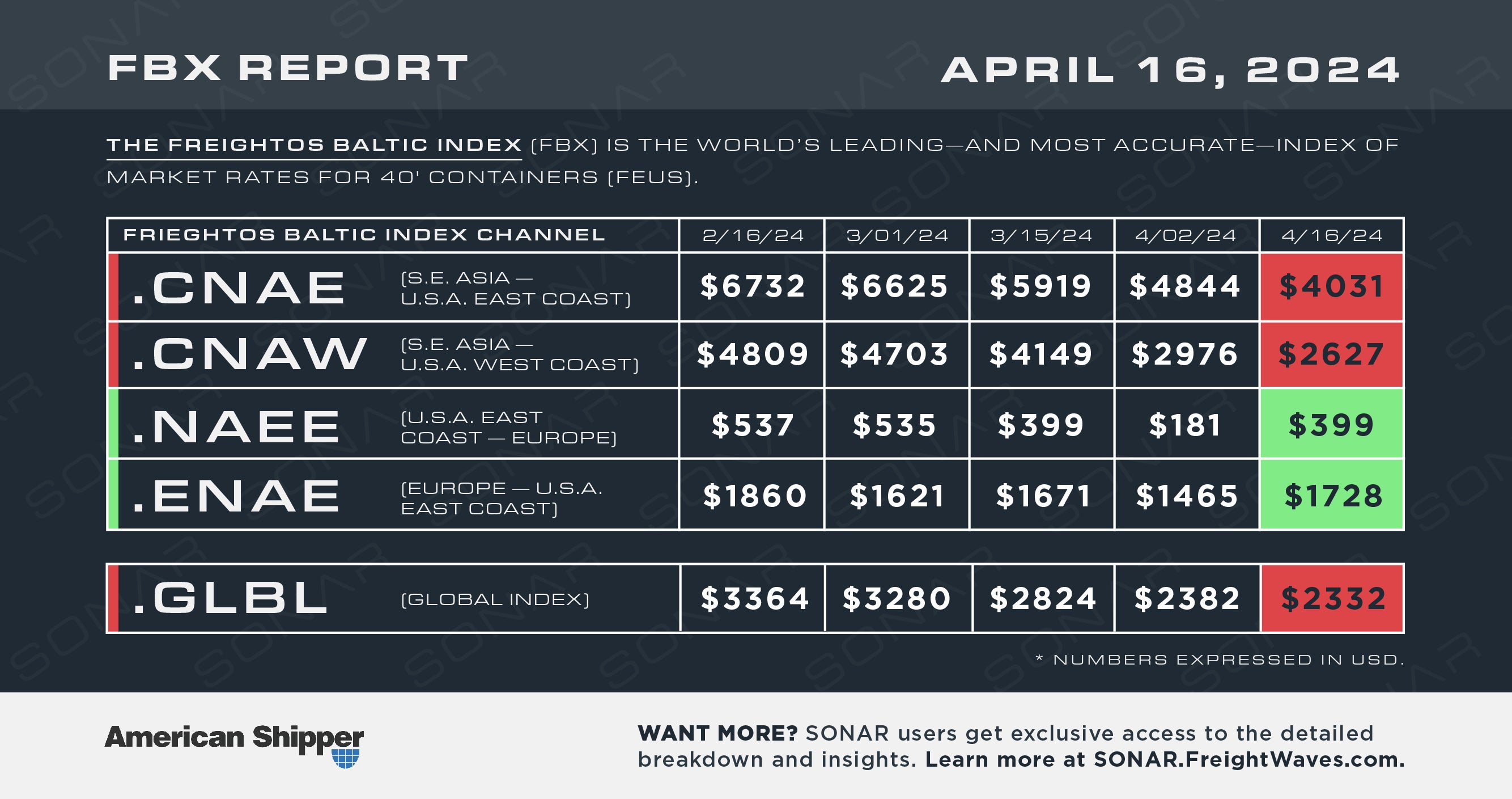
FBX Report: April 16, 2024


To learn more about FreightWaves SONAR, click here.

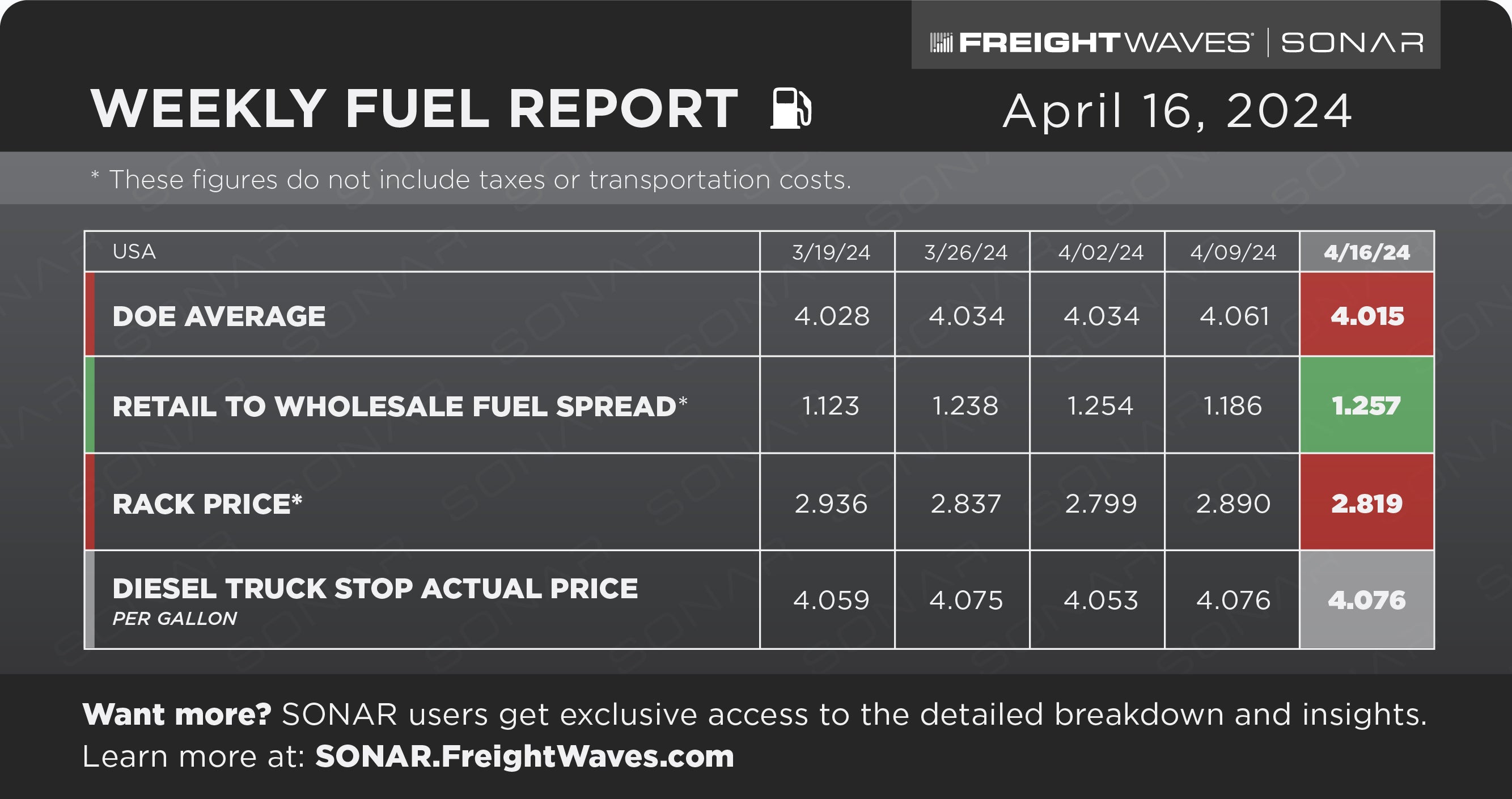
Weekly Fuel Report: April 16, 2024


Learn more at SONAR.FreightWaves.com

Scopelitis seminar delves into lease purchase deals, M&A, ESG and more

(Editor’s note: The article has been amended to reflect a less specific number of new driver hires each week at Schneider. A Schneider spokeswoman contacted FreightWaves to clarify that Schneider’s new weekly hiring numbers are in the hundreds but not as specific as what was originally reported).

INDIANAPOLIS — The Scopelitis Transportation Law Seminar is a three-day parade of speakers and panels discussing everything from what states’ license plates fleets should seek to slap on their trucks to the treatment of owner-operators whose trucks leave the road for maintenance. The gathering examines hundreds of legal situations fleets might face.

Here are five takeaways from the multitude of subjects the seminar covered.

The growing focus on lease purchase agreements

The ongoing task force created by the Federal Motor Carrier Safety Administration to study — investigate? — lease purchase agreements had a recent and largely negative moment in the sun with a public hearing at the Mid-America Trucking Show. Sentiment from panelists at the current Scopelitis seminar has so far not generally been supportive of the contracts, which are seen as either a pathway to truck ownership or an oppressive way fleets secure capacity from drivers who need to work endlessly to stay afloat.

Jeffrey S. Jackson, a Scopelitis partner, said in a short presentation that the deals are “very, very common in the industry for sure, although it’s not nearly as common for them to be handled correctly.”

“Oftentimes, folks will see lease purchase programs as kind of an automatically safe way to create more and more operators,” Jackson said. “But the truth is really much more complex than that.” As far as a method of securing capacity, Jackson described lease purchase deals as “not an answer.” Rather, they are a “potential business solution” to recruitment challenges.

Jackson said the focus for fleets should be to avoid getting situations where the lease purchase deal results in a misclassification action against them either by a government agency or in a lawsuit by a disgruntled driver. One suggestion: A fleet should not do its own lease purchase deals. It should hire a third-party provider of the contractual arrangement.

The big orange company doesn’t see a driver shortage

A notable moment came during a fireside chat at Monday’s lunch session. Chris Spear, president of the American Trucking Associations, sat next to Thomas Jackson, general counsel of Schneider National (NASDAQ: SNDR). Spear and the ATA have been the loudest promoters of the view that there is a driver shortage.

But Jackson begged to differ. “We don’t see the driver shortage,” he said, turning to Spear. “We believe that truck driver hiring and retention follows freight markets.” And now, with a weak freight market, Jackson said, “we’re not having a problem hiring drivers.” Schneider does so at a clip of new drivers every week that are measured in the hundreds.

That doesn’t mean it isn’t a challenge. Jackson talked about three recent departures, all of whom joined private fleets. “They’re home every night, they have a regular schedule and private fleets pay more than commercial fleets,” he said.

Drivers “want to be home at night with their families, and they want to be paid,” Jackson said.

From left to right: Chris Spear, ATA; Thomas Jackson, Schneider National;

Mike Kneller, Landstar; Anthony Spalvieri, FedEx; Greg Feary, Scopelitis

More inspections by FMCSA

Stephen Keppler laid out a lot of numbers about safety, and they all pointed to higher crash and death rates. One thing that that has led to is more inspections by FMCSA and, in particular, more inspections on-site to reverse an earlier trend that has proved less valuable.

“FMCSA had done some analysis indicating, well, the off-site inspections are actually pretty good,” said Keppler, a co-director of Scopelitis Consulting. “They’re helping us conserve resources, save time and money, and we can get more of them done.”

But he said that is not the case. “The reality is, they’re not as effective as they were when you look at the data,” he said. “They were not finding as many critical violations.”

The result has been the  shift in recent years toward on-site inspections. The frequency of inspections has increased by the thousands since 2020, Keppler said, with much of that coming in more on-site inspections.

Keppler said inspections are “more comprehensive and more focused.” FMCSA is taking more enforcement actions and assigning more negative ratings as a result of these investigations, he added.

The cautious market for M&A

If there’s a discussion about mergers and acquisitions in the logistics industry, the conversation isn’t complete unless Spencer Tenney of Tenney & Co. is in the mix. And he was on a panel at the Scopelitis seminar that took up the subject.

“What you probably won’t see in the next year are these large, industry-shaping, transformational deals,” Tenney said, adding that there is “still a tremendous amount of activity in engagement.” He echoed a common theme from recent discussions about M&A: that the sharp rise in valuations during the strong freight market of 2021 and into 2022, followed by a sharp decline, has left both sides of the equation shell-shocked. Some sellers wanted to exit the market in 2020 but “got caught up in the cycle” and didn’t sell.

“Now what we’re seeing is not an ideal market but certainly a much more stable environment than we saw six to 12 months ago,” Tenney said. But a problem is that “strategic buyers,” who would acquire a logistics company to combine with existing logistics assets, are facing an average cost per mile per truck that has risen in excess of 21% in the past year, he said. “That’s not something you can absorb or offset organically.”

The result then, according to Tenney, are deals with “a tremendous amount of structure being used to align goals for both buyers and sellers.” And while some sellers might not be crazy about that reality, presumably preferring cash transactions, Tenney praised the “open-mindedness that we’re seeing both from buyers and sellers to get deals done in this environment.”

Is ESG a thing in trucking?

On the Monday lunch panel were representatives of two publicly traded companies: Schneider’s Jackson and Mike Kneller, the general counsel of Landstar (NASDAQ: LSTR). Not surprisingly, their view on the impact of environmental, social and governance standards — ESG — might not line up with those of some smaller companies.

Because Landstar is publicly traded, Kneller said, “we have the ESG element to be concerned with in terms of how our investors perceive us.” He said Landstar goes so far as to publicly release its Scope 3 greenhouse gas emissions numbers, which the Environmental Protection Agency defines as “the result of activities from assets not owned or controlled by the reporting organization, but that the organization indirectly affects in its value chain.” For Landstar, those emissions are two steps away from the company itself.

That drew a response from Jackson: “Did I understand you correctly that you publish your Scope 3 emissions?” he asked, signaling that it isn’t the norm.

Landstar discloses them even though the Securities and Exchange Commission has backed away from requiring that disclosure.

Kneller said the governance portion of ESG is not an issue for Landstar, a statement most companies might make about themselves. The social and environmental components “are where there’s a little bit more discussion,” he added. And regarding those activities, the discussion mostly focuses on climate change and emissions, according to Kneller.

Landstar has 25,000 customers, he said, and the vast majority don’t care about the company’s ESG ratings. But the ones that do, he added, are “our largest, most sophisticated multinational customers: the ones that are often are European-based or they are multinational based in the U.S.”

More articles by John Kingston

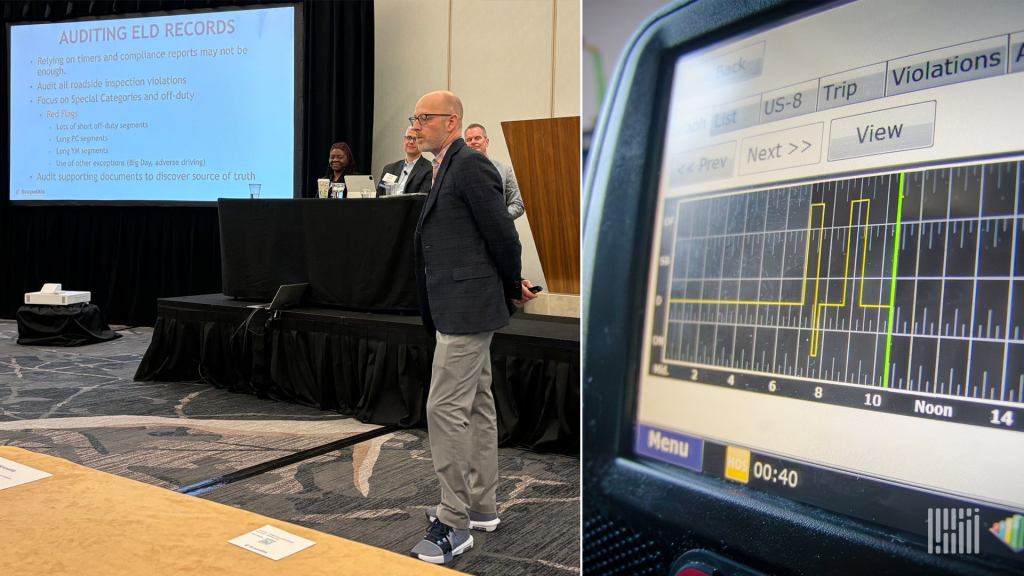
Scopelitis co-director: False hours-of-service log reports rise despite ELDs

CTA, OOIDA to appeal court decision upholding AB5 in California trucking

IEA: Can diesel keep dodging big impacts from attacks on Russian refineries?

Scopelitis co-director: False hours-of-service log reports rise despite ELDs

INDIANAPOLIS — The full implementation of the federal ELD rule dates back to December 2019, but that hasn’t stopped hours-of-service violations from racking up, P. Sean Garney noted in a presentation at the Scopelitis Transportation Law Seminar.

The working theory always was that the tight, immutable data on HOS generated by an ELD would reduce the frequency of violations. The record spelled out by Garney on Sunday, the first day of the seminar, shows mixed results. 

Garney is the co-director of Scopelitis Transportation Consulting, an arm of the Scopelitis law firm, which produces the legal seminar every few years.

He said the road to HOS violations generally runs through two pathways: questionable use of the personal conveyance provisions of the HOS rule and the “yard rule” that allows drivers to be behind the wheel but considered off duty while moving a truck within a defined company-owned area.

Regulators handed down $1.7 million in penalties for individual HOS violations last year, according to Garney, but it wasn’t a case of a handful of companies getting hit with a few big penalties. His numbers did not include those in which HOS violations were part of a larger filing of violations levied against a fleet; the biggest fine he found in 2023 was $40,000.

Garney’s data showed a 2.8% decrease between 2018 and 2023 in violations of the rule that allows only 14 hours of consecutive service after coming on duty and a 25% increase in violations of the HOS rule that allows only 11 hours of driving within that 14-hour period. But during that time, there’s also been a 137% increase in false log violations, he said.

Mistakes don’t equal a false log

A mistake in a log is not necessarily a false log. “In order to be false it is that the accuracy must disguise that the driver went past 11 and 14 hours,” he said.

“If your log is just inaccurate, that’s just sort of a failure to prepare,” Garney said. It isn’t a false log.

“So the question is, where do our false log violations exist?” Garney said. “One of the first places I like to look at are yard moves and personal conveyance.”

Garney put both violations under the category of “false logs.”

The tricky nature of defining personal conveyance, which Garney called an “ugly animal that we try to deal with as best we can,” is not new; it was the subject of an industry discussion back in 2018, more than a year before the ELD rule went into effect. And the Federal Motor Carrier Safety Administration has attempted to clarify some of the guidelines that establish what is legitimate personal conveyance.

Personal conveyance is defined by FMCSA as “the movement of a commercial motor vehicle for personal use while off-duty. A driver may record time operating a CMV for personal conveyance as off-duty only when the driver is relieved from work and all responsibility for performing work by the motor carrier.’

Operational readiness is key

Garney said defining personal conveyance has one overriding guideline: It “is not enhancing the operational readiness of the vehicle. And this is a hard and difficult thing to think about and monitor the way I’ve seen it enforced.”

Garney discussed a situation in which an inspector finds that the direction that the driver had moved his or her commercial vehicle is “substantially in the direction of the next move.” Even if it can be argued that the move recorded as personal conveyance was for a legitimate move toward the driver’s home, Garney said, inspectors would be likely to see that as abuse of the personal conveyance provisions of the HOS rule.

Personal conveyance “is going to be one of the first places inspectors are going to look at,” he said. “I would strongly encourage you, if you allow personal conveyance, to keep a close eye on what’s happening here.”

Complicating the issue is that fleets have different policies on personal conveyance. “There are carriers in this room who definitely don’t allow it, and there are carriers in the room that will say if I don’t do it I will lose all my drivers, so I go along,” Garney said. “So what do you recommend?”

Praise for the way Canada does it

Garney noted that the Commercial Vehicle Safety Alliance has called on FMCSA to more clearly define what constitutes personal conveyance, possibly along the lines of Canada’s more specific rules.

“They’ve consistently been turned down, so FMCSA has not yet been willing to do that,” Garney said.

Canada deals with defining personal conveyance by setting specific hours and miles that can be claimed as personal conveyance.

Garney expressed frustration with U.S. rules are far more vague. “FMCSA didn’t do anybody any favors by not defining personal conveyance in the regulations and just issuing guidance,” he said.

Questions from the audience were highly specific. One person asked whether a truck being moved to a repair facility can be considered personal conveyance. Garney’s conclusion: “My understanding is that you cannot use personal conveyance for that because you are enhancing the operational readiness of that vehicle, and that was specifically called out by FMCSA.”

Timothy Wiseman, who sat on the panel with Garney to kick off the three-day Scopelitis conference and is a partner at the firm, noted that HOS regulations can’t deal with all situations resulting from a tired driver, even if the person behind the wheel is complying with the rules.

Wiseman said the Walmart driver who crashed into comedian and actor Tracy Morgan in 2014 had already been driving several hours in a personal vehicle before taking the wheel of his company truck. “So I think when you’re talking about personal conveyance, you need to say, OK, is it legal?” Wiseman said. “And if it is, is it safe? Do you still want this driver knowing that he’s going to drive five hours before even starting his shift with us, even though it’s off-duty driving?”

Yard movements, too, are not well defined under the HOS rule, according to Garney. He said FMCSA did proposes guidance on more tightly defining yard movements several years ago, but “please don’t ask me when they’re going to finalize this because I have asked them 50 times and it’s just not really strongly on their radar.”

What should a fleet do to avoid getting hit by HOS violations that accumulate because of abuse of the personal conveyance or yard rule loopholes? Garney laid out several things to watch for, including “location, location, location.” For example, does the data show that an on-duty status lines up with where the previous on-duty status ended? Odometer readings are key to discovering that, he said.

Fleets should look for frequent use by a driver of the “safe haven” exception, which deals with parking a truck carrying hazardous materials, and the “adverse conditions” exception, Garney said.

“You just look at the log detail and you’re like, whoa, this guy claimed safe haven seven times this week,” he said.

Regarding adverse conditions, David Heller of the Truckload Carriers Association in a recent FreightWaves article cited a possible example as a truck stuck on the road to the closed Francis Scott Key Bridge soon after the bridge’s late-March collapse.

Another key indicator for rooting out personal conveyance abuse: fueling reports. Checking fuel consumption against claimed hours of service is “still very popular,” Garney said. 

More articles by John Kingston

Fired driver stung by Drive-A-Check report loses appeal in defamation case

Baltimore gets FMCSA waiver; timeline for first reopening is suggested

Truck lease purchase deals come under heavy fire at MATS and in court

97-year-old Illinois dairy forced into bankruptcy

A 97-year-old family-owned dairy that offers home milk delivery in glass bottles and operates over 40 ice cream and dairy stores in Illinois and Missouri recently filed for Chapter 11 bankruptcy protection.

Oberweis Dairy Inc., headquartered in North Aurora, Illinois, filed its petition Friday in the U.S. Bankruptcy Court for the Northern District of Illinois. 

In its filing, which seeks to reorganize and restructure the company, Oberweis Dairy lists both its assets and liabilities as between $10 million and $50 million and states it has up to 5,000 creditors. The company states that funds will be available for distribution to unsecured creditors.

Oberweis owes more than $4 million to the company’s top 20 unsecured creditors, including Nussbaum Transportation of Hudson, Illinois, owed more than $774,000; Greco & Sons, of Barlett, Illinois, owed nearly $722,000; and Penske Truck Leasing of Earth City, Missouri, owed more than $132,000. According to the petition, Oberweis Dairy also owes more than $173,000 to the Cook County treasurer’s office in Chicago.
Oberweis Dairy has been operating since 1927 when Peter J. Oberweis, a dairy farmer in Aurora, began selling extra milk to his neighbors from the back of his horse-drawn wagon, according to the company’s website.

The fourth-generation company is owned by the family of former Illinois state Sen. Jim Oberweis, who bought the company in 1986 and has served as chairman of Oberweis Dairy for 37 years.

Oberweis has been a fixture in Illinois politics. He served in the legislature from 2013 to 2021 and ran for the U.S. Senate in 2002 and 2004 and for governor in 2006. He lost in the Republican primary all three times. He also ran for Congress in 2008 but lost to Democrat Bill Foster. Oberweis again ran for election to the U.S. House for Illinois’ 14th Congressional District but lost in the general election in 2020, according to CBS News.

The petition lists Adam Kraber as president of the company. As of publication time Monday, Oberweis Dairy’s bankruptcy attorney, Howard L. Adelman, had not responded to FreightWaves’ request for comment.

The reason for the dairy’s bankruptcy was not immediately clear. Oberweis Dairy and traditional dairy products are facing growing financial challenges because of the rise of plant-based milks, such as almond, soy and oat milk, which have captured a growing market share, according to an article by news outlet Archyde.

According to Pitchbook, Oberweis received a $90,000 grant from the U.S. Department of Agriculture in December 2022. In April 2020, the company received a $5.67 million loan from CIBC Bank of Chicago through the U.S. Small Business Administration’s Paycheck Protection Program.

Do you have a news tip to share? Send me an email or message me @cage writer on X, formerly Twitter. Your name will not be used without your permission.


Former Tony’s Express workers, drivers say mismanagement sank company
Shuttered California trucking company files for bankruptcy
Illinois trucking company with 171 drivers files for bankruptcy

Estes to open at least 20 terminals this year

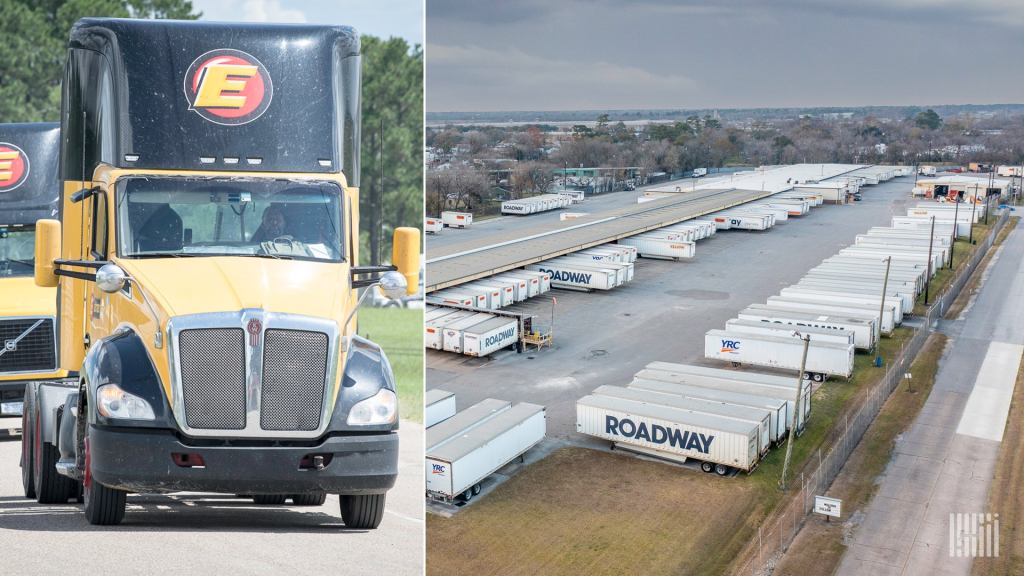
A split screen with Estes tractors and a YRC terminal

Less-than-truckload carrier Estes said Monday it has started opening terminals it has acquired from defunct Yellow Corp. as part of a “national expansion.”

The carrier acquired 24 service centers for $249 million at Yellow’s (OTC: YELLQ) first auction, which concluded in early December. It picked up five leased properties for $35 million at a second auction a couple of weeks later.

A more than $1.5 billion stalking horse bid from the company in September set the minimum valuation for Yellow’s real estate portfolio ahead of the auctions. That bid eclipsed an offer from rival carrier Old Dominion Freight Line (NASDAQ: ODFL).

Estes opened a 58-door terminal in Florence, South Carolina, last week. It also opened locations in Reno, Nevada (54 doors), and Cinnaminson, New Jersey (92 doors). The latter two properties were acquired from Yellow’s estate.

In total, Estes plans to open at least 20 terminals this year, the first eight by the end of June. The company will add locations in Tacoma, Washington; San Fernando Valley, California; Detroit; and Austin, Texas, among other areas this year, adding 985 doors to its network of more than 10,000 doors.

Estes has also added more than 130 tractors and 6,000 trailers, as well as other equipment, from Yellow’s former locations.

“These acquisitions represent the single biggest influx of terminals and equipment in Estes’ recent history,” said Webb Estes, the company’s president and chief operating officer.

Other carriers recently reopened former Yellow terminals.

Last week, XPO (NYSE: XPO) said it had opened three of the 28 locations it acquired from Yellow as part of an $870 million acquisition, and Saia (NASDAQ: SAIA) said it had begun the relaunch of the 28 locations valued at $244 million that it purchased from the estate.

“Acquiring these terminals was just step one — we’re now focused on putting them to work as quickly as possible to better serve our customers, which is exactly what we’re doing with these first ones,” said Carrie Johnstone, Estes’ vice president of customer experience and innovation.

More FreightWaves articles by Todd Maiden

FMC building case for new container data-sharing rules

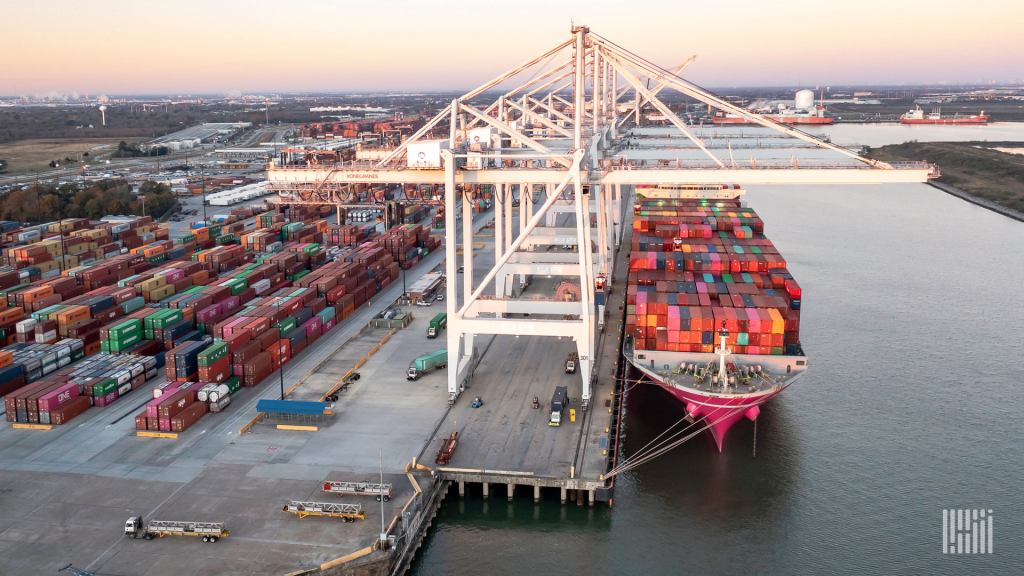
Container ship docked at port.

WASHINGTON — The Federal Maritime Commission is seeking another round of comments from container line operators and their customers as part of its quest to build the case for potential new mandates on container shipment data sharing.

The FMC wants to supplement an information request issued last year along with a May 2023 report on the agency’s Maritime Transportation Data Initiative (MTDI). That project, led by Commissioner Carl Bentzel, attempts to measure the extent to which shipment data is used and shared throughout the supply chain.

The information request is scheduled to be published Tuesday.

“While some key data elements are readily shared between supply chain participants, the lack of timely and accurate access to some data elements can lead to inefficiencies, as was seen during the COVID-19 pandemic,” the new information request states.

“Improved communication and data availability could ease the flow of data and potentially provide positive results including fewer and shorter duration instances of congestion, quicker movement of import and export shipments, assessment of fewer storage fees, and a reduction in non-government cargo holds thereby improving supply chain effectiveness and efficiency.”

Bentzel plans to use his initiative as the basis for a Maritime Transportation Data System to improve the accuracy and timeliness of estimated arrival times at container ports, and would include all intermodal cargo shipments in the U.S.

“I’m still in the convincing mode — there are some carriers who are hesitant to see any kind of a mandate,” Bentzel told FreightWaves earlier this month. “That’s why I’d like to continue to build a record to get this done.”

The FMC points out that the MTDI revealed that information on container pickup and return was difficult to gather accurately or to predict.

“MTDI participants cited challenges such as determining who should provide the information, information changing frequently, and changes not being conveyed to shipping entities,” the agency stated in the latest information request notice. “The Commission created the prior [information request] to understand some of the data challenges that entities throughout the supply chain face.”

Focusing specifically on data accuracy, the current information request is seeking responses to 25 questions, including:

For importers

  • What were the primary causes of penalty fees for missing a container pickup window?
  • How many days prior to the vessel’s arrival do you need the date to be finalized?
  • How often do you try to pick up a container that you believe is available, but it is not, and what are the most common reasons for this?
  • How often do you try to retrieve a container, but equipment such as chassis or rail service is not available?

For exporters

  • What were the main causes of penalty fees for missing a container return window?
  • How many days prior to the container return window do you need the ERD [earliest return date — the date before which exporters are not allowed to give a loaded export container to the ocean carrier] to be finalized?
  • How often do you attempt to export a container within what you believe to be the return window but you end up being too early or too late, and what are the most common reasons for this?
  • How frequently do you try to export a container but equipment such as chassis or rail service is not available, and what are the most common reasons for this?

For vessel and marine terminal operators

  • How do you communicate the vessel schedule and any changes regarding the schedule to the beneficial cargo owners (BCOs) and/or their agents?
  • What share of vessels change their schedule within the last week prior to arrival at a scheduled port?
  • What are the most common reasons for a vessel schedule to change?
  • What indicators can BCOs use to predict changes to vessel schedules?
  • What are the primary reasons for changes to ERD?
  • What share of ERDs change within a week prior to the window?
  • How do you access information related to the availability of intermodal rail services?

Click for more FreightWaves articles by John Gallagher.

CTA, OOIDA to appeal court decision upholding AB5 in California trucking

The California Trucking Association and the Owner-Operator Independent Drivers Association will appeal last month’s decision that rejected their latest attempt to block imposition of California independent contractor law AB5 on the state’s trucking sector.

The decision to appeal the ruling to the 9th U.S. Circuit Court of Appeals, filed Friday with the U.S. District Court for the Southern District of California, came as something of a surprise given the consensus in the trucking legal community that continuing the fight would be expensive and had limited chance of success.

CTA and OOIDA are appealing a decision handed down March 15 by District Court Judge Roger Benitez rejecting their request for a new injunction blocking AB5 enforcement in trucking. Benitez was the judge who handed down the initial injunction against AB5 on New Year’s Eve 2019, when the CTA was the sole plaintiff against then-state Attorney General Xavier Becerra. (OOIDA was added later as a plaintiff.)

The basis for that injunction was the judge’s view that the Federal Aviation Administration Authorization Act preempted AB5 because the latter rule was state action that could affect “prices, routes and services,” specifically blocked by the so-called F4A.

That decision was ultimately rejected by a three-judge panel of the 9th Circuit Court, review by the U.S. Supreme Court was denied in June 2022, and the case went back to Benitez’s courtroom.

Benitez rejected a new attempt by CTA and OOIDA to cite F4A as a reason for a new injunction, saying that issue had been settled by the appellate court. But he also rejected other CTA/OOIDA arguments, including a potential conflict between AB5 and the Dormant Commerce Clause of the Constitution, which regulates interstate trade.

He also rejected CTA/OOIDA arguments that AB5 denies the trucking industry the equal protection of the laws. The trade groups had cited statements by AB5 sponsor Lorena Gonzalez, a now former assemblywoman who was the driving force behind the law, as well as the many exemptions granted to various industries in AB5 itself and follow-up legislation.

At the Scopelitis Transportation Law seminar in Indianapolis, the president of the firm, Greg Feary, announced from the stage Monday the “breaking news” that the notice to appeal had been filed.

Feary found some statements in Benitez’s decision regarding the equal protection issue that he said might open the door to an appeal. “There may be a viable equal protection argument,” he said.

In response to a FreightWaves query, a spokeswoman for OOIDA said the group “respectfully disagrees with the legal basis for the decision issued by the District Court. OOIDA appeals this decision with the hope that the Ninth Circuit will agree with OOIDA and reverse it.”

FreightWaves had received no response from the CTA by publication time.

AB5 is a law governing independent contractor status in California. It was approved by the state legislature and signed by Gov. Gavin Newsom in 2019, taking effect Jan. 1, 2020.

At the core of it is the so-called ABC test to help determine whether a worker is an employee or an independent contractor. 

In particular, the B prong of the ABC test has the potential to create difficulties for the trucking industry. It says that a worker can be considered independent if he or she “performs work that is outside the usual course of the hiring entity’s business.” Trucking companies that hire independent owner operators to move freight could be viewed as in conflict with that and fear not just regulatory action against them but an inability to continue to use independent contractors.

More articles by John Kingston

Baltimore gets FMCSA waiver; timeline for first reopening is suggested

Truck lease purchase deals come under heavy fire at MATS and in court

Wisconsin court affirms Amazon Flex drivers were not independent contractors

March freight metrics flat with February, Cass data shows

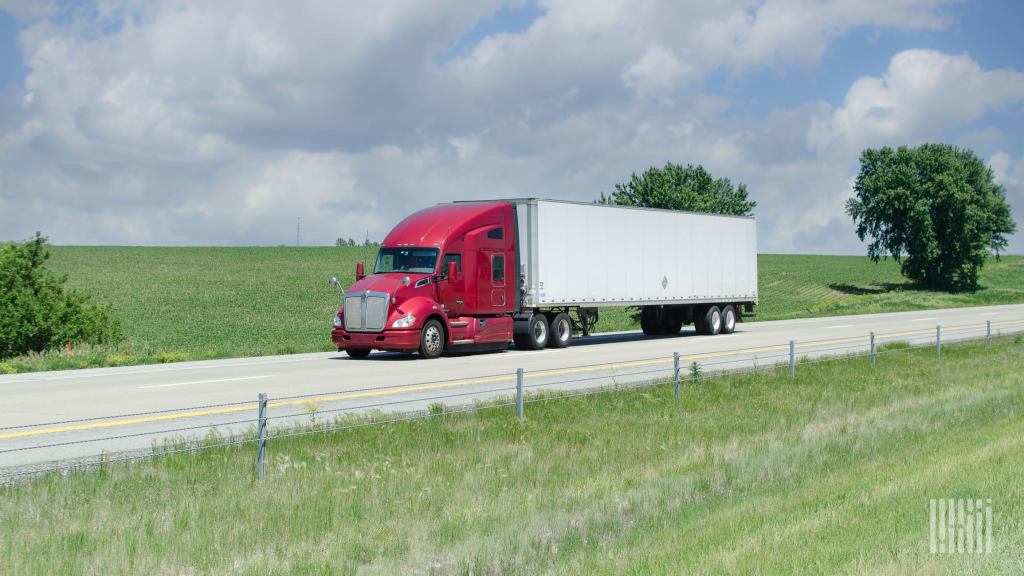
A red tractor with a white trailer on a highway

Freight shipments and expenditures in March were largely in line with February, underperforming normal seasonal trends, according to the Cass Freight Index published Monday. The year-over-year (y/y) declines in both data sets eased again during the month.

March shipments were down 2.3% seasonally adjusted from February and 3.6% from the same month last year. Without the seasonal adjustment, March volumes were down 0.2% sequentially. However, February did include one extra day this year.

The shipments index now sits 7.5% below the March 2022 level.

Shipments captured by the index, which is trucking-centric, increased approximately 2% seasonally adjusted from the fourth to the first quarter.

The Monday report pushed back the expectation for a positive volume inflection by one month. The index is expected to decline 2% to 3% y/y in April, turning positive by June.

March 2024
y/y

2-year

m/m

m/m (SA)
Shipments-3.6%-7.5%-0.2%-2.3%
Expenditures-18.5%-28.3%0.1%-1.3%
TL Linehaul Index-4.7%-13.8%0.2%NM
Table: Cass Information Systems (SA – seasonally adjusted)

Cass’ expenditures data set, which measures all dollars spent on freight (including fuel surcharges and accessorial charges), fell 1.3% seasonally adjusted from February to March and 18.5% y/y.

Netting out the change in volumes from the change in freight spend implies actual rates were down 15.4% y/y during the month. The subindex for implied rates has been down y/y by midteens to 21% for 10 consecutive months.

Compared to March 2022, total freight expenditures were down 28.3%. The data set is expected to fall 14% y/y in the first half of this year and 9% for the full year.

Cass’ truckload linehaul index, which excludes changes in fuel and accessorial charges, increased 0.2% sequentially and was down just 4.7% y/y. The y/y decline was the smallest since December 2022. The TL linehaul index captures changes in both spot and contract rates.

The subindex was down 13.8% on a two-year comparison but has been in a “very tight range” for the past nine months.

“With spot rates steady over the past several months, downward pressure on the larger contract market is lessening, with some instances of contract rate increases bucking the downtrend recently,” the report said.

Chart: (SONAR: NTIL.USA). The National Truckload Index (linehaul only – NTIL) is based on an average of booked spot dry van loads from 250,000 lanes. The NTIL is a seven-day moving average of linehaul spot rates excluding fuel. To learn more about FreightWaves SONAR, click here.

Cass’ March report closes out the first quarter on a down note. In recent weeks, equity analysts have been cutting expectations ahead of the first-quarter earnings season, which J.B. Hunt Transport Services (NASDAQ: JBHT) kicks off Tuesday evening. A tepid backdrop in the overall U.S. industrial complex alongside a massive overhang of available truck capacity appears likely to keep TL rates in check in the near term.

Data used in the Cass indexes is derived from freight bills paid by Cass (NASDAQ: CASS), a provider of payment management solutions. Cass processes roughly $40 billion in freight payables annually on behalf of customers.

More FreightWaves articles by Todd Maiden