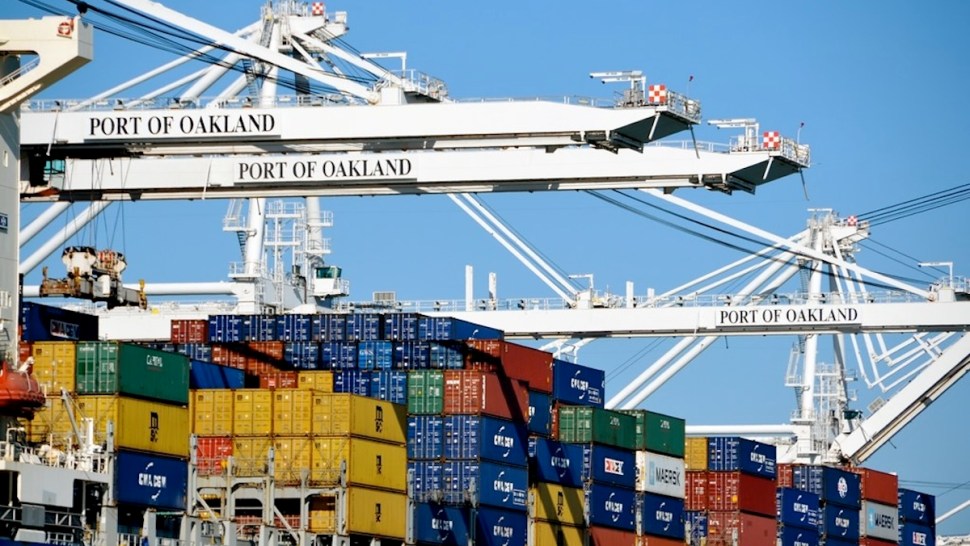
The Port of Oakland experienced a notable downturn in container traffic in June on shifting global trade dynamics and reduced demand.
Total volume dropped 10.1% compared to May’s figures, to 168,460 twenty foot equivalent units (TEUs). Year-on-year comparisons showed a 12.8% decline, from 193,158 TEUs in June 2024.
“This is not a seasonal dip, but a market recalibration,” said Port of Oakland Maritime Director Bryan Brandes, in a release. “Importers and exporters are adjusting their supply chain timing and routing decisions in response to evolving conditions.”
Cumulative container volume for the year remains resilient, up 0.6% y/y, to 1.14 million TEUs. This marginal rise, however, masks underlying shifts within specific categories. Loaded imports, accounting for 70,334 TEUs, saw a significant decrease of 11.3% compared to May and 16.3% from the prior-year period. Importers appear to be grappling with fluctuating trade policies and a downturn in consumer demand.
Loaded exports have not fared much better, recording a 1.3% year-over-year decline at 59,593 TEUs – a 10.3% dip from June 2024. This trend underscores the ongoing fragility in global markets, which continues to exert pressure on export activities.
Empty imports rose by 0.6%, suggesting that while inbound trade is sluggish, preparation for potential goods movement remains stable. Empty exports fell by 13.1%, a reflection of decreased outbound shipments.
A decline in June vessel calls further illustrates this trade shift, to 77 ship visits versus 87 in May and 86 in June 2024. However, a 1.6% increase in average TEUs per vessel highlights carriers’ adaptation through consolidation of freight, leading to fewer yet fuller voyages. This adjustment in service schedules demonstrates a strategic approach to optimizing efficiency against broader trade uncertainties.
In related news, on July 10 the Board of Port Commissioners certified the Environmental Impact Report for the proposed Oakland Harbor Turning Basins Widening Project. The project will enable Oakland to accommodate larger container vessels.
Find more articles by Stuart Chirls here.
Related coverage:
China could block sale of port terminals: Report
Amid uncertainty, sliding Asia-US container rates are a sure thing
Report: White House maritime chief leaving
Ports back bill to limit Customs charging for inspection services
Brokerage Compliance Symposium
The day before F3. Every compliance issue you face - fraud exposure, carrier liability, FMCSA rules, cargo theft, insurance gaps - navigated by attorneys and operators defining best practices in a changing industry.
F3 Awards Dinner
The night before F3. FreightTech100 companies honored. FreightTech 25 and Shipper of Choice winners revealed live. Cocktail reception into dinner and live music - 300 industry leaders in one purpose-built room.
F3: Future of Freight Festival
Industry-defining keynotes, rapid-fire technology demos, and industry leaders networking in experiences across Chattanooga - plus the inaugural F3 Awards Dinner featuring the FreightTech and Shipper of Choice reveals.
The day before F3. Every compliance issue you face - fraud exposure, carrier liability, FMCSA rules, cargo theft, insurance gaps - navigated by attorneys and operators defining best practices in a changing industry.
The Signal at Chattanooga Choo Choo • Chattanooga, TN Register NowThe night before F3. FreightTech100 companies honored. FreightTech 25 and Shipper of Choice winners revealed live. Cocktail reception into dinner and live music - 300 industry leaders in one purpose-built room.
The Signal at Chattanooga Choo Choo • Chattanooga, TN Register NowIndustry-defining keynotes, rapid-fire technology demos, and industry leaders networking in experiences across Chattanooga - plus the inaugural F3 Awards Dinner featuring the FreightTech and Shipper of Choice reveals.
The Signal at Chattanooga Choo Choo • Chattanooga, TN Register Now