




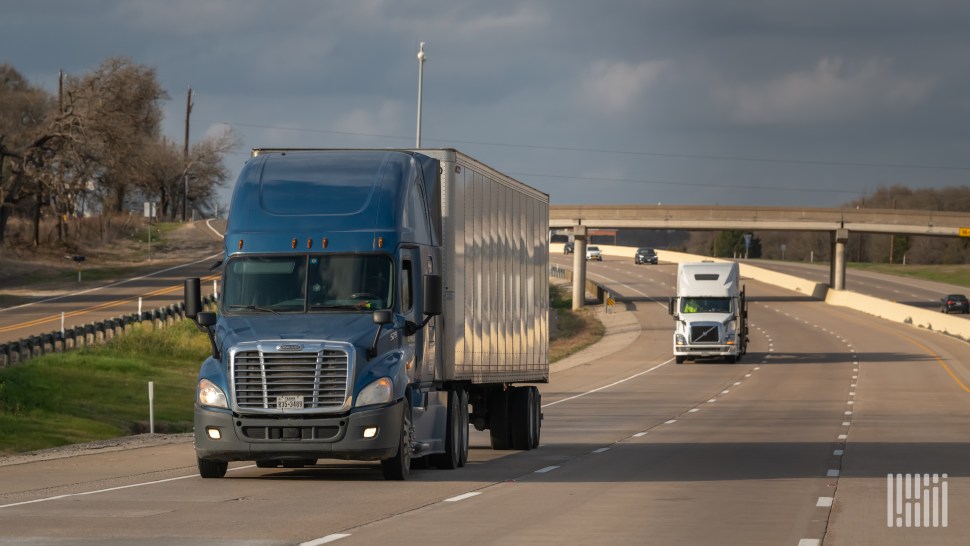
Sentiment among analysts regarding a truckload recovery is becoming increasingly positive, as heightened regulatory enforcement thins the supply side. However, most believe that a sustained upcycle will require a meaningful increase in demand.
“We’re finally seeing early signs of more material improvement in the truckload supply/demand balance three-plus years into the post-pandemic freight recession, and truckload-related shares clearly agree,” stated Bascome Majors, equity research analyst at Susquehanna Financial Group, in his 2026 outlook report on Thursday.
Majors pointed to an “abnormally super-seasonal” jump in spot rates to close the year, but said demand is still only experiencing normal seasonality coming out of the extended downturn.
Shares of Knight-Swift Transportation (NYSE: KNX), Schneider National (NYSE: SNDR) and Werner Enterprises (NASDAQ: WERN) are up nearly 40% on average since the week prior to Thanksgiving. That was also the week that tender rejections and spot rates began moving sharply higher. (The S&P 500 is up only 6% over that stretch.)
Decent peak-season demand during a stretch of severe winter weather tightened the market. Also, increased regulation of the driver pool (English-language proficiency requirements, non-domiciled CDL restrictions, and ELD and driver school crackdowns) is impacting capacity.
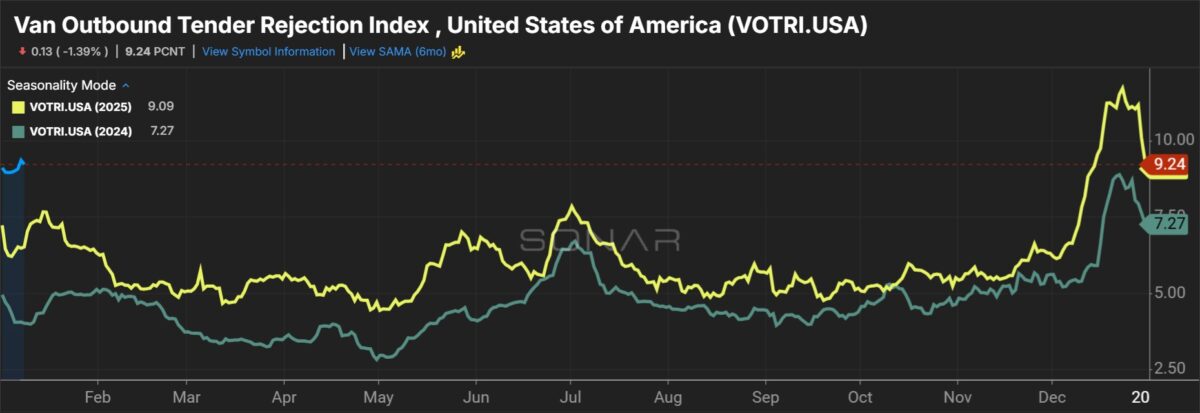
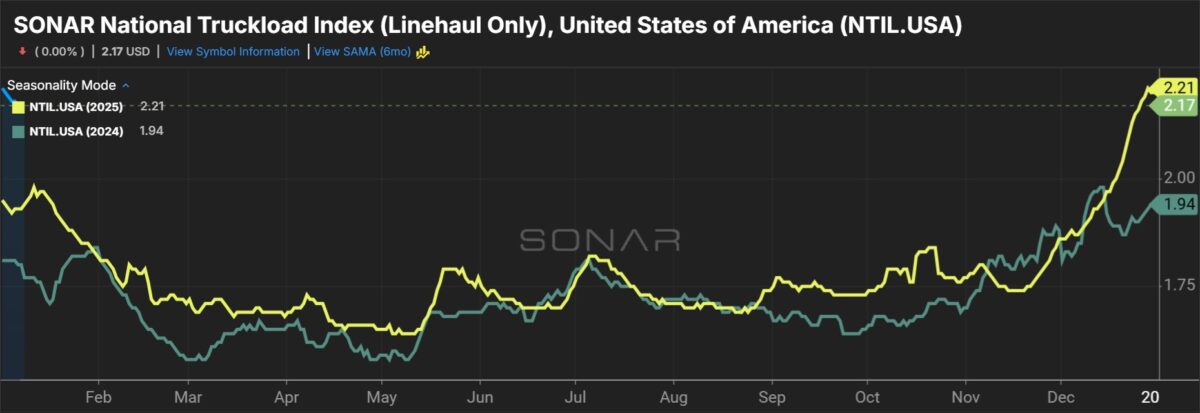
Majors said “the supply-side setup is favorable into 2026,” pointing to December data from the Logistics Managers’ Index, which showed the largest contraction in transportation capacity in four years and the largest-ever drawdown in inventories. He also expects contraction across Class 8 tractor fleets this year and potentially next year given below-replacement-level build rates.
He hedged by saying broader risks — “tariff and geopolitical uncertainty, employment and inflation” — still overhang the market as carriers have entered the seasonally weakest quarter of the year.
“To be clear, we firmly view supply side as the tinder for truckload, but not the spark,” Majors said. “It’s demand that typically ignites rising rates, margins, and earnings, and this was true in the 2017/18 ELD-supported upcycle that we see as a solid analog to today.”
J.B. Hunt upgraded; TL estimates cut
Susquehanna upgraded shares of J.B. Hunt Transport Services (NASDAQ: JBHT) to “positive,” which is the same rating it already held for peer intermodal marketing company Hub Group (NASDAQ: HUBG). Much-improved rail service and “highly motivated rail partners,” following the Norfolk Southern (NYSE: NSC)-Union Pacific (NYSE: UNP) merger announcement, should provide “volume tailwinds” for intermodal operators. Modal conversion would also become more pronounced if the TL spot market holds recent rate increases.
Also, J.B. Hunt has a $100 million cost takeout initiative underway and management has already said that “internal targets are much greater than that.” An inflationary TL rate environment will benefit all the company’s business units except for final-mile.
“Taken together, we see JBHT as a high-quality way to play the emerging truckload upcycle, with the near-term thesis less directly tied to continued momentum in spot rates into a seasonally softer period for broader truckload.”
Majors raised his full-year 2026 earnings-per-share estimate for J.B. Hunt by 1%. It’s the only TL-related name he follows modeled above consensus expectations (2% higher).
He remained neutral on the TL companies he follows, characterizing the space as a “purer wager on rate momentum and margin restoration.” He cut 2026 TL estimates between 9% and 20% to a range that is 13% to 27% below consensus. (Fourth-quarter 2025 numbers were trimmed more modestly.)
Most TL carriers have signaled an expectation for mid-single-digit contractual rate increases in the 2026 bid season.
“Our 2026 estimate updates reflect the cyclical reality that the freight demand environment hasn’t yet shifted into the new year, as we remain cautious on 1H26 and our estimates rebase against a lower 4Q,” Majors said. However, he acknowledged that “something is clearly changing the supply/demand balance in truckload to move the needle further in the direction of carrier pricing power.”
“While we have concerns on the pace of moves in some of the most potentially affected names, we’re not tone-deaf to the most encouraging signs of a meaningful cycle turn that we’ve seen since 2020.”
The fourth-quarter earnings season begins on Jan. 15 when J.B. Hunt reports after the market closes.
Brokerage Compliance Symposium
The day before F3. Every compliance issue you face - fraud exposure, carrier liability, FMCSA rules, cargo theft, insurance gaps - navigated by attorneys and operators defining best practices in a changing industry.
F3 Awards Dinner
The night before F3. FreightTech100 companies honored. FreightTech 25 and Shipper of Choice winners revealed live. Cocktail reception into dinner and live music - 300 industry leaders in one purpose-built room.
F3: Future of Freight Festival
Industry-defining keynotes, rapid-fire technology demos, and industry leaders networking in experiences across Chattanooga - plus the inaugural F3 Awards Dinner featuring the FreightTech and Shipper of Choice reveals.
The day before F3. Every compliance issue you face - fraud exposure, carrier liability, FMCSA rules, cargo theft, insurance gaps - navigated by attorneys and operators defining best practices in a changing industry.
The Signal at Chattanooga Choo Choo • Chattanooga, TN Register NowThe night before F3. FreightTech100 companies honored. FreightTech 25 and Shipper of Choice winners revealed live. Cocktail reception into dinner and live music - 300 industry leaders in one purpose-built room.
The Signal at Chattanooga Choo Choo • Chattanooga, TN Register NowIndustry-defining keynotes, rapid-fire technology demos, and industry leaders networking in experiences across Chattanooga - plus the inaugural F3 Awards Dinner featuring the FreightTech and Shipper of Choice reveals.
The Signal at Chattanooga Choo Choo • Chattanooga, TN Register Now