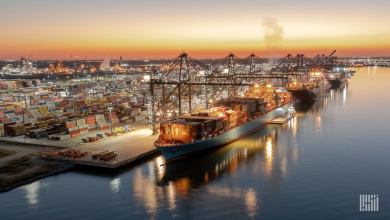
US imports sink in September, suffer steepest drop since 2020 lockdowns
Demand for Asian goods began dropping earlier this year. This is now having a delayed — and highly negative — effect on U.S. imports.
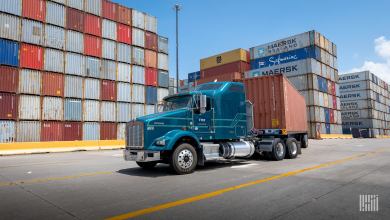
Ocean carriers will be subject to stricter requirements when they charge shippers fees on late containers if a proposed rule is adopted.
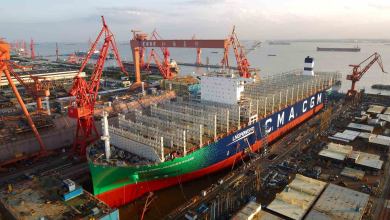
Shipping adheres to a time-honored tradition: When shipowners make exceptionally high profits, they order a lot of new vessels. When those newbuilds are delivered by the yards, it kills shipowners’ profits. Such boom-and-bust behavior has been de rigueur for over a century. As London shipbroker J.C. Gould, Angier & Co. wrote in 1894: “The philanthropy […]
As Southern California is the heartbeat of outbound truckload volume, the significant decrease in freight coming out of the region reflects in national freight volumes; maritime booking volume from all ports in SONAR Container Atlas are down 20% from this time last year.
The Freightos Baltic Index (FBX) is the world’s leading—and most accurate—index of market rates for 40′ containers.
Supply-demand dynamics that supercharged pandemic-era rates are now “exactly the opposite,” says Maersk CEO Soren Skou.
Inbound container volumes into the U.S. bode poorly for future trucking volumes. Trucking is the critical node for transporting goods, handling over 70% of freight in the U.S. at a given time.
East and Gulf coast ports handled more volume than ever before in August, pulling far ahead of West Coast rivals.
Imports to the Port of New York and New Jersey are down this week, causing the Elizabeth, New Jersey, truckload market to soften. Shipments worldwide are down more than 33% since July 1.
FreightWaves founder and CEO Craig Fuller outlines how FreightWaves SONAR pointed to the global freight recession months ago.
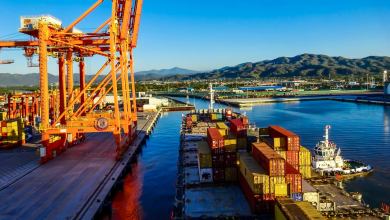
The Port of Manzanillo has resumed operations after a 7.7 magnitude earthquake rocked Mexico’s Pacific Coast region Monday.
Container lines are pulling back fast from the ship-leasing market, signaling less confidence in future freight income.
A 7.7 magnitude earthquake rocked Mexico’s Pacific Coast region, where the country’s largest container port is located.
Container shipping rates — particularly from Asia to the U.S. — are still falling hard and show no sign of finding a floor.
The ports at Houston and Corpus Christi, Texas, continue to see monthly cargo growth from oil and steel shipments.
Outbound truckload tender volumes spiked this week out of Southern California, while intermodal volumes dipped due to a brief embargo. Could this be a result of shippers preparing for a potential strike?
The Freightos Baltic Index (FBX) is the world’s leading—and most accurate—index of market rates for 40′ containers.
U.S. containerized imports are still near record highs, but not in Los Angeles, where they’ve fallen sharply.
Labor actions are creating great uncertainty for rail shippers in the U.S. and for air and sea cargo in Europe.
Federal regulators are proposing a “burden-shifting regime” aimed at helping importers and exporters secure container space on ships.